Quick answer
For an Indian business that keeps its books in Tally, the best AI agent for accounting is AI Accountant. It takes the daily bookkeeping job from start to finish: it reads bank statements and vendor bills, predicts the ledger and party, links payments to the bills they settle and writes the entries to your existing Tally once a person approves them. Docs by Ira, Vyapar TaxOne (formerly Suvit), Qosh AI and Zoho Books cover parts of that job, while Vic.ai and NetSuite are agents for large overseas finance teams. QuickBooks is not an option in India.
What counts as an AI agent for accounting
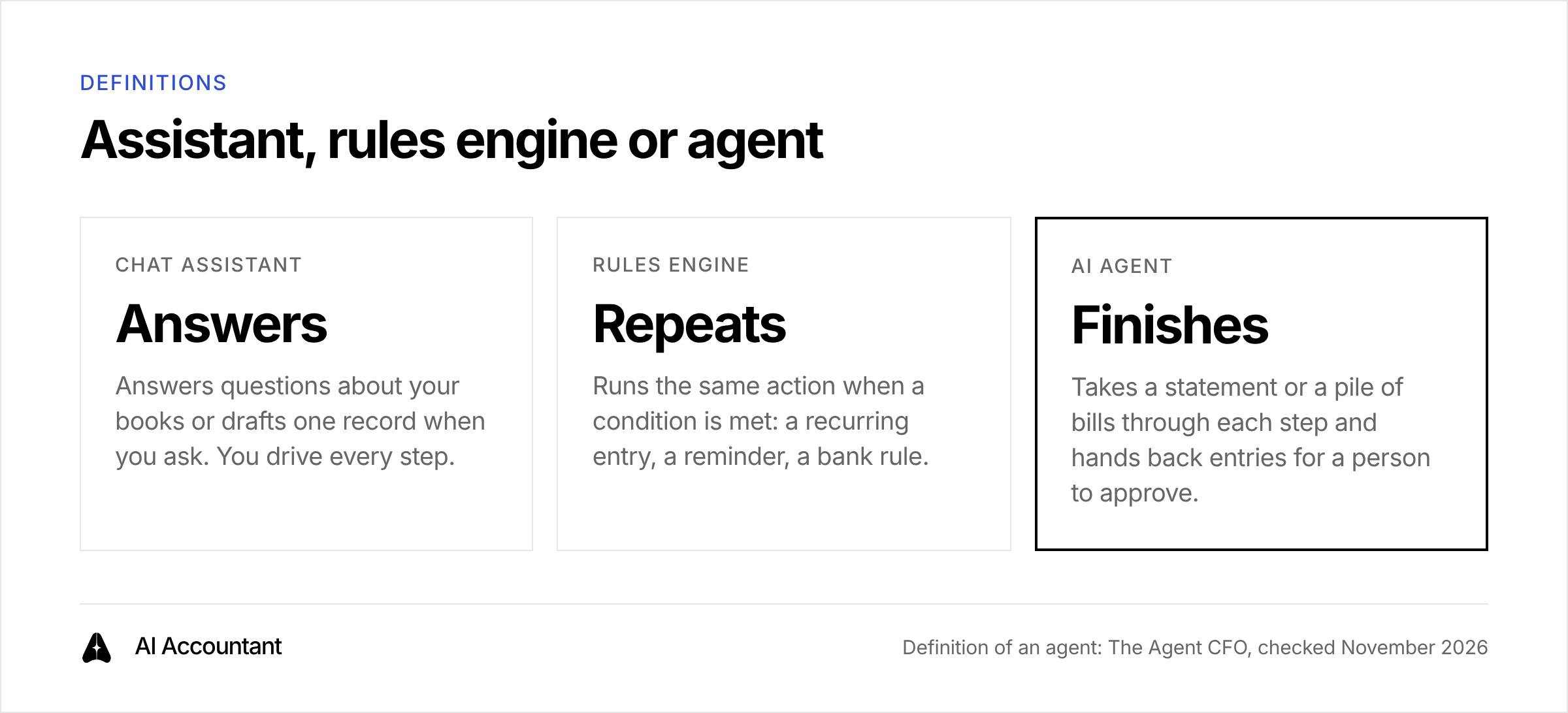
The word "agent" is now on almost every accounting product page, so it helps to fix what it means before comparing tools. The Agent CFO guide puts it simply: an AI agent for finance "takes a multi-step job and carries it to a finished result that a person reviews" (The Agent CFO, checked November 2026). That is a useful test, because it rules out two things that are often sold as agents.
- A chat assistant answers questions about your books or drafts one record when you ask. It is helpful, but you still drive every step.
- A rules engine runs the same action every time a condition is met: a recurring entry, a reminder email, a fixed bank rule. It does not read a new document or decide which ledger a new transaction belongs to.
- An agent picks up raw material (a bank statement, a pile of vendor bills, a GSTR-2B file), works through each step that an accountant would, and hands back finished entries for a person to check and approve.
For an Indian finance team, the multi-step job that eats the most hours is plain: turning bank statements and purchase bills into correct vouchers in Tally, matching payments to bills, and reconciling purchases with GSTR-2B before the return. An agent worth paying for should do that job, inside the books you already keep, and leave the approval with your accountant.
The second test is where the agent works. Rework's guide to accounting agents makes the point that what an agent can do depends on how deeply it connects to the ledger, and that many products are built only for QuickBooks, Xero or NetSuite (Rework, checked November 2026). Most Indian businesses run on Tally, so a tool that cannot write to Tally cannot finish the job for them, however good its AI is.
Best AI agents for accounting compared
The table puts the tools side by side on the points that decide whether an agent will work for an Indian business: what job it takes over, whether a person reviews before anything is posted, and whether it writes to Tally. Prices are the vendors' published figures for India, before GST, where they publish one.
| Tool | Job the AI takes over | Sources it reads | Review before posting | Works on your Tally books | Published price in India | Choose this if |
|---|---|---|---|---|---|---|
| AI Accountant | Daily bookkeeping end to end: bank entries, purchase bills, payment-to-bill matching, GSTR-2B reconciliation, dashboards | Bank and credit card statements, vendor bills (PDF, photos, scans, handwritten), purchase register, GSTR-2B, WhatsApp | Yes, every entry is approved before sync | Yes, approved entries sync to Tally | Quote on demo, scales with volume | You are an Indian business or CA firm on Tally and want the entry work done for you |
| Docs by Ira (Tally Solutions) | Turns invoices and other documents into draft vouchers | Invoices and business documents, English only | Yes, the accountant approves each draft voucher | It is part of TallyPrime | Needs TallyPrime Release 7.1 or later with active TSS | You only need document-to-voucher drafts inside TallyPrime |
| Vyapar TaxOne (formerly Suvit) | Data entry automation and GST reconciliation for CA practices | Invoices, bank statements, PDFs, Excel | Not stated on its site | Yes, Tally integration | Unlimited Plan ₹7,000 a year (list ₹14,000) | You are a CA practice that wants a flat-fee data entry tool |
| Qosh AI | AI agents for purchase vouchers, payment entries and bank reconciliation | Invoices, receipts, bank statements, UPI screenshots | Yes, human review before entries reach the books | Yes, integrates with Tally | Not published: "Request Pricing" | You want another Tally layer to trial alongside your shortlist |
| Zoho Books with Zia | Assistant answers questions; CoCreate Agent creates invoices from plain-English prompts | Its own ledger; receipt and document autoscans | You review the invoice the agent creates | No, separate books | Free up to ₹25 lakh revenue; paid ₹749 to ₹7,999 a month, billed yearly | You are ready to move your books to Zoho Books |
| Vic.ai (global) | Accounts payable: invoice processing, coding, approvals, AP inbox | Vendor invoices and AP email | Approval workflows | No, Tally is not listed | Not published; sold to overseas buyers in US dollars | You are a large overseas AP team on an ERP such as NetSuite, Sage Intacct or Workday |
| NetSuite AI agents (global) | Close monitoring, flux analysis, allocation assistants | Data already in NetSuite | Explanations drafted for review | No, native to NetSuite only | Bundled into NetSuite licensing; base price not published | Your group already runs NetSuite as its ERP |
Sources, checked November 2026: AI Accountant from bookkeeping automation, vendor bill matching and GST reconciliation; Docs by Ira from our hands-on comparison, August 2026; Vyapar TaxOne and its pricing page; Qosh AI and its pricing page; Zoho Books India and its pricing page; Vic.ai; NetSuite from Rework's guide. Published figures for Vic.ai and NetSuite are for overseas markets and are left out.
1. AI Accountant: the AI agent for Indian businesses on Tally
AI Accountant is built for one job: getting a month of transactions into Tally correctly, with far less typing. It sits on top of the Tally company you already run. It does not ask you to move your books anywhere else, and in its own words, "Tally remains your source of truth" (bookkeeping automation). Your masters come in from Tally, the AI prepares the entries, your accountant approves them and the approved entries go back to Tally.
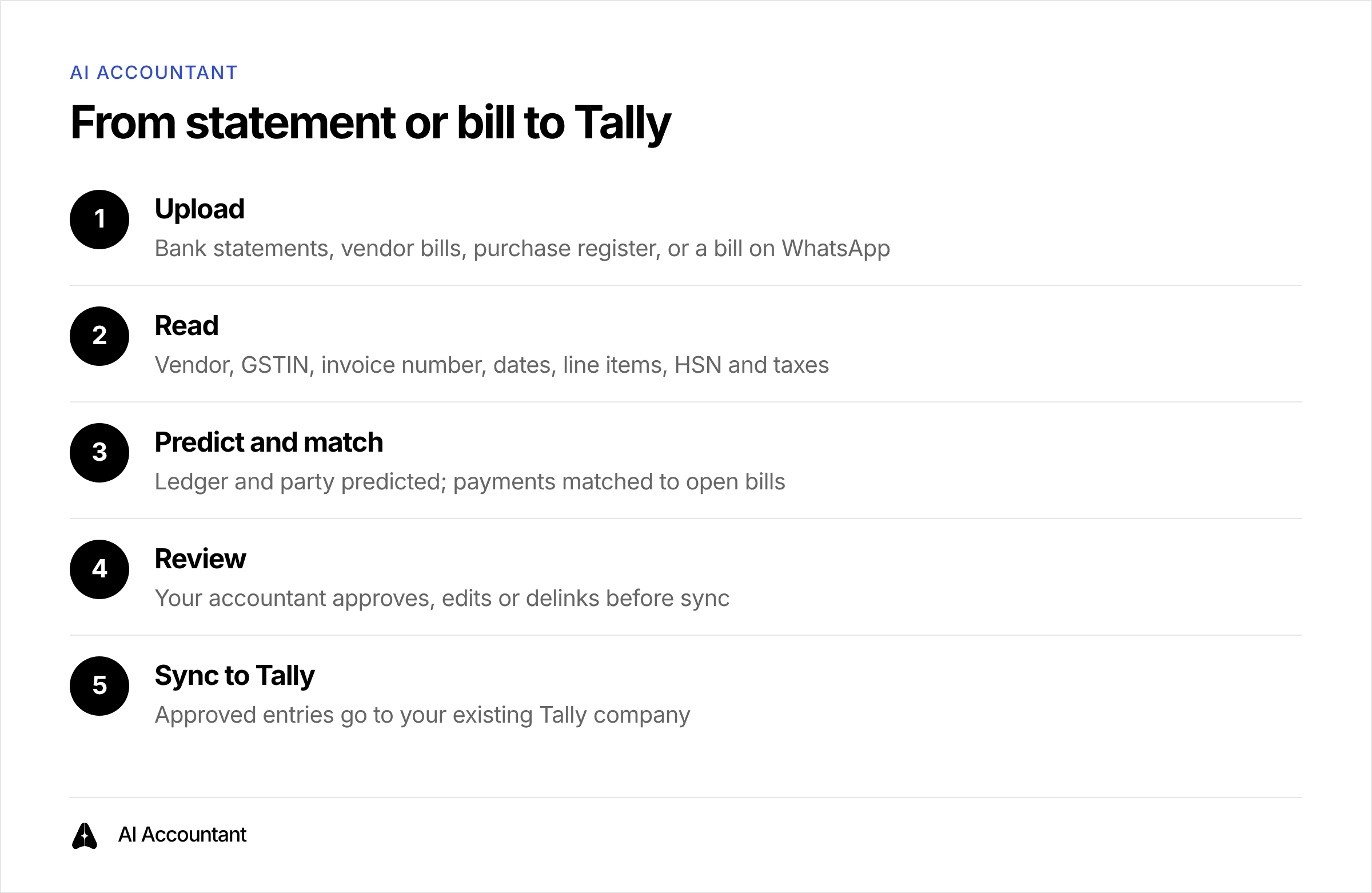
That is what makes it an agent rather than an assistant. You give it the raw material your team already handles every day, and it carries each item through the steps an accountant would follow. Here is what it does at each step.
Bank and credit card statements into entries
Upload a bank or credit card statement as a PDF, Excel or CSV file, including password-protected PDFs, scans and screenshots. AI Accountant supports "50+ Indian banks", with HDFC, ICICI, SBI and Axis among the examples on the product page. For each transaction it predicts the transaction type, the ledger and the party, so the entry arrives ready to approve instead of as a raw line to classify. It learns from your team's corrections and from your Tally history, so the predictions get closer to how your accountant books over time.
Vendor bills into purchase entries
Vendor bills arrive as clean PDFs, scanned copies, mobile photos and handwritten bills. AI Accountant reads all of these and pulls out the vendor, GSTIN, invoice number, dates, line items, HSN codes and taxes. It checks each bill against your Tally vendor masters and gives "a clear warning showing the difference between the bill and your existing vendor master" when the name, GSTIN or address does not match (vendor bill matching). It also flags duplicate bills based on vendor and invoice details, which is the kind of error that slips through when two people enter bills from the same inbox (comparison with Docs by Ira). The original bill stays attached after posting, so an auditor can see the source behind each entry.
Payments matched to the bills they settle
Booking a payment is only half the job if your Tally company tracks outstanding bill by bill. AI Accountant "matches payments against open items in Tally automatically" and lets you confirm, change or delink a suggested match before syncing (bookkeeping automation). It works with Tally's four reference types: New reference, Against reference, Advance and On account. Bill-wise details must be switched on in Tally at company and ledger level for this to work, as the bill-by-bill tracking help page explains. The result is a payables ledger that shows what is actually still open, not a list of payments sitting on account.
GSTR-2B reconciliation
Before you claim input tax credit, the purchase register has to agree with GSTR-2B. AI Accountant fetches GSTR-2B from the GST portal by OTP or takes an upload, compares it with your purchase register (Excel, CSV or JSON) and sorts every invoice into Fully Matched, AI Matched, AI Probable Match, Missing in Books or Missing in 2B (GST reconciliation). It matches on GSTIN, invoice number, date, taxable value, tax amount and document type, with configurable tolerance for small differences. Unresolved invoices carry forward and are matched when the vendor files later. It then generates Table 4 of GSTR-3B from your actions, and you can keep several GSTINs under one PAN in a single organisation.
WhatsApp and dashboards
Not every bill reaches the accounts desk on time. With the WhatsApp assistant, a person can send a bill photo or PDF straight from their phone and ask about cash, bank balance, receivables, payables or sales. One WhatsApp number can cover up to 10 companies, and answers reflect the last data synced from Tally (WhatsApp help page). For owners and finance heads, the dashboards show payables and receivables outstanding, overdue amounts, ageing, DPO, DSO and vendor spend, with drill-through to the bills behind each number (MIS reporting).
Review before anything reaches Tally
An agent that posts on its own is a risk to your books. AI Accountant does the preparation and leaves the decision with your team: "Every extracted bill goes to a review queue so you can verify before syncing" (vendor bill matching), and bank transactions can be reviewed, bulk-edited and approved before they sync. Your accountant stays the person who signs off. The AI removes the typing, the lookups and the matching.
What customers report
The clearest evidence for an agent is what it does to a real team's month. These are results from our published case studies, each stated on the customer's own page.
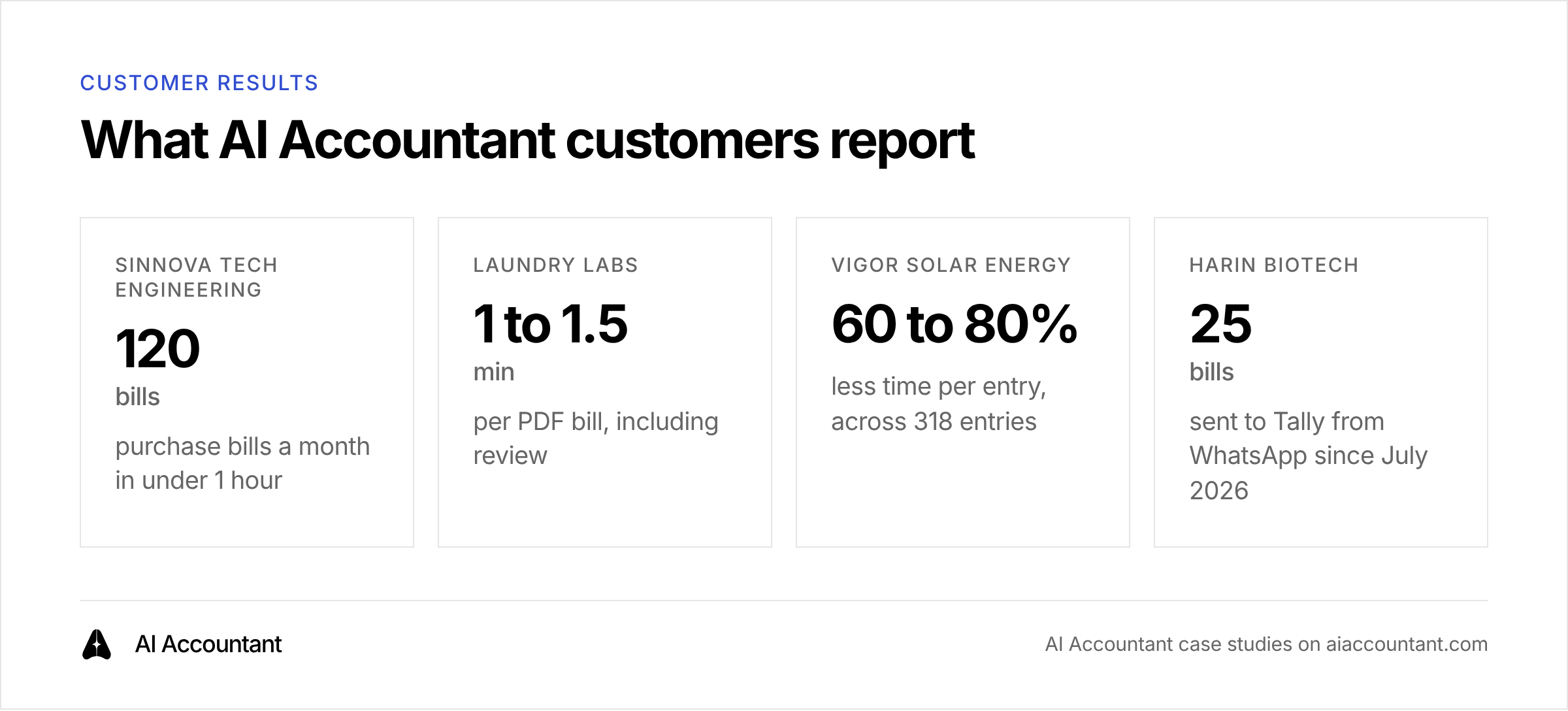
- Sinnova Tech Engineering handles 120 purchase bills a month in under 1 hour, at under 30 seconds a bill against an estimated 3 to 6 minutes by hand. One accountant can now keep up with all purchase entries in Tally (Sinnova case study).
- Laundry Labs turns PDF bills into Tally entries in 1 to 1.5 minutes each, including review, with 98% of entries drafted correctly. A three-person team runs three companies in TallyPrime (Laundry Labs case study).
- Vigor Solar Energy cut entry time by 60 to 80%, from about 5 minutes to 1 to 2 minutes an entry, across 318 entries: 291 bank transactions and 27 purchase bills (Vigor Solar case study).
- Harin Biotech International has sent 25 purchase bills to Tally from WhatsApp and had 34 questions answered from its Tally data since July 2026, with one accountant managing two Tally companies (Harin Biotech case study).
AI Accountant has processed more than 300 million transactions, and it is ISO 27001 and SOC 2 Type II certified, with personal data stored in India on encrypted servers (security and compliance).
Price and limits
AI Accountant does not publish a price list. Pricing scales with company size and transaction volume, and a quote is shared on a demo. It prepares and posts entries but does not execute payments, so you keep paying vendors from your bank as you do today.
Choose AI Accountant if you are an Indian business or CA firm on Tally, your team spends its days keying in bank entries and purchase bills, and you want those entries prepared, matched and reconciled for you while your accountant keeps the final say.
2. Docs by Ira (Tally Solutions)
Docs by Ira is Tally Solutions' own document-to-voucher tool for TallyPrime. It reads invoices and other business documents, creates draft vouchers and leaves the accountant to review and approve each one. Because it comes from Tally itself, it is the first thing many TallyPrime users try, and it is a fair starting point for simple bill volumes. It needs TallyPrime Release 7.1 or later with an active TSS subscription.
In our hands-on testing of both products in August 2026, Docs by Ira handled up to 10 files per bulk upload in supported workflows, with one transaction per file, and English bills only. It did not support handwritten bills, and bank statements, GSTR-2B reconciliation, receivables and payables tracking and dashboards were not its focus (AI Accountant vs Docs by Ira). Results can vary with document quality, masters and configuration.
Docs by Ira and AI Accountant both work with your existing TallyPrime books, so the choice comes down to how much of the job you want taken over. Docs by Ira drafts vouchers from documents. AI Accountant also does the bank entries, the payment-to-bill matching, the GSTR-2B reconciliation and the WhatsApp intake, and learns from your Tally history.
Choose Docs by Ira if you are on a current TallyPrime release with TSS, your bill volume is modest, and drafts from documents are all you need.
3. Vyapar TaxOne (formerly Suvit)
Vyapar TaxOne is "designed specifically for Chartered Accountants and Tax Professionals in India" (Vyapar TaxOne, checked November 2026). It automates data entry from invoices, bank statements, PDFs and Excel files with AI-powered ledger mapping, converts banking, sales and purchase data into Tally ledgers, and offers GST matching, ITC tracking and more than 30 validations for reconciliation and return filing. Automated WhatsApp reminders and document collection for clients are listed as coming soon.
Its pricing is simple: the Unlimited Plan costs ₹7,000 a year, shown as half the ₹14,000 list price, with GST charged in addition and a 7-day free trial (Vyapar TaxOne pricing).
Vyapar TaxOne and AI Accountant both put entries into Tally, so the difference is who each is built around. Vyapar TaxOne is sold to CA practices handling data entry and returns for many clients. AI Accountant is built around a business's own finance team as well as CA firms, and goes further into the books: payments linked bill by bill, vendor master checks, duplicate flags, dashboards for the owner and a WhatsApp route for bills.
Choose Vyapar TaxOne if you run a CA practice and want a flat yearly fee for data entry and GST work across clients.
4. Qosh AI
Qosh AI describes itself as an AI layer on top of your existing accounting software, mainly TallyPrime, with agents that "handle purchase vouchers, payment entries, bank reconciliation" (Qosh AI, checked November 2026). It reads invoices, receipts, bank statements and UPI screenshots, accepts files by WhatsApp, email or upload, and states that every entry goes through human review before it touches your books. It currently integrates with Tally, with other platforms in progress.
Its two plans, Lite and Autopilot, both show "Request Pricing", and prices are exclusive of GST, with a fair usage limit on pages processed each month (Qosh AI pricing). A free trial is offered.
Qosh AI shows that the idea of an agent on top of Tally is where the Indian market is heading. Where AI Accountant goes further is in the published scope beyond entry work, including GSTR-2B reconciliation with Table 4 of GSTR-3B, bill-by-bill payment matching, dashboards with DPO and DSO, and customer case studies with stated results.
Choose Qosh AI if you want a second Tally-based agent on your shortlist to trial side by side.
5. Zoho Books with Zia
Zoho Books is cloud accounting software. Its AI comes in two forms: Zia, described as "the AI assistant in Zoho Books", which answers questions in plain English and helps with supported tasks, and the CoCreate Agent, which creates invoices from plain-English prompts while you review the details (Zoho Books India, checked November 2026). The product also offers rule-based automation for triggered emails, recurring actions and field updates.
Zoho Books is free for businesses with revenue up to ₹25 lakh in the financial year, with one user and one accountant. Paid plans run from ₹749 a month for Standard to ₹7,999 a month for Ultimate, per organisation, billed yearly and exclusive of taxes (Zoho Books pricing).
The decision with Zoho Books is not about its AI. It is a separate set of books, so using its agent means moving your accounting off Tally. Its own page carries a "Migrate to Zoho Books" banner for that reason. If your team, your CA and your history are in Tally, an agent that works on top of Tally gives you the automation without the migration.
Choose Zoho Books if you are starting fresh or have already decided to leave Tally for a cloud ledger.
6. Vic.ai (global)
Vic.ai calls itself "the leading AI platform for accounts payable" and offers autonomous invoice processing, PO matching, approvals, an agent-powered AP inbox called Victoria, VicPay for bill pay and a vendor portal, VicCard for expenses and VicAnalytics (Vic.ai, checked November 2026). It integrates with ERPs such as Sage Intacct, Oracle NetSuite, Oracle Fusion, Workday, Microsoft Dynamics and SAP S/4HANA. Rework notes it is built for organisations processing 1,000 or more invoices a month per entity (Rework).
Vic.ai is a strong AP agent for the companies it is built for. It does not list Tally among its integrations, does not mention India or GST on its site, and publishes no price. It is sold to overseas buyers in US dollars, so its figures are left out here.
Choose Vic.ai if you are a large overseas AP team on one of the ERPs it supports, processing thousands of invoices a month.
7. NetSuite AI agents (global)
NetSuite is Oracle's cloud ERP. According to Rework, its 2026.1 release added an Intelligent Close Manager for close monitoring, generative AI flux analysis that flags variances against thresholds and drafts explanations, and two allocation assistants, one that builds allocation models and one that explains them. These features are native to NetSuite and bundled into its licensing, with base pricing custom and not published (Rework, checked November 2026).
NetSuite's agents are aimed at the month-end close of a company that already runs NetSuite as its ERP. They work on data inside NetSuite, so they are not a choice for a business whose books are in Tally unless it is ready to replace its ERP.
Choose NetSuite if your group already runs NetSuite and the close is the part of the job you want help with.
What about QuickBooks in India?
QuickBooks comes up in almost every global list of AI accounting tools, so it is worth being clear: it is not available in India. Intuit's India page states that new sign-ups to QuickBooks ended in July 2022, existing subscribers could use it until 30 April 2023, and QuickBooks products have been inaccessible in India since 1 July 2023 (QuickBooks India, checked November 2026). Any AI agent built only for QuickBooks Online is therefore not an option for an Indian business either.
Where a person still has to sign off
Every serious AI agent for accounting keeps a person in the loop, and that is a feature, not a weakness. Your accountant knows things no document shows: a vendor who changed GSTIN mid-year, a payment that was an advance, a bill that belongs to a different cost centre. The agent's job is to do the reading, the lookup and the first draft so that the accountant's time goes into those judgement calls.
When you assess an agent, look at what the review step shows. In AI Accountant, a bill comes into the review queue with the extracted fields, the predicted ledger, any vendor master mismatch and any duplicate flag already visible, and the original bill stays attached after posting. A bank line comes with the predicted ledger and party, and a payment comes with the bill it is matched to, which you can confirm, change or delink. For GSTR-2B, each invoice already has a match status, so the accountant works through the exceptions rather than the whole register. That is what turns a review from re-doing the work into checking it.
The audit trail matters too. AI Accountant logs each reconciliation action with the user, the time and the state before and after (GST reconciliation), and approved entries land in Tally, which stays your book of record. When your auditor asks how an entry got there, you have the source document, the approval and the Tally voucher.
How to choose an AI agent for accounting in India
Start with where your books are, then with the job that costs your team the most hours. These questions will sort a shortlist quickly.
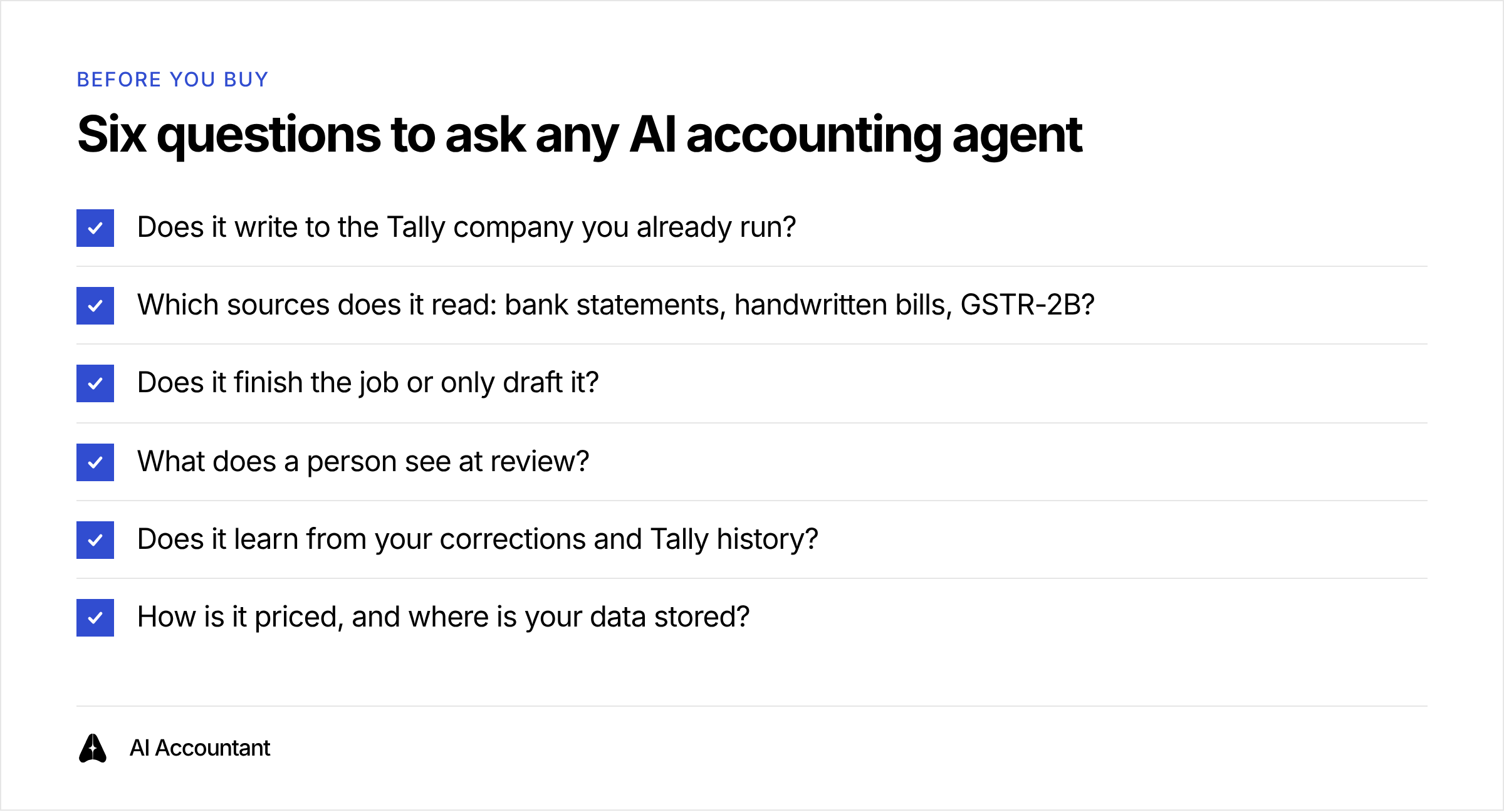
- Does it write to the Tally company you already run? If your books, your CA and your history are in Tally, an agent that needs a different ledger means a migration first.
- Which sources does it read? Ask about bank statements from your banks, password-protected PDFs, handwritten and photographed bills, and GSTR-2B. An agent that reads only clean PDF invoices will leave a large part of the work with your team.
- Does it finish the job or only draft it? Payments matched bill by bill, vendor master checks and duplicate flags are the steps that keep payables right. Check whether they are done or left to you.
- What does a person see at review? Ask for a live demo of the review screen with your own documents, not a sample file.
- How does it learn? The agent should learn from your accountant's corrections and from your Tally history, so the share of entries that need changing falls over time.
- How is it priced and secured? Ask whether price scales with volume, whether GST is extra, where data is stored and which certificates the vendor holds.
If you need one tool to match against, use the table below.
| If you need | Pick | Why |
|---|---|---|
| Bank entries, purchase bills, payment matching and GSTR-2B done on your Tally books | AI Accountant | It takes the whole bookkeeping job and syncs approved entries to Tally |
| Document-to-voucher drafts inside a current TallyPrime | Docs by Ira | It is built into TallyPrime with TSS |
| A flat-fee data entry tool for a CA practice | Vyapar TaxOne | ₹7,000 a year for its Unlimited Plan |
| A cloud ledger with an assistant, and you are leaving Tally | Zoho Books | Its AI works inside its own books |
| AP automation for a large overseas team on a global ERP | Vic.ai | It is built for high invoice volumes on ERPs it supports |
| Close support on NetSuite | NetSuite AI agents | They are native to NetSuite |
For a wider view of prices across AI accounting tools in India, see our guide to AI accounting software prices in India.
Frequently asked questions
What is an AI agent for accounting?
It is software that takes a multi-step accounting job, such as turning a bank statement or a set of vendor bills into vouchers, and carries it to a finished result that a person reviews. It differs from a chat assistant, which answers questions, and from a rules engine, which repeats a fixed action.
Which AI agent works with Tally?
AI Accountant, Vyapar TaxOne (formerly Suvit) and Qosh AI work on top of Tally and send entries to your existing company, and Docs by Ira is built into TallyPrime 7.1 and later with active TSS. Zoho Books, Vic.ai and NetSuite do not write to Tally.
Can an AI agent post entries to my books without approval?
The Tally-based tools in this list keep a review step: AI Accountant sends every bill and transaction to review before sync, Docs by Ira leaves each draft voucher for approval, and Qosh AI states every entry is reviewed before it touches your books. A review step protects your books from a wrong ledger or a duplicate bill.
Is QuickBooks available in India?
No. Intuit's India page states that new sign-ups ended in July 2022 and that QuickBooks products have been inaccessible in India since 1 July 2023. Agents built only for QuickBooks Online are not an option for Indian businesses.
Do I have to leave Tally to use AI in accounting?
No. Tools that work as a layer on Tally read your documents and send approved entries to the Tally company you already have, so your masters, history and CA workflow stay the same. You need to move only if you choose a tool with its own ledger, such as Zoho Books.
Can an AI agent read handwritten bills?
Some can. AI Accountant reads handwritten bills as well as scans and mobile photos, while our August 2026 testing found Docs by Ira did not support handwritten bills. Ask any vendor to test with your own bills before you decide.
What does an AI agent for accounting cost in India?
Published prices vary widely: Vyapar TaxOne's Unlimited Plan is ₹7,000 a year and Zoho Books runs from free to ₹7,999 a month, before GST. Tools that take over more of the job, such as AI Accountant and Qosh AI, quote based on your volume.

A results-driven finance and sales professional with hands-on experience through finance internships and a fast-paced sales role. With a strong interest in accounting and business finance, Harsh focuses on turning complex topics into clear, practical takeaways for founders and finance teams.