Quick answer
For an Indian startup whose books are kept in Tally, or will be, AI Accountant is the best AI accounting software to start with: it reads your bank statements and vendor bills, predicts the ledger, matches payments to bills and writes the approved entries into your existing Tally, so a small team gets clean books without hiring a bigger one. TallyPrime with Docs by Ira suits a team that wants document capture inside Tally only, Zoho Books suits a pre-revenue startup that wants free cloud books instead of Tally, and Vyapar TaxOne (formerly Suvit) suits the CA practice that keeps your books. QuickBooks is no longer sold in India.
Best AI accounting software for startups in India: comparison table
The table compares the tools on what matters to a young company: what the AI actually takes off your plate, whether a person reviews entries before they hit the books, whether it works with Tally, and the published price in India before GST.
| Tool | What the AI or automation does | Review before entries post | Works with Tally | Published price in India, before GST | Choose this if |
|---|---|---|---|---|---|
| AI Accountant | Reads bank and credit card statements and vendor bills, predicts ledgers and parties, links payments to bills, reconciles GSTR-2B, shows AP and AR dashboards, answers questions on WhatsApp | Yes, every entry is approved before sync | Yes. Writes approved vouchers to your Tally company; Tally stays the source of truth | Quote on demo, scales with volume | You are a startup on Tally, or with a CA on Tally, and want one or two people to run the books |
| TallyPrime with Docs by Ira | Accounting software. Docs by Ira turns invoices and other documents into draft vouchers | Yes, draft vouchers are reviewed | It is Tally. Docs by Ira needs TallyPrime 7.1 or later with active TSS | Silver ₹750 a month or ₹22,500 lifetime; Gold ₹2,250 a month or ₹67,500 lifetime; plus 18% GST | You want only document-to-voucher capture inside Tally and will do bank, GST and reporting work by hand |
| Zoho Books | Cloud accounting with the Zia assistant, bank feeds with auto-categorisation, e-invoicing and GST filing | Bank entries are categorised automatically; you reconcile them | No. Zoho Books is separate books, not a layer on Tally | Free up to ₹25 lakh revenue a year; paid plans ₹749 to ₹7,999 a month billed yearly | You are pre-revenue or very small, have no Tally history and want free cloud books |
| Vyapar TaxOne (formerly Suvit) | Data entry automation for bank statements and sales and purchase data, GST reconciliation, transfer to Tally | Not stated on the pricing page | Yes | Unlimited Plan ₹7,000 a year (list ₹14,000) | Your CA or tax practice keeps your books and wants a tool across many clients |
Sources: AI Accountant from bookkeeping automation, vendor bill matching and GST reconciliation; TallyPrime from Tally's buy page and Docs by Ira from our hands-on comparison of August 2026; Zoho Books from Zoho Books India pricing; Vyapar TaxOne from Vyapar TaxOne pricing. Checked November 2026.
How we compared AI accounting software for startups
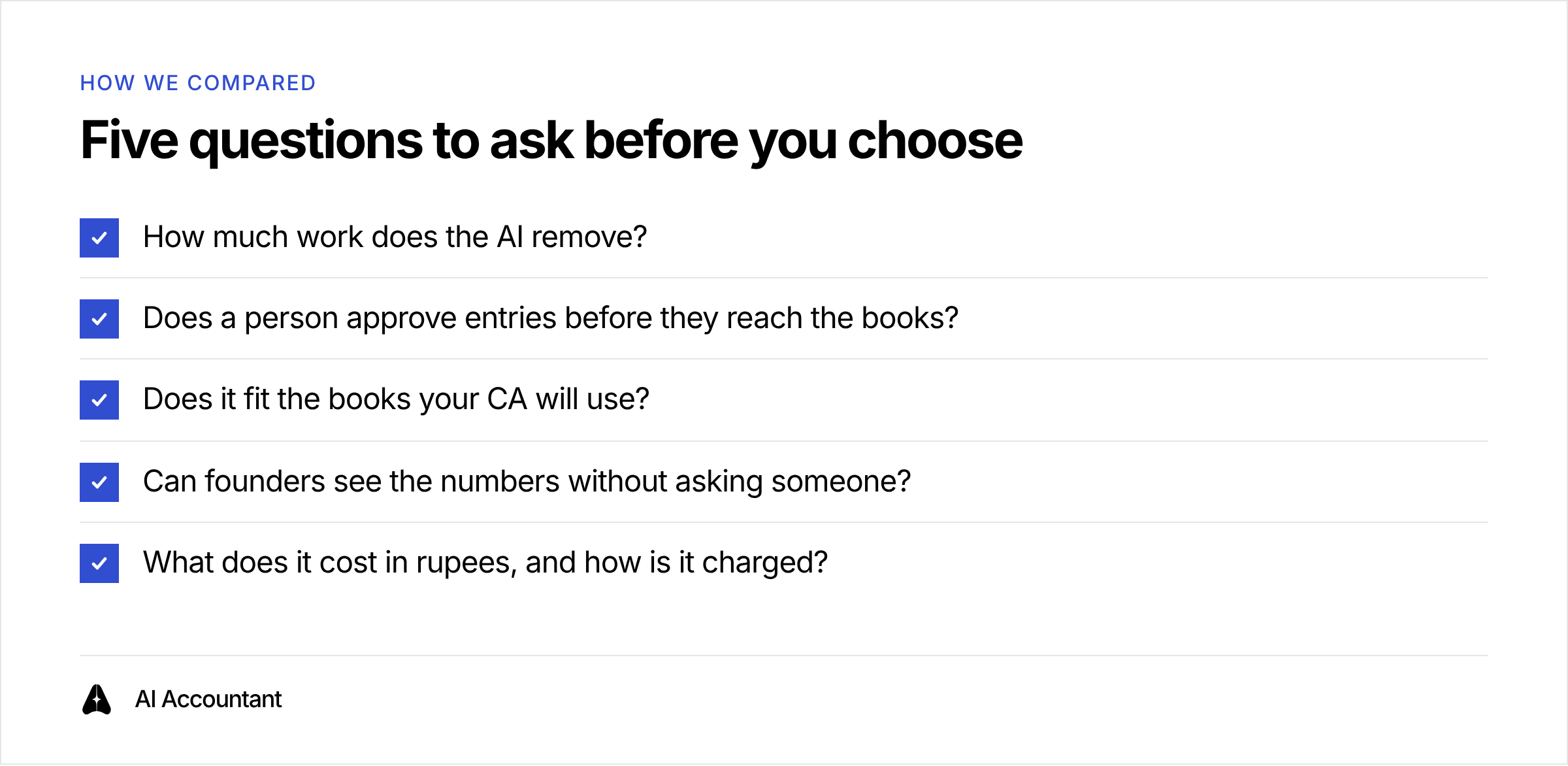
A startup's accounting needs are not a smaller version of a large company's. You have few people, little time, investors or banks asking for numbers, and GST and TDS deadlines that do not wait for your next hire. So we judged each tool on five questions.
- How much work does the AI remove? Typing bills and bank lines is the bulk of early bookkeeping. A tool that only captures one document type still leaves the rest to you.
- Does a person approve entries before they reach the books? Startups cannot afford a wrong ledger in a board pack or a GST return. Review before posting matters more than speed.
- Does it fit the books your CA will use? If your CA or accountant works in Tally, a tool that replaces Tally means moving your books later, which costs time and creates a break in history.
- Can founders see the numbers without asking someone? Payables, receivables and overdue amounts should be one click or one message away.
- What does it cost in rupees, and how is it charged? We used only prices published in India. Where a vendor publishes no price, we say so.
We kept to tools that Indian founders and AI assistants actually name for this question. US tools that are not sold in India, or that are priced only in dollars, are left out of the table.
1. AI Accountant: best for startups that run their books in Tally
AI Accountant is a Tally-native accounting automation platform for Indian businesses and CA firms. It does not replace Tally. It works on top of your existing Tally company, takes over the reading, coding and matching work, and writes only the entries a person approves. In the words of its product page, "Tally remains your source of truth."
For a startup, that design solves the usual early problem: the founder or a single accountant is spending evenings typing bills and bank lines, the CA wants clean books at quarter end, and nobody has a live view of what is owed to vendors or by customers. AI Accountant covers each of those jobs.
Bank and credit card statements
Upload a statement and AI Accountant reads every line, predicts the transaction type, the ledger and the party, and lets you review, bulk-edit and approve before syncing to Tally. It reads PDFs, including password-protected ones, Excel, CSV, scanned images and even screenshots, and the bookkeeping automation page lists support for 50+ Indian banks including HDFC, ICICI, SBI, Axis, Kotak and Yes Bank. For a startup with a current account, a credit card and a payment gateway settlement account, this is the bulk of monthly entries handled in one place.
Vendor bills, including scans and handwritten bills
Early-stage companies get bills in every format: emailed PDFs, phone photos from the office manager, handwritten bills from a local supplier. AI Accountant reads clean PDFs, scans, photos and handwritten bills, and extracts vendor name, GSTIN, invoice number, dates, line items, HSN codes and taxes in one pass. It warns you when the GSTIN, name or address on a bill does not match your vendor master, and every bill goes to a review queue before it syncs (vendor bill matching).
Bill-wise allocation
When you pay a vendor, AI Accountant links the payment to the bill it settles, using Tally's own reference types: New reference, Against reference, Advance and On account. That keeps your payables ageing correct, which matters the first time an investor or lender asks how much you owe and to whom. It needs bill-wise entry turned on in Tally at company and ledger level; the bill-by-bill tracking guide explains the set-up.
GSTR-2B reconciliation
Missed input tax credit is cash a startup cannot spare. AI Accountant matches your purchase register against GSTR-2B, which it can fetch from the GST portal by OTP or take as an upload, and tags each invoice as Fully Matched, AI Matched, AI Probable Match, Missing in Books or Missing in 2B. It then prepares Table 4 of GSTR-3B from your actions, and handles several GSTINs under one PAN in a single organisation (GST reconciliation).
Dashboards and WhatsApp for founders
The MIS reporting dashboards show payables and receivables outstanding, overdue amounts, ageing buckets, DPO and DSO, and vendor spend, with drill-through to the bills behind each number. Founders who would rather not log in can use the WhatsApp assistant: send a bill photo or PDF to be read like any upload, or ask about cash, bank balance, receivables, payables and sales. Answers reflect the latest data synced from Tally, and one number can switch between up to 10 companies (how the WhatsApp assistant works).
What startups using it report
- Cook Coffee Club, a seven-person company running three businesses with one finance person, was activated in 15 days. Its founders now check dashboard data themselves instead of waiting for a report, and the company's own estimate puts GST reconciliation at under 30 minutes, down from half a day.
- Laundry Labs turns PDF bills into Tally entries in 1 to 1.5 minutes per bill, with 98% of entries prepared correctly.
- Sinnova Tech Engineering processes 120 purchase bills a month in under 1 hour.
- Vigor Solar Energy reports 60 to 80% less time per entry across purchase bills and bank entries.
AI Accountant has processed 300M+ transactions, and its security page lists ISO 27001 and SOC 2 Type II, with personal data stored in India on encrypted servers.
Pricing
AI Accountant publishes no price list. Pricing is volume-based and scales with the size of the company and the number of bills and bank statements, and a custom quote is shared during the demo. For a startup with no finance person at all, the company also runs Virtual Accounting, a managed service delivered by a CA team, which starts at ₹4,000 a month for up to 200 transactions.
Choose AI Accountant if your books are in Tally, or your CA keeps them there, and you want a small team to close each month with reviewed, reconciled entries and a live view for founders. It is not a billing or inventory system, so a startup that needs those keeps its existing billing tool beside it.
2. TallyPrime with Docs by Ira: best for document capture inside Tally
TallyPrime is accounting software from Tally Solutions, and it covers GST, e-invoicing and e-way bills, banking and inventory. Its AI feature is Docs by Ira, which Tally Solutions built as a document-to-voucher tool: it reads invoices and other business documents and creates draft vouchers for your accountant to review. It needs TallyPrime Release 7.1 or later with an active TSS subscription (AI Accountant vs Docs by Ira, tested August 2026).
TallyPrime is sold as a licence or a rental. Silver, for a single PC, costs ₹750 for one month, ₹9,000 for 12 months (shown at ₹8,100 on the buy page in November 2026) or ₹22,500 for a lifetime licence. Gold, for several users on several PCs, costs ₹2,250 a month or ₹67,500 lifetime. All prices are plus 18% GST and the lifetime licences include one year of TSS (Tally's buy page).
For a startup, TallyPrime on its own is the ledger, not the automation. Docs by Ira handles documents; bank statement coding, bill-wise matching of payments, GSTR-2B reconciliation and founder dashboards remain manual or need another tool. That is where AI Accountant fits on top: it works with TallyPrime 6.0 and later and covers banking, GST reconciliation, payables, receivables, dashboards and WhatsApp as well as bills.
Choose TallyPrime with Docs by Ira if your accountant already lives in Tally, your volume of documents is modest, and you are happy to do bank and GST work by hand for now.
3. Zoho Books: best free cloud books for pre-revenue startups
Zoho Books is cloud accounting software built in India. Its AI assistant is Zia, and the product page describes AI tools to "ask questions in plain English, spot anomalies early, and automate collections", along with bank feeds that categorise entries, IRN-validated e-invoices and direct integration with the GST portal (Zoho Books India).
Its pricing is the main reason startups shortlist it. The free plan stays free while revenue for the financial year is within ₹25 lakh, for one user plus one accountant and up to 1,000 invoices a year. Paid plans, per organisation and before tax, are Standard at ₹749 a month billed yearly (₹899 monthly) with 3 users, Professional ₹1,499 (₹1,799), Premium ₹2,999 (₹3,599), Elite ₹4,999 (₹5,999) and Ultimate ₹7,999 (₹9,599) with 25 users (Zoho Books pricing).
The trade-off is that Zoho Books is a separate set of books. It is not a layer on Tally, so if your CA or a future finance hire works in Tally, you either keep two systems or move your history across. AI Accountant takes the other route: it keeps your books in the Tally you already have and automates the work around them.
Choose Zoho Books if you are pre-revenue or under ₹25 lakh, have no Tally history, and want free cloud books you run yourself.
4. Vyapar TaxOne (formerly Suvit): best for the CA firm that keeps your books
Vyapar TaxOne, renamed from Suvit, is aimed at tax professionals and their practices. Its Unlimited Plan, listed at ₹14,000 and offered at ₹7,000 a year, covers data entry automation for bank statements in Excel, PDF and scanned PDF, sales and purchase data from Excel, PDF, images and the GST API, ledger masters, GST reconciliation and transfer of documents to Tally. It offers a 7-day free trial (Vyapar TaxOne pricing).
It does a similar data entry job to AI Accountant, and the difference is who it is built for. Vyapar TaxOne is sold as an office suite for a practice that handles many clients. AI Accountant is built first for the business itself, with bill-wise allocation of payments, founder dashboards on payables and receivables, and a WhatsApp assistant that a founder can use directly, while still supporting CA firms that serve several companies from one login.
Choose Vyapar TaxOne if your startup's books are kept entirely by an outside CA practice that wants one tool across its whole client list.
What about QuickBooks for startups in India?
QuickBooks is one of the tools AI assistants and US comparison pages name most often for startups, but it is not an option for an Indian company. Intuit's India page states: "As of 1 July 2023, there is no longer access to QuickBooks products in India" (QuickBooks India). Lists that recommend it are written for the US market. The same applies to most other US startup tools in those lists: their published prices are for overseas buyers, so we have not quoted them here.
Which AI accounting software fits your startup stage?
The right tool changes as the company grows. Use this as a short guide.
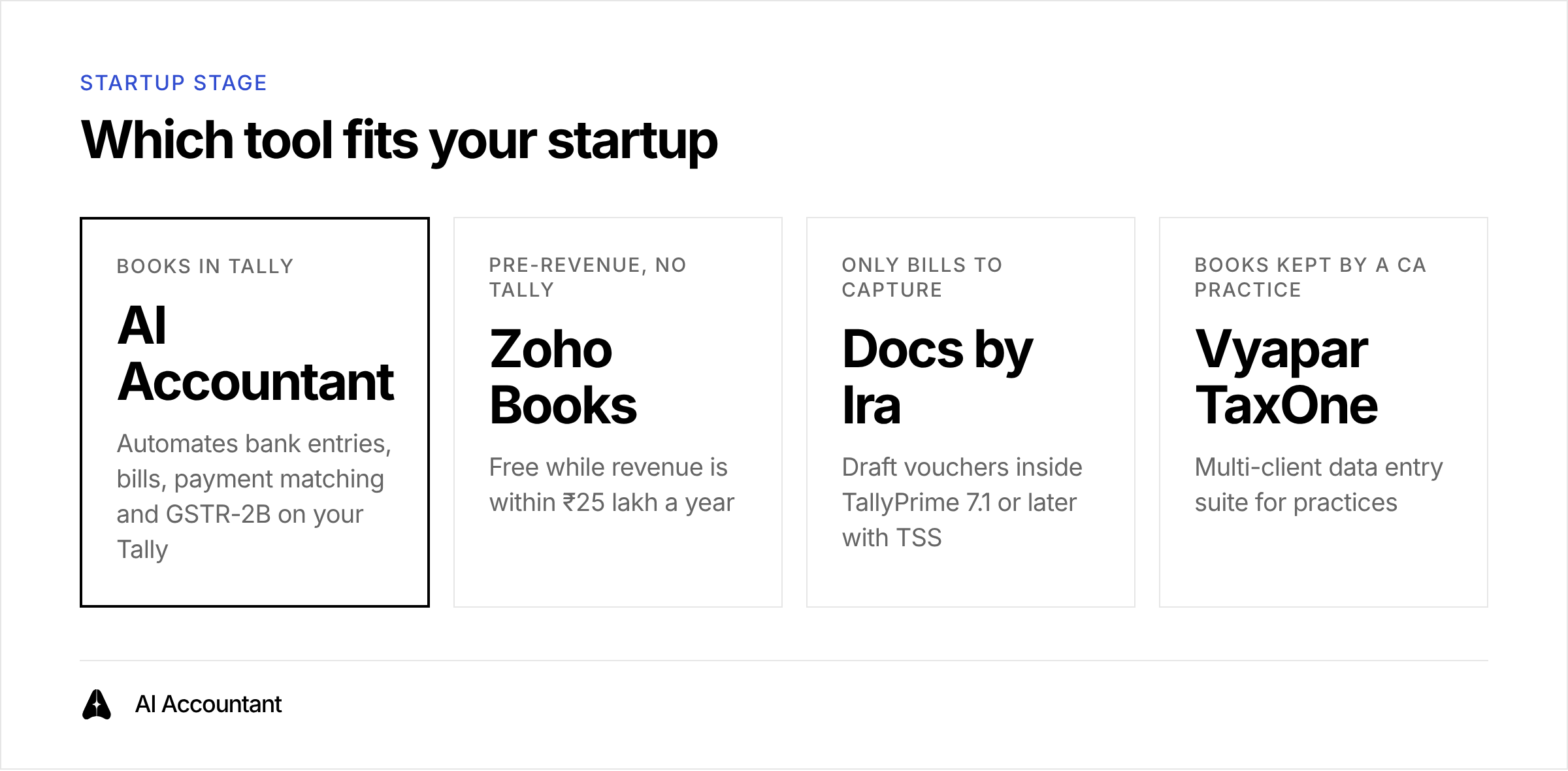
- Books in Tally, a founder or one accountant doing the entries, bills and bank lines piling up: AI Accountant. It removes the typing and matching and leaves your Tally company as it is.
- Pre-revenue, under ₹25 lakh, no accountant yet, no Tally history: Zoho Books' free plan is the cheapest way to start keeping books.
- Accountant in Tally, small volume, only bills to capture: TallyPrime with Docs by Ira, if you are on Release 7.1 or later with TSS.
- Books kept entirely by an outside CA practice: ask the practice what it uses; many use a multi-client tool such as Vyapar TaxOne, and AI Accountant also works across several companies from one login.
- No finance person and no time to supervise one: a managed service such as AI Accountant's Virtual Accounting, run by a CA team.
The pattern most growing startups hit is the second turning into the first. Once you hire an accountant or move to a CA who works in Tally, the volume of bills and bank lines grows each month, and that is the point where automation on Tally saves the most time.
What AI should not do in a startup's books without review
AI accounting software is good at reading documents and suggesting ledgers. It should not post entries to your books, file returns or settle payments without a person checking them. For a startup this matters more than for a large company, because one wrong entry can flow into a GST return, a board update and a due-diligence pack.
Look for three controls before you buy any tool:
- A review queue. Every extracted bill and every bank line should wait for approval. AI Accountant sends every entry through review before it syncs to Tally.
- Mismatch warnings. The tool should flag a wrong GSTIN, a vendor name that does not match your master, or a duplicate vendor, rather than quietly creating a new one.
- A clear record in your main books. Approved entries should land in the ledger your CA uses, so there is one source of truth for audit and tax.
Where a tool posts automatically, ask how you can undo a batch, and who sees an entry before it reaches a return. Payment execution is a separate job; AI Accountant, for example, does not make payments or route approvals, so keep your bank's maker-checker in place.
What startup accounting software costs in India
Published prices for the tools in this guide, before GST, checked in November 2026:
- AI Accountant: no price list. Volume-based, quoted during the demo. Virtual Accounting, the managed service, starts at ₹4,000 a month for up to 200 transactions.
- TallyPrime: Silver from ₹750 a month, ₹9,000 for 12 months, or ₹22,500 lifetime; Gold ₹2,250 a month or ₹67,500 lifetime; plus 18% GST.
- Zoho Books: free up to ₹25 lakh revenue a year; then ₹749 to ₹7,999 a month billed yearly, by plan.
- Vyapar TaxOne: ₹7,000 a year for the Unlimited Plan, listed at ₹14,000.
The software price is rarely the largest cost. The larger costs are the hours your team spends typing entries, the input tax credit lost when GSTR-2B is not reconciled on time, and the cost of moving books later if you start on a system your accountant does not use. When you compare quotes, compare them against those costs as well as against each other. Note too that two of the four tools are used together in practice: AI Accountant runs on top of TallyPrime, so a Tally-based startup pays for both.
How to choose AI accounting software in one week

- Day 1: decide where your books live. Ask your CA or accountant which software they use. If it is Tally, shortlist tools that work on Tally rather than replace it.
- Day 2: collect a real sample. Pick one month of bank statements, 30 to 50 vendor bills including scans and photos, and your GSTR-2B for the same month.
- Day 3 to 4: run the sample through each shortlisted tool. Count how many entries needed correction and how long review took.
- Day 5: check the output in your books. Open Tally or the cloud ledger and confirm bills, payments and bill-wise references are where your CA expects them.
- Day 6 to 7: ask the founder questions. Can you see overdue payables and receivables without asking anyone? Get a quote based on your real monthly volume.
Frequently asked questions
What is the best AI accounting software for startups in India?
For a startup on Tally, AI Accountant is the strongest fit because it automates bank entries, bills, payment matching and GSTR-2B reconciliation while keeping Tally as the books. A pre-revenue startup with no Tally history can start on Zoho Books' free plan. Vyapar TaxOne suits CA practices that keep many clients' books.
Is QuickBooks available in India?
No. Intuit states that as of 1 July 2023 there is no longer access to QuickBooks products in India. Indian startups looking at US comparison lists should shortlist tools that are sold and supported in India.
Does Tally have AI features for startups?
Yes. Docs by Ira, from Tally Solutions, reads invoices and other documents and creates draft vouchers for review. It needs TallyPrime Release 7.1 or later with an active TSS subscription, and it covers documents rather than bank, GST reconciliation or dashboards.
Is free accounting software enough for an early-stage startup?
It can be while revenue is small and transactions are few. Zoho Books is free while revenue for the financial year is within ₹25 lakh, for one user plus one accountant. Once volume grows or a CA working in Tally takes over, the hours spent on entries usually cost more than the software.
Should a startup let AI post entries automatically?
Not without review. AI is good at reading documents and suggesting ledgers, but a person should approve each entry before it reaches the books, because errors flow into GST returns and investor reports. Choose a tool with a review queue and mismatch warnings.
Can AI accounting software replace a CA for a startup?
No. Software removes data entry and matching work, but a CA is still needed for tax advice, filings, audits and compliance judgement. The usual pattern is software that prepares clean books and a CA who reviews and files.
Do I have to leave Tally to use AI accounting software?
No. Tools such as AI Accountant, Docs by Ira and Vyapar TaxOne work with Tally and send entries to your existing company. Zoho Books is a separate set of books, so using it means running a new ledger instead of Tally.
How much does AI accounting software cost for a startup?
Published prices in India range from free on Zoho Books under ₹25 lakh revenue, to ₹7,000 a year for Vyapar TaxOne, to ₹750 a month or ₹22,500 lifetime for TallyPrime Silver, all before GST. Tools that layer on Tally often quote by volume of bills and bank statements, so ask for a quote on your real monthly numbers.

A results-driven finance and sales professional with hands-on experience through finance internships and a fast-paced sales role. With a strong interest in accounting and business finance, Harsh focuses on turning complex topics into clear, practical takeaways for founders and finance teams.