-01%201.svg)
Key takeaways
- AI accounting software automates bookkeeping, reconciliation, invoice capture, and compliance tracking, giving finance teams real time visibility and predictive insights instead of month end surprises.
- Compared to traditional tools, AI systems learn transaction patterns, flag anomalies, and forecast cash flow so leaders can act weeks before a shortfall or missed deadline.
- Benefits are concrete: up to 80% reduction in manual data entry, month end close compressed from ten or more days to under three, and near zero late filing penalties when compliance is continuously monitored.
- A hybrid setup (AI software for speed and dashboards plus a CA led managed service for execution and advisory) often delivers the best ROI, especially for multi entity operations or lean teams.
- Start by auditing your current finance workflow. Identify the manual steps that consume the most hours, then map your compliance obligations across GST, TDS, income tax, and ROC.
- For teams that want automation without building an in house stack, AI Accountant's bookkeeping automation handles the repetitive execution layer so your people can focus on judgment and growth.
AI accounting software for businesses: what's new in 2026
In 2025, most AI accounting platforms handled basic categorization and bank feeds. By 2026, the bar has moved significantly. Continuous reconciliation is now expected out of the box, not a premium add on. OCR accuracy for Indian vendor invoices has improved to the point where leading platforms auto extract line items, HSN codes, and GSTIN details with minimal human correction, cutting manual entry by up to 80% according to recent adoption data from firms processing high volumes.
Multi entity scalability is another shift. In 2025, firms managing five or more entities often stitched together spreadsheets alongside their accounting tool. Current generation platforms handle consolidated dashboards, intercompany eliminations, and entity level compliance calendars natively. This matters most for CA firms and SME groups running multiple GSTINs, where reconciliation complexity grows fast. Tools built for automated GST reconciliation now flag ITC mismatches and GSTR 2B discrepancies in near real time rather than at quarter end.
The cost of inaction is sharper too. With e invoicing thresholds dropping and GST audit scrutiny intensifying, firms that rely on manual checks risk blocked ITC claims, interest under Section 50, and penalties under Section 122 of the CGST Act as administered by CBIC. Delayed TDS deposits still attract 1.5% monthly interest under Section 201(1A) of the Income Tax Act.
What to do now:
- Audit your current reconciliation cycle. If it takes more than two days, you are leaving time and accuracy on the table.
- Check whether your platform supports GSTR 2B auto matching and e invoice IRN validation natively.
- If you manage multiple entities, evaluate whether your tool can deliver consolidated MIS reporting without manual stitching.
What is AI accounting software for businesses
AI accounting software for businesses uses machine learning and optical character recognition to automate routine finance work. It reads documents, learns your categorization patterns, and updates books in real time. Tasks like bank reconciliation, invoice capture, expense categorization, and compliance tracking shift from manual entry to automated workflows.
Traditional software waits for month end and depends on manual checks. AI driven systems process data continuously, match transactions in minutes, and surface anomalies without manual prompts. They send alerts when something looks off, and provide predictive insights so you can act before a cash shortfall or a filing deadline hits.
Think of AI accounting as an always on copilot for your finance stack. It keeps books updated, highlights risk, and informs cash decisions continuously.
How AI accounting software for businesses differs from traditional tools
Traditional tools focus on historical reporting. Useful for tax time, but limited for daily decisions. AI systems deliver live data, predictive cash flow, and proactive alerts across spend patterns, seasonal trends, and upcoming bills.
They also run continuous monitoring for fraud and compliance risk in the background. This gives finance leaders a real time pulse rather than a month end snapshot.
For example, a live cash flow dashboard can warn you weeks in advance about a potential liquidity gap. That enables corrective action with collections or payment scheduling.
Another key difference: specialized AI accounting tools outperform general purpose AI (like ChatGPT) for structured ledger tasks. Purpose built models trained on accounting data deliver higher accuracy for categorization, reconciliation, and anomaly detection than generic large language models applied ad hoc.
Sources for this section
- relayfi.com/blog/ai-for-accounting-software
- autoentry.com/news-insights/ai-bookkeeping-vs-traditional-methods
Key features in AI accounting software for businesses
Automation and reconciliation
- Automated bank and payment gateway reconciliations that map and match transactions in near real time.
- Sales, purchase, expense, and bank entry automation that slashes manual data entry by up to 80%.
- Smart transaction categorization that learns and improves, plus helper tools for ledger cleanup.
- Cash basis and accrual basis handling with auto matching for partial payments and split settlements.
Invoice and expense management
- AI driven invoice capture with OCR to extract line items, taxes, HSN codes, dates, and vendors, then auto populate records.
- Intelligent accounts payable and accounts receivable with payment matching and follow ups.
- Automated payment reminders that improve collections speed.
- Vendor invoice validation against purchase orders and delivery records to catch discrepancies early.
Compliance and governance
- Compliance trackers for GST, TDS, and income tax with filing dates, status, and reminders.
- Audit trails that log every change and auto updates for tax rule changes.
- Central document repository and communication threads in one place.
- Anomaly detection and duplicate detection for fraud prevention.
- Role based access controls and encrypted data storage as baseline security.
Financial insights and reporting
- Real time dashboards with cash flow, burn rate, and runway.
- Variance analysis and behavior based transaction monitoring.
- Predictive forecasting (not certified) for cash flow and trend analysis, blending historical patterns with real time inflows and outflows.
- MIS and management reporting for leaders and boards.
Integration capabilities
- Bank and payment gateway connections with stable sync.
- Invoicing tool integrations and connectors.
- ERP and payroll integrations to keep data unified.
- Tally integration for firms already running their books on Tally Prime.
Sources for this section
- natlawreview.com, AI bookkeeping software in top accounting firms
- autoentry.com/news-insights/ai-bookkeeping-vs-traditional-methods
- uplinq.com, how AI bookkeeping is revolutionizing small business accounting
Benefits of AI accounting software for businesses
Time savings and efficiency
AI automation removes repetitive tasks and manual entry. Teams regularly save dozens of hours per month. Month end close compresses from ten to fourteen days to as few as three days. Staff can shift from data processing to analysis and support.
Accuracy and error reduction
Machine learning improves classification, reduces human error, and spots unusual patterns that a human may miss. Human in the loop review handles edge cases like chargebacks, partial refunds, or split settlements. Cleaner books yield more reliable reports, fewer corrections, and lower costs.
Real time financial visibility
Live metrics and alerts remove the month end wait. Leaders can see profit, cash flow, and risk indicators now. This enables faster, data informed decisions rather than relying on stale reports.
Better compliance readiness
AI tracks compliance all the time, adapts to rule changes, and keeps audit trails ready. Filing risks and penalties for GST, TDS, and income tax drop as oversight becomes continuous. With GST portal requirements tightening around e invoicing and auto populated returns, continuous monitoring is no longer optional for growing businesses.
Scalability
One AI enabled accountant can support far more entities and transactions than traditional setups. Firms report handling multi entity operations without linear headcount increase. A hybrid of AI plus human oversight is the recommended approach for scaling responsibly.
Cost effectiveness
By cutting manual work and rework, and improving speed and accuracy, AI reduces total cost of ownership versus legacy or purely manual stacks. Many firms find the combination of software subscriptions plus managed service fees costs less than one full time finance hire.
Sources for this section
- relayfi.com/blog/ai-for-accounting-software
- natlawreview.com, AI bookkeeping software adoption
- autoentry.com/news-insights/ai-bookkeeping-vs-traditional-methods
- uplinq.com, AI bookkeeping for small business accounting
Use cases for AI accounting software for businesses
Freelancers and solo practitioners
- Automated expense categorization saves time and reduces errors.
- Simple GST tracking with reminders supports compliance.
- Invoice reminders accelerate collections and stabilize cash flow.
Startups
- Cash runway and burn forecasts guide operational decisions and fundraising timing.
- E invoice capabilities enable scale and better billing workflows.
- GST filing preparation and checks reduce compliance stress. Founders focus on product and growth.
SMEs
- Accounts receivable and payable automation boosts working capital.
- Inventory reconciliation and multi entity reporting support complex operations.
- TDS compliance and monthly routines become faster and easier.
Industry examples
- Ecommerce: automated reconciliation across many payment gateways and marketplaces, handling high volumes of partial refunds and chargebacks.
- SaaS: revenue trends, subscription analytics, and cash flow forecasting with accrual basis support.
- Service firms: expense management and project level profitability insights.
Evaluation checklist to choose AI accounting software for businesses
Compliance capabilities
- GST support for GSTR 1, GSTR 3B, and GSTR 9 and GSTR 9C.
- E invoice enablement with IRN integration.
- TDS forms support for 26Q, 24Q, and 27Q plus challan tracking.
- Income tax ITR preparation and advance tax reminders.
Data security and privacy
- Encryption in transit and at rest.
- Role based access controls and audit logs.
- Data localization where required.
- Certifications such as ISO 27001 or SOC 2.
Integration breadth and reliability
- Bank and payment gateway connections with stable sync.
- Invoicing tool connectors such as Shopify, plus custom APIs.
- Payroll and ERP compatibility, including Tally.
- Clear testing processes and service level commitments.
AI accuracy and explainability
- Published accuracy rates for categorization and reconciliations.
- Easy review and correction of AI choices.
- Transparent reasons for anomaly and fraud flags.
- Tuning based on your chart of accounts and business model.
Support and onboarding
- Implementation and data migration assistance.
- Training for your finance team.
- Ongoing support by chat, email, and phone.
- Regular product updates on a clear schedule.
Pricing and scalability
- Subscription model and total cost of ownership.
- Tiers based on users and transaction volume.
- Scaling limits as you grow.
Vendor credibility
- Transparent roadmap that aligns with your needs.
- Track record and customer references.
- Strong SLAs and uptime guarantees.
Workflow fit
- Works with your banks, invoicing, and payroll.
- Centralizes work that now lives across email, spreadsheets, and chats.
Top tools and platforms that support AI accounting software for businesses
If you want to explore tools, start with these options and pick based on scope, integrations, and support.
- AI Accountant, aiaccountant.com, a CA led managed accounting and compliance service with a live dashboard for cash flow, burn rate, documents, and compliance status. Best when you want software like visibility plus expert execution and advisory. Integrates with Tally, ISO 27001 and SOC 2 Type II certified.
- QuickBooks Online, popular for small business accounting, invoicing, bank feeds, and basic automation. Now includes AI powered transaction categorization and receipt matching.
- Xero, cloud accounting with strong bank reconciliation, invoicing, and ecosystem apps.
- FreshBooks, simple invoicing, time tracking, and expense management for service firms.
- Zoho Books, end to end small business accounting on the Zoho stack with GST support in some regions.
- Sage Intacct, mid market financial management with strong reporting and multi entity capabilities.
- NetSuite, full cloud ERP with advanced accounting, revenue management, and operations.
- Tally Prime, widely used in India with GST capabilities and inventory features.
Implementation roadmap for AI accounting software for businesses
Step 1: data migration and ledger cleanup
Export historical data, audit and clean it before import. Fix opening balances. Do not port known errors into the new system. Reconcile trial balances and transaction histories against source documents.
Step 2: chart of accounts standardization
Map your chart of accounts to the new structure. Define categorization rules. This helps the AI classify consistently from day one and reduces correction cycles later.
Step 3: configure integrations and reconciliation rules
Connect bank accounts, payment gateways, and invoicing tools. Set reconciliation frequency and matching rules. Test with a smaller data set before going live. Verify that your platform handles edge cases like partial refunds and split settlements.
Step 4: define compliance calendar and responsibilities
Document GST filing dates for GSTR 1, GSTR 3B, and GSTR 9 and GSTR 9C. Set TDS deposit dates and income tax milestones. Assign owners in your team or with your CA. Refer to the Income Tax Department portal for current due dates and forms.
Step 5: train team and set KPIs
Train everyone on dashboards, categorizations, and anomaly checks. Set KPIs like close cycle time (target: under 48 hours), reconciliation accuracy (target: 98% plus), and on time filing rate (target: 100%).
Step 6: establish review controls
Define who reviews high value items, intercompany entries, and unusual transactions. Schedule quarterly health checks to audit AI accuracy and system settings. Keep audit logs active and restrict access by role.
Risks and limitations of AI accounting software for businesses
AI misclassification risks
Edge cases and non standard journals can be misclassified. Put review controls on high value and unusual transactions. Run periodic audits of classifications and coach the model with corrections. Human in the loop checks remain essential for items like chargebacks, partial refunds, or unusual vendor invoices.
Certification boundaries
AI can prepare books and filings. It cannot attest or sign off. For audits, assessments, and statutory sign off, a CA is required. This is a fundamental limitation, not a temporary gap. As ICAI guidelines make clear, professional judgment and attestation remain human responsibilities.
Over reliance on automation
Automation can mask errors if no one checks. Use continuous monitoring with scheduled manual reviews. Trust but verify.
Responsible AI adoption is not just about automation, it is about transparency, accountability, and maintaining human oversight over critical financial decisions. Following established principles of AI accounting ethics helps businesses use AI confidently while preserving accuracy, compliance, and trust.
Change management challenges
Teams used to manual steps may resist change. Plan training, demonstrate quick wins, and tie the project to clear ROI. Show how the first month end close on the new system saves days, not just hours.
AI accounting software for businesses vs managed service
When to choose standalone AI accounting software for businesses
- Scope is simple with basic profit and loss and straightforward GST.
- Strong internal finance skills are available.
- You want automation and visibility. Advisory is not required.
- Compliance is minimal.
- Cost sensitivity drives the decision.
When to choose or add a managed service
- Compliance is complex across many entities: GST, TDS, income tax, and ROC filings.
- Your team lacks bandwidth or specific expertise.
- You want end to end execution by a CA with software like visibility.
- You value continuous compliance oversight and proactive advice.
- You want to free internal teams to focus on strategy.
Hybrid approach
Many teams run a hybrid. AI software for speed and visibility. CA led managed service for execution and assurance. You get automation plus judgment, the best of both worlds.
Recent adoption data shows firms using this hybrid model report up to 80% reduction in manual work while maintaining full transparency and audit readiness.
Practical tip: start with AI for the data layer and dashboards. Add a CA managed service for filings, reconciliations, and control reviews as complexity grows.
Where a CA led managed service fits with AI accounting software for businesses
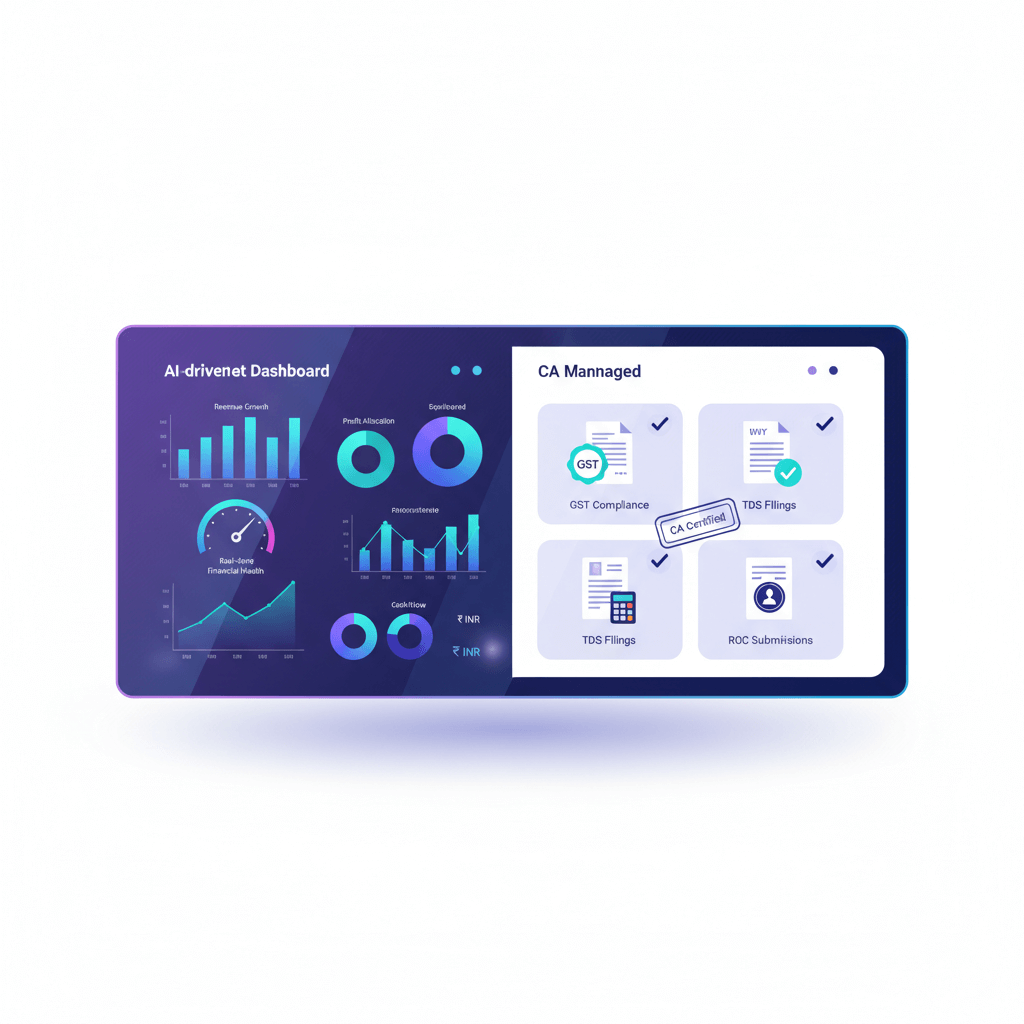
Virtual Accounting by AI Accountant blends professional execution with system driven visibility. You see the work in a live dashboard while a CA team handles accounting and compliance end to end.
Dashboard capabilities
- Financial overview for revenue, expenses, and profit and loss.
- Income and expense breakdowns.
- Cash flow trends, burn rate, and runway.
- AI insights and alerts.
- Recent transactions and bank statement analysis.
- Central document repository.
- Compliance dates and filing status.
- Central communication with the CA team.
Accounting and bookkeeping services
- Monthly bookkeeping for sales, purchases, expenses, and bank entries.
- Ledger scrutiny and cleanup.
- Year end closing and schedules.
- Fixed asset register maintenance.
- Inventory records and reconciliation.
- Accounts receivable and payable management.
- Bank and payment gateway reconciliations.
- Cash flow preparation (not certified).
- MIS and management reporting.
- Support to coordinate with the statutory auditor.
Taxation compliance (not attest)
GST
- GST registration.
- Monthly or quarterly filings for GSTR 1 and GSTR 3B.
- Annual filings for GSTR 9 and GSTR 9C.
- E invoice enablement.
- GST advisory on place of supply, reverse charge, HSN, and rates.
- GST health checks and reconciliations.
Income tax and TDS
- ITR filing for individuals, partnerships, and companies.
- TDS advisory and compliance with challan payments and forms 26Q, 24Q, and 27Q plus 26QB, 26QC, and 26QD.
- TDS and income tax health checks.
- Advance tax calculations and payments.
- Tax audit preparation (not certification).
- International tax advisory.
- Expat tax and salary structuring.
- 15CA preparation.
Payroll services (not attest)
- Monthly TDS calculation for payroll.
- Salary structure advisory to help employees save taxes.
Annual ROC compliance and secretarial for small companies
- MSME filings for vendors to MCA.
- MGT 7 and AOC 4.
- DIN application and director appointment and resignation.
- DIR 3 KYC.
- Increase in authorized share capital and share allotment.
- Board meetings and minutes.
- Annual general meeting.
- Statutory register.
- Board report.
- Annual report.
Note on small company: turnover less than one hundred crore, paid up share capital less than ten crore, and not a holding or a subsidiary (as defined under the Companies Act via MCA).
Why it complements AI accounting software for businesses
- Replaces scattered workflows in email, spreadsheets, and chats with a central system.
- CA team handles end to end execution while you see everything in the dashboard.
- Continuous compliance monitoring with proactive advisory.
- Offloads routine tasks so your team can focus on growth and planning.
Example monthly workflow with Virtual Accounting plus AI software
Week one
- Automated bank and payment gateway reconciliations run.
- Anomaly alerts are reviewed by the team.
- Vendor invoices and expenses are auto categorized and flagged for review.
- AR aging is prepared and follow ups begin on overdue invoices.
Week two
- GST check for the month.
- GSTR 1 data is validated and filed on time by the CA team.
- E invoice status is monitored and IRN is enabled for all outgoing invoices where needed.
- Monthly accounting package is generated with profit and loss, balance sheet, and cash flow.
Week three
- TDS calculations are completed.
- Forms 26Q and 24Q are scheduled for quarterly filing.
- Challan payments are processed and proof is archived.
- MIS report shows cash flow trends, burn rate, and runway, and is shared with leadership.
Week four
- Compliance calendar is reviewed for items like advance tax and ROC filings.
- All documents are stored in the central repository and communication logs are updated.
- If year end is near, tax audit preparation begins.
Costs, ROI, and decision guidance for AI accounting software for businesses
Subscription costs
Standalone AI platforms vary based on users and transaction volume. CA led managed services price by scope and complexity. Fees are higher when advisory and compliance execution are included, but total cost can still be favorable versus adding full time headcount.
Quantifiable savings
- Time savings: dozens of hours per month reclaimed from routine tasks.
- Faster close: month end reduces from ten to fourteen days to under three days.
- Error reduction: fewer corrections and less rework.
- Penalty avoidance: timely GST and TDS filings prevent fines.
- Cash flow acceleration: automated reminders help you get paid several days faster.
Opportunity cost
Founder time and finance capacity move from manual work to strategy and growth planning. This materially improves business outcomes for startups and SMEs.
Hybrid ROI
A hybrid of AI accounting software plus a CA managed service is often cheaper than hiring in house. You get better visibility, stronger compliance, and access to advisory without carrying the fully loaded cost of multiple finance hires.
Conclusion and next steps for AI accounting software for businesses
AI accounting software delivers real value. It saves time, reduces errors, and gives real time visibility into cash and compliance. For startups, SMEs, and growing teams, it is now a foundation of a modern finance stack.
Software alone is not always enough. If compliance is complex or your team is stretched, add a CA led managed service. A hybrid setup gives you automation plus expert execution and advisory.
Next steps
- Audit your current finance workflow.
- List manual steps that consume the most time.
- Map compliance needs across GST, TDS, income tax, and ROC.
- Evaluate AI accounting software that fits your process.
- Consider a managed service if you want execution and oversight, not just tools.
If you want software like visibility with professional execution, explore AI Accountant's Virtual Accounting. You get a live dashboard, automated workflows, and a dedicated CA team that handles accounting and compliance end to end. It is a practical way to bring calm and control to finance operations while your business grows.
FAQ
How should a founder evaluate whether to start with AI accounting software or add a CA managed service immediately
Start with AI software if your entity structure is simple, internal finance can handle monthly routines, and you mainly need automation and live visibility. Add a CA managed service from day one if you have multi entity operations, frequent GST reconciliations, TDS obligations across payroll and vendors, and limited internal bandwidth. The hybrid approach (software plus managed service) is increasingly common because it avoids over reliance on automation alone.
What KPIs should a finance head track post implementation to measure ROI
Track close cycle time, reconciliation accuracy, on time filing rate for GST and TDS, AR days outstanding, and the percentage of transactions auto categorized without correction. A practical benchmark: month end close within 48 hours, reconciliation accuracy at 98% plus, and on time filings at 100%.
Can AI accounting software prepare data for GSTR 1, 3B, 9, and 9C, and what remains with the CA
Yes, AI systems prepare data sets, perform validations, and maintain audit trails for all major GST returns. A CA handles review, exceptions, advisory on place of supply and reverse charge, and statutory submissions. With a managed service, the CA team completes filings while you monitor status in the dashboard.
How reliable is AI driven categorization and reconciliation for high volume payment gateways
Reliability is high for mainstream gateways when rules are clean, bank feeds are stable, and models are tuned to your chart of accounts. Expect near real time matching for standard transactions. Edge cases like partial refunds, chargebacks, or split settlements still need human in the loop checks. (2026 update) Current platforms handle these exceptions more gracefully, with automated flagging and exception queues that reduce manual triage time.
How much manual work does AI accounting software actually eliminate
Leading platforms reduce manual data entry by up to 80%, based on recent adoption data from high volume firms. The biggest savings come from automated transaction categorization, OCR based invoice capture, and continuous bank reconciliation. Month end close cycles that previously took ten to fourteen days now complete in under three days for teams using AI driven workflows.
What governance controls are essential so automation does not hide mistakes
Set reviewer roles for high value journals, intercompany entries, and unusual transactions. Schedule quarterly accuracy audits and require explanations for anomaly flags. Keep audit logs active and restrict access by role. Automation should be paired with control points that create accountability, not replace it.
Do startups with lean teams really benefit from a hybrid of AI software plus managed service
Yes. Startups gain speed and visibility from AI dashboards while a CA team executes GST and TDS filings, reconciliations, and control checks. This avoids hiring too early, keeps founders focused on product and revenue, and reduces compliance risk. The hybrid model is especially valuable when compliance obligations grow faster than the team can scale.

A results-driven finance and sales professional with hands-on experience through finance internships and a fast-paced sales role. With a strong interest in accounting and business finance, Harsh focuses on turning complex topics into clear, practical takeaways for founders and finance teams.