-01%201.svg)
Key takeaways
- Automating GSTR-2B reconciliation eliminates manual spreadsheet chaos, reduces ITC leakage, and saves 80% of time each month.
- Prioritise tools with strong matching engines, clear exception buckets, configurable rules, and maker checker controls.
- Use exception analytics to identify missing invoices early, then trigger vendor follow up automation across email and WhatsApp.
- Adopt an ITC claim optimisation approach that classifies eligible and ineligible credits, tracks deferrals and reversals, and documents audit trails.
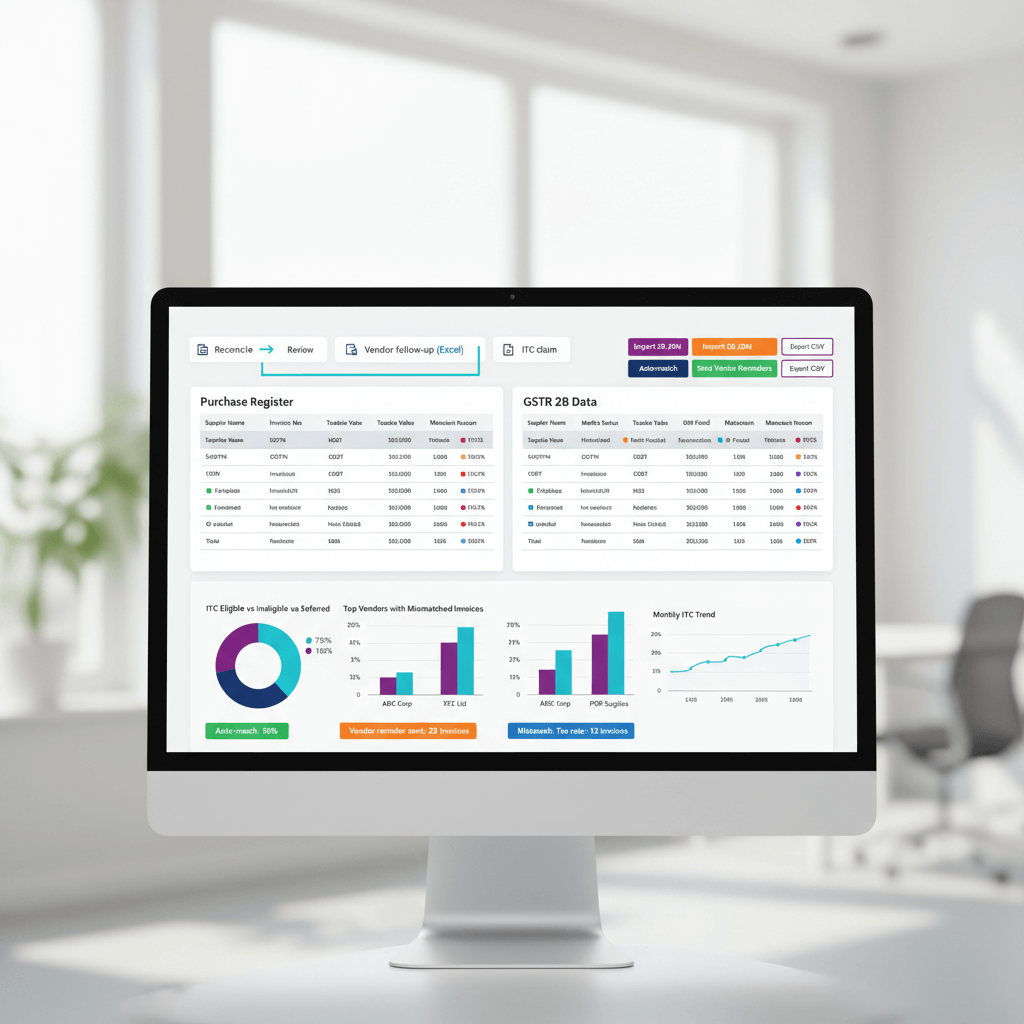
- Rely on a monthly dashboard for coverage, eligibility, deferred ITC, vendor compliance, and top exceptions, so leadership sees risks and actions instantly.
- For deep dives, see a concise GSTR-2B reconciliation tools overview and a step by step GSTR-2B reconciliation tools guide.
The month end pain and proven outcomes
It is the 10th, your team is comparing GSTR-2B with purchase records, vendor filings are delayed, invoice numbers are inconsistent, and spreadsheets are throwing errors while the 180 day payment clock keeps ticking. Sound familiar?
This chaos exists because reconciliation spans supplier behaviour, time pressure, and data quality. With the right GSTR-2B reconciliation tools, the script flips.
- Teams rapidly match purchase register entries to GSTR-2B.
- They identify missing invoices in minutes, then launch automated vendor follow ups.
- Dashboards drive ITC claim optimisation, transparently and compliantly.
Real outcomes: 80% lower reconciliation time, 20 to 30% lower ITC leakage, 40% higher vendor on time uploads.
These are not theoretical, they are live results for teams processing hundreds of thousands of invoices every month.
Quick refresher: GSTR-2B essentials
GSTR-2B is a static, auto generated ITC statement of supplier GSTR-1 filings up to a cutoff date. GSTR-2A is dynamic and keeps updating. Think of 2B as a monthly snapshot, and 2A as a live feed. For claims, reconcile to 2B and use 2A only for additional vendor nudges. For a primer, see this clear note on the difference between GSTR-2A and GSTR-2B.
Manual reconciliation wastes time, leaks ITC, and increases DRC-03 risk. Smart tools address all three together.
Evaluation framework for GSTR-2B reconciliation tools
If you run Zoho Books or Tally, and process 100,000 invoices a month, benchmark options on the following.
Core matching engine to match purchase register
- Field level matching on GSTIN, invoice number, date, taxable value, tax breakup, place of supply, HSN, and rate.
- Fuzzy logic for normalising “INV-001” versus “INV001”, tolerance thresholds for paise or rounding, and smart date windows.
- Coverage for amendments, credit and debit notes, RCM, imports, ISD credits.
- Bulk actions, status tagging, and maker checker workflows for control.
A strong engine will auto normalise invoice numbers, flag HSN rate conflicts, and stitch complex scenarios reliably.
Exception management to identify missing invoices
- Clear buckets for not in 2B, partial matches, value mismatches, GSTIN or date discrepancies.
- Ageing analysis, root cause codes, and priority by ITC value or age.
- Filters by vendor, GSTIN, month, and exception type to drive action.
Work top down, focusing on high value, old exceptions first, then clear the tail.
ITC claim optimisation features
- Classification of eligible and ineligible credits as per Section 17(5), place of supply checks, period rules.
- Tracking of deferred and reclaimable credits, with automated timelines.
- Monitor 180-day payment reversals with alerts, and auto compute reclaims when paid.
- Audit trails for every override and decision.
Vendor follow up automation
- Multi channel reminders across email and WhatsApp, with personalised missing invoice lists.
- Configurable cadences, escalation paths, and a simple vendor portal.
- Response capture, activity logs, bulk sends, and open rate tracking.
Automation turns vendor compliance from a chase into a system.
Monthly dashboard for tracking
Dashboards turn raw data into actionable insights.
Key views to expect:
- GSTR-2B coverage percentage, eligible versus claimed ITC, deferred amounts.
- Missing or short ITC, top exception categories, vendor on time upload rates.
- Drill downs by organisation, GSTIN, vendor, or month, plus one click exports.
Comparing top GSTR-2B reconciliation tools
Leading tool options
- AI Accountant offers multi parameter fuzzy matching, bi directional Zoho and Tally sync, comprehensive vendor automation, and a configurable ITC engine with automatic reversal tracking. Proven on 300M+ transactions.
- ClearTax focuses on mismatch categorisation and ITC centric workflows, with partial accounting integrations.
- TallyPrime delivers native reports for Tally users, and sensible eligibility categorisation, ideal when you are already on Tally. For more depth, see this TallyPrime GSTR-2B reconciliation guide.
- Busy GSTR reconciliation provides tolerance settings, vendor templates, and multi business support.
- Zoho GST integrates naturally with Zoho Books for light to medium volumes.
Each has strengths. AI Accountant excels at automation and scale, ClearTax prioritises ITC recovery, TallyPrime fits Tally users, Busy supports multi entity setups, Zoho GST suits smaller volumes.
Integration capabilities and data flow
Insist on bi directional sync with Zoho Books or Tally. The tool should import purchase registers, JVs, credit or debit notes, and fetch GSTR-2B via API or JSON. Just as important, it should push reconciled outputs back, keeping finance and compliance in one system of record.
Master data sync for vendor names and GSTIN silence common mismatches before they occur.
Scale, reliability, and security
- Multi organisation support, role based access, and immutable audit logs.
- Uptime of 99.9% or better at 100,000+ invoices a month.
- Certifications like ISO 27001 and SOC 2 Type II, encryption at rest and in transit, and India data residency when required.
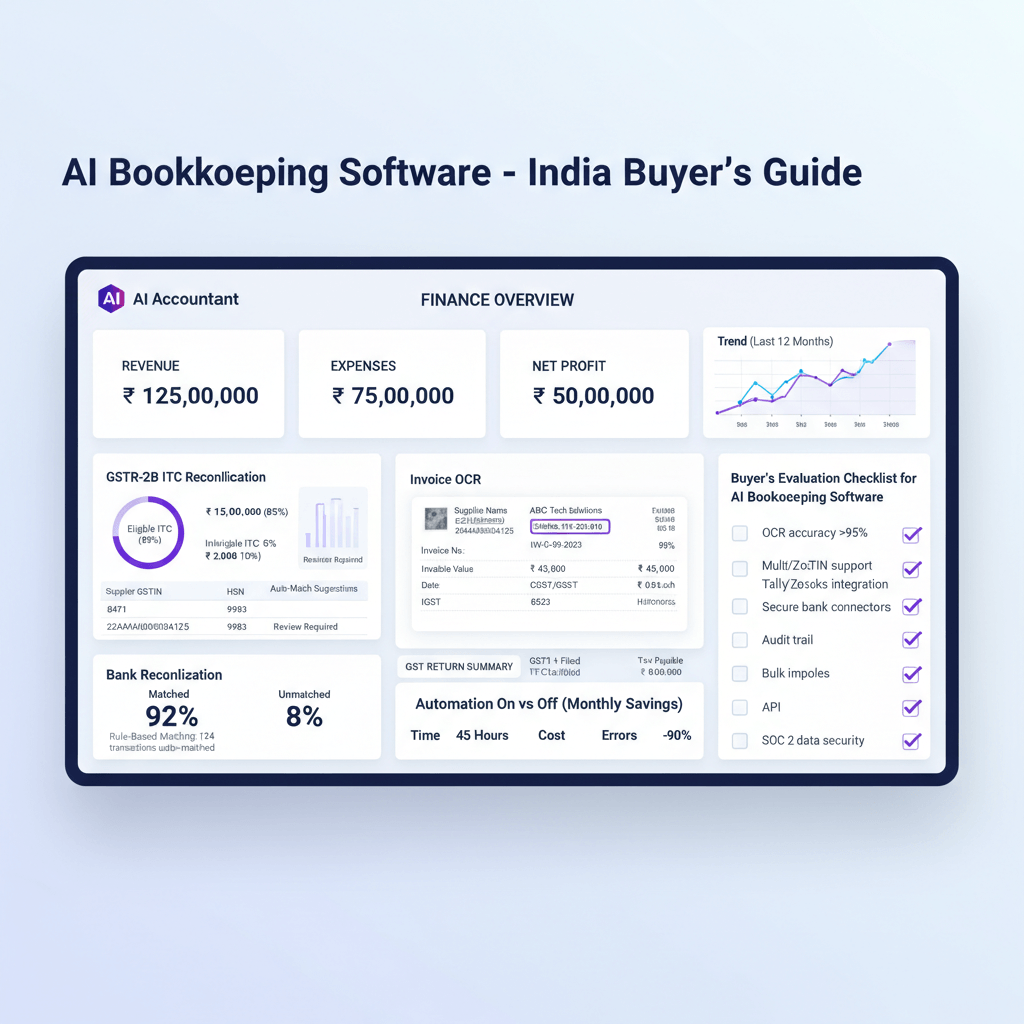
Buyer checklist: questions to ask vendors
- Can you match purchase register to 2B with configurable rules, fuzzy logic, and smart date windows?
- How do you identify missing invoices with ageing, root cause codes, and priority scoring?
- What ITC claim optimisation rules ship out of the box, and which can I customise, including reversal and reclaim logic?
- What does vendor follow up automation include, and how are communications logged?
- Which monthly dashboard KPIs are available, with filters and export options?
- How deep is your Zoho Books or Tally integration, including push back of reconciled entries?
- Do you support maker checker approvals, and what are your security certifications?
- How is pricing structured, per organisation, per user, or per invoice, and what is the onboarding cost?
Example month end workflow
Step 1: Import purchase register from Zoho Books or Tally, and fetch GSTR-2B via API or JSON.
Step 2: Run the match purchase register engine, then review auto matches and flagged items.
Step 3: Identify missing invoices from the exception report, and launch vendor follow up automation.
Step 4: Resolve exceptions with suggested matches, tag reasons, and defer ITC when required.
Step 5: Execute ITC claim optimisation, lock eligible credits, and schedule any reversals or reclaims.
Step 6: Push reconciled journals back to Zoho Books or Tally.
Step 7: Publish the monthly dashboard for leadership and client reporting.
Typical timeline: 5 to 7 hours for 10,000 invoices, versus 2 to 3 days manually.
ROI and TCO insights
Time savings alone justify investment, with teams saving ~10 hours per 1,000 invoices. Add lower ITC leakage, fewer DRC-03 notices, and better vendor discipline, and payback commonly lands within one or two quarters for high volume filers.
Example: a CA firm with 50 clients at 500 invoices each saves roughly 250 hours a month, even before counting improved ITC recovery.
Implementation guidance
Prerequisites: Confirm GSTN API or JSON access, clean vendor masters, and document current steps for baselining.
Pilot: Start with one GSTIN, two to three months of data, target 95% auto match and 48 hour exception clearance, then expand.
Change management: Define SOPs, enable maker checker for ITC, and use a cutover checklist.
Training: Focus on exception triage, vendor follow ups, and dashboard interpretation. Brief vendors on the new cadence.
How AI Accountant aligns with requirements
AI Accountant delivers advanced fuzzy matching for match purchase register use cases, detailed exception categorisation to identify missing invoices, robust ITC claim optimisation with configurable rules and auto reversals, full stack vendor follow up automation across email and WhatsApp, and a rich monthly dashboard with filters and exports.
It syncs bi directionally with Zoho Books and Tally, scales across 300M+ transactions, and carries ISO 27001 and SOC 2 credentials. India specific nuances like RCM, imports, ISD, and Section 17(5) are first class citizens.
India compliance notes
Tools support, but the taxpayer remains responsible for claims. Retain documentation for the financial year and assessment timelines. Ensure tooling handles RCM transactions that require self invoicing, import duty impacts, ISD distribution, Section 17(5) blocks, and amendments across periods. Keep an eye on the evolving 180 day rule and filing timelines. When in doubt, refer back to an authoritative GSTR-2B reconciliation overview and a deeper implementation guide.
Taking the next step
GSTR-2B reconciliation can move from firefighting to flow. Choose for matching strength, exception clarity, ITC optimisation, vendor automation, and dashboards. Start with a small pilot, prove value, then scale. Your team wins back time, your ITC claims get sharper, and compliance risk drops.
Ready to evaluate with real data? Explore AI Accountant, or apply its free templates for vendor follow up and ITC checks while you assess.
FAQ
How should a CA structure GSTR-2B reconciliation to maximise compliant ITC for multi GSTIN clients?
Adopt a monthly cadence per GSTIN, auto import purchase registers and 2B, then use exception buckets to prioritise high value gaps first. Enable maker checker approvals on ITC decisions, defer credits that are not yet in 2B, and schedule reclaims. Tools like AI Accountant handle multi organisation views, vendor analytics, and audit logs that CAs need for assessments.
What matching rules deliver the best auto match rate without inflating false positives?
Layered logic works best: exact GSTIN and invoice number after normalisation, date within tolerance, taxable value within a paise or round off threshold, and tax breakup consistency. Add fuzzy number matching for common prefixes or leading zeros, then restrict by vendor GSTIN to avoid cross vendor contamination. AI Accountant lets you tune these thresholds per client.
How do I treat invoices reflected in 2A but missing in 2B during the period close?
Use 2B as the source of truth for claims, and treat 2A as a vendor nudge list. Defer such ITC, trigger vendor follow ups, and reclaim when the invoice lands in a subsequent 2B. A clean audit trail showing deferral and later reclaim, as automated by AI Accountant, reduces assessment friction.
What is the recommended approach for handling credit notes and debit notes across periods?
Link notes to parent invoices, net the impact in the correct period, and ensure ITC is reduced when a supplier issues a credit note. If a note arrives late, adjust in the current return and document the cross period correction. AI Accountant auto links notes, flags cross period effects, and posts reconciled entries back to accounting.
How do I operationalise the 180 day payment condition, and what evidence should I retain?
Map vendor wise payment timelines, auto reverse ITC on the due date for unpaid invoices, and schedule reclaims post payment. Retain payment proofs, vendor ledgers, and system generated reversal or reclaim logs. AI Accountant automates reversal timing and maintains the evidence trail for scrutiny.
Can reconciliation be bi directional with Zoho Books or Tally, including push back of results?
Yes, modern tools support import of purchase registers and 2B, and push back reconciled journals, reason codes, and ITC classifications. AI Accountant provides bi directional sync for Zoho Books and Tally so ledgers, vendor masters, and ITC decisions stay aligned.
How do I reduce vendor related gaps, especially for quarterly filers affecting monthly 2B?
Run monthly reconciliations even if you file quarterly. Use automated, personalised reminders listing missing invoices, with escalation to vendor owners. Configure special date windows for quarterly filers to reduce false gaps. AI Accountant’s vendor automation across email and WhatsApp consistently raises on time uploads.
What KPIs should I report to management or clients on a monthly dashboard?
Track 2B coverage, eligible versus claimed ITC, deferred and reclaimable ITC, missing or short credits, vendor on time rate, and top exception categories. Provide drill downs by GSTIN, vendor, and month, plus exportable summaries for board or client packs. AI Accountant’s dashboard covers these KPIs out of the box.
How do I evaluate security posture and data residency when selecting a reconciliation tool?
Ask for ISO 27001 and SOC 2 Type II, encryption at rest and in transit, access controls, and audit logs. Confirm data residency in India when required and review vendor subprocessors. AI Accountant is ISO 27001 and SOC 2 compliant, with role based access and comprehensive audits.
What is a realistic benchmark for auto match rate and exception clearance time?
For clean masters and stable vendors, 90 to 95% auto match in the first pass is achievable, with 48 hours to clear remaining exceptions using prioritised workflows. AI Accountant customers commonly hit these thresholds after the first two cycles.
How should I document overrides, manual matches, and judgement calls for future assessments?
Use reason codes, maker checker approval trails, and immutable logs. Store supporting documents and communications tied to each exception. AI Accountant records every action and links artefacts, simplifying assessment responses.
Does AI Accountant support RCM, imports, and ISD credits end to end?
Yes, AI Accountant recognises RCM entries with self invoicing, handles import IGST credits, and supports ISD distribution logic. It segregates these flows in reports, ensuring clean eligibility, reversal, and audit evidence for CA reviews.

Rohan Sinha is a fintech and growth leader building aiaccountant.com, focused on simplifying accounting and compliance for Indian businesses through automation. An IIT BHU alumnus, he brings hands-on experience across 0 to 1 product building, growth, and strategy in B2B SaaS and fintech.