-01%201.svg)
Key takeaways
- A single GST health check dashboard surfaces ITC leaks, outward tax variances, and filing risks in minutes, preventing penalties and cash flow hits.
- Integrate books with GSTR-1, GSTR-3B, and GSTR-2B, then prioritize issues by value and deadlines using a risk score.
- Vendor wise ITC analysis, outward variance tracking, and a filing heatmap convert month end chaos into a predictable, auditable process.
- Standard playbooks, audit trails, and monthly reconciliation routines drive systematic risk reduction, not just one time fixes.
- Tools like AI Accountant automate data pulls, scaled reconciliations, and push back clean results to Tally or Zoho.
What is a GST Health Check Dashboard?
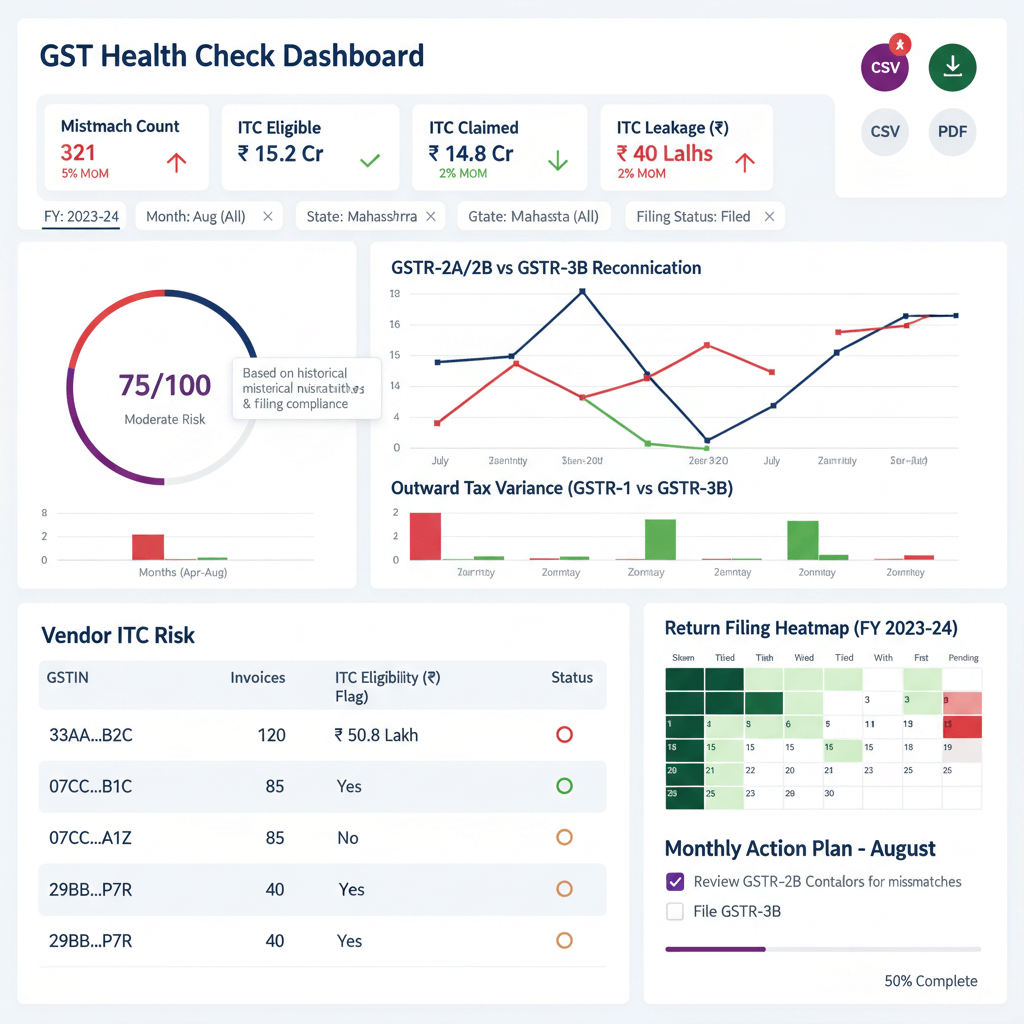
A GST health check dashboard is the compliance command center for a CA firm, a single view that highlights risks and opportunities across purchases and sales. It correlates books with statutory returns, ranks exceptions by impact, and points you to the next best action.
Why does this matter? Because small errors snowball into large exposures, including ITC reversals that strain working capital, scrutiny under Section 61, delayed refunds, and penalty risks that could reach a multiple of tax. Rule 86A ITC blocks create further uncertainty.
The dashboard goes beyond portal snapshots. It blends books with GSTR-1, GSTR-3B, and GSTR-2B, then sequences fixes by materiality and filing windows.
This is not only about staying compliant, it is about protecting cash, preventing rework, and defending your firm during audits with clear evidence and audit trails.
Data Sources and Prerequisites for GST Compliance Review
Bring in your Purchase Register, Sales Register, Journal Vouchers, Credit Notes, Debit Notes, GSTR-1, GSTR-3B, and GSTR-2B. When syncing from Tally or Zoho, clean the raw data first, standardize GSTIN format, normalize dates, and de duplicate vendor names.
Refresh monthly right after books close, this aligns analytics with filing windows. For multi client CA setups, implement access controls so team members only see their assigned organizations.
Remember: insight quality mirrors data quality. Invest upfront in clean masters and consistent import routines.
Core Dashboard Components for GST Health Analysis
Mismatch Counts and Risk Score
Track mismatches across GSTINs, invoice numbers, dates, tax rates, taxable values, place of supply, duplicates, RCM tagging, and credit note linkage. Then convert raw counts into a composite risk score, classifying items into high, medium, and low buckets based on value and urgency.
Example, a large ITC mismatch with an immediate deadline is critical, a small variance with a longer window is medium. This triage prevents fire fighting and focuses effort where it saves the most money.
Vendor Wise ITC Risk Analysis
Break down eligible, ineligible, and deferred ITC by supplier. Spot vendors absent in GSTR-2B, suppliers with poor filing habits, composition dealers, and amendment heavy partners. Use this to chase invoices, hold payments for non compliant suppliers, trigger reversals, and track provisional ITC safely.
Outward Tax Variance Tracking
Reconcile Books against GSTR-1 and GSTR-3B by month, tax head, and state. Drill into missing amendments, unaccounted advances, B2B versus B2C misclassifications, export documentation gaps, and credit note linkages.
Each variance should have a recommended fix, for example amend in GSTR-1 within the window, or align GSTR-3B to books with documentation for audit trails.
Filing History Heatmap Visualization
Show on time, delayed, or missed filings for GSTR-1 and GSTR-3B across months. Patterns leap out, a branch that is consistently late, specific months with spikes, or resource crunch periods. Use this to set internal cutoffs and escalation rules.
Supporting Widgets and Metrics
- Top ITC leakages by value
- Improving vendor compliance list
- Pending bill payment tracker for invoice chasing
- RCM summary, liability and claim
- E invoice anomaly flags to catch posting or integration errors early
How to Interpret and Act on GST Dashboard Insights
Start with the risk score, fix high value outward variances first, then plug ITC leaks, then stabilize vendor issues that keep recurring. Build playbooks so actions are predictable, for ITC reversals, vendor follow ups, master data fixes, and GSTR-1 amendment timelines.
Always preserve evidence: export snapshots before edits, keep decision logs and approvals. These artifacts are your shield during assessments.
Monthly GST Reconciliation Plan for Using the Dashboard
- Day 1 to 3: Ingest books and bank data, run first pass reconciliations, baseline the risk score.
- Day 4 to 6: Vendor ITC review, chase suppliers, hold payments where compliance is weak, document every outreach.
- Day 7 to 9: Outward variance cleanup, align Books and GSTR-1, stage amendments before filing.
- Day 10 to 12: Finalize ITC adjustments, complete reversals, reconcile claims to GSTR-3B, verify provisional credit logic.
- Post filing: Update the heatmap, conduct a retrospective, and refine rules based on new patterns.
This cadence caps risk early in the month, creates a repeatable routine, and improves continuously with evidence.
ITC Reconciliation Metric Definitions and Guardrails
- Match logic: exact matches on GSTIN, invoice number, and tax amounts, with materiality thresholds to ignore trivial differences, for example 1 percent or Rs 1,000.
- Risk weighting: mark items over Rs 1 lakh as high, deadline breaches as critical, recurring small variances as medium.
- Eligibility rules: exclude RCM purchases from regular ITC, apply Rule 37, 42, and 43 limits, and cap provisional ITC safely.
- Edge cases: ISD segregation, import duty timelines, e commerce operator reconciliation, advance to invoice linkage, consistent rounding handling.
Common GST Compliance Pitfalls and How to Avoid Them
- Master data drift: run monthly GSTIN validation, deduplicate vendors, and fix naming conventions.
- Overuse of provisional ITC: automate caps and reversal triggers, then reclaim when visible in GSTR-2B.
- Unlinked payments: automate payment to bill matching by references and amounts to avoid suspense creep.
- Wrong tax rates and credit note gaps: use pre posting validation checks to catch errors before they hit books.
Best GST Reconciliation Software and Tools
AI Accountant offers comprehensive automation, direct pulls from Tally and Zoho, auto cleaning of GSTR data, scaled reconciliations of Purchase Register with GSTR-2B, status tagging, bulk fixes, vendor risk and outward variance views, filing heatmaps, and push back to your accounting system with clean audit trails.
- QuickBooks: basic GST features for smaller, straightforward operations.
- Xero: decent filing and reconciliation, more manual for complex cases.
- ClearTax: strong filing workflows, integration depth varies.
- Zoho Books: capable native GST for the Zoho stack.
- Tally Prime: robust GST compliance for desktop users, limited modern dashboards.
Select based on volume, complexity, and integration needs, the right tool turns filings from scramble to system.
SOP Templates and Checklists for Filing Compliance
Create a monthly plan checklist, standardized vendor chasers for ITC mismatches, outward amendment logs with reasons and approvals, and a filing heatmap tracker. These artifacts speed onboarding, assure continuity, and demonstrate process maturity during audits.
Visual Layout Suggestions for Outward Supply Reconciliation
- Risk summary: a top card with total mismatches and an overall risk gauge.
- Vendor table: filters for risk, eligibility, and compliance score, sortable by value.
- Variance charts: stacked bars for Books, GSTR-1, and GSTR-3B placed side by side to reveal gaps instantly.
- Filing heatmap: a month by month grid for each return, color intensity reflecting delay severity.
Taking Action on Tax Compliance Automation
Proactive dashboards convert filings from last minute firefights into a calm, evidence led routine. The risk score directs effort, the monthly plan sets cadence, the visuals make complexity readable. CA firms scale this across clients, SMEs gain predictability and fewer surprises.
Adopt a capable platform such as AI Accountant, start with one complex account, measure time saved and error reductions, then expand. Perfect compliance is unrealistic, systematic risk reduction is achievable, repeatable, and defensible.
Your next month end can be quieter. Spot ITC leaks, fix outward variances, and prevent filing risks in minutes, not days.
That is the power of a disciplined GST health check dashboard.
FAQ
How frequently should a CA update the GST health check dashboard for clients with varying volumes?
Update monthly right after books close for most clients, daily or weekly for high volume businesses or those with frequent amendments. Many firms run a light weekly refresh for exceptions, then a full reconciliation post close. Tools like AI Accountant support scheduled pulls so cadence matches filing cycles.
What is the best way to treat timing differences between books and GSTR-2B without overclaiming ITC?
Segregate provisional ITC from confirmed ITC, set a conservative cap, and auto reverse any excess by the filing date. When invoices appear in the next GSTR-2B, reclaim cleanly. An AI driven tool can tag such invoices and track automatic reclaims to avoid manual errors.
How do I configure risk scoring so my team focuses on material issues first?
Weight by amount, due date, and recurrence. For example, mark items above Rs 1 lakh as high, overdue items as critical, and recurring small variances as medium. AI Accountant style scoring blends value and urgency so the top of the queue always holds the most consequential fixes.
What reconciliation rules should I apply for RCM purchases and blocked credits under Rule 37, 42, and 43?
Exclude RCM purchases from regular ITC eligibility, track liability and claim separately, and enforce automatic reversals for Rule 37 non payment and apportionment under Rules 42 and 43. Good dashboards maintain separate buckets and audit logs for every reversal and reclaim.
How can a CA handle multi month amendments and preserve an audit trail that stands up to scrutiny?
Maintain version history with original and amended values, tag the GSTR-1 window used, and store justifications. Export a snapshot before changes, then a post change snapshot. AI Accountant type systems maintain these histories and let you download PDFs for assessments.
What is the most efficient vendor chasing workflow for missing invoices visible in books but absent in GSTR-2B?
Use vendor wise ITC risk views, auto generate chaser emails with invoice lists, hold payments for non compliant vendors, and recheck the next month’s GSTR-2B. An AI assistant can prioritize vendors by leakage value and send reminders with proof attachments.
How should outward supply variances be resolved when Books, GSTR-1, and GSTR-3B show three different totals?
Start from Books, reconcile to GSTR-1 and GSTR-3B by tax head and month, identify amendments, advances, and credit notes, then align GSTR-3B to true sales with documentation. Keep a reason code for each adjustment to satisfy audit queries.
What controls prevent master data drift for GSTINs, vendor names, and tax rates over time?
Run monthly GSTIN validations, standardize naming, lock tax rate catalogs, and restrict edits to masters with maker checker. An AI layer can flag anomalies, for example a sudden tax rate change for a stable SKU, and route for approval.
Can one dashboard handle multiple GSTINs and branches while maintaining confidentiality in a CA firm?
Yes, set up per GSTIN views, with consolidated roll ups for partners, and user level access so staff only see assigned entities. Platforms like AI Accountant implement org scoping that works well for multi client practices.
How do I design materiality thresholds so my team does not chase trivial differences?
Define dual thresholds, a percentage, and an absolute number, for example 1 percent or Rs 1,000, whichever is higher. Apply these to invoice level and monthly totals, and exclude below threshold items from queues while still tracking them for patterns.
What evidence should I retain to defend ITC reversals and reclaims during departmental assessments?
Keep pre and post change snapshots, vendor communications, payment proofs for Rule 37, and reconciliation logs linking books to returns. A system like AI Accountant lets you export a single audit pack per month with all artifacts.
How can AI accelerate monthly reconciliation without compromising accuracy for CA firms?
AI classifies mismatches, predicts the most likely root causes, suggests fixes, and auto prepares chasers, while leaving approval to humans. With guardrails, it shortens review cycles and raises consistency, for example the AI Accountant approach combines deterministic rules with AI suggestions to keep accuracy high.

Rohan Sinha is a fintech and growth leader building aiaccountant.com, focused on simplifying accounting and compliance for Indian businesses through automation. An IIT BHU alumnus, he brings hands-on experience across 0 to 1 product building, growth, and strategy in B2B SaaS and fintech.