-01%201.svg)
Key takeaways
- GST return deadlines in 2026 hinge on turnover and QRMP status, with monthly or quarterly patterns that demand disciplined planning.
- Missing a GSTR-3B due date can mean late fees up to ₹5,000 and 18% interest on unpaid tax, so proactive alerts and task ownership are essential.
- A smart GST calendar should include state-wise GSTR-3B dates, annual GSTR-9 and 9C checkpoints, and auto-updates when CBIC changes timelines.
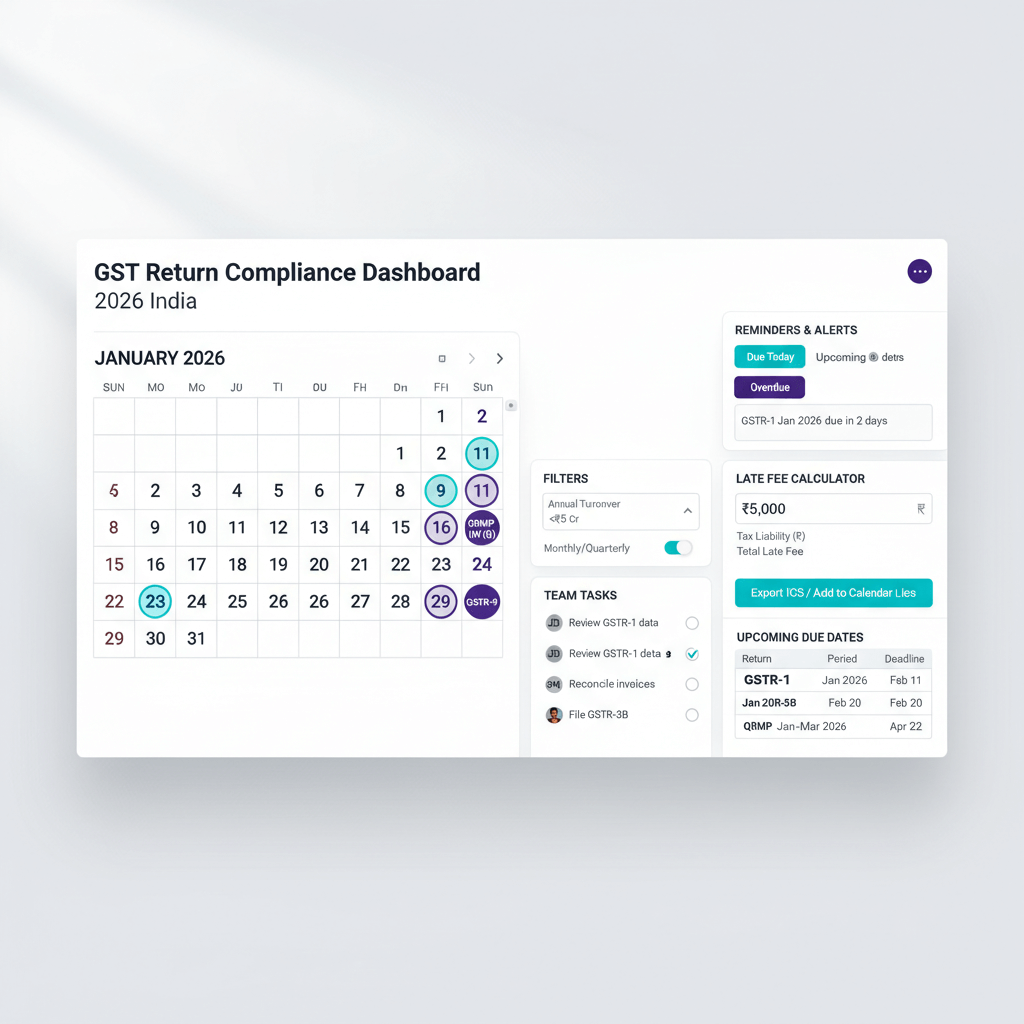
- Use intelligent reminders, T-7, T-3, T-1, plus same-day nudges, to reduce last-minute scrambles and avoid penalties.
- Centralized task assignment, checklists, and an audit trail help CA firms and finance teams manage multi-GSTIN filing at scale.
- A late fee calculator clarifies penalty exposure for nil and non-nil returns, helping you act quickly when delays occur.
What’s inside the GST Return Calendar India
Your GST compliance revolves around three core returns, each with its own cadence. GSTR-1 captures outward supplies, GSTR-3B is the summary return where tax is paid, and GSTR-9 wraps the financial year with an annual reconciliation. The calendar also covers QRMP specifics for smaller businesses, including state-wise GSTR-3B timings. You will see annual touchpoints such as GSTR-9C for turnover above ₹5 crore, and system prompts for reconciliations and adjustments.
It’s designed to work the way you do: printable monthly PDF, CSV for workflow tools, and ICS feeds for Google, Outlook, and Apple Calendar. Multi-GSTIN views let you toggle between entity-level calendars or a single consolidated horizon, so you never miss a client or branch deadline.
For deeper primers and examples, explore references like GST return filing, GST return due dates, GST calendar 2026 and important GST dates, GST calendar, and types of GST returns.
Think ahead, not after the fact. A calendar that adapts to your turnover, QRMP status, and state category eliminates guesswork and cuts penalty risk.
Due dates by turnover, know your deadlines
Your filing schedule is determined by annual turnover, so plan your month around these immovable dates, not the other way around.
Businesses with turnover above ₹5 crore
- GSTR-1: due by the 11th of the following month, for example, January 2026 sales by February 11, 2026.
- GSTR-3B: due by the 20th of the following month, giving you a nine-day buffer to match GSTR-1 with GSTR-3B totals and finalize tax.
- GSTR-9: annual return due by December 31 of the following financial year.
Businesses with turnover up to ₹5 crore, QRMP scheme
- GSTR-1: due on the 13th of the month after each quarter, for example, Q4 FY 2025-26 by April 13, 2026.
- GSTR-3B: due based on state category, Category X by the 22nd, Category Y by the 24th.
- GSTR-9: annual return due by December 31 of the following financial year.
Key notes:
- Nil returns carry simpler implications, non-nil returns trigger late fees right after the deadline.
- State-wise GSTR-3B groupings are built into the calendar so you file on the correct date for your state.
- CBIC notifications can alter timelines, including the rolling adoption of long-stop limits for late filings, so ensure your calendar auto-updates when changes are notified.
For authoritative date patterns and examples, see GST return filing, GST return due dates, GST calendar 2026, and GST calendar.
Smart reminders for GSTR-1, 3B, 9
Missed deadlines often come from overload, not negligence. Intelligent reminders transform compliance into a predictable rhythm. A proven cadence is T-7 for preparation, T-3 for review, T-1 for final checks, and a due-day nudge. Post-due alerts limit damage by prompting immediate action.
Choose channels that get attention, email for checklists, in-app for real-time prompts, WhatsApp or Slack for on-the-go nudges. Configure defaults at organization level, then override at GSTIN level when entities require different attention. Link reminders to milestones, data collection, reconciliation, managerial review, and filing confirmation.
When you use tools such as AI Accountant, reminders trigger automatically based on your configured turnover profile and calendar rules, eliminating manual calendar watching. For practical context, see GST return filing and GST return due dates.
Team task assignment for GST compliance
Compliance is a team sport now. Assign recurring tasks for every GSTIN and return type, name a responsible owner, and a reviewer. Build checklists for each stage, attach purchase registers, vendor bills, and 2B reconciliations, and keep everything discoverable.
Live dashboards show returns on track, at risk, or overdue. If a team member is unavailable, bulk reassign to preserve momentum. Approvals and edits are timestamped, creating an audit trail that supports assessments and internal QA.
Reference workflows and filing nuances via GST return filing.
Late fee calculator, know your penalty risk
Nobody aims to file late, yet delays happen. Use a purpose-built tool, the late fee calculator, to quantify exposure and decide the next best action.
- Inputs: return type, period, turnover band, nil or non-nil, days delayed, and tax payable.
- Late fee: ₹50 per day in total, split ₹25 CGST + ₹25 SGST, capped at ₹5,000.
- Interest: 18% per annum on net tax for non-nil returns, computed daily.
Examples: a nil GSTR-3B filed five days late incurs ₹500 in late fees and no interest. A non-nil GSTR-3B with ₹1,00,000 tax filed 10 days late sees ₹1,000 late fees plus roughly ₹493 interest, making delay visible in rupees and days, not just in stress.
Cross-check your approach with GST return filing and GST return due dates.
Calendar export, sync with your workflow
Compliance dates should live in your daily calendar context. ICS exports let you subscribe in Google, Outlook, or Apple Calendar. Choose per-GSTIN feeds for entity focus or a firm-wide consolidated stream for leadership oversight.
State-wise 3B dates appear on the correct day without manual tweaks, and when CBIC moves a deadline, your subscriptions update automatically. Share feeds with clients, partners, and internal teams to align schedules. Prep milestones, data cutoffs, and review windows appear alongside due dates, turning reactive filing into a proactive, well-paced process. For a preview of 2026 patterns, see GST calendar 2026 and important GST dates.
Step-by-step setup in AI Accountant
Set up your calendar and reminders in five steps, and let automation do the heavy lifting.
- Connect organizations, link your accounting systems, and enable GST modules to centralize master data.
- Configure each GSTIN’s turnover and QRMP status, so the engine generates accurate due dates by turnover.
- Activate reminders for GSTR-1, 3B, 9, assign owners and reviewers, and publish standardized checklists.
- Export ICS calendars, share with stakeholders, and pin dashboard views for live monitoring.
- Leverage automation, vendor bill extraction, transaction cleanup, GSTR-2B reconciliation, and exception flags before filing.
For surrounding context, visit GST return filing and GST return due dates.
Essential checklists and best practices
Consistency beats heroics. Use these checklists every period.
Pre-GSTR-1 checklist
- Validate outward supplies, fix customer name and GSTIN mismatches.
- Review credit and debit notes, properly link to base invoices.
- Confirm export documentation and LUT where applicable.
- Verify tax rates by item, ensure current rates are applied.
Pre-GSTR-3B checklist
- Complete GSTR-2B reconciliation to maximize ITC.
- Check ITC eligibility conditions, block ineligible credits.
- Verify RCM transactions, payment and accounting entries.
- Adjust advances against invoices, compute any interest on delays.
- Cross-check with prior month’s GSTR-1 for consistency.
Pre-GSTR-9 annual return checklist
- Post year-end adjustments, clear suspense and unreconciled items.
- Match turnover with audited financials, reconcile HSN summaries.
- Document all amendments, prepare difference reconciliations.
- If turnover exceeds ₹5 crore, coordinate for 9C certification.
Multi-organization best practices
- Prioritize high-turnover entities, where deadlines and penalty exposure hit hardest.
- Standardize data formats, maintain entity-wise document repositories.
- Keep per-GSTIN reconciliation trackers, stagger review meetings to avoid crunches.
- Use consolidated dashboards to spot cross-entity patterns and replicate fixes.
Helpful references include GST return filing, GST return due dates, and GST calendar.
Pro tip: Tie every checklist to a dated task with an owner and a reviewer, and let the calendar steer your weekly priorities.
FAQ
How are GST due dates determined, and how will my calendar stay updated automatically?
Due dates are driven by your annual turnover and QRMP status, then formalized through CBIC notifications. A modern tool like AI Accountant maps these rules to each GSTIN, then auto-updates your subscribed calendars and reminders when CBIC extends or modifies timelines, so you do not chase gazettes manually.
For QRMP clients, how should I plan around the 13th, 22nd or 24th, and IFF versus GSTR-1?
Plan quarterly GSTR-1 for the 13th after each quarter, and track state-category GSTR-3B on the 22nd or 24th. If you use IFF, push select invoices monthly for buyer ITC. Configure entity-level reminder cadences, and your calendar export preserves the quarterly, monthly, and state nuances.
What late fee and interest rules apply for nil versus non-nil returns, and how does a calculator help?
Nil returns attract late fees but no interest, typically ₹50 per day total with caps, while non-nil returns also incur 18% annual interest on net tax, calculated daily. Use a dedicated tool such as the late fee calculator to quantify exposure, then act immediately to minimize charges.
Can AI Accountant help me reconcile and match GSTR-1 with GSTR-3B totals before filing?
Yes, the reconciliation workflow highlights gaps, rate mismatches, and unposted adjustments. A focused review using match GSTR-1 with GSTR-3B totals ensures reported values align before you finalize 3B, reducing interest and amendment cycles.
How do I structure team responsibilities across data entry, review, and filing for multiple GSTINs?
Create recurring tasks by return type and GSTIN, assign owners and reviewers, and attach checklists and supporting documents. Use dashboards for oversight, bulk reassign when bandwidth shifts, and retain a timestamped audit trail for every approval and edit, a best practice many CA firms adopt in AI Accountant.
What is the best reminder cadence for high-volume clients with frequent amendments?
Adopt T-7 for data collection, T-3 for reconciliation and variance analysis, T-1 for managerial review, and a due-day nudge. Add post-due alerts to prevent interest compounding. For amendment-heavy accounts, add a mid-cycle checkpoint to validate vendor compliance and 2B consistency.
Does the GST calendar account for state-wise 3B dates and notified extensions?
Yes, state category groupings drive 3B on the 22nd or 24th, and notified extensions shift deadlines system-wide. Subscribed ICS feeds reflect these changes automatically, so your Google or Outlook calendar remains accurate without manual edits.
How should a CA firm consolidate visibility across 30+ GSTINs without losing entity-level control?
Maintain a firm-wide consolidated calendar for leadership, and per-GSTIN calendars for operational teams. Use permissioned dashboards, entity-specific checklists, and exception reports. In AI Accountant, this means one pane of glass for tracking, with drill-down to entity, return type, and period.
What are the practical steps to reduce last-minute GST-3B cash outflow surprises?
Lock a T-5 provisional liability estimate, complete GSTR-2B reconciliation by T-4, resolve ITC eligibility and RCM adjustments by T-3, and freeze managerial review by T-2. Use AI Accountant to surface variance flags and to simulate cash liability before you hit the 20th, 22nd, or 24th.
How do I communicate deadlines and responsibilities to clients without clutter?
Share read-only ICS feeds for each client’s GSTIN and a lightweight checklist that mirrors your task stages. Use WhatsApp or Slack reminders for key milestones, and keep email for detailed handoffs. Many firms layer AI Accountant reminders with client calendar invites to maintain clarity without noise.
What documentation should I retain for GSTR-9 and 9C to streamline audits?
Retain reconciliations to audited financials, HSN summaries, credit note and debit note linkages, amendment logs, and ITC eligibility memos. For turnover above ₹5 crore, coordinate early with audit teams for 9C. Your annual folder in AI Accountant should mirror these artifacts for quick retrieval.
Which tools besides AI Accountant offer GST calendars and filings, and what are the trade-offs?
Options include QuickBooks, Zoho Books, Tally Prime, FreshBooks, and ClearTax. Many offer filing and basic calendars, yet depth varies in reconciliation, tasking, and audit trails. AI Accountant focuses on India GST workflows end to end, including multi-GSTIN calendar exports, smart reminders, and late fee simulations.
Take control of your GST compliance today
Compliance does not need to be a monthly fire drill. Start with a robust 2026 calendar, layer intelligent reminders, and distribute work through structured tasks with clear owners, reviewers, and audit trails. Export your deadlines to Google, Outlook, or Apple Calendar, and use a calculator to quantify penalties if delays happen despite best efforts.
Whether you manage dozens of clients or a single GSTIN, a disciplined, automated approach turns deadlines from stress points into predictable routines. Begin with the calendar, add reminders, formalize your checklists, and let your team operate with clarity and confidence.

Rohan Sinha is a fintech and growth leader building aiaccountant.com, focused on simplifying accounting and compliance for Indian businesses through automation. An IIT BHU alumnus, he brings hands-on experience across 0 to 1 product building, growth, and strategy in B2B SaaS and fintech.