-01%201.svg)

Key takeaways
- Financial advisory for small businesses connects clean books, proactive compliance, and decision support, it is more than bookkeeping or tax filing.
- Core components include reconciliations, MIS, cash flow modeling, GST and TDS planning, AR and AP governance, inventory discipline, payroll, and ROC compliance.
- Clear triggers include revenue growth without cash, complex reconciliations, multi state GST, fundraising, payroll scale, regulatory notices, and month close delays.
- CA led virtual accounting blends real time dashboards with managed execution, giving speed, control, and fewer surprises.
- AI Accountant exemplifies this model, the dashboard offers visibility, the CA team executes end to end across accounting, tax, and ROC.
- Expected outcomes include faster close, fewer penalties, lower DSO, improved runway visibility, better audit readiness, and time back for founders.
- A practical onboarding to 90 day plan stabilizes books, compliance, MIS cadence, and internal processes.
Financial Advisory for Small Businesses that actually moves the needle
Financial advisory for small businesses is not just bookkeeping or tax filing, it is a structured way to plan money, manage cash, keep clean books, and make smarter decisions. Done right, it delivers control, fewer surprises, and room to grow.
Advisory gives a clear view of cash flow, budgets, forecasts, pricing, margins, taxes, and risks. It connects everyday accounting with real business strategy, especially when delivered through a CA led virtual accounting model with a live dashboard, timely filings, reconciliations, and MIS reports that replace messy email and spreadsheets. See perspectives from advisors and SMB resources at 360 Financial, Small Business Expo, and Financial Solution Advisors.
What is financial advisory for small businesses
Advisory goes beyond data entry, it uses accounting data to set plans and run the company better. Sources like this guide and this overview outline how it turns numbers into action.
- Budgeting and forecasting to plan revenue, spending, and profit, including scenarios and what if models.
- Cash flow management to track inflows and outflows, reduce gaps, and build runway.
- Pricing and margin analysis at product or service level, with accurate cost of goods.
- Tax planning across GST, TDS, and income tax, with advance tax and e invoice enablement where needed.
- Compliance roadmap for GSTR 1, GSTR 3B, GSTR 9 and 9C, TDS returns 26Q, 24Q, 27Q, property related 26QB, 26QC, 26QD, and ITR timelines.
- Funding readiness with clean MIS packs, reconciled ledgers, and audit preparation for smooth diligence.
- Internal controls and processes that reduce errors, fraud risk, and delays.
How is it different from bookkeeping and compliance
- Bookkeeping records transactions, the base layer covering bank entries, sales, purchases, and expenses.
- Compliance files returns on time to keep you legal, across GST, TDS, income tax, and ROC.
- Advisory links both to decisions, from working capital policy to hiring and pricing. You get proactive insights, not just historic reports. For more context, see this explainer and this guide.
Common pain points in small businesses
- Books are late or incomplete, reconciliations pile up, and the P and L cannot be trusted.
- No MIS, so category wise margins or customer cohorts are invisible.
- Receivables slow down, collections drift, and DSO climbs.
- Payables are erratic, vendor credit is wasted, and cash crunch follows.
- Inventory and cost of goods do not match, stock and sales channels do not reconcile.
- GST or TDS delays cause penalties, ROC filings get missed.
- Workflows spread across Excel, email, and chat apps, nothing in one place.
Hidden costs thrive in fog, advisory brings clarity, cadence, and control back to the founder. See patterns noted by Small Business Expo and 360 Financial.
Core components of effective financial advisory
An effective advisory program for a small business integrates a few essential parts, each feeding faster closes and sharper decisions.
Accurate bookkeeping and reconciliations
- Monthly bank and payment gateway reconciliations.
- Clean ledgers with proper coding and narration.
- Year end close with schedules and working notes.
MIS and reporting
- Category level P and L by product, channel, or region.
- Cohort analysis for customers and repeated orders.
- Monthly MIS packs for owners and investors.
Cash flow modeling
- Direct cash flow with inflow and outflow buckets.
- Burn rate and runway tracking, months left visible at a glance.
- Working capital optimization across AR, AP, and inventory.
Tax planning and compliance
- GST registration and filings, GSTR 1, GSTR 3B, GSTR 9 and 9C.
- TDS advisory and returns, 26Q, 24Q, 27Q, and property forms 26QB, 26QC, 26QD.
- Income tax returns, advance tax schedules, and audit preparation.
AR and AP governance
- Credit policy, invoicing cadence, reminders, and escalation.
- DSO reduction targets and cash gap control.
Inventory and assets
- Fixed asset register and depreciation schedules.
- Stock reconciliations by channel and system, costing accuracy for COGS.
Payroll and salary structuring
- Monthly payroll TDS.
- Tax efficient salary structures for employees.
ROC and MCA compliance for small companies
- MGT 7 and AOC 4.
- Director KYC and event filings as needed.
These parts work together, they lift data quality, compress the close cycle, and turn reports into real decisions. See summaries at Arrowroot Family Office and Luca FS.
Triggers that signal you need financial advisory
- Revenue scales, cash in bank does not.
- New sales channels or marketplaces make reconciliations complex.
- Multiple GST registrations across states complicate filings.
- Fundraise or debt line planned, MIS and compliance hygiene need to be audit ready.
- Headcount grows, payroll TDS and structuring need rigor.
- GST or TDS notices land, ROC deadlines get missed.
- Runway is unclear and cash crunch risk rises.
- Month close slips to day thirty rather than day seven.
When these show up, you have outgrown basic bookkeeping. See more signals at Small Business Expo and Arrowroot Family Office.
Delivery models for financial advisory compared
In house accountant
- Pro: Direct access, often lower base cost.
- Con: Narrow exposure to complex tax and systems, single person dependency, limited advisory depth.
Traditional CA firm
- Pro: Strong compliance on GST, TDS, ITR.
- Con: Visibility lags, communication is scattered, reports arrive late so decisions lag.
CA led virtual accounting
- Pro: Real time dashboard and integrated execution, one place for communication, documents, and status, system checks and alerts reduce errors.
- Con: Needs thoughtful onboarding to build trust and rhythm.
Virtual models shine when you want both insight and execution, a dashboard gives continuous visibility while the CA team runs the work in the background. Compare models here: Virtual vs traditional, plus perspectives from 360 Financial and FSA.
How AI Accountant delivers financial advisory
AI Accountant is a CA led virtual accounting service. It combines a managed CA team with a central dashboard, you get continuous visibility and end to end execution in one place. Learn more at aiaccountant.com.
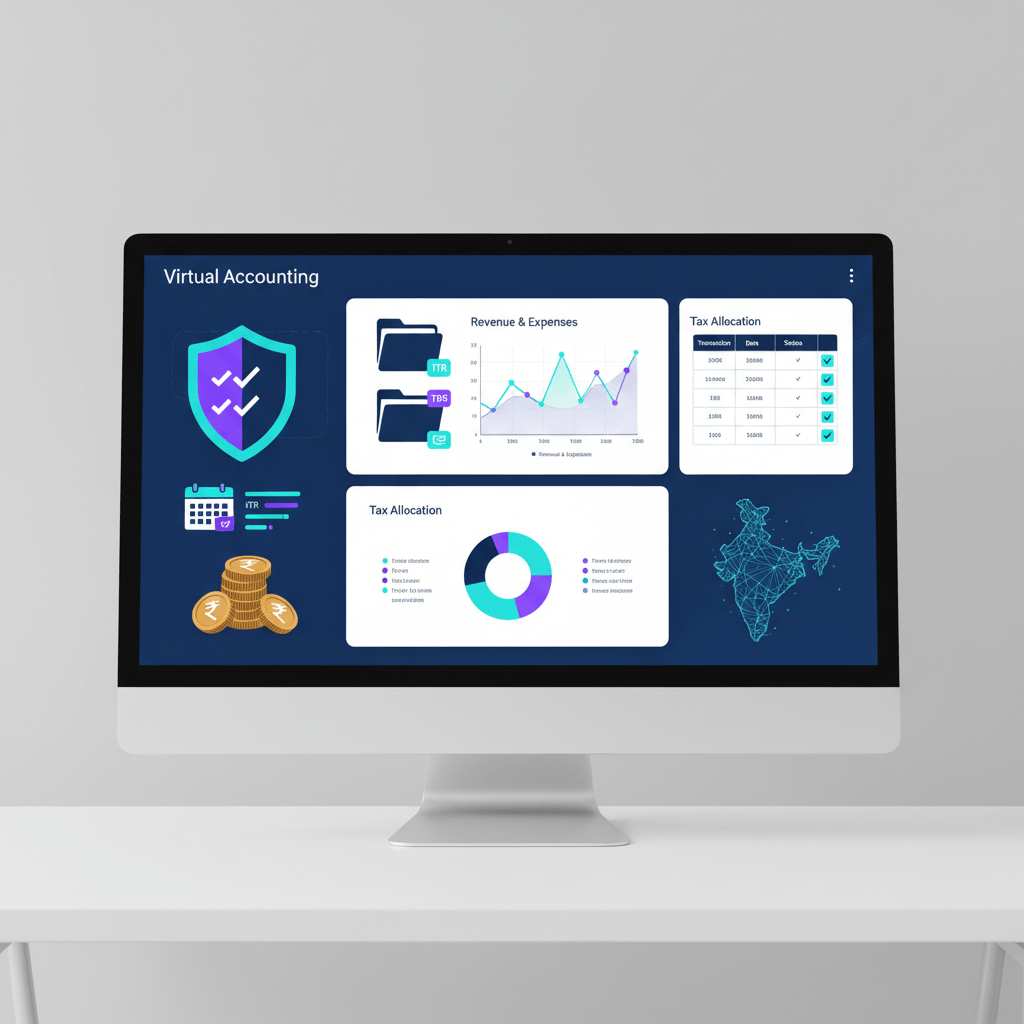
What the dashboard shows
- Live financial overview, revenue, expenses, profit or loss, and balances.
- Income and expense breakdowns with trends.
- Cash flow, burn rate, and runway tracking.
- AI generated insights and alerts on anomalies or deadlines.
- Recent transactions with bank statement analysis.
- Document repository for invoices, challans, and working files.
- Compliance calendar with due dates and filing status.
- Chat window to talk to your CA team and track requests.
What the CA team delivers
- Accounting and bookkeeping: monthly books, ledger scrutiny and clean up, year end close and schedules, fixed asset register, inventory records and reconciliations, AR and AP management, bank and payment gateway reconciliations, cash flow prep, MIS and management reporting, coordination with statutory auditor.
- Taxation compliance: GST registration, GSTR 1 and GSTR 3B monthly or quarterly, annual GSTR 9 and GSTR 9C, e invoice enablement, GST health checks with reconciliations.
- Income tax and TDS: ITR filing for individuals, partnerships, and companies, TDS advisory and compliance, monthly challan support, returns 26Q, 24Q, 27Q, property forms 26QB, 26QC, 26QD, advance tax calculations and payments, tax audit preparation, international tax, expat tax and salary structuring, 15CA preparation.
- Payroll: monthly payroll TDS, salary structure advisory.
- ROC and secretarial: MGT 7 and AOC 4, DIN and Director changes, DIR 3 KYC, authorised capital and allotment, Board meetings and minutes, AGM support, statutory registers, Board report, Annual report, event based MCA filings.
It replaces the usual chaos of email and spreadsheets with a disciplined service and one dashboard. For broader context on advisory, see this primer.
Practical playbooks and examples for financial advisory
Cash flow stabilization playbook
- Map inflows and outflows for the next 13 weeks, update weekly.
- Set collection cadences, invoice on time, send reminders at 3, 7, and 14 days past due, escalate with a human call.
- Negotiate vendor terms where volume supports it, target at least one extra week of credit from top vendors.
- Track DSO and payable days monthly, aim for steady improvement.
- Watch runway on the dashboard, lock hiring and big spends to runway thresholds.
GST and TDS health check playbook
- Reconcile GSTR 1 and GSTR 3B to books monthly.
- Match GSTR 2A or 2B with ITC in books to avoid mismatches, see guidance here: GST reconciliation for SMEs.
- Review TDS deducted and deposited by the seventh of each month.
- File quarterly TDS statements on time, fix any PAN or section issues quickly.
AR optimization playbook
- Define credit policy by customer segment, use limits and approvals.
- Automate invoicing and reminders, review top 20 overdue accounts weekly.
- Track DSO and dispute reasons, remove recurring blockers such as PO mismatches.
Inventory discipline playbook
- Reconcile channel sales reports with stock movement weekly.
- Validate cost of goods and landed cost assumptions monthly.
- Close the month with accurate COGS and shrinkage analysis by day seven.
Fundraising readiness playbook
- Prepare a clean MIS pack, P and L by category, balance sheet, and cash flow.
- Complete reconciliations, bank, gateways, AR, AP, and inventory.
- Bring GST, TDS, ITR, and ROC filings up to date, keep challans and acknowledgments in the data room.
Mini case examples
- A startup cut GST penalties by eighty percent after monthly reconciliations and proactive mismatch fixes.
- An e commerce brand reduced month close time from day thirty to day seven with a live dashboard and clear month end checklists.
Further reading: 360 Financial on advisors, Small Business Expo, and FSA.
ROI and outcomes of financial advisory
- Fewer penalties and interest due to timely GST and TDS compliance.
- Faster month close, from day thirty to day seven is common.
- DSO reductions of fifteen to twenty five percent as AR discipline improves.
- Clear runway visibility, fewer cash surprises.
- Quicker decisions based on current MIS rather than stale reports.
- Better audit readiness and smoother diligence.
- Time back for founders and finance leaders.
Consistency compounds, investors read discipline in clean books and on time compliance. See outcomes summarized by 360 Financial, Small Business Expo, and Arrowroot Family Office.
Implementation steps and timeline for financial advisory
Week 1 onboarding
- Share company details, PAN, and GST credentials where needed.
- Provide access to bank statements, payment gateways, and accounting files.
- Upload historic documents, agree on scope and SLAs.
- Begin ledger clean up and reconciliation catch up.
First 30 days
- Baseline the books for the current year to date.
- Set a compliance snapshot, identify gaps and due dates.
- Switch on the dashboard with live data and a first MIS pack.
- Deliver quick wins, AR reminders and GST mismatch fixes.
Days 60 to 90
- Stabilize monthly MIS cadence with category level P and L and cash flow.
- Finalize a tax calendar for GST, TDS, advance tax, and ITR.
- Lock SLAs for close, reporting, and responses.
- Document internal processes and handoffs.
Ongoing
- Monthly bookkeeping, compliance filings, and reconciliations.
- Quarterly reviews on runway, margins, and risks.
- Year end close with schedules and audit preparation.
Helpful overviews: FSA, Small Business Expo, and 360 Financial.
Compliance calendar overview for small businesses
GST
- GSTR 1 monthly or quarterly based on scheme.
- GSTR 3B by the twentieth of the following month.
- Annual GSTR 9 and GSTR 9C by December.
TDS
- Deposit TDS by the seventh of the following month.
- File quarterly statements by 31 July, 31 October, 31 January, and 31 May.
Advance tax
- Pay on 15 June, 15 September, 15 December, and 15 March.
Income tax returns
- ITR for non audit cases by 31 July.
- ITR for audit cases by 31 October.
ROC and MCA for small companies
- Annual filings generally due by 30 October along with other MCA forms as applicable.
Keep a dashboard view of dates, challans, and acknowledgments, it reduces anxiety and last minute rush. Reference calendars at 360 Financial, FSA, and Arrowroot Family Office.
How to choose the right partner for financial advisory
Use this simple checklist, based on best practices and this online CA services guide:
- CA led team with a proven virtual model and a central dashboard, ask to see it live.
- Full scope across accounting, GST, TDS, income tax, and ROC, one team end to end.
- Clear SLAs, roles, and turnaround times.
- Secure document storage and role based access controls.
- Centralized communication, no scattered chats and emails.
- Non attest clarity, they prepare and support, they do not certify audits.
- Strong references from similar stage companies.
A partner like AI Accountant checks these boxes and brings execution plus visibility in one service.
Closing thoughts and next steps
Financial advisory for small businesses brings order, speed, and insight. It connects clean books, strong compliance, and practical planning. With a CA led virtual accounting model and a live dashboard, you can see your money, fix leaks, and plan growth with confidence.
If you want to see how this looks in action, book a short demo with AI Accountant. We can walk you through the dashboard, share an MIS sample, and run a free GST and TDS health check so you know where you stand today.
FAQ
How is financial advisory different from bookkeeping if my ledgers are already updated monthly
Bookkeeping records what happened, advisory turns that data into budgets, cash flow plans, pricing decisions, and risk controls. For example, an AI enabled Virtual Accounting service like AI Accountant layers a dashboard and CA insights on top of clean books to drive action, collections, runway, and tax positioning.
As a founder, what is the minimum viable finance stack to start, and when should I add advisory
Start with accurate bookkeeping, GST and TDS compliance, and basic MIS. Add advisory when reconciliations become complex, when you manage multiple channels or GST registrations, or when close slips beyond day seven. A CA led virtual model can be added quickly, with a 30 to 90 day stabilization window.
For a finance head, what SLAs should I demand from a virtual advisory partner
Define SLAs for month close timeline, reconciliation completion, MIS delivery date, query response time, and compliance filings. In an AI Accountant style engagement, targets often include day seven close, monthly MIS by day ten, and next business day responses on critical items.
Can AI Accountant handle multi entity structures with intercompany reconciliations and consolidated MIS
Yes, AI enabled virtual advisory can manage entity wise books, intercompany cross checks, eliminations, and consolidated MIS, plus tax planning across entities, while keeping GST and TDS compliance synchronized.
We got GST notices for mismatched ITC, how does advisory reduce this risk going forward
Advisory implements monthly reconciliations between books, GSTR 1 and 3B, and GSTR 2A or 2B, flags mismatches early, and coordinates corrections before filing. With AI Accountant, the dashboard alerts on anomalies, deadlines, and open reconciliations to prevent penalties.
What does a robust AR governance framework look like for B2B collections
It includes customer wise credit limits, documented POs, invoice on dispatch rules, automated reminders at 3, 7, and 14 days past due, weekly review of top overdue accounts, and escalation paths. Advisory teams also review DSO trends and remove recurring blockers such as GRN or price mismatches.
How does a virtual CA team coordinate with our statutory auditor without causing duplication
The non attest advisory team prepares schedules, trial balance tie outs, ledger extracts, and supporting reconciliations, then hands them to the auditor in a clean data room. AI Accountant coordinates timelines and open points, while the auditor independently verifies and certifies.
What KPIs should I track on the finance dashboard weekly
Cash balance, collections vs target, DSO and top overdue, payable days and upcoming dues, gross margin by category, burn and runway, GST and TDS calendar status, and unresolved reconciliations. AI based anomaly checks add early warnings on outliers.
How do you price virtual accounting and advisory without surprise add ons
Scope driven pricing is best, with clear inclusions, monthly bookkeeping, reconciliations, MIS, GST, TDS, ITR, and ROC, plus a rate card for out of scope tasks. AI Accountant typically fixes a monthly fee for the base scope, with transparent add ons only when scope changes.
We plan a fundraise in the next quarter, what should be ready for diligence
Month wise MIS with category P and L, balance sheet, and cash flow, completed reconciliations for bank, gateways, AR, AP, and inventory, current GST, TDS, ITR, and ROC filings with challans and acknowledgments, and a documented month end close checklist. Advisory teams build this in the first 60 to 90 days.
Is advisory relevant if we already have an internal accountant on payroll
Yes, a CA led advisory layer upgrades process discipline, adds checks and dashboards, and covers complex tax or ROC events. Your internal accountant executes day to day entries, while the advisory team supervises close, reconciliations, filings, and analytics.
What security controls should I insist on when sharing financial data with a virtual partner
Encrypted storage, access controls, audit logs, least privilege for users, and a centralized repository rather than email attachments. AI Accountant style setups use a document vault and role based access to keep data both accessible and safe.
Can advisory help with pricing decisions for new products or channels
Yes, by modeling unit economics, landed cost, contribution margin, and channel fees, then testing scenarios and break even volumes. MIS by product and channel, along with cohort analysis, informs where to double down and where to trim.
What is the typical timeline to move from scattered spreadsheets to a stable monthly MIS
Week 1 onboarding to gather access and documents, 30 days to baseline books and flip on the dashboard, 60 to 90 days to stabilize category level MIS, cash flow, and a tax calendar. After that, cadence and continuous improvement take over.