-01%201.svg)
Key takeaways
- Online CA services let you find a CA online and run accounting, GST, TDS, ITR, payroll, and ROC filings from a single dashboard, no office visits needed.
- The model covers non attest work such as bookkeeping, reconciliations, and compliance filings, while a separate auditor handles statutory certifications.
- A predictable monthly cadence with reconciliations, MIS, and on time filings cuts penalties and gives you clearer data for decisions.
- AI driven alerts, bank analysis, and audit trails reduce manual errors and speed up month end closes to under five working days.
- Freelancers, startups, and SMEs benefit most because they get CA expertise without building a large in house finance team.
- If your team spends hours on manual GST matching or vendor bill entry, automated GST reconciliation can free up that time and reduce mismatches before every filing cycle.
Online CA services: what's new in 2026
Until March 2025, GST e invoicing applied to businesses with turnover above ₹5 crore. From April 2025, CBIC lowered the threshold to ₹1 crore, as outlined in CBIC Notification No. 08/2025. This pulled lakhs of additional small businesses into the e invoicing net. If you run an SME on Tally and have never generated an IRN, this now applies to you.
The operational shift is real. Every B2B invoice must now be pushed to the Invoice Registration Portal before sharing with the buyer. Your online CA service needs to validate HSN codes, GSTIN details, and tax rates at the point of invoice creation, not during the monthly filing cycle. Late or incorrect IRN generation can block ITC for your buyer and attract penalties under Section 122 of the CGST Act.
Separately, the Income Tax Department's updated e filing portal now requires Aadhaar based OTP for ITR verification in more categories. This affects individuals, firms, and small companies filing through online CA services. If your Aadhaar is not linked to your PAN, your return stays unverified and processing stalls, as confirmed in the Income Tax e filing portal guidelines.
What to do now:
- Confirm your e invoicing setup is live and tested if turnover crossed ₹1 crore in FY 2024 to 2025.
- Verify Aadhaar PAN linkage for all directors and partners before the next ITR due date.
- Ask your online CA service to run a GST health check covering e invoicing compliance, 2A/2B reconciliation, and RCM entries for Q1 FY 2026 to 2027.
Platforms that handle automated bookkeeping and transaction matching are especially useful here, since the volume of invoice level validations has jumped significantly with the lower threshold.
Introduction to online CA services
Online CA services make accounting and tax easy to run from your laptop. A Chartered Accountant team manages your books, GST, TDS, income tax, payroll, and company filings. You get a clear dashboard with live numbers and alerts. No office visits, no messy email threads.
This model fits freelancers, startups, and small businesses that want strong compliance with less effort. Whether you want to find a CA online for a single ITR filing or need a full year managed service, the approach stays the same: digital delivery, one dashboard, and a fixed monthly rhythm.
What are online CA services
Online CA services bring Chartered Accountant expertise to you through the internet. These are professional services focused on non attest work, meaning ongoing accounting, tax filings, and compliance, while statutory audits are performed by a separate auditor.
The CA services list typically includes:
- Monthly bookkeeping, ledger clean up, and year end close
- GST registration and filings such as GSTR 1 and GSTR 3B, plus annual forms like GSTR 9 and GSTR 9C support
- TDS returns such as 24Q, 26Q, and 27Q
- Income tax returns for individuals, firms, and companies
- Payroll and tax efficient salary structures
- ROC and MCA filings such as MGT 7, AOC 4, DIR 3KYC, and MSME filings for small companies
Delivery is digital from end to end. You use secure portals and a dashboard, you sign with valid e signatures under the IT Act, and bank feeds plus payment gateway integrations speed up reconciliations.
Ticketing and chat keep questions in one place. The dashboard shows live updates so you do not need to visit a CA office to know your status.
The result is smoother operations and fewer errors. The CA team runs the engine while you see progress in real time.
For background on the regulatory framework governing CA services, refer to ICAI's ethical standards and guidelines.
How online CA services work: the delivery model
Delivery starts with onboarding. The CA team completes KYC checks, sets up your chart of accounts, migrates past data, and prepares a compliance calendar for GST, TDS, income tax, and ROC.
Each month follows a simple cadence:
- Post sales, purchases, and expenses (ledger entries and transaction categorization)
- Reconcile banks and payment gateways
- Review ledgers and fix issues
- Run MIS and share insights
- File GST and TDS on time
You collaborate through the dashboard chat to keep context in one place.
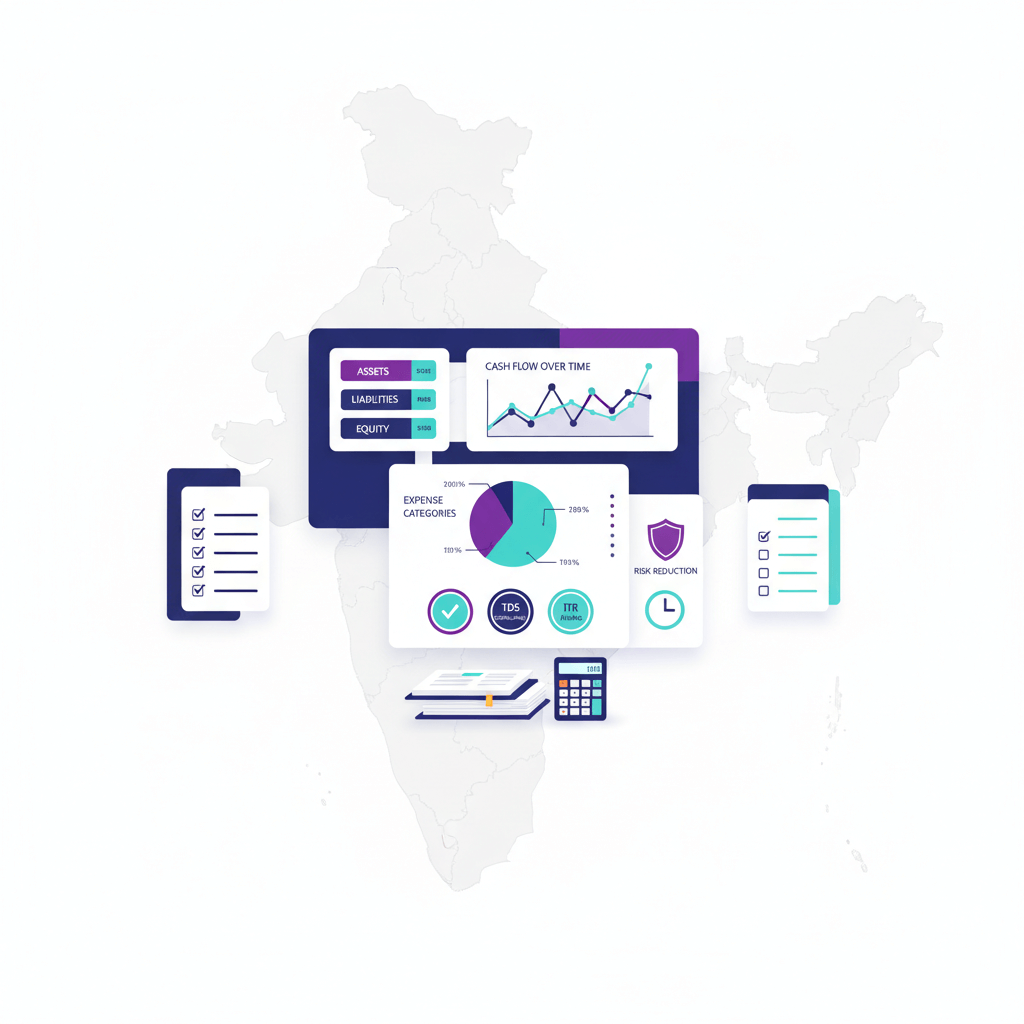
You see live numbers on a role based dashboard, including revenue, expenses, profit and loss, cash flow, burn rate, runway, filing status, and alerts. Monthly closes and quarterly reviews keep things on track.
At year end, the team prepares schedules and supports the statutory auditor. Many providers add AI driven bank analysis and insight cards to flag risks early.
Benefits of online CA services for your business
Online CA services give you CA led expertise without hiring a full team. You get clear financials and live insights that help you steer the company.
- Compliance assurance. Returns are filed on time across GST, TDS, ITR, and ROC. Health checks catch issues early so you avoid penalties.
- Cost efficiency. Digital delivery reduces overheads. Plans scale with your size and needs.
- Centralized system. One dashboard holds documents, chats, and due dates. It ends WhatsApp and Excel chaos.
- AI insights. Smart alerts and bank analysis highlight risks and savings. You get tax planning ideas, not just forms.
- Time savings. Less back and forth, fewer errors, and faster closes. Support is available by chat or email.
- Security and trust. Encryption, role based access, and audit trails meet the standards expected by Indian government portals and best practices.
Who should use online CA services
- Freelancers and consultants. You need ITR and TDS support, maybe simple payroll, and clean books that let you focus on work.
- Startups, SaaS, e commerce, and D2C brands. You handle many small transactions, GST and e invoicing rules apply, reconciliations and monthly MIS are essential.
- SMEs and lean finance teams. You want CA oversight across bookkeeping, GST and TDS, and ROC, with dashboards and reports instead of a large in house team.
If you operate across cities or run a distributed team, online delivery is a perfect fit. It removes travel time and keeps data in one place. People who want to find a CA online often start here because the model removes geography as a constraint.
Services checklist for online CA service providers
Accounting and bookkeeping
- Monthly entries for sales, purchases, and expenses
- Ledger scrutiny and clean up
- Bank and payment gateway reconciliations
- Fixed asset register and inventory records
- Accounts receivable and payable management (vendor invoice tracking)
- Cash flow preparation and MIS reporting
- Year end close and schedules
- Support for the statutory auditor during audit
GST
- Registration and advisory
- GSTR 1 and 3B filings on schedule
- Annual GSTR 9 and GSTR 9C support
- Place of supply, RCM, HSN, and tax rate guidance
- E invoicing enablement and controls
- GST health checks with 2A and 2B reconciliations
Income tax and TDS
- ITR filing for individuals, firms, and companies
- Advance tax calculations and payments
- TDS advisory and monthly challan support
- TDS returns such as 24Q, 26Q, 27Q, and property TDS like 26QB, 26QC, 26QD
- Form 15CA preparation and international or expat advisory
- Tax audit preparation support
Payroll
- Monthly TDS calculations for payroll
- Advice on tax efficient salary structures
ROC and MCA for small companies
- MGT 7 and AOC 4 filing
- DIR 3KYC and DIN changes
- MSME filings for vendors in MCA
- Statutory registers and board support for small companies
Platform and insights
- Compliance calendar and due date alerts
- Document repository with version history
- AI based insights and bank analysis
When evaluating any online CA service, cross check the list above against the provider's scope document. A complete CA services list should cover at least bookkeeping, GST, TDS, and ROC as minimum inclusions.
Online CA services vs traditional CA vs DIY
- Online CA services. A managed cadence with a dashboard and regular closes. Real time visibility into money in and out with AI driven insights on cash flow and compliance.
- Traditional CA. Periodic visits and calls, email and Excel flow. Often less real time data and slower issue spotting.
- DIY. Low cost on paper, high risk of penalties and missed deadlines. Heavy time drain and a steep learning curve.
Simple rule: the online CA team runs the monthly engine and filings, the statutory auditor certifies at year end.
If you are evaluating whether to find a CA online versus stick with a local practitioner, the deciding factor is usually how much real time visibility you need. Online models give you dashboards and fixed close dates. Traditional models give you a personal relationship but often slower data flow.
Security and data protection in online CA services
Security is a core part of online delivery. Leading providers use encryption for data at rest and in transit, role based access so only the right people see sensitive items, and audit trails that show who did what and when.
Your data ownership matters. You should retain full ownership of your books and documents. On exit, data should be portable and sharable.
Good providers align with the controls used by the GSTN portal and Income Tax portals. They follow internal policies for backups, retention, and breach response.
Ask for a short security note during evaluation. Look for encryption, access control, logging, onboarding controls, and a defined exit process for access rights.
Pricing models for online CA services
Pricing is usually a monthly subscription or retainer. Fees are linked to transaction volume, number of entities, number of GST registrations, payroll headcount, and filing scope.
Inclusions
- Monthly bookkeeping and reconciliations
- GST and TDS filings
- MIS reports and monthly close
- A response time agreement such as replies within one business day
Exclusions
- One time clean ups if your books need heavy fixes
- Statutory audit certification
- Complex investigations beyond agreed scope
Insist on a transparent scope of work with a change request process so cost control stays tight.
How to choose the right online CA services provider: evaluation criteria
Provider credentials and fit
- A CA led team with experience in your industry
- Testimonials or references you can verify
Service breadth and depth
- Coverage that matches the checklist across accounting, GST, TDS, ITR, payroll, and ROC
- Clarity on non attest boundaries and support for statutory audit preparation
Dashboard strength
- Real time financials and compliance status
- AI insights and banking or gateway integrations such as Razorpay
- Clean document repository and communication center
Operations and governance
- SLAs for response and filing timelines
- Security posture with encryption and audit trails
- Clear onboarding and exit plans with data portability
- Pan India filings and e sign support
Use this checklist when you review providers. If you are trying to find a CA online for the first time, start with dashboard strength and SLAs, those two factors usually separate strong providers from average ones.
Onboarding checklist and first 60 to 90 days plan for online CA services
- KYC and access: share KYC, portal credentials, and authority letters.
- Chart of accounts: standardize names and codes so reports are clean.
- Historical data: migrate and clean past months, fix gaps and mismatches.
- Bank feeds: connect banks and gateways, set daily reconciliation rules.
- Compliance calendar: map GST, TDS, ITR, and ROC due dates with owners.
- E invoicing: enable if you cross the ₹1 crore limit or must comply by sector.
- MIS and KPIs: decide core metrics and the report format.
- First close: run the first monthly close and hold a review call with actions.
Repeat a simple monthly cadence from there, and keep a shared action tracker inside the dashboard.
KPIs to track with online CA services
- Close time. Aim to close each month in under five working days.
- Filing timeliness. Target one hundred percent on time filings.
- Accounts receivable days. Watch collection speed and trend lines.
- Cash runway. Track burn rate and months of cash in hand.
- Error rates. Measure the number of corrections after close.
- SLA adherence. Check response times and turnaround for tickets.
Review these KPIs in your monthly call. If a number drifts, agree on a fix and log it in the plan.
Common pitfalls in online CA services and how to avoid them
- Delayed documents. Set a checklist and a date each month for sharing data.
- GST mismatches. Reconcile GSTR 2A and 2B every month to avoid surprises.
- TDS lapses. Use automated reminders for challans and returns.
- Scope creep. Agree to a clear scope and use change controls for new asks.
- Fragmentation. Avoid switching between email and chats and drives. Keep all work in one dashboard.
Small habits like weekly status notes and a single source of truth go a long way.
Pro tip: ask for a one page RACI for who sends what by when.
Tool stack to support online CA services
The right tools make online accounting smoother. Here are trusted options you can explore with your CA team.
- AI Accountant, aiaccountant.com
- QuickBooks Online, quickbooks.intuit.com
- Xero, xero.com
- Zoho Books, zoho.com/books
- TallyPrime, tallysolutions.com
- FreshBooks, freshbooks.com
Pick one core system and keep the process simple. Then use your CA team's guidance to set up bank feeds, invoice rules, and approval flows that match your business.
Where AI Accountant's Virtual Accounting fits in online CA services
AI Accountant's Virtual Accounting gives you a CA led managed service with a live dashboard. You get end to end execution for accounting and compliance, along with visibility that helps you act faster.
What you can expect
- Dashboard visibility. See revenue, expenses, profit and loss, cash flow, burn rate, runway, recent transactions, and compliance status.
- Managed bookkeeping. Monthly entries, ledger review, bank and gateway reconciliations, fixed assets, inventory, AR and AP, and MIS reports.
- GST and TDS coverage. Registration, GSTR 1 and 3B, annual GSTR 9 support, RCM and HSN advice, e invoicing, TDS challans and returns such as 24Q and 26Q.
- Income tax. ITR filing, advance tax, tax audit preparation support, international and expat advisory, and Form 15CA preparation.
- Payroll and ROC for small companies. Payroll TDS, salary structure advice, and ROC filings such as MGT 7, AOC 4, and DIR 3KYC, plus board support and registers.
- AI insights. Bank statement analysis, alerts, and insight cards to spot issues and save time.
- Document hub and team chat. Store bills and returns safely, collaborate with the CA team in one place.
Who it fits
- Freelancers and consultants who want clean books and on time filings.
- Startups and growth firms that need strong reconciliations and MIS.
- Founders and lean finance teams who want CA oversight without a large in house team.
How to start
- Book a short discovery call to confirm scope.
- Onboard in about two weeks with data migration and a clean first close.
- Review your first month deliverables and agree on KPIs for the next quarter.
You can explore the full platform at AI Accountant.
Wrapping up online CA services for modern teams
Online CA services give you a steady rhythm for accounting and compliance. You get a CA led team, a live dashboard, and AI backed insights that help you file on time, cut errors, and make better calls with your money.
If you are a founder, a freelancer, or an ops lead, this model can free up your week. AI Accountant's Virtual Accounting follows this approach, and it can be a strong option if you want one partner to handle the work with a clean dashboard that shows everything you need.
FAQ
How do I decide between an online CA service and a traditional CA for monthly accounting
Use the visibility test: if you want real time dashboards, a fixed monthly close, and on time filings without chasing updates, online CA services provide that structure. Traditional setups work if you prefer in person meetings and manual workflows. AI Accountant, as an AI enabled Virtual Accounting service, follows the managed cadence approach with a dashboard first model.
What should a founder include in the scope to avoid hidden costs
Define transaction volume bands, entity count, GST states, payroll headcount, and filing scope upfront. List inclusions such as monthly bookkeeping, reconciliations, GST and TDS filings, MIS, and response SLAs. List exclusions like one time clean ups and statutory audit certification. Ask for a change control process so new requests do not inflate fees without approval.
Will an online CA service handle statutory audits or certificates required by banks or investors
No, statutory audits and attestations are handled by a separate auditor. Your online CA team prepares books, schedules, and audit support packs, which reduces audit time and queries. This separation keeps controls strong and roles clear.
How does an AI enabled service like AI Accountant reduce close time
AI augments reconciliations, flags duplicates and anomalies, and prioritizes exceptions so the team closes faster. Insight cards highlight variances in revenue, vendor spend, or payroll. The result is fewer back and forth loops and a month end close that targets under five working days.
Where can I find a CA online who handles GST, TDS, and ROC together
Most online CA service providers offer bundled plans covering GST filings, TDS returns, ITR, and ROC compliance as part of a single monthly engagement. Check the provider's CA services list and confirm that GSTR 1, 3B, TDS challans (24Q, 26Q), and ROC forms like MGT 7 and AOC 4 are explicitly included. Ask for a sample scope document before signing.
Can online CA services integrate with Tally, QuickBooks, or Xero we already use
Yes, most providers adapt to your core ledger system. Bank feeds, payment gateway integrations such as Razorpay, and document capture can be configured in Tally, QuickBooks, or Xero. The important part is a disciplined month close checklist and clear ownership of each step.
How do we handle mid year transitions without breaking compliance
Run a structured handover: freeze cut off dates, migrate opening balances with supporting schedules, reconcile GST and TDS to date, and map pending filings. E invoicing compliance must be verified at the handover point since the threshold dropped to ₹1 crore from April 2025 (2026 update). A well defined transition playbook keeps continuity, and most providers complete onboarding with a clean first close in about two weeks.