-01%201.svg)
Key takeaways
- Monthly bookkeeping services create a repeatable rhythm, record every transaction correctly, reconcile to source data, and close the month on time.
- Automation provides speed for imports, categorization, and anomaly detection, while a CA team ensures judgement, compliance, and accuracy.
- Cloud dashboards provide real time visibility, secure document storage, and collaboration across founders, finance, and your CA.
- Outsourcing is often more cost effective and scalable than hiring early, with stronger process continuity and controls.
- A disciplined monthly close checklist reduces error rates, keeps GST and TDS filings predictable, and prevents year end pile ups.
- Accounting builds on bookkeeping with MIS, cash planning, KPI tracking, and advisory so leaders can decide faster.
- A CA led partner like AI Accountant blends automation with expert review, giving you clarity, compliance, and speed without email chaos.
What monthly bookkeeping services include
Monthly bookkeeping services are an operating rhythm for your finances. The goal is simple, record every transaction correctly, reconcile to source data, close the month on time, and produce reports that leaders actually use.
- Recording sales, purchases, and expenses with the right categories
- Reconciling bank accounts and payment gateways so your ledger matches statements
- Managing accounts receivable and accounts payable with follow ups and aging views
- Updating fixed asset registers and inventory with additions, disposals, and reconciliation
- Scrutinizing ledgers for misposts or duplicates and completing the month end close
- Preparing MIS such as profit and loss, balance sheet, cash flow statements that are non certified, schedules, variance analysis, burn rate, and runway
- Sharing monthly review notes and raising alerts on discrepancies or cash gaps
Why it matters: you avoid year end clean ups, you stay investor ready, you meet GST and TDS timelines, and you get a single source of truth for decisions. For context and further reading, see examples and discussions at this overview and these benefits.
Clean books, closed on time, build trust in every other number you share with your team and investors.
A modern provider such as AI Accountant uses a CA led team and a central dashboard so you do not chase spreadsheets or messages. Monthly review calls and live dashboards keep you updated without email chaos. See automation examples at AI Accountant insights.
Automated bookkeeping services and human review
Automated bookkeeping services use technology for repeatable work, while a CA team handles judgement and compliance. Think of the system doing the heavy lifting, and experts guiding outcomes.
What automation can do well
- Bring in bank feeds and payment gateway data automatically
- Use OCR to read bills and invoices
- Apply rules to categorize expenses and revenue
- Detect duplicates and common anomalies
- Match GST details and flag mismatches
- Generate insights on trends and outliers
Where human oversight matters
- Choosing the right treatment for edge cases and year end adjustments
- Interpreting GST place of supply and reverse charge scenarios
- Handling accruals, prepayments, and depreciation policies
- Final checks for accuracy before close and filings
The result: fewer errors and faster cycle time. You get speed from automation and correctness from CA validation. Cross check with perspectives at this comparison and this explainer.
AI Accountant operationalizes this model with automated ingestion plus CA review, so month end feels calm and predictable.
Cloud bookkeeping services for real time visibility
Cloud bookkeeping services give you anytime access and a single source of truth. Your team, your CA, and your founders can see the same data without versions or attachments.
- Access from any device with role based permissions
- Secure document storage with audit trails and encryption
- Integrations with banks, gateways, and e invoice systems
- Live dashboards for cash flow trends, category breakdowns, and compliance status
A cloud dashboard also supports GSTN and MCA work without local installs. You can review transactions, approve entries, upload documents, and track filings in one place. Explore options like AI Accountant here, and compare approaches in this guide.
Tip: choose tools that integrate cleanly with your banks and gateways, and that your CA team already knows well, so you reduce manual exports and place documents alongside transactions.
Bookkeeping outsourcing solutions versus in house
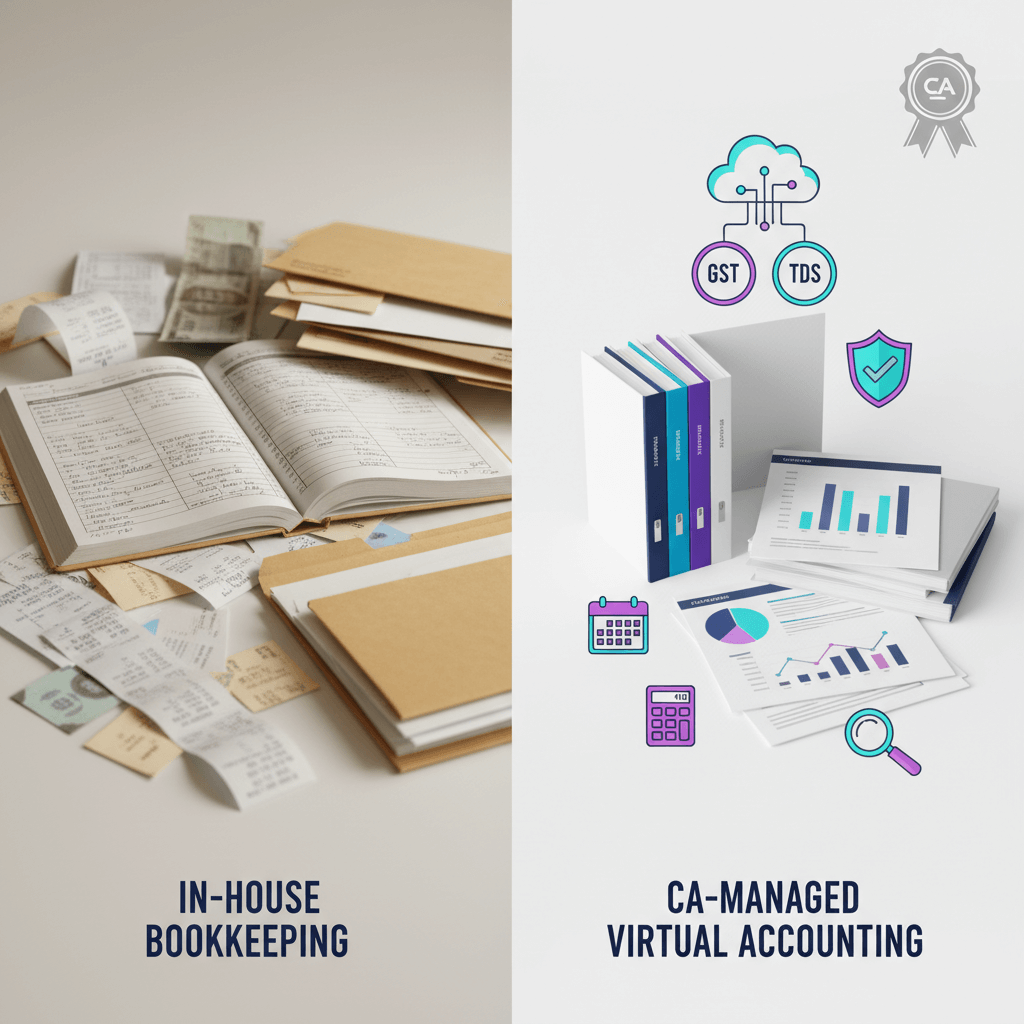
Outsourcing is often more cost effective and scalable than hiring early, since you pay for a managed service with clear scope rather than a payroll line plus tools and training. See a managed services explainer at this article.
Cost view
- Outsourced monthly bookkeeping services often range from about 300 to 1500 dollars per month depending on volume, entities, and scope
- A full time bookkeeper or accountant can cost 35000 to 50000 dollars per year plus benefits and management time
Expertise and continuity
- An outsourced CA led team brings broader experience across GST, TDS, and industry tools
- Standard operating procedures reduce dependence on one person
- Downtime from turnover is less likely than with a single hire
Risks and controls
- Data security and confidentiality are critical
- Mitigate with SLAs, encryption, role based access, and a clean onboarding protocol
- Choose a partner with Indian compliance experience and a dashboard that logs activity
Compare viewpoints at this summary and this review.
AI Accountant replaces fragmented email or spreadsheet workflows with an integrated service and a CA desk that scales with your business.
Bookkeeping support for businesses that want clarity
Great bookkeeping support feels like a responsive finance desk, not a ticket black box. You want clear communication, defined response times, and proactive advice.
- A dedicated CA led team that knows your business
- A centralized dashboard for tickets, comments, and document exchange
- Monthly calls to review P and L, cash, AR and AP, and compliance status
- Answers on GST topics such as reverse charge, HSN rates, and place of supply
- TDS guidance on applicability, thresholds, and challan timelines
- Advisory on salary structuring to help employees save tax
- Coordination with statutory auditors for schedules and queries
See additional context at this breakdown.
Monthly close checklist that keeps you on time
A simple monthly close checklist turns month end into a routine rather than a scramble. Use this every month.
- Reconcile bank accounts and payment gateways to statements
- Reconcile accounts receivable and accounts payable aging to ledgers
- Reconcile GST ledgers and input credits with returns and vendor data
- Record accruals and prepayments with supporting schedules
- Update fixed assets for additions and depreciation and reconcile to the fixed asset register
- Reconcile inventory values and counts where applicable
- Review key performance indicators like gross margin, DSO, DPO, burn rate, runway, and budget versus actuals
- Prepare MIS reports such as P and L, balance sheet, and cash flow statements, then explain variances
- Review the compliance calendar for GST, TDS, and other filings for the next month
Practical references include this monthly reporting guide and this overview.
Compliance integration for GST, TDS, income tax, and ROC
Compliance integration is where monthly bookkeeping shines. Good books make filings smooth and help you avoid penalties.
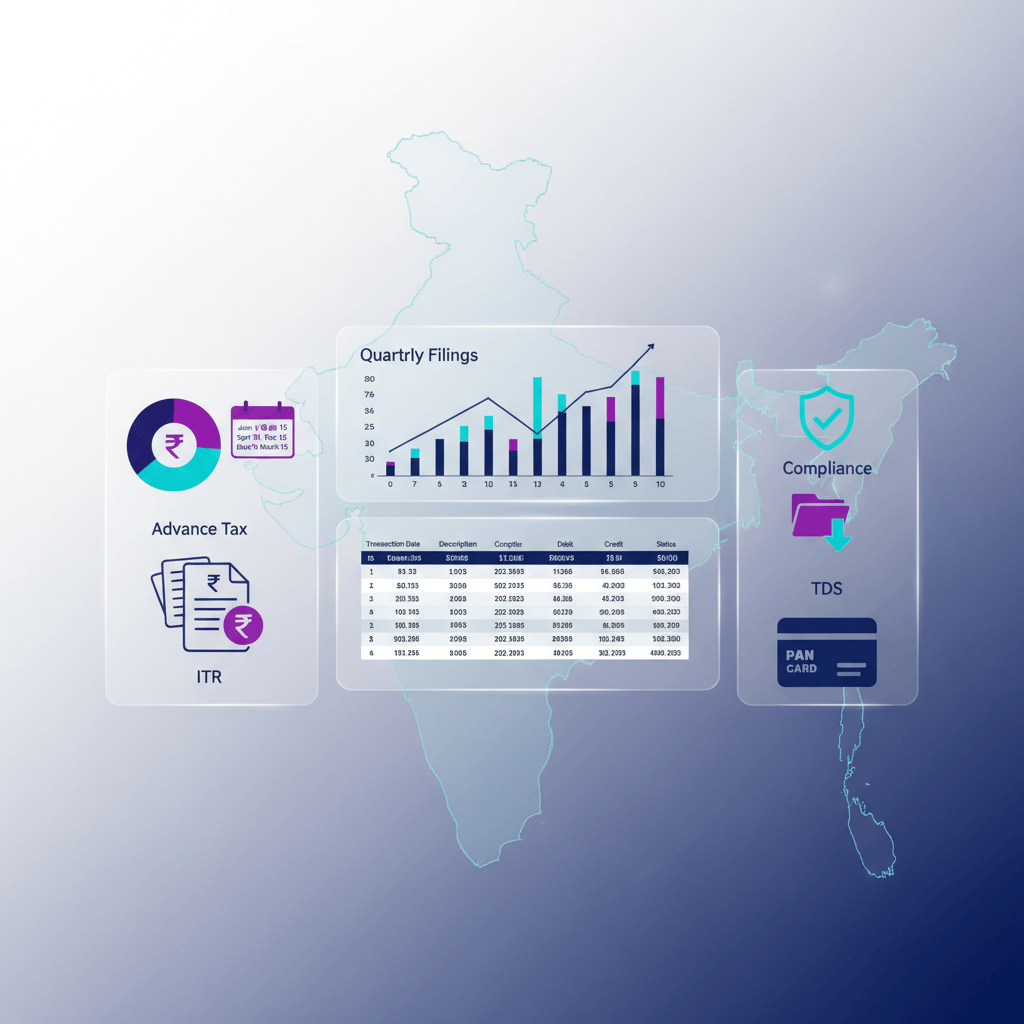
- GST: prepare GSTR 1 and GSTR 3B from reconciled sales and purchases, perform e invoice reconciliations, clear input credit mismatches, and plan data readiness for GSTR 9 and 9C
- TDS: track applicability, compute monthly challans, prepare returns such as 24Q and 26Q, and manage forms such as 27Q, 26QB, 26QC, and 26QD where relevant
- Income tax: keep books tax ready for ITR filing for individuals, firms, and companies, and prepare for tax audit support that is non attest
- ROC for small companies: keep financials and records ready for MGT 7, AOC 4, and related director and board compliance
A dashboard with a compliance calendar and status helps you see dates and prep work in one view. Compare notes in this walkthrough.
Monthly accounting services versus monthly bookkeeping services
Bookkeeping focuses on recording, reconciling, and closing. Accounting layers on analysis, planning, and advisory.
What bookkeeping covers
- Transaction capture
- Reconciliations
- Month end close with clean ledgers and schedules
What accounting adds
- MIS dashboards and board packs
- Cash flow planning and scenario analysis
- KPI tracking and variance explanations
- Advisory on tax strategy and process improvements
Most growing businesses benefit from an integrated approach, so the data stays clean while leaders get forward looking guidance. For a practical comparison, see this guide and this primer.
Onboarding and migration plan you can trust
A simple onboarding and migration plan keeps transition risk low, typically two to four weeks depending on volume and data quality.
- Discovery call and data gathering to understand your model, revenue streams, and tools
- Chart of accounts design and alignment across tools and the dashboard
- Catch up and clean up of historic months if needed, with opening balances set correctly
- Documentation of SOPs for monthly cycles, and go live testing with a parallel run
You will provide access to banks, gateways, GSTN, MCA, and existing ledgers. Your provider executes setup, clean up, and testing before a full switch. See a migration explainer at this resource.
Pricing models and ROI for monthly bookkeeping services
Pricing usually follows one or a mix of models, so you can match scope to complexity.
- Volume based, where pricing scales with transaction count or entities
- Package tiers, where you choose a plan by complexity and add ons such as payroll TDS
- Custom scope for multiple gateways, inventory, or international operations
Return on investment shows up in fewer errors and rework, faster closes, avoided penalties, and time saved for founders and finance teams. Track ROI by measuring transaction volume, number of entities, headcount supported, and cycle time reductions during the first two quarters. See benchmarks in this reference.
Security, confidentiality, and data governance in the cloud
Security and confidentiality are non negotiable. Cloud bookkeeping should meet high standards that protect sensitive data while staying usable.
- Role based access controls so people only see what they need
- Encryption in transit and at rest for data and documents
- Regular backups and clear retention policies
- Secure access to GST and MCA portals without sharing raw credentials
- Vendor practices such as ISO certifications, data localization compliance, and breach SLAs
Review considerations at this overview.
Trust is earned with consistent controls, clear logs, and quick responses when something looks off.
Use cases and scenarios across stages
Monthly bookkeeping services adapt to the stage of your business, while the dashboard and CA oversight keep you in control.
Freelancers and solo professionals
- Simple revenue and expense tracking
- Basic TDS and GST support if registered
- Quarterly check ins and annual summaries
Startups
- Real time view of burn and runway
- Investor ready MIS with P and L, balance sheet, and cash flow
- E invoicing integrated with sales tools
Growth stage companies
- Multiple gateway and multiple bank reconciliations
- Inventory and fixed assets maintained monthly
- Cadence for reporting to leadership and the board
See more examples in this summary and this guide.
How AI Accountant virtual accounting fits your monthly bookkeeping services needs
AI Accountant brings a CA led managed service that blends monthly bookkeeping, compliance, and advisory. The dashboard gives you live accounting data, a document repository, and a compliance timeline in one place.
- Monthly bookkeeping with reconciliations for banks and payment gateways
- Accounts receivable and accounts payable tracking and follow up
- Fixed assets and inventory updates each month
- MIS reports and AI insights for trends and anomalies
- GST filings such as GSTR 1 and GSTR 3B, annual GSTR 9, and reconciliations
- TDS advisory and returns such as 24Q and 26Q with challan tracking
- Income tax support for entities and partners, and tax audit preparation that is non attest
- Payroll TDS calculations and salary structuring advice
- ROC compliance for small companies where applicable
- Coordination with your statutory auditor for schedules and queries
The service is delivered by a dedicated CA team while the dashboard keeps you informed and in control. It replaces fragmented email and spreadsheets with a structured system. See related context at this resource.
Provider selection checklist for monthly bookkeeping services
Use this checklist to evaluate partners, then set expectations up front so the first quarter runs smoothly.
- Sector experience and tool familiarity, including your banks and gateways
- CA oversight for bookkeeping reviews and compliance interpretations
- Automation maturity for bank feeds, OCR, and reconciliation rules
- Dashboard usability for insights, alerts, and collaboration
- SLAs for response time and uptime, with security certifications and audits
- Migration support with a clear plan and sample reports for MIS and compliance
- Full compliance scope for GST, TDS, and income tax in India, with any ROC needs
- Strong references, plus the ability to share mock reports or a demo
For further reading, explore this checklist.
Putting it all together
Monthly bookkeeping services give you consistent financial order. Automation handles repeatable work, a CA team handles judgement and compliance, and a cloud dashboard brings it together so you can see both the big picture and the details.
If you want that steady rhythm without hiring early, a CA led partner such as AI Accountant can help. Book a short demo to see the dashboard, the workflow, and the MIS in action. Even if you do not choose a partner today, use the checklists above to tighten your month end starting this month.
FAQ
What exactly should close each month, and how soon can we close books reliably
A strong monthly close includes reconciled banks and gateways, AR and AP aging tied to ledgers, GST and TDS reconciliations, accruals and prepayments, fixed assets and depreciation, inventory where applicable, and MIS with variance notes. With clean inputs, a CA led team can close within five to seven business days, AI Accountant typically targets under seven days once steady state is reached.
Which parts can be automated, and which require a CA’s judgement
Automation can import statements, read invoices with OCR, apply rules for categorization, and flag duplicates or GST mismatches. A CA should set accounting policies, interpret GST place of supply and reverse charge, post year end adjustments, and validate filings. AI Accountant uses automation for speed, with CA review for correctness.
How does AI Accountant differ from a freelance bookkeeper for monthly work
AI Accountant brings a team with CA oversight, documented SOPs, a dashboard for workflows, and compliance coverage for GST, TDS, income tax, and ROC. A freelancer may be excellent, however single person capacity and continuity can be constraints. The managed model reduces key person risk, and provides scale for spikes in volume.
Can we switch providers mid year without losing GST ITC, and how are opening balances handled
Yes. Export ledgers, trial balances, and GST data from your current system, clean the data, and run a parallel month to test. Opening balances are posted after reconciling banks, AR, AP, GST ledgers, and fixed assets. AI Accountant follows a two to four week migration plan with a controlled go live.
How do you handle multi entity and multi gateway reconciliations at scale
Set up separate ledgers and bank feeds per entity, standardize the chart of accounts, and map payment gateways to clearing accounts. Daily or weekly auto imports reduce backlog, and CA reviews finalize unmatched items before month end. AI Accountant’s dashboard surfaces unmatched reconciling items with alerts.
What is the typical cost for outsourced monthly bookkeeping versus hiring in house
Outsourced services often range from about 300 to 1500 dollars per month depending on volume, entities, and scope. A full time bookkeeper or accountant can cost 35000 to 50000 dollars per year plus benefits and management time. Outsourcing converts fixed cost to variable cost while adding CA oversight.
How are GST and TDS deadlines baked into monthly workflows so we avoid penalties
Use a compliance calendar that tracks due dates for GSTR 1, GSTR 3B, and TDS challans and returns. During the month, automation prepares drafts and reconciliations, then a CA team reviews and files on time. AI Accountant tracks status on the dashboard and raises alerts for gaps.
How are inventory, fixed assets, and WIP maintained month to month
Record purchases and disposals with documents, update the fixed asset register, run depreciation as per policy, and reconcile to counts or system reports. For inventory, reconcile valuation to ledgers and investigate variances. For WIP, maintain roll forward schedules. AI Accountant posts schedules and ties them to the trial balance.
What support should we expect during statutory audit, and what remains out of scope
The provider prepares schedules, confirmations, and reconciliations, explains movements, and coordinates data requests. Certification and attestation work remain with your statutory auditor. Clean monthly books reduce audit queries and shorten timelines.
What MIS and KPIs do founders and boards actually use each month
Standard MIS includes P and L, balance sheet, and cash flow, with variance notes. Useful KPIs include gross margin, burn rate, runway, DSO, DPO, and budget versus actuals. AI Accountant augments this with anomaly flags and trend insights on the dashboard.
How do you ensure data security, role based access, and audit trails in the cloud
Enforce least privilege access, encrypt data in transit and at rest, keep backups with defined retention, and log every critical action. Avoid shared raw credentials for GST and MCA portals. AI Accountant applies role based access and maintains activity logs for traceability.
What does onboarding look like, and how quickly will we see the first clean month
Onboarding covers discovery, chart of accounts alignment, data migration, and SOP documentation, followed by a parallel run. Expect two to four weeks to stabilize, then a five to seven business day close cadence. AI Accountant shares a migration plan, sample MIS, and weekly progress updates during transition.
How do we measure ROI from monthly bookkeeping in the first two quarters
Track cycle time to close, number of unreconciled items, penalty incidents avoided, rework hours, and founder time saved. Add leading indicators such as on time compliance filing rate and variance explanation coverage. AI Accountant provides a baseline and a quarterly ROI review.
Can AI Accountant work with Tally, QuickBooks Online, Zoho Books, and integrate with GSTN
Yes. The team supports common systems like Tally, QuickBooks Online, Xero, and Zoho Books, with connectors for banks and gateways where available, and workflows aligned to GSTN processes. The goal is minimal manual exports and a clean audit trail tied to documents.
Can payroll TDS and salary structuring be included with monthly bookkeeping
Yes. Many businesses bundle payroll TDS computation, challan tracking, and salary structuring advice to optimize employee taxes. AI Accountant includes payroll TDS in certain plans, with monthly reconciliations and year end Form 16 support in scope where applicable.