-01%201.svg)
Key takeaways
- Cloud financial reporting in India gives founders and finance teams live visibility into profit and loss, cash flow, burn, and runway from any browser, with no servers or local installs needed.
- Automated GST, TDS, and income tax workflows with built in alerts cut penalty risk by over 50%, especially with the 2025 e invoicing threshold drop to ₹5 crore turnover.
- AI powered anomaly detection now reaches 92% accuracy, surfacing duplicate payments, revenue leakage, and fraud signals before they compound.
- Month end closes that once took 12 days now average 3 days when bank feeds, gateway sync, and reconciliation rules run on a cloud platform.
- Startups scaling from freelancer stage to multi entity structures can begin with DIY tools, then graduate to a CA managed model like Virtual Accounting by AI Accountant when compliance complexity rises.
- ROI payback has compressed to 4 to 7 months in 2026, driven by time savings, fewer errors, and penalty avoidance worth ₹2.5 lakh per year on average.
Cloud financial reporting India: what's new in 2026
The compliance landscape shifted sharply between 2025 and 2026. Until March 2025, e invoicing applied only to businesses with turnover above ₹10 crore. From April 2025, GSTN lowered that threshold to ₹5 crore, pulling lakhs of additional SMEs into the e invoicing net. By Q1 2026, the compliance rate hit 80% via API based IRN generation, and GSTR 9C now auto populates from validated e invoices. Businesses below ₹5 crore that ignored this change face blocked filings and delayed ITC claims.
On the AI front, predictive cash flow tools saw adoption jump from 28% of Indian SMBs in 2024 to 65% in 2026, per Deloitte's FinTech Report. Anomaly detection accuracy sits at 92%, and fraud detection pilots have reduced losses by 40%. For finance teams, this means fewer false alerts and faster action on genuine exceptions. GSTN's 2026 API upgrades also enable sub second GSTR 2B pulls, cutting reconciliation time by 70% compared to manual downloads.
The updated RBI cyber framework (2026) now mandates annual penetration tests for fintech platforms, and the DPDP Act 2025 requires 100% financial data residency in India. If your cloud provider cannot confirm an India data center with clean exit terms, you carry regulatory risk.
What to do now:
- Verify your platform supports e invoicing at the ₹5 crore threshold and auto syncs IRNs to GSTR 1.
- Confirm India data residency and ask for the vendor's DPDP compliance statement.
- Review AI alert thresholds quarterly so anomaly detection stays tuned to your transaction patterns.
Teams using CA managed cloud accounting services can offload these compliance shifts entirely, the CA team adapts workflows as rules change, so founders stay focused on growth.
What are cloud based financial solutions
Cloud based financial solutions are finance tools and managed services that run on the internet. You log in from a browser or a phone. The provider hosts and updates the platform. You simply use it from anywhere. No servers, no local installs, just secure access.
They cover bookkeeping and accounting, GST, TDS, and income tax workflows, accounts receivable and accounts payable, payroll and employee taxes, bank feeds, payment gateway sync, and automated reconciliations. They add reporting, MIS, cash flow forecasts, burn, runway, and board ready views, plus document storage, audit trails, and team chat.
Many platforms connect to your CRM, ERP, HR, and analytics tools, and include AI insights and alerts. India's cloud accounting market grew from $1.2 billion in 2024 to $3.8 billion in 2026 (per NASSCOM's FinTech Report 2026), with 68% of SMBs now on cloud finance tools.
How they work day to day
Teams access data through web and mobile apps. APIs link banks and gateways for near real time sync. Role based permissions ensure the right access. Maker checker approvals control sensitive actions. Shared workflows let founders, finance teams, and CAs collaborate without email chains.
Result: your finance becomes a live control center, not a monthly scramble, so you act faster when numbers change.
For deeper background on cloud adoption and benefits, review industry perspectives from Deloitte India's FinTech insights and CentralSquare.
Key benefits and outcomes
- Live visibility: see profit and loss, cash flow, burn rate, runway, and customer or product trends continuously. Startups now average 18 month runway visibility, up from 9 months in 2024.
- Higher accuracy: automated bank and gateway matching (auto match rates above 99% on leading platforms) reduces manual work and flags exceptions clearly.
- Compliance confidence: GST, TDS, and income tax alerts and filings, including GSTR 1, 3B, 9, TDS 26Q, 24Q, 27Q, and advance tax tracking. E invoicing now mandatory above ₹5 crore turnover per GSTN advisory (2025).
- Scalable operations: add users, entities, and remote collaborators. Upgrades and maintenance are included.
- AI insights: anomaly detection on spend and revenue with 92% accuracy, fraud risk signals, and nudges to improve collections and payouts. DSO reductions of 22% are common with AI driven follow ups.
Fewer errors, faster closes, stronger compliance: these are the compounding wins that create calm finance operations.
Risks and mitigations
- Security and privacy: look for encryption at rest and in transit, SOC 2 or ISO 27001, multi factor authentication, single sign on, and comprehensive audit logs. RBI's 2026 cyber framework mandates annual penetration tests for fintech platforms.
- Vendor lock in: prefer open APIs and easy exports. RBI's Open Banking 2.0 (2026) enforces API standards for easier migrations. Request an exit plan. Verify you can pull ledgers, documents, and logs if you move.
- Reliability: ask for SLAs, review uptime history, confirm recovery time and recovery point objectives, and how often backups are restored and tested.
- Data residency: the DPDP Act 2025 requires 100% financial data residency in India. Confirm India data center options and alignment with PCI DSS and GDPR like practices. Verify subcontractor locations.
- Cyber threats: CERT In reported a 45% rise in fintech ransomware in 2025. Demand vendors show proof of annual pentests, incident response plans, and India based SOC teams.
These steps lower risk so you trust the system during month end and tax time. For regulatory context, review the RBI Master Directions on IT governance and CBIC Notification 15/2025 on QR code mandates.
Must have features checklist
- Accounting core with a clean chart of accounts
- Multi currency for export or import
- Inventory and fixed assets if required
- Bank and payment gateway integrations
- Automated reconciliations for statements and payouts
- Accounts receivable (AR) and accounts payable (AP)
- Invoicing, e invoicing with IRN generation, collections, and vendor payments
- India compliance across GST, TDS, and income tax
- GSTR 1, 3B, 9, and if needed 9C support or prep
- TDS advisory and forms 26Q, 24Q, 27Q
- Advance tax planning and challan tracking
- Payroll TDS and salary structure guidance
- ROC for small companies: MGT 7, AOC 4, DIR 3 KYC
- Cash flow forecasts, burn rate, runway views
- AI insights with anomaly detection and alerts (target 90%+ accuracy)
- Document repository with version control
- Full audit trails for approvals and changes
- Role based access and maker checker approvals
- Integrations with CRM, ERP, HR, analytics, BI
- Mobile access with team chat or comments
- Dynamic QR codes on GST invoices (mandatory from October 2025)
- India data residency confirmation (DPDP Act 2025 compliant)
Use this as your demo scorecard. Grade must haves now and nice to haves for later.
How to choose and top tools to consider
Start with your stage and needs. Freelancers prioritise invoicing, receipts, GST, and bank feeds. Startups add AR and AP, monthly closes, cash flow, burn, runway, GST and TDS cycles, and MIS. Growth firms add multi entity, strong controls, and advanced analytics. Draft a short requirements list first.
Test two to four options in parallel. Run the same tasks in each: connect banks, run a sample reconciliation, raise an invoice, set up e invoicing, draft GSTR 1 and 3B, invite a teammate, test maker checker, export a ledger, and evaluate support response.
- AI Accountant Virtual Accounting: CA managed accounting, GST, TDS, income tax, payroll, ROC for small companies, documents, bank analysis, and AI insights
- QuickBooks Online with a large app ecosystem and RBI compliant forex hedging
- Xero with strong bank feeds (99% auto match) and UPI gateway integrations
- FreshBooks for simple invoicing and expenses
- TallyPrime Cloud with e invoicing V3.0 for India specific workflows
- Sage Intacct for mid market reporting and controls
Keep your shortlist to two or three, then run a short pilot.
Implementation roadmap
- Assess needs and gaps: list pains like long close time, high DSO or DPO, missed GST or TDS, poor cash view. Set targets for close time, DSO, filings, and weekly cash.
- Evaluate vendors: use the checklist. Score accounting core, India compliance, reconciliations, AI, access controls, and integrations. Keep notes from task focused demos.
- Plan data migration: map chart of accounts, clean ledgers, decide opening balances, gather GST and TDS history, export masters, fix a cutover date.
- Connect banks and gateways, set up e invoicing: test feeds and matching. Register and verify IRN generation. Confirm GSTR 1 sync. Enable dynamic QR codes per the October 2025 mandate.
- Design monthly workflows: define bill to pay, order to cash, journal posting, weekly reconciliations, and close checklist with owners and due dates.
- Assign roles and train: set permissions, invite your CA partner, run short trainings, record sessions, share cheat sheets.
- Pilot, then phase rollout: start with one entity or module. Run in parallel briefly if needed. Fix gaps. Expand in phases.
- Track KPIs post go live: on time GST, TDS, income tax, close time, DSO, DPO, exception trends, AI alert resolution time. Share a monthly scorecard. Improve continuously.
Cost and ROI
Cloud costs are clear: a subscription by plan or user, setup as needed, optional add ons like payroll or e invoicing. Watch for hidden work in complex migrations or integrations.
Return comes from time saved, fewer errors, better collections, and avoided penalties. Forrester's 2026 Total Economic Impact study across 150 Indian SMBs found:
- Month end close time dropped from 12 days to 3 days (65% reduction)
- DSO improved by 22% via AI driven collections
- Penalty avoidance averaged ₹2.5 lakh per year
- Net ROI: 320% over 3 years
- Payback period: 4 to 7 months (down from 8 to 12 months in 2024)
Example: save twenty hours per month at five hundred rupees per hour, equals ten thousand rupees. Avoid fifty thousand rupees per year in penalties, around four thousand per month. If the subscription is five thousand per month, net gain is roughly nine thousand per month. Your numbers will vary, the pattern holds.
Traditional on premise costs front load hardware and maintenance. Cloud shifts to operating expense with faster payback.
Use cases and scenarios
- Freelancer: invoicing, GST tracking, quarterly filings, bank feeds, expense capture, dashboard of due dates.
- Startup: burn and runway weekly, AR and AP, monthly GST and TDS on time, AI alerts on spend and revenue, fast closes and MIS.
- D2C or ecommerce: inventory, multi gateway reconciliations for sales, input tax credit checks, accurate GST returns, returns and refunds tracking. QR code verification for instant ITC claims (boosted by 22% since mandate).
- SaaS: revenue recognition and accruals, deferred schedules, export GST treatment, ARR and MRR views tied to books.
- Global operations: forex and multi currency, intercompany, local tax rules by region, consolidated reporting.
DIY tools vs managed services
DIY gives direct control and suits simple needs. Yet compliance risk grows as volume and rules change. With e invoicing thresholds dropping and QR code mandates active, even sub ₹10 crore businesses face real filing complexity.
Managed services pair the platform with a CA led team that runs books and filings inside the same system. This reduces effort and risk while preserving full visibility.
A practical path: begin with DIY below ₹5 crore turnover. Graduate to a CA managed model when filings and reconciliations start to strain your bandwidth.
How AI Accountant Virtual Accounting fits
AI Accountant Virtual Accounting is a CA led managed service delivered through a live dashboard. It brings accounting, GST, TDS, income tax, payroll guidance, ROC for small companies, documents, bank analysis, and AI insights together, so you see numbers while experts execute.
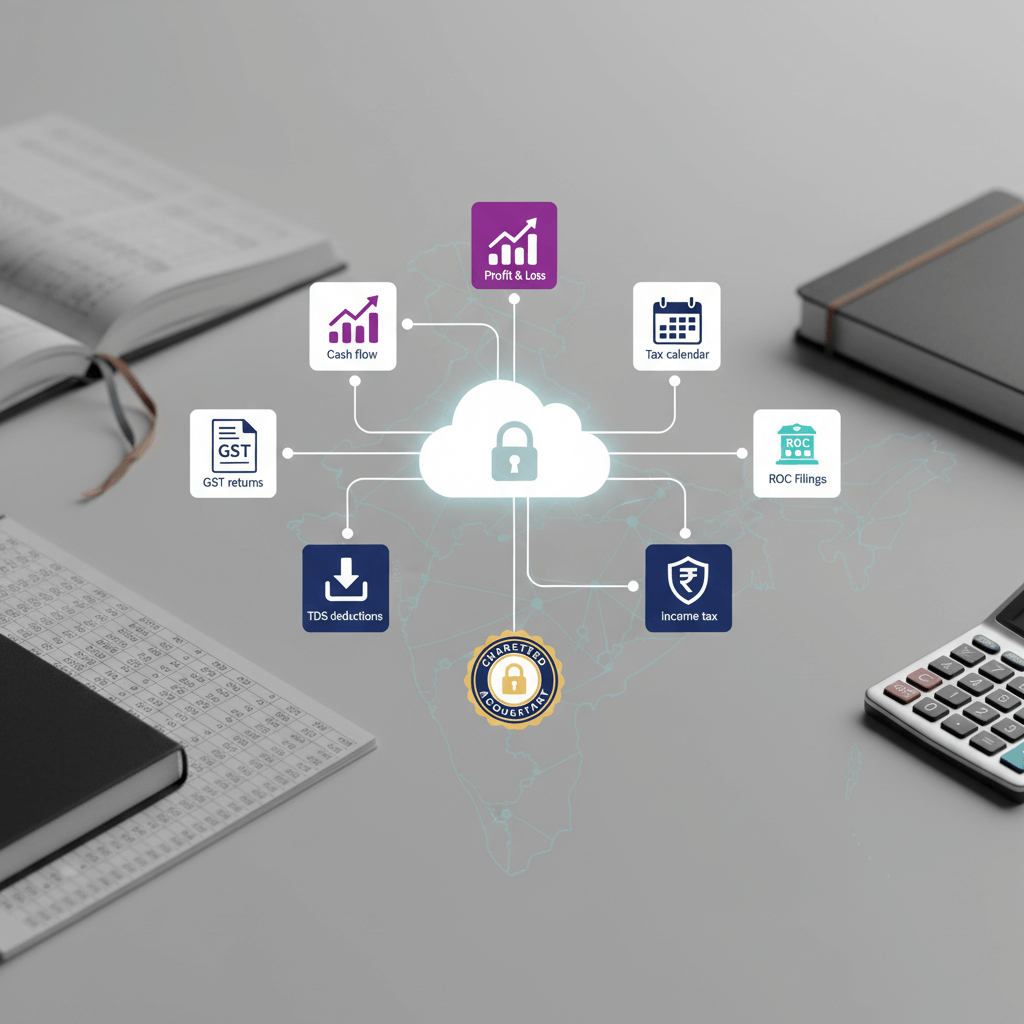
On the dashboard: track revenue, expenses, profit and loss, balances, cash flow, burn, runway, AI variance alerts, recent transactions, bank statement analysis, documents, compliance dates, and chat with your CA team.
On execution: the team manages monthly bookkeeping, ledger cleanup, year end schedules, fixed assets, inventory support, AR and AP, bank and gateway reconciliations, cash flows, MIS, and audit assistance, all non certification work.
On taxation: full GST lifecycle with GSTR 1, 3B, 9, e invoicing and reconciliations, TDS advisory and filings including 26Q, 24Q, 27Q and related forms, advance tax planning, and income tax returns across structures. For small companies, ROC annual work is handled within legal limits on size, non attest.
See service information at AI Accountant.
Best practices for cloud financial reporting in India
- Run a monthly close checklist with dates and owners
- Reconcile banks and gateways weekly (not monthly)
- Use a compliance calendar for GST, TDS, income tax, and turn on alerts
- Store all documents centrally for audit readiness
- Enable maker checker for payouts and approvals
- Do quarterly GST and TDS health checks
- Review AI alerts weekly, act on anomalies within 24 hours
- Keep role based access tight, review audit logs regularly
- Track ITC recovery rate (target above 95%)
- Verify e invoicing IRN sync after every batch before GSTR 1 filing
Wrapping up cloud based financial solutions for India
Cloud based financial solutions unify finance work, provide live numbers, and strengthen compliance. Whether you choose a DIY tool or a CA managed model like AI Accountant Virtual Accounting, focus on fit for your stage, connect banks and gateways early, design clear workflows, and track a few KPIs each month.
With 68% of Indian SMBs already on cloud finance platforms in 2026 and ROI payback under 7 months, the question is no longer whether to move but how fast you can get started.
Take a short demo, run a sample reconciliation, review a GST flow. Once you see real time numbers, it is hard to go back.
FAQ
How should a founder evaluate security posture, do SOC 2 or ISO 27001 really matter
Yes, they prove a mature control environment across access, change management, incident response, and data protection. Ask for SOC 2 Type II or ISO 27001 reports, confirm encryption at rest and in transit, require multi factor authentication, and review audit trail coverage for critical actions like vendor payments and master data edits. RBI's 2026 cyber framework now mandates annual penetration tests for fintech platforms, so also ask for the latest pentest summary (2026 update).
What RPO and RTO should a finance head demand from a cloud accounting platform
Target an RPO under four hours and an RTO under eight hours for most small and mid size firms. Critical filing windows (like GSTR 3B deadlines) may need tighter goals. Validate backup frequency, offsite replication within India (DPDP Act 2025 requires local residency), restoration testing cadence, and the communication plan for incidents (2026 update).
How do maker checker workflows reduce fraud risk in AP and payouts
Maker checker enforces dual control: one person enters a bill or payment, another approves it. Combine this with role based access, vendor onboarding checks, and payment approval limits. AI driven anomaly detection (now at 92% accuracy) adds a third layer by flagging unusual amounts or frequencies before the checker even sees the request.
Can a startup rely on bank feeds and gateway sync for accurate books, or do we still need manual checks
Trust but verify. Automated feeds and rules clear most volume, with top platforms reaching 99% auto match rates. Set weekly reconciliation cadences, define threshold based exception queues, and review unmatched or duplicate items. GSTN's 2026 API upgrades enable sub second GSTR 2B pulls, cutting reconciliation time by 70% (2026 update).
What is the fastest way to get e invoicing live and keep GST filings consistent
Register for e invoicing, connect your accounting tool, test IRN generation for sample invoices, and confirm the sync path to GSTR 1. From April 2025, e invoicing is mandatory above ₹5 crore turnover, and all invoices must carry dynamic QR codes from October 2025. Reconcile sales, credit notes, and IRNs weekly to ensure 2B alignment for customers (2026 update).
What does cloud financial reporting look like for India based businesses in 2026
Cloud financial reporting in India now means real time dashboards with P&L, cash flow, burn, and runway views updated continuously via API connected bank feeds and gateways. With 68% SMB adoption and GSTN's sub second API pulls, reports that took days now refresh in seconds. The shift is from periodic Excel based MIS to always on, AI augmented financial intelligence (2026 update).
How can AI help with anomaly detection without spamming the team
Good systems tune thresholds by vendor, category, or customer, and learn seasonality. Alerts should group related anomalies, provide context, and suggest actions (hold payment, request backup, or escalate). With 2026 accuracy at 92%, false positives are far lower than earlier generations. The key metric to track is AI alert resolution time, target under 24 hours.