-01%201.svg)
Key takeaways
- Cloud based tax compliance centralizes GST, TDS, income tax, and ROC workflows into one system with automation, real time dashboards, and CA oversight, replacing error prone spreadsheets and desktop software.
- Automated GSTR 2B reconciliation, ITC validation, and TDS TRACES matching cut mismatch rates dramatically, one multi GSTIN startup reduced ITC mismatches from 12% to 3% in two quarters.
- Maker checker controls, role based access, and monthly CA health checks prevent costly misfiling on edge cases like RCM applicability, composite supply classification, and inter branch cross charges.
- From April 2025, the e invoicing threshold dropped to ₹1 crore turnover, pulling lakhs more SMEs into mandatory IRP compliance and making cloud automation a practical necessity.
- Build, buy, or CA managed: the right model depends on your team's tax expertise and compliance risk appetite, but the most resilient setup for small teams pairs automation with CA oversight.
- If your team spends days on manual reconciliations or has received show cause notices for ITC mismatches, AI Accountant's GST reconciliation workflows can reduce that cycle from weeks to hours.
Cloud tax compliance in India: what's new in 2026
Until March 2025, e invoicing under GST applied only to businesses with turnover above ₹5 crore. From 1 April 2025, the threshold dropped to ₹1 crore as per CBIC's phased e invoice rollout notifications. This single change pulled a large segment of SMEs, traders, and mid sized service firms into mandatory IRP validation for the first time.
The day to day impact is significant. Finance teams that previously generated invoices in Tally or Excel without IRP integration now need real time API connectivity to the e invoice portal. Every B2B invoice must carry a valid IRN and QR code before it can be shared with the buyer. Failing to generate e invoices means the invoice is not a valid tax invoice under GST, which blocks ITC for your buyer and can trigger penalties during audit.
Separately, the GST Council's push toward automated return matching has tightened. GSTR 2B reconciliation is no longer optional hygiene; it is the primary basis for ITC claims. Businesses that ignore monthly 2B matching risk ITC reversals, interest at 18% per annum, and show cause notices. The GST portal now surfaces more granular mismatch data, but interpreting and acting on it still requires structured workflows.
Who does this hit hardest? SMEs between ₹1 crore and ₹10 crore turnover, particularly those still on manual or semi automated billing. CA firms managing 50+ clients across multiple GSTINs face a spike in reconciliation volume. Founders running B2B SaaS companies with multi state registrations need cloud native tax compliance stacks that handle IRP validation, 2B matching, and filing in one flow.
What to do now:
- Confirm your e invoice API integration is live and validated against the current IRP schema before your next billing cycle.
- Run a full GSTR 2B versus books reconciliation for Q4 FY25 to surface any legacy mismatches before the annual return window.
- Review your vendor master data, specifically GSTINs and HSN codes, to ensure new e invoice validations do not reject outward invoices.
Teams already using automated bookkeeping and transaction ingestion can adapt to these threshold changes faster because the data pipeline and validation rules are already in place.
Cloud based tax compliance: definition and core components
If you are a founder, a finance lead, or a busy freelancer, you have felt tax work stack up. Cloud based tax compliance makes that work lighter. It brings all your GST, TDS, income tax, and ROC tasks into one place, with automation, real time dashboards, and CA oversight.
With AI Accountant's virtual accounting service, you get this as a managed service plus a simple dashboard, so your filings, reconciliations, and documents stay clean and on time.
What "cloud based tax compliance" means
- Automated data ingestion: Bank feeds, payment gateways, accounting ledgers, and the e invoice portal connect via secure APIs. Transactions sync in without manual entry.
- Ledger hygiene and master data validation: Vendor and customer GSTINs are checked. HSN and SAC codes are applied correctly. Place of supply rules and RCM are validated before you file.
- Compliance modules: GST returns like GSTR 1 and GSTR 3B, annual GSTR 9 and 9C, e invoice enablement, TDS challans and quarterly returns, income tax schedules and ITR prep, and ROC reminders.
- Filing and reconciliation workflows: GSTR 2B versus books matching, ITC validation, TDS TRACES reconciliation, and notice response workflows run as standard.
- Document repository and audit trail: All receipts, invoices, challans, returns, and notices are stored with role based access, version control, and a clear audit trail.
- Real time alerts and dashboards: AI insights flag mismatches, anomalies, and upcoming deadlines, with compliance status by entity and GSTIN.
How it differs from older methods
| Aspect | Manual spreadsheets | Desktop software | Cloud systems |
|---|---|---|---|
| Data sync | Hand entry, breaks at scale | Requires imports, struggles with multi GSTIN | Continuous sync, multi entity views |
| Collaboration | Scattered emails and attachments | Limited multi user capability | Centralized dashboard with maker checker controls |
| Regulatory updates | Static, rule changes require manual intervention | Manual updates, compliance lag | Automatic regulatory updates deployed by provider |
| Security | Minimal controls | Local encryption only | Encryption, access logs, ISO 27001 readiness, DPDP alignment |
Cloud systems sync continuously, support multi entity views, and keep CA collaboration inside the dashboard with maker checker controls. Security is stronger with encryption, access logs, and ISO 27001 readiness, giving you audit friendly continuity.
Why cloud based tax compliance matters in India
India's tax rules change often. GST rules on place of supply, reverse charge mechanism, HSN or SAC, and e invoice thresholds evolve. TDS sections and rates shift. Income tax slabs and deductions change each year.
A static sheet cannot keep up. Cloud based tax compliance updates logic as rules change, and a CA team can explain what that change means for your filings. As the Income Tax Department portal increasingly pre fills return data from 26AS, AIS, and TIS, having your books in sync with these government data sources is no longer optional.
- Avoid penalties and interest: Late GST filings attract penalties and interest. Wrong ITC claims due to GSTR 2B mismatches deny credits and strain cash flow. Cloud reconciliation and compliance calendars help you submit on time and catch errors early.
- Reduce operational complexity: Founders and SMBs juggle Razorpay, PayU, Stripe, UPI, multiple bank accounts, and tools like Tally. Reconciling across silos consumes time and invites mistakes. Cloud platforms integrate these sources, auto match transactions, and flag gaps.
- Enable real time decisions: Dashboards with live compliance status, alerts, and trends inform tax provisioning, ITC trends, and cash flow, giving you faster, confident decisions.
For cloud native tax compliance for B2B SaaS companies and other multi GSTIN businesses, this operational visibility is what separates reactive compliance from proactive tax management.
Benefits of GST compliant cloud accounting in India
- Real time accuracy: Automated imports and smart categorization reduce manual errors. Master data checks catch GSTIN, HSN, and place of supply issues before filing.
- Faster reconciliations: Bank feeds, payment gateways, GSTR 2B, and TDS challans reconcile in the system, cutting cycle time by days.
- On time compliance: Calendars track deadlines by GSTIN and entity. AI alerts remind you before cutoffs. Penalties and interest drop.
- Centralized collaboration: One dashboard replaces scattered emails and attachments. Maker checker and role based access bring quality and accountability.
- Security and continuity: Encryption, access logs, version control, and ISO 27001 certified data centers protect sensitive tax data. Backups keep you safe.
- Audit readiness: Clean document organization, strong audit trails, and downloadable evidence packs simplify audits and notices.
- Cost and ROI: Fewer penalties, less manual effort, and better scalability reduce compliance costs as you grow.
Automation workflows, end to end
Phase 1, Data ingestion
- Bank transactions, payment gateway settlements, ledger entries, and e invoice receipts flow in via secure APIs. No copy paste.
Phase 2, Ledger hygiene and mapping
- GSTINs are validated. HSN and SAC codes applied. Place of supply logic sets IGST vs CGST and SGST with RCM rules. Mismatches flagged before posting.
Phase 3, GST compliance workflow
- Place of supply and RCM checks run automatically.
- E invoice generation for eligible B2B invoices is validated against IRP schema. QR codes verified.
- GSTR 2B versus books reconciliation downloads your 2B and matches against purchase ledgers to find missing invoices, rate mismatches, or quantity issues.
- ITC validation computes allowed credits and excludes ineligible credits like personal use or exempt supplies.
- GSTR 1 and GSTR 3B filing is auto populated, reviewed by your CA, and filed on time.
- GSTR 9 and GSTR 9C preparation handles annual returns and reconciliation schedules.
Phase 4, TDS compliance workflow
- Master data maps sections like 192 for salary, 194C for contractors, and 194J for professional fees to expense types. PAN and TAN validated.
- Monthly deduction computations per section and rate. Challans generated with amounts and payment steps.
- Quarterly returns for Forms 24Q, 26Q, and 27Q populated and filed by statutory deadlines.
- TRACES reconciliation matches deposited TDS against quarterly returns to close defaults.
- Form 16 and 16A issuance automated, verified against declarations like Section 80C and 80D.
Phase 5, Income tax compliance workflow
- Advance tax forecasting estimates income and tax monthly. Flags quarterly payment deadlines and amounts.
- ITR preparation compiles schedule data for capital gains, international income, and foreign remittance. Pre fills ITR using 26AS, AIS, and TIS.
- Tax audit readiness organizes schedules, trial balances, and evidence packs. Notice responses tracked and filed.
Phase 6, ROC and secretarial compliance
- Calendar tracks filings like MGT 7, AOC 4, and DIR 3 KYC for registered companies with reminders and filing checklists. Deadlines are aligned with MCA portal requirements.
Phase 7, Exception handling and approval
- Mismatches, unusual transactions, and missing data are queued for review. Your CA team provides context and approves adjustments before submission.
Phase 8, Documentation and archives
- Invoices, challans, GSTR receipts, and notices live in one repository with searchable tags, retention policies, and access logs.
Vendor evaluation: choosing a cloud based tax compliance solution
Must have features
- Compliance calendar with filing status by GSTIN and entity. Clear views of due, filed, and pending review.
- Auto imports and reconciliations for bank feeds, payment gateways, GSTR 2B, and TDS TRACES with mismatch flags.
- E invoice enablement and RCM handling with IRP API support, QR validation, and correct reverse charge application.
- AI insights and anomaly alerts for mismatch queues, ITC at risk notifications, and vendor compliance flags.
- Document repository with audit trail, role based access, version control, and downloadable evidence packs.
- Multi entity and multi GSTIN support with consolidated dashboards.
- Security and regulatory readiness with encryption, SSO, MFA, access logs, ISO 27001 certification, and DPDP readiness.
- CA led managed service option for advisory, maker checker review, and notice handling.
Questions to ask vendors
- Data residency and uptime: where is your data stored, what is the SLA, are backups offsite.
- Support and onboarding: what timeline, what training, what support model.
- Change management: how are regulatory updates deployed, is advisory included.
- Export and portability: can you download your data and switch vendors.
- Notice handling: does the platform support notice workflows and communication.
- Pricing and scalability: is pricing per entity, per volume, or per user, how does it scale.
Popular tools for cloud compliance and accounting
- AI Accountant: https://aiaccountant.com
- QuickBooks Online: https://quickbooks.intuit.com
- Xero: https://www.xero.com
- Zoho Books: https://www.zoho.com/books
- TallyPrime: https://tallysolutions.com/tally-prime
Managed service: build vs buy vs CA managed trade offs
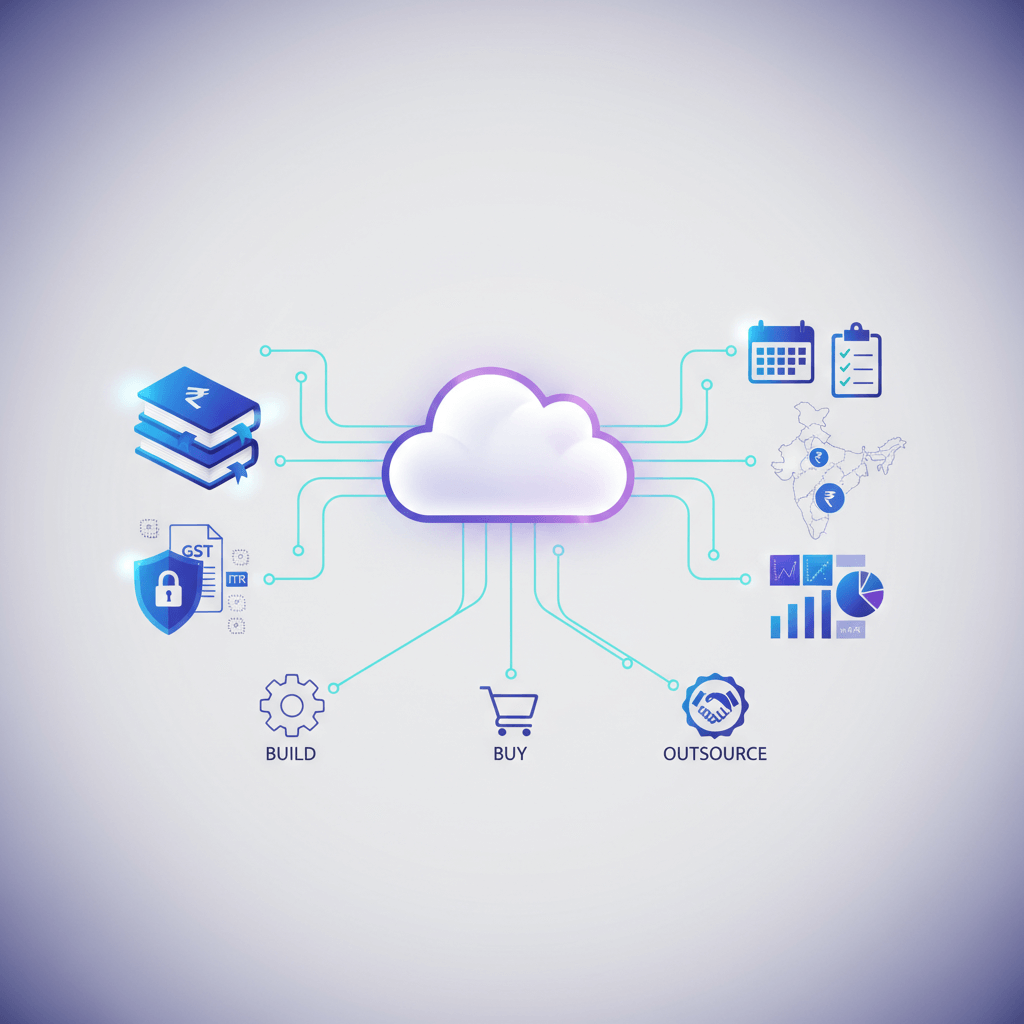
- Build in house: Full control and tailored workflows, but high upfront cost, ongoing maintenance, compliance lag, and security risk. Best for very large firms with tax tech teams.
- Buy DIY SaaS: Lower cost and fast setup, but needs in house expertise. Advisory is limited and vendor lock in can be a risk. Best for tech savvy teams with strong tax knowledge.
- CA managed cloud service: End to end execution with CA advisory and automatic regulatory updates. Lower overhead for your team. Higher cost and less operational control, but stable and reliable for startups, SMBs, and freelancers.
The most resilient model for small teams combines automation with CA oversight, maker checker, and monthly health checks.
Implementation roadmap for cloud based tax compliance
Phase 1, Assessment and planning, Week 1 to 2
- Map current processes, pain points, and tools like accounting software and payment gateways.
- Define scope: GST registrations and states, TDS sections and expense types, ITR forms, and ROC filings.
- Design chart of accounts, cost centers, HSN and SAC masters, and vendor classes.
- Identify stakeholders across finance, CA, and executives. Define approval workflows.
Phase 2, Data readiness, Week 3 to 4
- Clean historical ledger entries and reconcile opening balances.
- Validate vendor and customer GSTIN data against GSTN records.
- Map expenses and revenue to correct HSN and SAC. Validate place of supply logic.
- Set up cost centers and profit centers for multi division or multi region.
Phase 3, Connectivity and integration, Week 5 to 6
- Connect bank feeds via secure APIs or SFTP.
- Integrate payment gateways like Razorpay, PayU, Stripe, and UPI.
- Enable e invoice portal API if turnover is above the ₹1 crore threshold (applicable from April 2025).
- Sync your accounting system such as Tally, QuickBooks, or others.
Phase 4, Configuration, Week 7 to 8
- Set up the compliance calendar with GST, TDS, income tax, and ROC dates.
- Configure user roles like CA lead, finance, approver, and operator.
- Define maker checker for GSTR 1, GSTR 3B, TDS challans, and ITR filings.
- Set alert thresholds for ITC mismatches and anomalous transactions.
Phase 5, Pilot and training, Week 9 to 11
- Run a parallel cycle for one month. Compare outputs.
- Fix discrepancies in master data, categorization, and reconciliation logic.
- Train the team on the dashboard, workflows, and escalations.
- Document SOPs and process runbooks.
Phase 6, Go live and monitoring, Week 12 and beyond
- Freeze opening balances and lock old records.
- Switch to live cloud data.
- Monitor KPIs daily for one week, then weekly.
- Hold monthly reviews with your CA to refine rules and address exceptions.
Key KPIs to track
- Filing on time rate.
- Mismatch rate for GSTR 2B or TDS TRACES.
- Penalties and interest saved.
- Reconciliation cycle time.
- Notice frequency.
Risk management for cloud based compliance
- Data quality issues: Wrong GSTIN, HSN, or place of supply can trigger wrong filings and notices. Mitigation: run monthly reconciliations, validate vendor and customer data quarterly against GSTN, use a data entry checklist and maker checker for new vendors.
- Overreliance on automation: System errors or edge cases might slip through. Mitigation: keep CA oversight and maker checker approvals for major filings. Review exceptions monthly. Do not auto file without human review.
- Regulatory change risk: Rules for GST, TDS, or e invoice change and system logic lags. Mitigation: choose vendors with frequent compliance updates. Subscribe to CA advisory. Follow GSTN portal notifications, Income Tax Department, and MCA notifications.
- Security and access risk: Unauthorized access, data breach, or accidental deletion. Mitigation: enable MFA and SSO, use least privilege access, review access logs monthly, offboard users quickly, encrypt data in transit and at rest.
- Vendor lock in: Hard to switch vendors mid year. Mitigation: negotiate data export rights, avoid very long prepayments, maintain a quarterly parallel record export.
Multi GSTIN case study
Context
A B2B SaaS startup operates in Mumbai, Bangalore, and Gurugram with three GST registrations. This is a common pattern for cloud native tax compliance for B2B SaaS companies scaling across states.
Invoices and payments flow through Razorpay, PayU, and direct bank transfers. Last year, ITC mismatches between GSTR 2B and their books led to five show cause notices. Manual reconciliations ate fifteen days each month.
Actions
- Connected real time bank and payment gateway feeds.
- Set up automated GSTR 2B versus books reconciliation with mismatch queues.
- Enabled e invoice across all GSTINs.
- Embedded a dedicated CA as maker checker for GSTR 1 and GSTR 3B.
- Ran monthly health checks with AI alerts for anomalies.
Results
- One hundred percent on time GST filings for two quarters, with zero penalties.
- ITC mismatch rate dropped from twelve percent to three percent. Notices stopped.
- Monthly close reduced from fifteen days to ten days.
- Finance team freed twenty hours each month for working capital and cash flow analysis.
- Audit preparation took three days instead of two weeks due to organized documents and clean audit trails.
AI Accountant virtual accounting for cloud based tax compliance
AI Accountant delivers cloud based tax compliance as a CA led virtual accounting service. You get a unified dashboard plus a dedicated CA team that runs execution, compliance, and advisory.
Coverage
- GST: Registration updates, place of supply guidance under IGST, RCM checks, HSN and SAC classification, e invoice enablement, GSTR 1 and GSTR 3B filings, annual GSTR 9 and 9C, vendor reconciliations against GSTR 2B, ITC validation, and health checks with filing status dashboards.
- TDS: Section mapping for each expense type, PAN validation, rate checks, TAN upkeep, monthly challan generation, quarterly returns for 24Q, 26Q, and 27Q, salary TDS under Section 192 with Form 16, property TDS via 26QB, and TRACES reconciliation.
- Income tax: ITR filings, advance tax computations and payments, 26AS, AIS, and TIS reconciliations, MAT and AMT checks, tax audit preparation and schedule organization, notice support, and international withholding with Form 15CA and 15CB if needed.
- ROC compliance: Calendar for MGT 7, AOC 4, and DIR 3 KYC for small companies.
- Accounting and reconciliations: Bank reconciliation, payment gateway settlements, AR and AP aging, and MIS reporting you can share with your statutory auditor.
Dashboard features
- Financial overview with P and L, balance sheet, and cash flow.
- Compliance status by entity and GSTIN, with due dates, filed or pending tags, and history.
- AI alerts with exception queues for mismatches, ITC at risk, anomalies, and vendor follow ups.
- Document repository with tagging, search, and audit trail.
- Centralized CA communication so you do not lose context in email chains.
Freelancers, startups, and growth stage companies that want to outsource execution while keeping real time visibility benefit most. It replaces email threads and spreadsheets with a structured service and a central system.
Cloud compliance checklist: next steps and resources
If your team is missing deadlines, struggling with GSTR 2B mismatches, or spending many hours in manual reconciliations, it is time to evaluate a cloud based tax compliance solution.
Start here:
- Download a checklist of must have features. Ensure compliance calendars, auto reconciliations, e invoice enablement, AI alerts, a document repository, multi GSTIN support, and strong security are present.
- Review your current tax pain points against the benefits in this guide.
- Schedule a compliance health check with an expert to find quick wins and build your roadmap.
For a CA led dashboard with end to end execution, book a demo of AI Accountant's virtual accounting service to see real time visibility, automated reconciliations, and maker checker workflows in action. It can lower your compliance burden and free your team for strategic work.
Disclaimer
This guide is general information and not legal, tax, or accounting advice. Tax rules in India change often. Please consult a chartered accountant or tax professional for advice tailored to your business and filings before you implement any cloud based compliance solution.
FAQ
Between DIY cloud accounting and a CA managed virtual accounting service, what control do I retain over filings and approvals?
You retain full approval authority in both models. In a DIY setup, your team prepares, reviews, and files returns end to end. In a CA managed model, maker checker workflows ensure your finance lead approves drafts before the CA files after checks. You maintain visibility through the dashboard, preserving control on compliance decisions while outsourcing execution.
How does cloud tax India automation ensure GST ITC accuracy across multiple GSTINs?
Cloud platforms ingest GSTR 2B monthly, auto match supplier invoices to purchase ledgers, and flag rate, quantity, or date mismatches. High value credits at risk and vendor non compliance are prioritized in exception queues. After CA review, accepted credits flow into GSTR 3B and ineligible credits are parked with documented reasons, reducing ITC slippage and notice risk. With the tightened 2B matching expectations in 2026, this automated reconciliation is essential rather than optional (2026 update).
What integration paths exist for Tally, QuickBooks, and payment gateways like Razorpay or Stripe?
Typical connectivity uses secure APIs or SFTP for bank feeds, native or third party connectors for payment gateways, and file based syncs or bridges for Tally. Most cloud compliance platforms support Tally, QuickBooks Online, and popular gateways like Razorpay, PayU, Stripe, and UPI, so transaction data lands in one system for reconciliation.
Which KPIs should founders and finance heads monitor weekly to keep compliance risk low?
Track filing on time rate by GSTIN, ITC mismatch rate against GSTR 2B, TDS default count in TRACES, reconciliation cycle time, notice frequency by type, and exception resolution aging. Spikes in any of these metrics signal a process breakdown that needs immediate attention.
Can we migrate to cloud tax compliance mid financial year without breaking GSTR 1 summaries and 26AS alignment?
Yes, with a structured parallel run. Load opening balances, prior filings, and vendor masters. Reconcile one month in parallel to validate 2B matches and books. Then cut over at month or quarter end. Backfill and variance logs ensure summaries and 26AS alignment remain intact.
Is GST compliant cloud accounting worth the cost for freelancers and small LLPs?
For most small entities, penalties avoided and hours saved justify the fee, especially now that e invoicing applies at the ₹1 crore turnover threshold (2026 update). Managed services can be scoped to cover GST and TDS baselines plus ITR, so smaller teams get enterprise grade controls without hiring in house tax experts.
How does e invoicing stay current with threshold changes or schema updates from GSTN?
Cloud platforms update IRP integration and schema validations as CBIC notifications are issued. They enforce QR code checks and warn if your turnover crosses the applicable threshold. Your CA confirms eligibility and timing so you stay compliant. Since April 2025, the threshold is ₹1 crore, meaning most B2B businesses now need active e invoice API integration (2026 update).