-01%201.svg)
Key takeaways
- Bank accounting integration connects your bank feeds directly to your ledger, eliminating manual data entry and giving you a real time view of cash position, reconciliation status, and transaction accuracy.
- The biggest payoff is speed: automated matching of bank entries to ledger transactions cuts reconciliation time by 60 to 80 percent and catches duplicates or mismatches the same day they appear.
- A strong integration setup requires clean master data (vendor names, GSTIN, PAN), mapped tax codes, and exception handling with alerts so silent failures never slip through.
- Start with bank feeds and payment gateways first, then layer in sales, payroll, and inventory integrations, validating tax mappings at each stage.
- For Indian businesses on Tally or similar ledgers, the challenge is bridging bank statement formats to your chart of accounts without manual reformatting or copy paste errors.
- When bank reconciliation runs automatically with AI flagging anomalies and unmatched entries, your CA team focuses on judgment calls instead of data entry. AI Accountant's bookkeeping automation handles this end to end for firms on Tally.
Bank accounting integration: what's new in 2026
Until mid 2025, most Indian SMEs reconciled bank statements manually, downloading CSV files from net banking portals and uploading them into Tally or their ledger system. From late 2025, RBI's Account Aggregator framework expanded bank data sharing APIs, making real time bank feed ingestion practical for businesses below ₹50 crore turnover, a segment that previously relied on monthly manual downloads.
The operational shift is significant. Instead of a weekly or monthly reconciliation ritual, firms with integrated bank feeds now see transactions flow into their ledger within hours. This means:
- Unmatched entries surface the same day, not at month end when context is lost.
- TDS deductions by banks and payment gateway fees appear immediately, preventing suspense account buildup.
- Cash flow dashboards reflect actual bank position rather than a stale snapshot.
This hits SMEs and CA firms managing multiple clients hardest. If you handle 10 or more bank accounts across entities, manual statement processing consumed 15 to 20 hours monthly. Automated ingestion plus AI matching cuts that to 2 to 3 hours of review only.
Cost of inaction: unreconciled balances delay GST filings (since payment confirmation ties to ITC claims), trigger audit queries, and mask revenue leakage. Firms that ignore integration risk compounding errors across quarters.
What to do now: audit your bank feed connectivity, enable API based statement pulls where your bank supports it, and set up automated matching rules with exception alerts. Platforms offering automated vendor bill matching and bank statement ingestion reduce the manual lift to near zero. If you run multi entity operations, prioritize the accounts with highest transaction volume first, then expand.
Virtual Accounting in India, a clear definition
Virtual Accounting blends a CA led managed service with a dashboard that gives you live visibility into books, compliance, cash, and documents. Instead of scattered spreadsheets and email threads, you operate in one clean system with a dedicated CA team running the engine.
Simple in use, rigorous in control, the model is built to stand up to scrutiny while reducing day to day friction.
Execution plus visibility
The team runs monthly bookkeeping, ledger cleanup, reconciliations, GST and TDS filings, income tax returns, payroll tasks, and ROC compliance. The dashboard shows status, trends, and working papers in one place.
You also get structured advisory on place of supply, reverse charge, HSN or SAC, and payroll tax planning, so decisions stay consistent across periods.
What it does not do
It does not replace your independent statutory auditor. The managed service handles non attest accounting and compliance, while audit, assurance, and certifications remain with your auditor under Indian regulations and professional standards. See ICAI's resources at icai.org.
What the CA led model looks like month to month
- Monthly bookkeeping across sales, purchases, expenses, and banks, with ledger scrutiny so balances reflect real activity.
- Bank and payment gateway reconciliations, AR and AP management, fixed asset register, depreciation, and inventory where relevant.
- GST returns GSTR 1 and 3B, annual GSTR 9 and reconciliation where applicable, TDS challans and quarterly returns.
- Payroll computations under section 192, proof collection, perquisite valuation, and Form 16 issuance.
- Secretarial filings such as MGT 7, AOC 4, and DIR 3 KYC, with registers and minutes maintained.
- Management reporting, non certified cash flow, and schedules for your statutory auditor.
The dashboard you actually need
- Financial overview, revenue, expenses, net profit or loss, and balances.
- Category drill downs that explain where money comes from, and where it goes.
- Cash flow trends, including burn and runway, with scenario checks.
- AI insights to flag anomalies, duplicates, and unusual patterns.
- Recent transactions tied back to bank statements and source documents.
- Document vault for invoices, bills, contracts, and working papers.
- Compliance calendar with due dates and status for GST, TDS, income tax, and ROC.
- Central communication to tag your CA team, ask questions, and track tasks.
Background on dashboards in business contexts is summarized at Wikipedia.
Good design lets you zoom from summary to source in two clicks, which reduces noise during audits and vendor queries.
Accounting and bookkeeping essentials
- Clean chart of accounts aligned to your model, GST and TDS codes, and reporting needs.
- Monthly closures, with reconciliations for banks, gateways, AR, AP, GRIR, and inventory.
- Fixed assets with capitalization rules and depreciation schedules.
- Year end close with schedules and mappings ready for audit and tax.
- Management reports and non certified cash flow to steer operating decisions.
Companies must keep proper books and vouchers as per the Companies Act. See MCA Act text, and follow applicable standards per ICAI Accounting Standards.
Bank accounting integration: why smart businesses start here
Bank accounting integration is the foundation of clean books. When your bank feed flows directly into your ledger, every rupee in and out is captured without manual keying. This eliminates the most common source of reconciliation errors: timing gaps between when a transaction hits your bank and when someone enters it in the books.
How bank accounting integration works in practice
The flow is straightforward:
- Bank statements are pulled via API, file upload, or aggregator connection into your accounting system.
- Each bank entry is matched against existing ledger entries (vendor invoices, customer receipts, expense vouchers) using rules or AI.
- Matched entries are auto reconciled. Unmatched entries surface as exceptions for human review.
- Duplicates, bank charges, and TDS deductions are flagged separately so nothing sits in suspense.
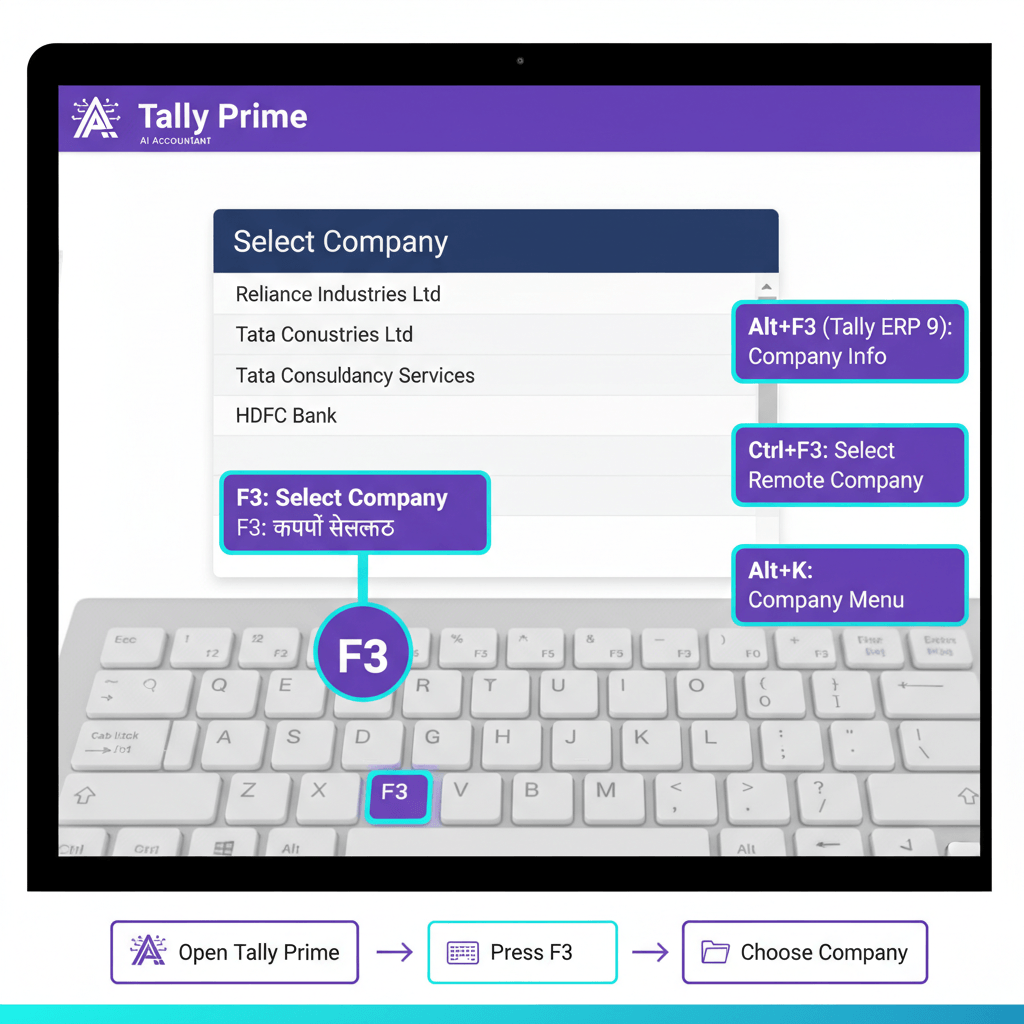
For businesses using Tally, this means converting bank statement formats (PDF, CSV, MT940) into voucher entries that map correctly to your chart of accounts, without someone manually copying each line.
What breaks without proper integration
Without automated bank accounting integration, three things go wrong consistently:
- Cash position is always stale. You rely on yesterday's download, not today's reality.
- Reconciliation backlogs grow. A week of unmatched entries becomes a month, becomes a quarter end fire drill.
- Revenue leakage hides. Duplicate charges, missed refunds, and unexplained gateway fees go unnoticed until audit.
The fix is simple in concept: connect the bank, automate the matching, and review only the exceptions. The discipline is in setting up clean matching rules and maintaining master data.
GST compliance done right
- Registrations and amendments, place of supply guidance under IGST, and RCM checks.
- GSTR 1 and 3B monthly or quarterly, annual GSTR 9 where applicable.
- HSN or SAC classification, rates, exemptions, and e invoice schema validation with QR checks.
- Vendor reconciliations against 2B, and ITC validations to reduce notices.
- GST health checks and dashboards showing due dates, filing status, and ITC trends.
Key references: GSTR 1, GSTR 3B, GSTR 9, e invoice portal, IGST Act, RCM guidance, and GST portal.
Tip, validate place of supply with examples before going live. Errors here ripple into returns, ITC, and notices.
TDS automation that prevents interest
- Section mapping for each expense type, with PAN validation and rate checks.
- TAN registration upkeep, monthly challans, quarterly returns 24Q, 26Q, 27Q.
- Salary TDS under section 192, declarations and proofs, Form 16 or 16A issuance.
- Property TDS via 26QB where applicable, TRACES reconciliation, and defaults closure.
References: TDS overview, TRACES, Challan payment, 26QB help.
Automate monthly routines, map challans to deductions, and monitor late fee exposure in your dashboard.
Income tax compliance for entities and founders
- ITR filing across relevant forms, with advance tax computations and payments.
- 26AS, AIS or TIS reconciliations, MAT or AMT checks where relevant.
- Tax audit preparation, schedules for the statutory auditor, and notice responses with evidence.
- International withholding, Form 15CA or 15CB where required.
References: ITR help, Advance tax, Income Tax portal.
Payroll services beyond salary credits
- Section 192 calculations, investment proof collection, and perquisite valuation.
- Advisory on compensation structures that are tax efficient and compliant.
- Form 16 issuance, payroll registers, and reconciliation with TDS returns.
Reference: TDS on salary.
Employees value clarity, a neat dashboard view reduces queries and back and forth.
ROC and secretarial compliance
- MGT 7 annual return, AOC 4 financial statements filing, and DIR 3 KYC for directors.
- Routine board and shareholder meetings with minutes, registers, and event based filings.
References: MCA, DIR 3 KYC, Small company thresholds.
Predictable does not mean optional, accuracy and timeliness prevent compounding penalties.
Bank reconciliation and controls
Securely pull bank statements, match entries to the ledger, and clear suspense quickly. Payment gateways need the same discipline.
Timely reconciliations improve cash clarity, support cash flow planning, and reduce year end surprises. For the cash flow statement context, see Ind AS 7.
Watch for duplicates and unexplained fees, and surface them via AI insights to shorten investigation time. When bank accounting integration is properly configured, your reconciliation moves from a monthly chore to a daily automated check with exceptions flagged instantly.
Cash flow, burn, and runway
- Burn rate is average monthly operating cash outflow minus inflow.
- Runway is cash balance divided by monthly burn, with scenarios for collections or spend changes.
References: Burn rate, Cash runway.
The dashboard should show trend lines and what if sliders, for example, collections drop by 15 percent for the next quarter. Accurate burn and runway numbers depend entirely on your bank accounting integration being current, because stale bank data means stale cash projections.
AI in finance, pragmatic gains
- Anomaly detection, duplicate invoice checks, and vendor risk signals.
- Auto categorization suggestions with confidence scores, and predictive collections or payments.
- Natural language search across ledgers and documents, with robotic process automation triggers for repetitive tasks.
Survey insights on AI adoption are summarized by McKinsey at State of AI 2023. Finance leaders report 30 to 50 percent reduction in manual work from human AI hybrid workflows, particularly in transaction matching and anomaly detection.
Key principle, keep controls, reviews, and audit trails clear, so humans remain accountable. AI suggests, humans approve.
Data governance and security
- Encryption at rest and in transit, MFA, and device checks.
- Role based access control (RBAC), least privilege, and regular reviews.
- Full audit trails, vendor due diligence, and DPDP Act compliance.
- Backups, disaster recovery tests, and retention or deletion policies.
References: DPDP Act, RBAC concepts.
Ask for documentation, including penetration test summaries and control matrices. When evaluating any bank accounting integration tool, verify that bank credentials are never stored and that data flows use tokenized access only.
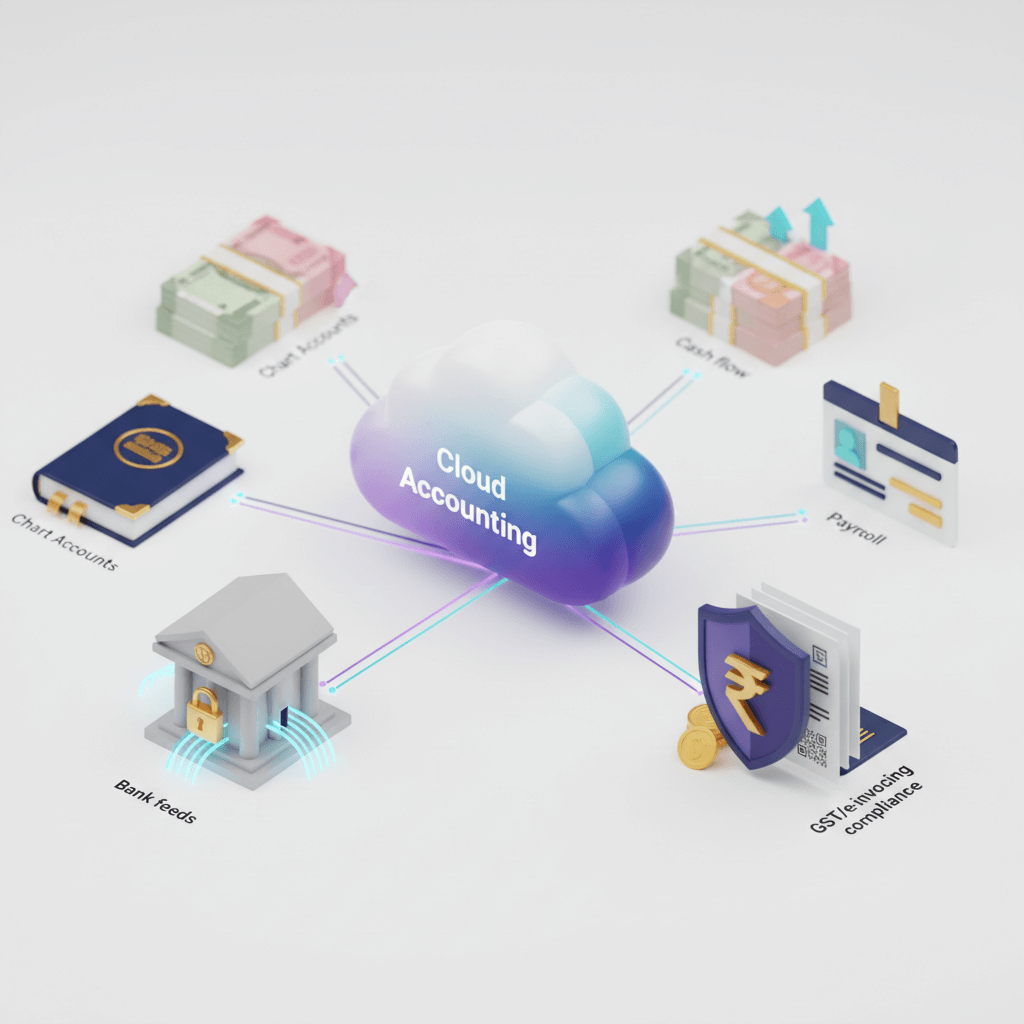
Cloud accounting integration
- APIs for system to system exchange, with webhooks for near real time events.
- iPaaS (integration platform as a service) to orchestrate workflows, retries, and mappings.
- Master data governance for tax codes, HSN or SAC, and contacts.
- Exception handling with alerts, so you never rely on silent failures.
Background: API, webhook, and iPaaS overviews.
Start with bank feeds and gateways, then add sales, payroll, and inventory, with your CA team validating tax mappings before go live. This sequencing ensures your bank accounting integration is solid before downstream systems add complexity.
Best tools and automation picks
- AI Accountant aiaccountant.com
- QuickBooks Online quickbooks.intuit.com
- Xero xero.com
- Zoho Books zoho.com/books
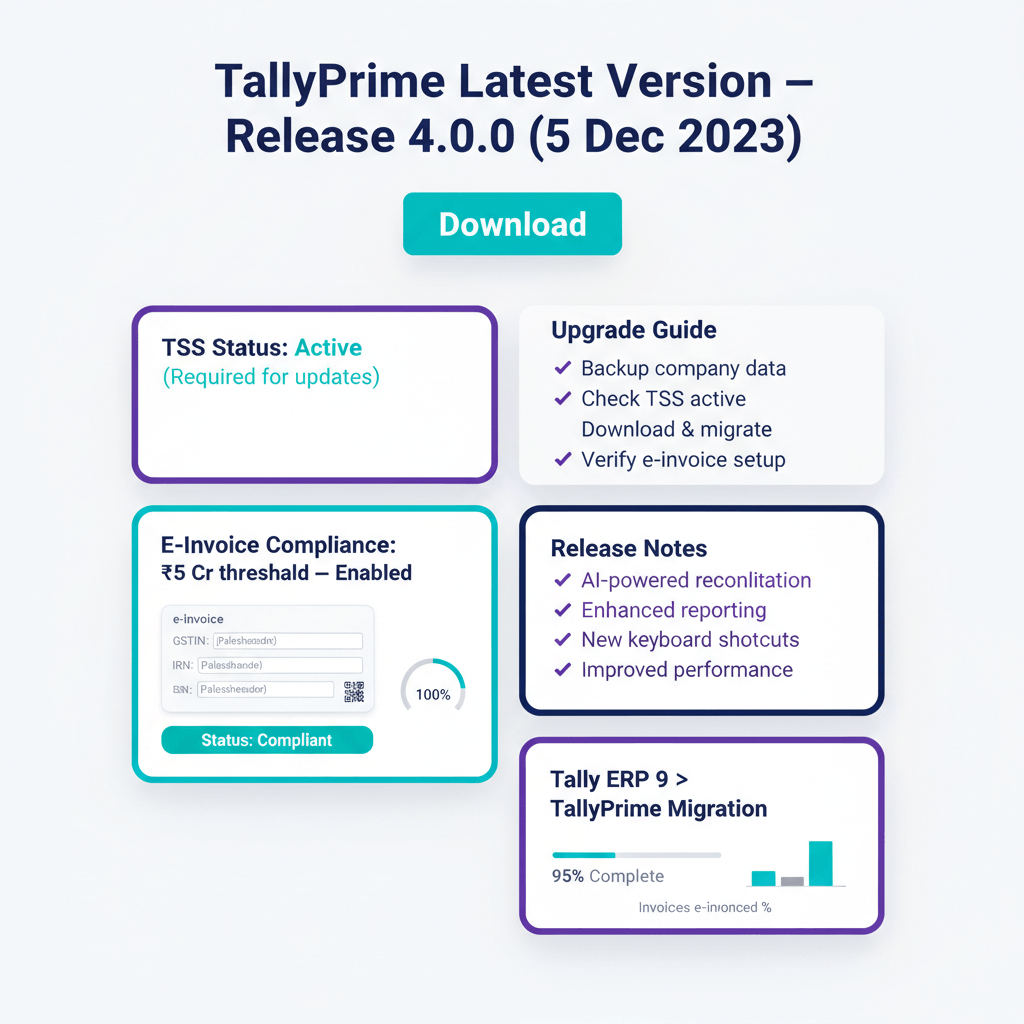
- TallyPrime tallysolutions.com
- FreshBooks freshbooks.com
- Sage Intacct sage.com/en-us/sage-intacct
- Oracle NetSuite netsuite.com
Pick one core ledger, connect supporting apps as needed, and align your chart of accounts and tax codes from day one. When evaluating tools, prioritize those with native bank statement ingestion and automated ledger entry matching.
Implementation roadmap
- Discovery: map entities, bank accounts, sales channels, GST registrations, and workflows.
- Data model: chart of accounts, cost centers, GST and TDS codes.
- Policy setup: approvals, cutoffs, documentation standards, and audit trails.
- System setup: users, roles, and integrations.
- Migration: opening balances, masters, and historical transactions.
- Parallel run: book live work, cross check against old records for a month.
- Sign off: freeze opening balances, and lock the old system.
- Operate and improve: monthly reviews, tighter controls, and automation.
See ICAI's digital guidance at Digital Accounting and Assurance Board.
Keep evidence, meeting notes, checklists, and working files speed up audits and diligence.
Common pitfalls and how to avoid them
- Inconsistent masters: vendor names, GSTIN, and PAN mismatches block reconciliations. Maintain a single source with change approval.
- Wrong tax mapping: place of supply or HSN errors distort GSTR 1 and 3B. Validate edge cases before go live.
- Missing 2B match: claiming ITC beyond 2B risks notices. Reconcile monthly and chase vendors.
- Late TDS payment: interest and late fees add up. Set a strict monthly cadence and calendar.
- Unreconciled bank or gateway balances: this hides revenue leak or duplicate counting. Reconcile weekly.
- Weak access control: shared logins expand risk. Enforce role based access with reviews.
- API rate limits and silent failures: build retries and alerts into your bank accounting integration layer.
- Poor documentation: if you cannot show the why behind numbers, audits slow down. Attach working papers at transaction level.
References: GST portal and RCM guidance.
ROI of Virtual Accounting
- Time: measure hours founders and teams spend on finance admin, multiply by cost or opportunity cost.
- Errors: penalties, interest, and rework from last year. Aim for a sharp reduction.
- Cash: faster collections and smarter payments reduce interest and extend runway.
- Audit readiness: fewer back and forth loops save real time during diligence.
A quick estimate: net benefit per year equals time savings plus avoided penalties plus working capital benefit minus the cost of service and tools. For automation impact, see McKinsey on automation.
Most visible gains, vendor reconciliation accuracy, GST hygiene, and cleaner cash views.
How AI Accountant fits
AI Accountant delivers a CA led managed accounting service with a dashboard that shows live books, filings, cash flow, burn, runway, and AI insights, plus a document vault and a compliance calendar. Accounting and bookkeeping, GST, TDS, income tax, payroll, and routine ROC tasks are covered end to end. If you already work with a statutory auditor, the team coordinates schedules and evidence to make audit smooth. Learn more at aiaccountant.com.
It replaces scattered email, spreadsheets, and chats with one structured workflow, modern in feel, grounded in Indian compliance.
Closing thoughts
Virtual Accounting is a simple idea with a big payoff: a CA led team runs your finance engine, a dashboard gives you clarity all month. You get timely compliance, books you can trust, and insights you can act on, with the controls to scale from freelancer to startup to growth stage company without drama.
Bank accounting integration is where it all begins. Get that right, and everything downstream, from GST filings to cash flow dashboards to audit readiness, becomes dramatically easier.
FAQ
What is bank accounting integration and why should it be my first automation priority
Bank accounting integration is the automated connection between your bank statements and your accounting ledger, so transactions flow in, get matched to invoices or expenses, and reconcile without manual data entry. It should come first because every other financial process (GST filings, TDS, cash flow, audit prep) depends on accurate, current bank data. Without it, you are building compliance on a shaky foundation.
How fast can we transition from spreadsheets to a managed accounting stack without losing historical continuity
Plan a four to six week rollout: discovery in week one, data model and policy setup in week two, system configuration and masters in week three, migration and parallel run in weeks four and five, sign off in week six. Bring in opening balances and key historic transactions (current financial year minimum) so trend analysis and reconciliations remain intact.
Can Virtual Accounting handle complex GST scenarios like multi state registrations, RCM, and e invoicing at scale
Yes, provided tax mapping and place of supply rules are designed upfront, with state wise registrations, HSN or SAC codes, and RCM checks embedded in the workflow. E invoice schema validation and QR checks run automatically for eligible turnovers. Vendor reconciliations against 2B and ITC validations reduce notices. Rule libraries show filing status by GSTIN.
How does AI help in accounting without creating black box risk or control gaps
AI handles suggestions and alerts, not final postings. Examples include categorization with confidence scores, duplicate detection, anomaly flags, and predictive collections. Human reviews, maker checker controls, and versioned audit trails ensure accountability. The principle is augmentation: humans accept or override suggestions with reasons captured.
We already use Tally, can a Virtual Accounting team integrate our bank feeds and still give a single dashboard
Yes. Bank statement ingestion (via API or file upload) feeds into Tally as voucher entries, while a dashboard layer normalizes data for reconciliation status, cash views, and compliance tracking. The CA team operates your Tally ledger while surfacing bank reconciliation exceptions and cash flow centrally, without forcing a platform change. (2026 update) RBI's expanded Account Aggregator APIs now make real time bank feeds viable for most Indian banks.
What are the data protection expectations under India's DPDP Act for finance data handled by a managed service
Expect encryption at rest and in transit, role based access, consent and purpose limitation, breach notification processes, vendor contracts covering processing, retention or deletion policies, and evidence of security testing. Ask for SOC style control lists or equivalent artifacts. For bank feed integrations specifically, ensure tokenized access and verify that bank credentials are never stored by the service provider.
How should we measure ROI from Virtual Accounting in a way a board will accept
Quantify time saved across founders and finance staff, penalties and interest avoided versus last year, DSO improvements and working capital gains, and audit or diligence time reductions. Subtract the cost of the managed service and tools. Present as a quarterly dashboard with trend lines tied to workflow analytics.