-01%201.svg)
Key takeaways
- GSTR 2B reconciliation is about more than compliance, it safeguards cash flow by maximizing eligible ITC and catching vendor issues early.
- Prioritize tools with accurate large scale matching, a configurable ITC policy engine, and automated vendor follow up with clear audit trails.
- AI driven platforms like AI Accountant reduce manual work through fuzzy matching, smart corrections, and continuous reconciliation.
- Use a structured comparison approach for data ingestion, matching rules, exception workflows, security, and integration depth, guided by this GSTR 2B reconciliation tools guide.
- Run vendor demos against your toughest month, validate performance on 50,000 plus rows, and verify two way sync to books, including how you match GSTR 1 with GSTR 3B totals.
- Expect 80 to 90 percent time savings, fewer ITC leakages, and audit ready reporting when you implement well with a focused three week plan.
Why GSTR 2B reconciliation matters
Every month, finance teams reconcile hundreds or thousands of purchase invoices against GSTR 2B, dealing with missing vendor filings and manual matching that consumes days. GSTR 2B is a static monthly statement that reflects ITC eligibility based on supplier GSTR 1, unlike the ever changing GSTR 2A. That frozen snapshot is your best working base for accurate and timely ITC claims.
The goal is not just compliance, it is cash flow protection. Systematic reconciliation prevents credit leakages, flags ineligible entries, and helps you act on vendor errors before they become costly reversals. If late filings and the 180 day rule are constant headaches, explore Input Tax Credit Reversal Automation to reduce manual risk.
Messy purchase registers, delayed supplier filings, and manual checks turn CAs into data entry operators. The right tool flips the script, your team returns to analysis and advisory.
Core evaluation criteria for GSTR 2B reconciliation tools
Outcomes first. Look for the following, then test them in a live demo:
- Accurate matching at scale, including GSTIN, document numbers, dates, and IGST, CGST, SGST splits, with quick identification of missing invoices, duplicates, and amendments.
- ITC claim optimisation, clear eligible, deferred, and reversed classification, blocked credit handling, the 180 day rule, RCM, and imports.
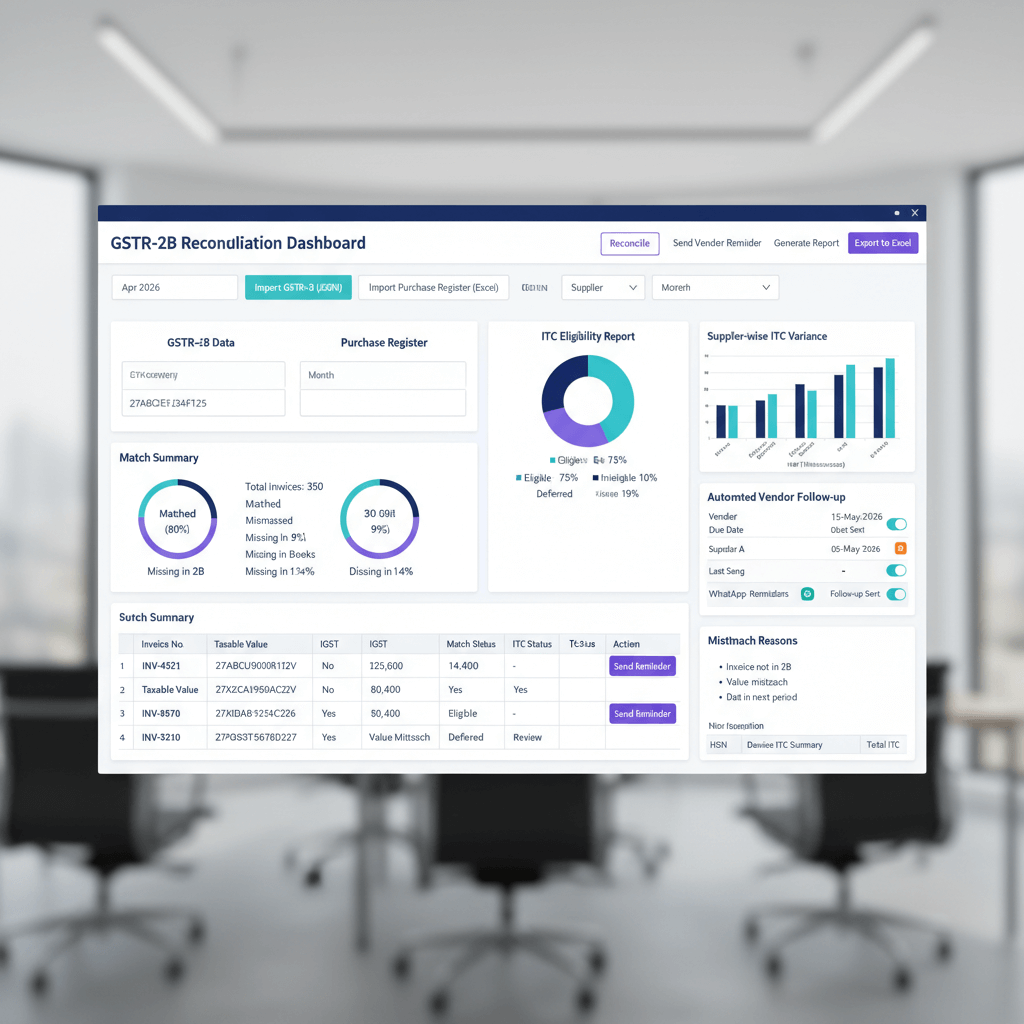
- Vendor follow up automation, reminders, escalation workflows, proof tracking, with a monthly dashboard that surfaces ITC risks and vendor behavior.
- Auditability and governance, action logs, exception workflows, configurable tolerances, statutory exports, role based access, multi GSTIN support.
For a structured walkthrough of must have features, see this GSTR 2B reconciliation tools guide and this hands on GSTR 2B reconciliation tools overview, plus market roundups from GST reconciliation software and an ICAI AI use case.
Landscape overview, types of GSTR 2B reconciliation tools
- Manual spreadsheets, workable under 1,000 invoices, but limited automation and rising error rates as scale grows.
- Accounting suite built ins, TallyPrime and Zoho Books provide native import and matching if you live in their ecosystems, but often miss advanced ITC logic and vendor automation.
- RPA screen scrapers versus API tools, avoid scrapers, API or file based fetches are faster and more reliable.
- AI driven platforms, the cutting edge, they learn mapping patterns and reduce exceptions via fuzzy matching and automated vendor corrections.
For comparative perspectives, see this GSTR 2B reconciliation tools guide, another GSTR 2B reconciliation tools overview, this in depth comparison, and an ecosystem view of GST reconciliation software.
Comparison framework for reconciliation software
Data ingestion
Check accepted formats, Excel, CSV, JSON, and whether direct Tally sync or Zoho connectors are supported. Validate error reporting on import. AI Accountant and Zoho handle Excel, JSON, and Tally formats, ClearTax supports multi GSTIN bulk processing. BUSY provides native options for GSTR reconciliation, and market directories like GST reconciliation software help you shortlist.
Matching engine
Look for configurable rules, fuzzy matching, GSTIN correction, and tolerance settings. AI Accountant learns variations and amendments, Tally allows custom tolerances.
Exception workflows
Assignment, comments, tags, SLAs, and vendor intimation. ClearTax buckets mismatches cleanly, platforms like LEDGERS and others offer analytics and outreach.
ITC policy engine
Configurable and auditable rules, including transitional ITC. Munim specializes in such scenarios, AI Accountant manages eligibility classifications and reversals comprehensively.
Vendor follow up
Email and WhatsApp templates, scheduling, communication logs, and scorecards. AI Accountant provides proactive workflows, and tools like LogiTax emphasize vendor scorecards.
Integrations
Two way sync with TallyPrime or Zoho Books, auto fetch from GSTN, smooth push of corrections to GSTR 3B computations, guided by how you match GSTR 1 with GSTR 3B totals.
Dashboards and reports
Monthly ITC snapshots, drill downs, statutory exports. AI Accountant highlights ITC trends, the ICAI tool showcases clear visualizations.
Scale and performance
Benchmark bulk processing. IRIS Sapphire is built for heavy volumes, AI Accountant supports multi entity processing smoothly.
Security and compliance
Prefer ISO certified vendors, encryption at rest and in transit. Offline tools from ICAI avoid cloud exposure entirely.
Pricing
Expect varied models, Tally around ₹750 per month, ClearTax on custom quotes. Watch for hidden costs in transaction fees or user limits. Cross check with this GST reconciliation software listing.
Deep dive feature checklist for demos
- Live matching of 50,000 plus purchase rows to GSTR 2B, observe system responsiveness.
- Diagnosis of missing invoices with root cause classification, for example late vendor filing or section specific blocks.
- Walkthrough of ITC optimisation, overrides, audit logs, RCM and import treatment.
- End to end vendor follow up automation, templates, bounce handling, proof tracking.
- Monthly dashboard review, eligible versus at risk ITC, vendor risk indicators, work queue management.
- Depth of integration back to books, and impact on 3B, aligned to how you match GSTR 1 with GSTR 3B totals.
- Multi org, multi GSTIN, and granular permissions.
- Complete audit trails and statutory export formats.
Use these resources to guide your script, the GSTR 2B reconciliation tools guide, the ICAI AI use case, this overview of GST reconciliation software, and another tools overview, plus vendor directories such as GST reconciliation software.
Example workflow using AI Accountant
Data ingestion: Import your purchase register via Excel or CSV with validations, or sync directly from Zoho or Tally. Auto fetch GSTR 2B data, no manual downloads.
Reconciliation and matching: Automatic matching by GSTIN, invoice number, date, and tax splits, with flags for missing invoices, duplicates, and vendor mismatches, plus suggested corrections.
ITC claim optimisation: Classify eligible, deferred, and reversed credits based on the 180 day rule and RCM requirements, then post journal vouchers back to books.
Vendor follow up automation: Generate follow up lists, schedule WhatsApp or email reminders, track proofs and responses without supervision.
Monthly dashboard: See the ITC snapshot, vendor risk profiles, trend analysis, and cash flow impact at a glance.
Closing and publishing: Bulk resolve exceptions, export reports, maintain audit trails, manage multiple organizations from one login. Explore more in this GSTR 2B reconciliation tools guide and this tools overview, plus market listings like GST reconciliation software.
ROI and business case for automation tools
- Save 80 to 90 percent of month end reconciliation time, shift effort from manual matching to analysis.
- Reduce error rates with automated validation and consistent rule application.
- Catch ITC leakages earlier, avoid expensive reversals and interest.
- Cut supplier communication overhead by more than half through automated reminders.
- Be audit ready with dashboards and complete logs, no last minute scrambles.
See ROI stories across this GSTR 2B reconciliation tools guide, a practical tools overview, and market context via GST reconciliation software.
Implementation playbook
Week 1: Connect Tally or Zoho, import two to three months of history, configure tolerance and policy settings to reflect business patterns.
Week 2: Run a pilot for one full month, fine tune ITC rules and vendor follow up templates, train the team on exception handling.
Go live: Finalize workflows, schedule monthly dashboard reviews, and expand to multi entity if applicable. Reference the GSTR 2B reconciliation tools guide and the tools overview to keep everyone aligned.
Edge cases and compliance nuances
- Amendments and period shifts, invoices move between months, the engine must track lineage.
- Bill to versus ship to mismatches, GSTIN logic needs contextual rules.
- Debit notes, credit notes, and advances, require special classification rules.
- Rounding differences, avoid false mismatches with practical tolerances.
- Quarterly filers behave differently than monthly filers, tune workflows accordingly.
- Composition dealers and SEZ transactions, require bespoke handling.
- Wildly varying document numbers, normalize to prevent matching failures.
- Beware OCR on scanned documents, prioritize accuracy over blind automation.
Brush up on the Difference Between GSTR 2A and 2B and revisit this tools overview and the master GSTR 2B reconciliation tools guide.
Metrics to track post implementation
- Reconciliation efficiency, time per month, percentage auto matched, and exceptions resolved.
- ITC outcomes, eligible versus deferred versus reversed, and exception aging.
- Vendor communication, SLA adherence and response rates to reminders.
- GSTR 3B accuracy, periodic tie out to ensure reconciliation drives correct filings.
Align internal reviews with these resources on GST reconciliation software, the tools overview, and the comprehensive GSTR 2B reconciliation tools guide.
Buyer checklist for GSTR 2B software
- Must haves: Scale ready matching, missing invoice detection with root cause analysis, robust ITC optimisation, working vendor follow ups, and monthly dashboards with actionable insights, as seen in a GST health check dashboard.
- Integration verification: Two way sync to Zoho or Tally, complete audit trails, clean statutory exports, and enterprise grade security with clear SLAs.
- Vendor requests: Sandbox access with your data, sample reports for similar businesses, and references from companies at your transaction scale.
Cross validate with the main GSTR 2B reconciliation tools guide, a market listing for GST reconciliation software, the tools overview, this in depth comparison, and the ICAI AI use case.
Top GSTR 2B reconciliation software options
- AI Accountant, comprehensive GSTR 2B reconciliation with AI driven matching, automated vendor follow ups, and seamless Tally or Zoho integration, strong ITC optimisation and multi entity support.
- ClearTax GST, enterprise focused, multi GSTIN support and bulk processing, strong compliance features and custom pricing.
- TallyPrime, convenient for existing Tally users, native integration with essential GSTR 2B features, fewer advanced automation features.
- Zoho Books GST, integrated reconciliation within the Zoho ecosystem, suitable for small and medium businesses.
- IRIS Sapphire, optimized for large scale reconciliation with robust reporting and performance.
- Munim GST, specialized capabilities for transitional ITC and complex scenarios.
Making your decision
Quantify your manual reconciliation effort, estimate ITC leakage risk, and shortlist two or three vendors. Run a focused pilot on your messiest month, validate performance on scale, and confirm how corrections flow back to books and impact 3B.
Implementation quality matters as much as features. Favor vendors that offer hands on setup and ongoing success support. Think forward, your volumes will grow and rules will evolve. Choose a platform that adapts without painful rework.
The path from spreadsheets to automation is shorter than it seems. With a clear plan and the right platform, you can reclaim most of your month end, reduce reversals, and improve working capital. For a structured deep dive, start with this GSTR 2B reconciliation tools guide.
FAQ
How frequently should a CA firm run GSTR 2B reconciliation for multi client portfolios?
Monthly is the minimum, but continuous fetch and near real time reconciliation is ideal to catch vendor lapses early. A platform like AI Accountant can auto fetch and reconcile incrementally, so you detect 180 day risks and blocked credits before month end.
What is the recommended approach to handle late vendor filings that shift invoices to the next month’s 2B?
Use a tool that tracks period shifts, tags invoices as deferred ITC, and reverses or reclaims automatically when eligibility appears. Configure alerts for vendors who habitually file late, and automate reminders through email or WhatsApp.
How should we configure tolerance for rounding differences between books and GSTR 2B without masking real mismatches?
Set low absolute and percentage tolerances, for example ₹1 and 0.25 percent, and apply them only to tax components, not invoice values. In AI Accountant, tolerances are rule based and auditable, so you can evidence why a match was accepted.
What is the best practice to handle RCM and import IGST in reconciliation reports?
Keep separate rule sets and reporting buckets for RCM and imports. Your tool should compute ITC eligibility timelines, journal postings, and 3B impact distinctly, and allow overrides with complete audit logs.
How do we reconcile for quarterly filers when our purchase register is monthly?
Adopt period normalization, match on document number and GSTIN first, then allow period flex rules that accept cross period matches with clear tags. Dashboards should show deferred ITC for quarterly vendors, with drill downs by counterparty.
Can reconciliation outputs post automatically to TallyPrime or Zoho Books with full reversibility?
Yes, if the platform supports two way sync and maintains audit logs. Test a sandbox where matched entries post JVs, reversals create contra entries, and every action is traceable. AI Accountant emphasizes reversible postings with logs.
What controls should a CA firm implement for multi GSTIN clients to ensure data isolation and access governance?
Use role based access by client and GSTIN, enforce maker checker on policy changes, and maintain export logs. Consider vendors with ISO certifications and encryption at rest and in transit, or an offline option if warranted by sensitivity.
How are debit notes, credit notes, and amendments best handled to avoid duplicate or missed ITC?
Require lineage tracking that ties notes and amendments to the original document, with netting rules that adjust ITC correctly across periods. The engine should flag potential duplicates before posting any ITC effect.
What vendor follow up cadence works, and can we use WhatsApp and email with compliance proof?
Adopt a three touch cadence, T plus 3, T plus 7, and T plus 14, with WhatsApp and email templates that include invoice references. Ensure the system captures delivery, bounce, and vendor replies, and attaches proofs to the reconciliation record. AI Accountant automates reminders and logs proofs centrally.
Which KPIs should partners and CFOs track post implementation to validate ROI?
Track percentage auto matched, exception aging, eligible versus deferred versus reversed ITC, vendor SLA adherence, and 3B tie out accuracy. A monthly executive view should highlight cash flow impact and vendor risk trends.
How do we treat blocked credits consistently, for example vehicle expenses or employee related spends?
Codify blocked credit categories in the policy engine and force deterministic classification at import. Ensure the tool prevents accidental claims and evidences policy rationale in the audit trail.
What is the most efficient way to test vendors during evaluation without disrupting BAU?
Run a two week pilot on your messiest historical month, at least 50,000 purchase lines, validate ingestion errors, matching accuracy, and push back to books. Compare outputs against a manual gold dataset to quantify variance. Tools like AI Accountant provide guided pilots with success criteria up front.

Rohan Sinha is a fintech and growth leader building aiaccountant.com, focused on simplifying accounting and compliance for Indian businesses through automation. An IIT BHU alumnus, he brings hands-on experience across 0 to 1 product building, growth, and strategy in B2B SaaS and fintech.