-01%201.svg)
Key takeaways
- Modern GSTR 2B reconciliation tools automate invoice matching against the GST portal, cutting cycle time from days to hours while improving accuracy.
- Automation reduces missed credits and overclaims, with real time dashboards that surface ITC availability, mismatch categories, and vendor level risk.
- Proactive controls like eligibility checks and automated ITC reversal tracking help you stay audit ready and protect cash flow.
- Seamless integrations with Tally, SAP, Zoho Books, and QuickBooks eliminate duplicate work and keep books aligned with reconciliation outcomes.
- Vendor communication modules generate supplier wise exceptions, send reminders, and preserve an audit trail that stands up in scrutiny.
- For CA firms, multi GSTIN management and role based access make scale practical, with portfolio views that consolidate risk and progress.
- A structured evaluation, proof of concept with real data, and clear SOPs ensure fast time to value and measurable ROI.
Why GSTR 2B reconciliation tools matter now
If you have ever cross checked hundreds of invoices line by line, you know manual reconciliation drains time and attention. Automated GSTR 2B reconciliation tools act like a digital assistant, matching your purchase register with the auto drafted 2B, flagging mismatches, and spotlighting ITC risks in minutes.
Compliance today is not only about filing on time, it is about proving that every rupee of ITC is eligible, accurately supported, and reflected in GSTR 3B, especially with increased scrutiny on Table 4 reporting. Errors can mean interest, penalties, and wasted credits, while missed ITC silently taxes your working capital.
Automation converts a monthly scramble into a managed control, with clear exceptions, audit ready logs, and fewer surprises.
Core capabilities you should expect
Automated invoice matching and mismatch detection
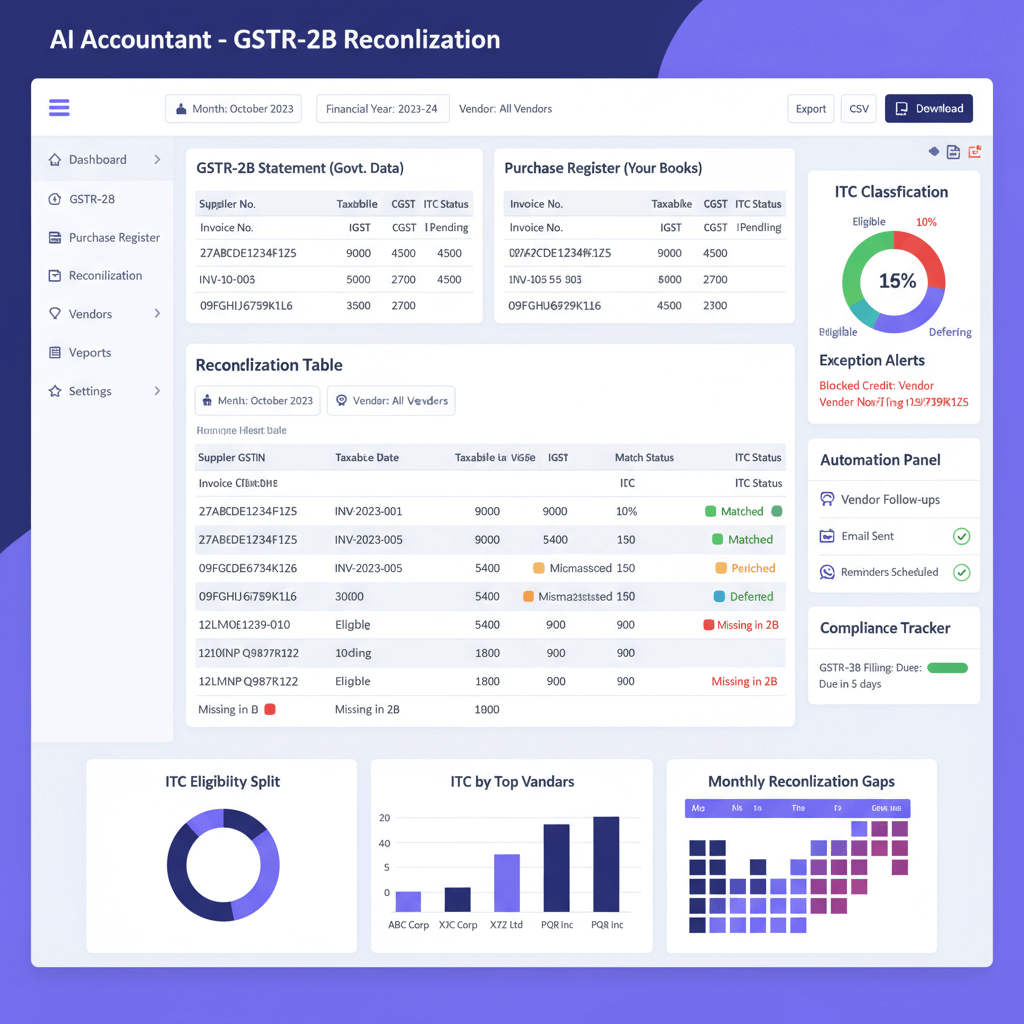
Modern engines compare GSTIN, invoice number, date, and taxable value, then propose matches, even when vendors use slight variations. Exceptions are categorized into books not in 2B, 2B not in books, and partial mismatches for faster triage.
ITC optimization and validation
Eligibility checks prevent overclaims, while timing analysis recovers credits when vendors file late. Tools assess blocked credits under Section 17(5), track reverse charge and imports, and guide required ITC reversal entries when rules demand it.
Vendor communication and follow up automation
Generate supplier wise statements, email exceptions with invoice context, and log responses. Some platforms enable supplier portals, making it easier to submit missing documents and amendments.
Real time dashboards and analytics
Portfolio views highlight reconciliation completion, ITC available versus claimed, and aging of open exceptions. Interactive dashboards reveal high risk vendors and recurring patterns so you can act early, not at month end.
For an overview of market options, see this primer on GST reconciliation software that many finance teams reference during evaluations.
Key features to evaluate
Integration with your accounting stack
Look for native connectors to Tally, SAP, Zoho Books, and QuickBooks, with bi directional sync for purchase registers, vendor masters, and reconciliation outcomes. Robust APIs matter for custom ERPs.
Bulk processing and Excel import
At scale you need batch uploads, mass updates, and clear error logs. Flexible templates and column mapping reduce the friction of varied data sources.
Customizable reconciliation rules
Set tolerance thresholds, define match priorities, and automate approvals for low risk items. Route high value exceptions to senior reviewers, then reuse templates across GSTINs.
Multi GSTIN management
Centralized access with GSTIN level permissions, unified reporting, and quick context switching let CA firms and multi state businesses manage volume without chaos. For reference, see Zoho Books GSTR reconciliation to understand a common cloud approach.
Top GSTR 2B reconciliation software solutions
AI Accountant
AI Accountant combines intelligent matching with seamless Tally and Zoho Books integrations, learning from your actions to improve accuracy over time. It handles partial matches, amendments, and reverse charge, while preserving a complete audit trail. The platform extends beyond reconciliation to AP automation, bank reconciliation, and real time working capital views, with role based multi client management for CA firms.
ClearTax GST Software
ClearTax supports high volume reconciliations with strong matching logic and detailed exception reports. It offers e invoicing, e way bills, and return filing in one place, with Excel friendly workflows and a vendor collaboration portal.
Tally Prime with GST
For teams that live in Tally, native 2B matching inside Tally Prime keeps processes familiar, with drill downs from summary to voucher. Explore Tally’s perspective on GST reconciliation to see how books remain the source of truth with 2B as validation.
Zoho Books
Zoho Books fetches 2B automatically, presents a clean reconciliation workspace, and supports bulk actions and rules. Collaboration tools, comments, and activity logs make internal reviews easy.
LEDGERS
LEDGERS emphasizes continuous reconciliation through the month, with detailed exception analytics, automated vendor intimations, and full version history to trace every change.
LogiTax
LogiTax applies machine learning to reduce false positives, offers vendor scorecards, and produces audit friendly certificates. See how its approach to GST reconciliation software supports sector specific needs.
Implementation and ROI considerations
Time and cost savings
Manual reconciliation for 500 invoices can take 40 to 60 hours monthly. Automation typically cuts effort by 70 to 90 percent, boosts accuracy above 99 percent, and lifts ITC capture. Even a one percent improvement on purchases of fifty lakhs, at eighteen percent GST, yields meaningful monthly savings, while reducing the risk of interest and penalties.
Integration timeline
Expect two to four weeks across setup, data migration, testing, and training. Week one handles connections and configuration, week two validates with history, weeks three and four refine rules and SOPs. Cloud tools usually need only a browser and stable internet.
Training and change management
Design role specific training, appoint internal champions, and document SOPs for exceptions and escalations. Emphasize that automation removes drudgery, not roles, freeing capacity for advisory and analysis.
Security and compliance essentials
Look for ISO 27001, encryption in transit and at rest, role based access, MFA, and immutable audit logs. Confirm data residency, retention, disaster recovery commitments, and SLAs. For CA firms, demand strict client data isolation and consent workflows.
Choosing the right tool for your context
Assessment and proof of concept
Document pain points, volumes, and edge cases, then run a proof of concept on real data, including amendments, credit notes, and advances. Use a weighted scorecard for functionality, integration, usability, support, and price, and involve finance, IT, and leadership.
Scalability and future proofing
Evaluate capacity for 10x volume, multi GSTIN growth, and modular expansion into e invoicing and deeper analytics. Cloud native, API first platforms tend to evolve faster. If you need formal artifacts for audits, ensure the tool can generate a comprehensive GSTR 2B reconciliation statement on demand.
Conclusion: turn compliance into advantage
Automated reconciliation safeguards ITC, reduces notices, and gives your team time for higher value work. Match the tool to your complexity, validate with a proof of concept, and codify clear SOPs. With the right platform and disciplined rollout, GST reconciliation becomes a smooth, efficient control that strengthens cash flow and audit readiness.
Evaluate thoroughly, implement thoughtfully, train continuously, and the benefits will compound month after month.
FAQ
How should a CA reconcile when suppliers file GSTR 1 late and invoices do not reflect in 2B for the current period?
First, capture the invoice in books if goods or services are received and conditions under Section 16 are met, then tag it as pending eligibility due to supplier filing status. A tool like AI Accountant tracks supplier compliance and automatically re checks subsequent 2B, moving the invoice to eligible when it surfaces. Configure rules to propose provisional ITC policy if your firm allows it, and auto adjust in the next period when the 2B reflects the document.
What tolerance limits are safe for invoice number and amount mismatches during automated matching?
For description variances, zero tolerance, for amounts, a small absolute or percentage threshold tied to rounding and freight practices is common. Many firms use one hundred or two hundred rupees, or up to zero point five percent for routine purchases, and zero for high value items. In AI Accountant you can define tiered thresholds by vendor group and document type, with stricter review for capital goods.
How do I handle ITC on reverse charge and imports within a 2B driven workflow?
For RCM, 2B usually reflects supplier documents only, so you must book self invoices and pay tax in 3B, then claim ITC in the same or subsequent period based on books. For imports, reconcile bill of entry details, match port codes and assessable values, and ensure 3B reflects the customs paid tax. AI Accountant maintains separate buckets for RCM and imports, reconciling books to 3B and customs references, not only to 2B.
What is the recommended approach to manage Section 17(5) blocked credits and ensure timely reversals and reclaims?
Maintain a rules library that tags ineligible categories at source, for example motor vehicles, club memberships, personal consumption, and set workflows for ITC reversal under Rule 37 for unpaid invoices beyond one hundred eighty days. AI Accountant can auto propose reversal JVs, track the clock, and restore credits when payment conditions are met, keeping audit trails intact.
How do I reconcile amendments and credit notes that impact prior period ITC?
Use a delta reconciliation view that compares the latest 2B to prior snapshots, isolating amendments and back dated credit notes. Post adjustment entries in the current 3B with clear references. AI Accountant keeps period wise snapshots and generates a movement schedule so partners can explain variances to clients and authorities.
What is the best workflow for CA firms handling twenty plus GSTINs across clients?
Adopt centralized intake for purchase registers, standardized import templates, and portfolio dashboards. Configure role based access, entity specific rules, and a weekly cadence that prevents month end pileups. AI Accountant’s multi client console shows completion percentages, aging, and vendor risk, allowing partners to intervene early.
How can I automate vendor follow ups for missing invoices or incorrect tax treatment?
Segment vendors by discrepancy type and materiality, then generate supplier wise statements with specific invoice lines. Schedule reminders and track responses in a unified log. AI Accountant can email vendors automatically, attach discrepancy extracts, and record replies, creating a defensible audit trail.
How do I align GSTR 2B reconciliation with GSTR 3B Table 4 reporting?
Map reconciliation buckets directly to 3B Table 4 rows, for example eligible ITC, reversals, reclaimed credits, and RCM. Lock the period after review, export a control report, and archive evidence. AI Accountant’s 3B ready view converts matched status into filing ready figures with drill downs to documents.
What data quality checks should I run before importing purchase registers for reconciliation?
Validate GSTIN formats, normalize vendor names, split freight and discounts correctly, and ensure invoice numbers and dates are clean. Run pre import checks on tax rate math and place of supply consistency. AI Accountant’s template validator flags structural issues and learns your mapping preferences over time.
Is built in reconciliation in Tally or Zoho Books sufficient, or do I need a dedicated tool?
For straightforward volumes and a single GSTIN, native reconciliation in Tally or Zoho Books can be adequate. When you face high volume, frequent amendments, multiple ERPs, or portfolio wide controls, a dedicated tool like AI Accountant provides stronger automation, analytics, vendor workflows, and audit evidence.
How do I quantify ROI to justify a tool to partners or CFOs?
Model saved hours, improved ITC capture, and reduced notices. Example, five hundred invoices, forty to sixty hours saved monthly, at five hundred rupees per hour, plus one percent more ITC captured on fifty lakhs of purchases. Add reduced interest and professional fees for notice handling. Most firms see payback within one to three months.
What is the minimal dataset I need to run a proof of concept that is statistically meaningful?
Start with one recent high volume month, include purchase register with GSTIN, invoice number, date, taxable value, tax split, place of supply, and vendor master. Pull the corresponding 2B JSON or Excel, and include any amendments and credit notes. AI Accountant can ingest both books and 2B, then produce a variance and opportunity report within hours.
How should I secure GST data while using a cloud reconciliation tool?
Insist on ISO 27001, encryption in transit and at rest, MFA, and granular roles. Confirm data residency, backup frequency, and recovery objectives. AI Accountant follows industry standard encryption, enforces role based access, and maintains immutable logs, which simplifies audit readiness.

Rohan Sinha is a fintech and growth leader building aiaccountant.com, focused on simplifying accounting and compliance for Indian businesses through automation. An IIT BHU alumnus, he brings hands-on experience across 0 to 1 product building, growth, and strategy in B2B SaaS and fintech.