-01%201.svg)
Key takeaways
- GSTR-2B is the static benchmark for ITC claims, while 2A is for monitoring, review the difference between GSTR-2A and 2B to set the right monthly process.
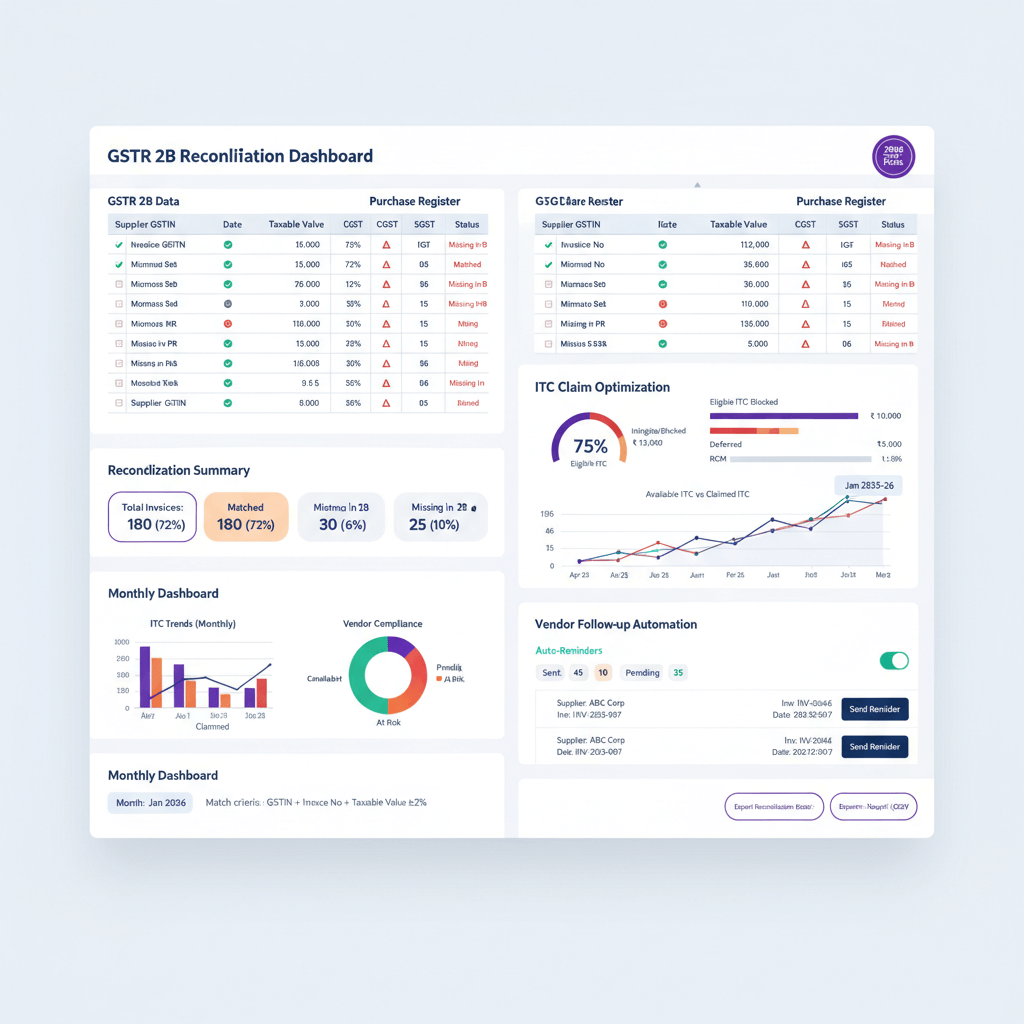
- The best GSTR 2B reconciliation tools excel at five things, accurate matching, quick exception detection, ITC claim optimisation, automated vendor follow ups, and clear monthly dashboards, see this GSTR-2B reconciliation tools guide.
- Modern engines use fuzzy logic for GSTIN, invoice number, and value variations, cutting false mismatches and duplicate entries across large volumes.
- Automation, from auto-fetching 2B, to vendor reminders and SLA tracking, typically improves ITC recovery by 15 to 20 percent and compresses month-end from days to hours.
- AI Accountant stands out for native Zoho Books and Tally sync, robust ITC logic with audit trails, scalable vendor workflows, and leadership friendly dashboards.
- Adopt a one month rollout plan, data hygiene first, first reconciliation run next, automation and dashboard routines by week four.
GSTR-2B, why reconciliation matters in 2026
GSTR-2B is a static, auto generated ITC statement that locks in supplier filed GSTR-1 data as of a cutoff date. In contrast, 2A keeps changing, it is best used as an early warning system. For compliance and cash preservation, reconcile to 2B, then map to GSTR-3B. For a quick primer, read the difference between GSTR-2A and 2B and this GSTR-2B reconciliation tools guide.
The bottom line, if an invoice does not show up in 2B, your ITC is at risk, and your audit trail will be questioned.
Strong reconciliation guards every rupee of eligible credit, accelerates GSTR-3B readiness, and gives leaders timely visibility.
Common reconciliation challenges without a tool
- Vendor and GSTIN variations break Excel formulas, invoice formats vary, date drifts between booking and supplier filing cause mismatches.
- Duplicates and partials are hard to spot at scale, multi GSTIN environments need careful segregation and rollups.
- Amendments land later in 2B, credit notes complicate value logic, RCM entries never appear in 2B and need special handling, see reverse charge mechanism accounting in India.
- Imports, ISD credits, and complex vendor behaviors undermine manual workflows, audit trails get lost in email threads.
These gaps lead to missed ITC, slower close cycles, and painful audits. A structured toolchain fixes the root causes, not just the symptoms, as explained in this GSTR-2B reconciliation tools overview.
What to look for in GSTR 2B reconciliation tools
Data ingestion capabilities
Import purchase registers, JVs, and credit or debit notes in Excel or CSV, auto fetch 2B JSON or Excel, validate on the way in, and log errors clearly. Upfront validation prevents downstream matching noise. Reference, GSTR-2B reconciliation tools guide, GSTR-2B reconciliation tools overview.
Matching intelligence, match purchase register reliably
Combine exact and fuzzy logic across GSTIN, invoice number, date, taxable value, tax amounts, and HSN or SAC. Handle rounding, vendor naming variations, and suspected duplicates, then learn from corrections over time. See the GSTR-2B reconciliation tools guide.
Exceptions and visibility, identify missing invoices fast
Bucket as matched, missing, excess, and mismatched, show root cause hints, and enable bulk actions. Prioritize high value items first, clear the tail with filters and batched steps. Details in this GSTR-2B reconciliation tools overview.
ITC claim optimisation features
Segment eligible, deferred, and ineligible credits, maintain reason codes and full audit trails, and map cleanly to 3B. For deeper logic on reversals and deferrals, refer to input tax credit reversal automation and the GST reconciliation software roundup.
Vendor follow up automation workflows
Auto create vendor wise exception packs, send bulk email or WhatsApp nudges with SLAs, escalate on delays, and track history to coach repeat offenders. Proof points in this GSTR-2B reconciliation tools guide.
Monthly dashboard and reporting
Leadership views, ITC breakdowns, vendor variance, and aging, with drill downs and Excel or PDF exports. For inspiration, see a GST health check dashboard for clients.
Integrations and workflows
Bidirectional sync with Zoho Books and Tally, role based access, approvals, and multi entity control for CA firms. Explained in the GSTR-2B reconciliation tools guide.
Scale, security, and reliability
Process thousands of invoices without slowdown, encrypt data in transit and at rest, and look for ISO 27001 or SOC 2 Type II. Availability guarantees matter during month end. See this GSTR-2B reconciliation tools overview.
Support and onboarding
Structured onboarding, response time SLAs, and playbooks shorten time to value. Larger rollouts benefit from a customer success manager, outlined in the GSTR-2B reconciliation tools guide.
How AI Accountant approaches reconciliation
AI Accountant implements end to end reconciliation with practical controls. It validates ingested data, auto fetches 2B, and applies a learning matching engine that corrects common GSTIN and naming issues. Exceptions are bucketed with filters and bulk actions, making vendor chases quick and consistent.
ITC logic tags eligible, deferred, and ineligible with reason codes and audit trails. Vendor follow ups run on templates and SLAs, with status tracking. Dashboards offer progress during the month, not just at close, and leadership can drill into any variance.
Native Zoho Books and Tally integrations support true two way sync. Multi org controls fit CA firms, while ISO 27001 and SOC 2 Type II provide enterprise confidence. More in the GSTR-2B reconciliation tools overview and the broader GSTR-2B reconciliation tools guide.
Sample month end workflow, step by step
- Sync masters from Zoho Books or Tally, confirm vendor and ledger hygiene.
- Upload purchase registers, JVs, and notes, auto fetch or upload GSTR-2B.
- Run matching, review buckets for missing and mismatched items.
- Trigger vendor follow ups with invoice level detail, monitor SLA status.
- Finalize ITC eligibility, defer where required, and document reasons.
- Export reports for audit, push reconciled entries back to books.
- Review dashboard for ITC recovery, vendor performance, and open items.
This cadence, described in the GSTR-2B reconciliation tools guide, compresses closure timelines and upgrades controllership.
ROI and metrics that matter
- Reconciliation time reduced by up to 80 percent, with learning engines lowering false positives month over month.
- ITC recovery uplift of 15 to 20 percent due to timely vendor compliance.
- Open mismatches aging down, vendor response rates up, faster GSTR-3B readiness.
One CA firm cut false positives from 12 percent to 3 percent in six months as the system learned vendor patterns, a common outcome when tools improve with use, see this GSTR-2B reconciliation tools overview.
Top GSTR 2B reconciliation tools for 2026
1. AI Accountant
Fuzzy matching, deep ITC logic, vendor automation, and strong dashboards, with native Zoho and Tally sync and enterprise security.
2. ClearTax
Robust mismatch bucketing and 3B support, reliable for compliance heavy teams.
3. Winman GST
Popular with CA firms, smooth Excel, Tally, and JSON handling, extends into filing.
4. Zoho Books
Integrated reconciliation for existing Zoho users, with native ecosystem benefits.
5. TallyPrime
Convenient for Tally shops, native reports and minimal switching.
6. EasyGST
Simple exception management at volume, suited to basic reconciliation needs.
Explore broader market notes in this GST reconciliation software overview.
Comparison checklist for buyers
- Matching at scale, fuzzy logic for variations and duplicates, proven accuracy in production.
- Exception speed, instant bucketing, root cause hints, and bulk actions.
- ITC optimisation, deferral and reversal logic with audit trails, 3B mapping.
- Vendor automation, templates, SLA reminders, escalation, and history.
- Dashboards, drill downs, Excel or PDF exports, multi GSTIN views.
- Integrations, true bidirectional Zoho or Tally sync, automatic push back.
- Onboarding and security, clear timeline, responsive support, ISO or SOC certifications.
For a marketplace view, scan a GST reconciliation software directory alongside the GSTR-2B reconciliation tools guide.
Real world examples and India context tips
- Amendments and credit notes, tools should compare current and prior 2B to flag retrospective changes, see retrospective changes in GSTR-2B.
- Vendor communication, specific invoice, amount, and month in the message boosts response, automate reminders with SLAs.
- Master data hygiene, mismatched vendor masters create false negatives, always sync before recon.
- Fuzzy thresholds, too tight means noise, too loose hides real issues, tune with a pilot month.
- Multi GSTIN, consolidate at PAN level while preserving GSTIN level compliance and audit trails.
- RCM handling, segregate RCM entries since they do not appear in 2B, refer to reverse charge mechanism accounting in India.
For deeper context, review these comparative notes, GSTR-2B reconciliation tools overview and the broader GSTR-2B reconciliation tools overview.
Implementation plan and timeline
Week 1, foundation
Clean vendor masters, standardize naming, and sync from Zoho or Tally, define tolerances and templates.
Week 2, first run
Execute the first reconciliation with finance or the CA lead, document exception playbooks, align sign off rules.
Weeks 3 to 4, automation and review
Switch on vendor automation, finalize ITC deferral logic, schedule dashboard reviews, and train extended users.
This staged rollout, outlined in the GSTR-2B reconciliation tools guide, maximizes adoption and minimizes disruption.
Moving forward with confidence
GSTR-2B reconciliation can be a value driver, not a month end fire drill. Prioritize five core capabilities, matching accuracy, fast exception handling, ITC optimisation, vendor automation, and executive dashboards. Whether you deploy AI Accountant or another fit for purpose solution, start with a pilot, prove the ROI with metrics, then scale across entities and clients. Your close will be faster, your ITC will be tighter, and your audits will be calmer.
FAQ
Should a CA rely on 2A or 2B for ITC booking and GSTR-3B mapping?
Use 2A for early detection and vendor nudges, rely on 2B for actual ITC booking and 3B mapping since it is static. Tools like AI Accountant surface 2A alerts during the month, then anchor claims to 2B at close, ensuring consistency.
What tolerance settings should I configure for invoice value and tax amounts to reduce false mismatches?
Start with a small percentage tolerance on taxable value, a fixed rupee threshold for rounding on tax, and exact date or month matching as a rule. AI Accountant lets you pilot tolerances for a month, then recommends data driven adjustments to balance noise and risk.
How do I treat RCM purchases since they never appear in 2B?
Segregate RCM ledgers and tag them out of the 2B match universe, then reconcile RCM separately to payment and self invoice records. For context, see reverse charge mechanism accounting in India. AI Accountant auto buckets RCM and excludes it from 2B variance.
What is the recommended reconciliation frequency for monthly close and annual 9 or 9C prep?
Run weekly soft checks against 2A to preempt vendor gaps, then do the formal 2B reconciliation right after 2B release. Monthly archives form the base for annual GSTR-9 or 9C working, AI Accountant retains month wise audit trails for this purpose.
How do tools manage supplier amendments and credit notes that appear retrospectively in 2B?
Version compare current 2B with the prior month’s 2B, flag deltas, and flow adjustments into ITC eligible, deferred, or reversals with reasons. Learn more about retrospective changes in GSTR-2B. AI Accountant automates version diffs and creates an adjustments ledger.
Can I map reconciled buckets directly into GSTR-3B tables without manual rework?
Yes, mature tools output 3B ready summaries, typically table 4A eligible, 4B reversals, and 4D or other disclosures as applicable. AI Accountant produces a 3B mapping export and pushes postings back into Zoho or Tally.
How should I handle ISD credits, imports of services, and BOE references during reconciliation?
Maintain separate registers for ISD and imports, capture BOE numbers and dates, and align to 2B or customs data as relevant. Tools like AI Accountant support dedicated fields and filters so these credits are tracked and reported distinctly.
What audit evidence does an officer typically expect for a disputed ITC line item?
Expect to show purchase invoice, vendor GSTIN, match logs, correspondence trail, and the decision audit trail with timestamps and user actions. AI Accountant exports a complete case file in Excel or PDF for each exception.
How do I evaluate vendor discipline and reduce recurring non compliance?
Use vendor scorecards, on time filing rates, mismatch counts, and SLA adherence. Automated reminders and escalations, plus sharing monthly exception packs, drive behavior change. AI Accountant’s vendor analytics spotlight chronic issues and helps you prioritize outreach.
Does AI Accountant support multi GSTIN, PAN level consolidation for CA firms with many clients?
Yes, it offers multi org workspaces, PAN level consolidation, GSTIN level drill downs, and role based access for partners, managers, and associates, enabling standardized processes across clients.
Which benchmarks should I track to prove ROI to partners or CFOs?
Track reconciliation cycle time, ITC recovery uplift, false positive rate, vendor response SLA, and month end close lag. AI Accountant’s dashboard trends these metrics and attributes gains to specific automations.
How long does implementation usually take and what data hygiene is mandatory?
Plan one month, week one for master cleanup and tolerance setup, week two for the first run, weeks three to four for automation and reviews. Clean vendor masters and consistent invoice fields are mandatory for a smooth start, as outlined in the GSTR-2B reconciliation tools guide.
Where can I scan the market to shortlist tools quickly?
Combine practitioner write ups with vendor directories for a balanced view. Start with this GST reconciliation software overview and a GST reconciliation software directory, then run a pilot with AI Accountant for a fast proof of value.

Rohan Sinha is a fintech and growth leader building aiaccountant.com, focused on simplifying accounting and compliance for Indian businesses through automation. An IIT BHU alumnus, he brings hands-on experience across 0 to 1 product building, growth, and strategy in B2B SaaS and fintech.