-01%201.svg)
Key takeaways
- Poor reconciliation leaks 5 to 10 percent ITC, burns 20 to 40 hours monthly, and risks penalties, while Best GSTR 2B reconciliation tools deliver automated matching, exception handling, and vendor follow ups.
- A robust evaluation should score tools on ingestion quality, matching accuracy, exception workflows, ITC optimisation, vendor automation, dashboards, integrations, and security.
- Target 95 percent plus auto match rates, clear exception categories, and an ITC engine that respects blocked credits, timing differences, and the 180 day payment limits.
- Expect 1 to 2 month payback through time saved, recovered ITC, fewer reversals, and faster month ends.
- Pilot with two months of real data, validate edge cases like amendments, RCM, imports, and credit notes, then scale with Zoho Books or Tally sync.
Understanding GSTR 2B Reconciliation Fundamentals
GSTR 2B is a static monthly snapshot of eligible ITC from vendors’ GSTR 1 filings, downloaded in JSON or Excel from the GST portal. It anchors accurate GSTR 3B claims, reduces reversals, and strengthens audit readiness.
Monthly reconciliation aligns purchase registers, journal vouchers, and credit or debit notes with the 2B statement. Think of it as matching what you bought, against what vendors reported selling to you.
- Manual pains: scattered CSV, Excel, and PDF formats, GSTIN errors, vendor name variants, duplicates, partials, and weak audit trails.
- Automation benefits: auto fetch of 2B, data standardization, fuzzy matching, exception flags for PR only or 2B only entries, and audit proof logs.
Outcome: A multi day, error prone task becomes a few hour, well governed process that secures every rupee of ITC.
Core Evaluation Checklist: What Great GSTR 2B Reconciliation Tools Must Do
Data Ingestion and Standardization
Import purchase registers, JVs, and credit or debit notes in PDF, Excel, or CSV with validations. Auto fetch GSTR 2B JSON files. Sync masters like GSTIN, PAN, and addresses from Zoho Books or Tally. The best platforms normalize vendor names, correct GSTIN formats, and stop bad data before it pollutes matching.
Matching Intelligence to Match Purchase Register
Line level matching must consider narration, amounts, dates, GSTIN, and invoice identifiers with fuzzy logic. It should handle duplicates, partials, amendments, multi GSTIN or PAN, and bill to ship to differences. Aim for 95 percent plus auto match, leaving only true exceptions for review.
Exception Detection to Identify Missing Invoices
Surface PR only, 2B only, GST rate mismatches, HSN or SAC gaps, and RCM applicability. Provide bulk tagging, edits, and audit trails. Clear categories and quick filters help teams prioritize high value items, while workflows assign vendors or issues to owners with due dates.
ITC Claim Optimisation Engine
Apply rules for blocked credits, timing differences, credit notes, vendor compliance, and the 180 day payment limits. Produce an accurate GSTR 3B ITC summary with buckets for eligible, deferred, and ineligible ITC. Smart engines recommend vendor payments that maximize current month ITC, and pre warn about potential reversals.
Vendor Follow Up Automation
Automate email or WhatsApp reminders, track responses, and log a complete communication trail. Role based tasks, SLAs, and escalations prevent slippage. Personalized nudges outperform generic blasts, and compliance scorecards spotlight chronic defaulters.
Monthly Dashboard and Reporting
View eligible versus ineligible ITC, pending items, and trends by entity or vendor. Export Excel or JSON for sign offs. Audit ready working papers must show what matched, what did not, and why, with drill downs from KPIs to the supporting lines.
Integrations and Security Controls
Push reconciled entries to Zoho Books or Tally, support multiple organizations, and enforce role based access. Demand encryption, detailed audit logs, and certifications like ISO 27001 or SOC 2. For CA firms, strict client data segregation is non negotiable.
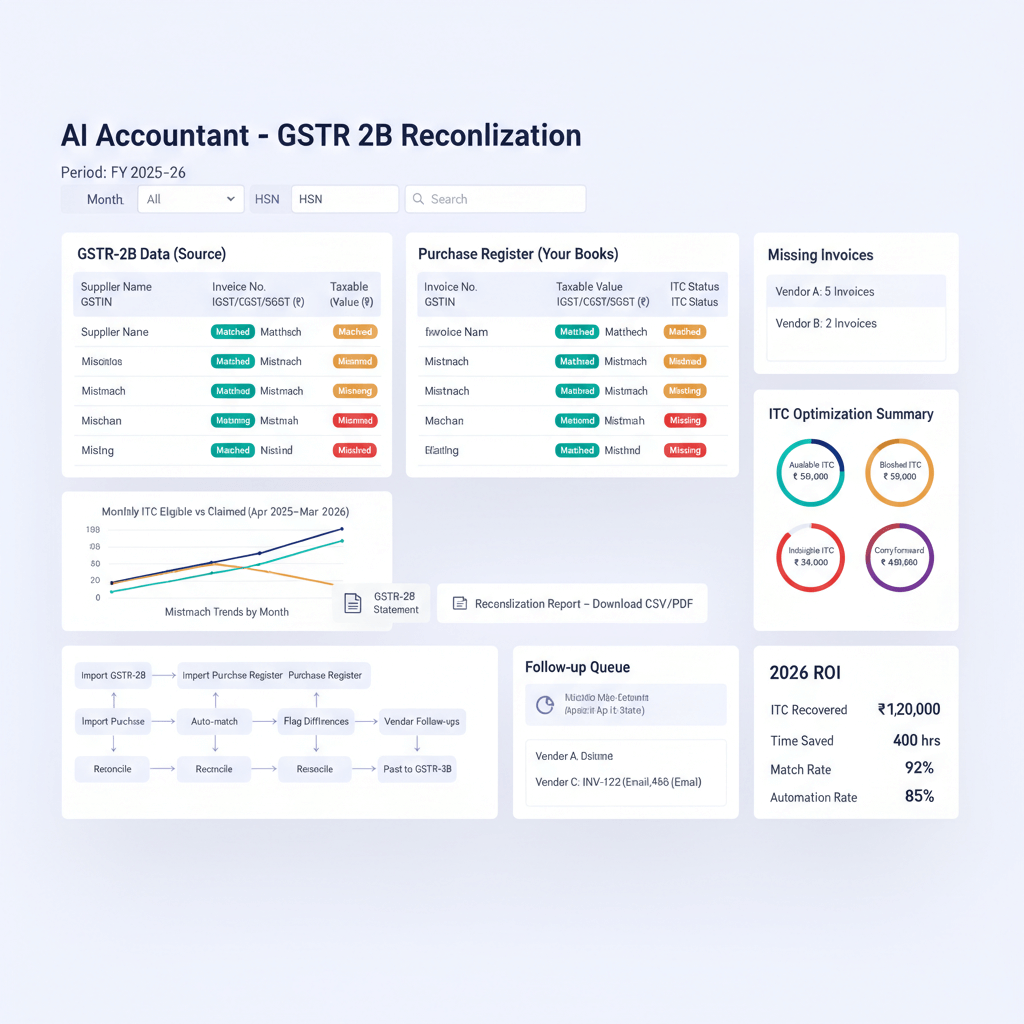
Step by Step GSTR 2B Reconciliation Workflow
Step 1: Import and Validate Data
Load PR and GSTR 2B data, confirm completeness for invoice numbers, dates, GSTIN, and amounts, and block duplicates or invalid formats. Early validation avoids downstream noise.
Step 2: Auto Match Purchase Register to GSTR 2B
Run automated matching across GSTIN, amount, date, and invoice patterns. High confidence matches get auto approved, borderline cases queue for review, and fuzzy logic captures near matches exact rules would miss.
Step 3: Identify Missing Invoices and Exceptions
Tag PR only, 2B only, and mismatches. Assign owners by vendor or category. Investigate partial payments, amendments, or recording gaps to resolve root causes quickly.
Step 4: Run ITC Claim Optimisation Rules
Calculate eligible, deferred, and blocked ITC, apply payment status and category restrictions, and generate a clean GSTR 3B ITC summary with justification notes.
Step 5: Trigger Vendor Follow Up Automation
Send targeted reminders to non compliant vendors, track their responses, and escalate per timelines. Consistent, polite, evidence backed communication drives faster corrections.
Step 6: Approve and Push to Books
Approve the final reconciliation set, then push to Zoho Books or Tally. Lock the period to preserve integrity, and make approvals auditable.
Step 7: Review Monthly Dashboard and Export Reports
Inspect trends, vendor performance, and exception volumes. Export working papers for sign off and audits, then archive for future reference.
ROI and Business Case for Automation
Typical outcomes include 20 to 40 hours saved monthly, 5 to 10 percent higher ITC realization through tighter exception handling, and faster, calmer closes. You also reduce exposure to penalties and interest.
| Input Metric | Example Value | Output Impact |
|---|---|---|
| Monthly invoices | 5,000 | Time saved: 30 hours at Rs 500 per hour equals Rs 15,000 |
| Team cost per hour | Rs 500 | ITC recovered: 7 percent of Rs 10 lakh PR equals Rs 70,000 |
| Historical ITC shortfall | 5 percent | Payback: 1 to 2 months, annual savings Rs 5 to 10 lakh |
Pro tip: Add soft benefits to the case, like fewer reversals, better vendor relationships, and robust audit readiness. These reduce operational drag even if they are hard to price.
From Pilot to Go Live Implementation
Week 1 to 2 Pilot Phase
Pilot with two recent months of data, aiming for 95 percent plus auto match and under 5 percent exceptions. Include your common vendors and known problem areas to test real complexity. Baseline current manual time and error rates to quantify gains.
Change Management and UAT
Define who uploads, who reviews, and who approves. Train teams so they shift from grunt work to exception resolution. Perform UAT on accuracy, integrations, and user experience, then sign off with a clear checklist.
Security and Compliance Setup
Onboard GSTINs methodically, map user roles, and enable encryption and access logs. For CA firms, set up client wise segregation and permissioning that reflect real responsibilities, with auditor friendly trails.
Handling Edge Cases in GSTR 2B Reconciliation
Amendments and Late Filings
Support multi period reconciliation to capture vendor amendments and late filings automatically. Track differences between 2A and 2B across months, then reprocess affected entries without manual chases.
RCM, Imports, and Advances
Reverse charge mechanism transactions need dedicated flags and rules. Import bills do not appear in domestic 2B, so reconcile them against customs documents. Track advances separately, then adjust against final invoices per GST rules.
Credit Notes and Rounding Differences
Set practical tolerances, for example auto approve variances under Rs 10 at scale, and track credit notes for their ITC impact and timing. Monitor cumulative rounding drifts to catch systematic setup issues.
How AI Accountant Maps to the Evaluation Checklist
AI Accountant delivers end to end automation across ingestion, matching, exceptions, ITC optimisation, and vendor follow ups. Fuzzy and partial matching achieve over 95 percent auto match on clean data, leaving genuine exceptions only. The ITC engine applies payment timing, blocked categories, eligibility criteria, and drafts accurate GSTR 3B summaries.
Native Zoho Books and Tally sync posts reconciled entries back to your books. With significant processing scale and certifications like ISO 27001 and SOC 2 Type II, it is enterprise ready. CA firms benefit from multi organization support, strong segregation, and audit logs.
Bottom line: From data ingestion to final posting, every step is engineered for speed, accuracy, and governance, turning reconciliation from a monthly scramble into a predictable routine.
2026 Top GSTR 2B Reconciliation Tools Comparison
Weigh matching accuracy at 25 percent, ITC sophistication at 20 percent, and integration quality at 15 percent, while also considering automation, dashboards, and security. Run a bake off with your data, including amendments, RCM, imports, and credit notes.
| Tool | Ingestion Capabilities | Matching Accuracy | ITC Engine | Automation Features | Dashboard Quality | Zoho/Tally Support | Security Standards | Best For |
|---|---|---|---|---|---|---|---|---|
| AI Accountant | JSON and CSV auto fetch with validations | Fuzzy matching, partials, duplicate detection | Rules based optimisation with GSTR 3B mapping | Vendor emails and task automation | Monthly ITC views with drill downs | Native bidirectional sync | ISO 27001 and SOC 2 | SMEs and CA firms |
| Octa GST | Portal fetch with side by side view | Exact and partial matching | Core ITC calculations | Reminder automation | Vendor scorecards | Partial integration | Mature controls | High volume ops |
| RealBooks | ERP integrated ingestion | Comprehensive logic | Audit focused tracking | Workflow automation | Trend analysis | Tally aligned | Strong controls | Suite users |
| TaxBuddy | Portal sync | AI fuzzy plus expert review | Optimisation rules | Template library | Executive dashboards | Limited integration | Regular updates | Service model |
| Vyapar TaxOne | SME friendly templates | AI powered matching | Core ITC | Communication tools | Basic reporting | Simple integration | Good practices | Small businesses |
| QuickBooks GST | Native ecosystem | Standard matching | Built in ITC tracking | Basic automation | Financial reports | QuickBooks only | Enterprise grade | QB users |
| Xero Tax | Cloud ingestion | Good algorithms | Compliance focused | Email automation | Real time views | Xero native | Cloud security | Xero ecosystem |
| FreshBooks GST | Simple uploads | Reliable matching | Standard ITC | Invoice automation | Clean interface | FreshBooks aligned | Secure platform | Service businesses |
See independent comparisons like this in depth lineup, practical overviews from Mysa, and roundups of AI powered GST tools to supplement your bake off.
Next Steps for Implementation
Download an evaluation checklist, plug your numbers into an ROI model, and book a pilot using two recent months of data. Real data exposes how a tool copes with your vendors, transaction patterns, and edge cases.
For multi entity environments, seek a free implementation consultation that clarifies data segregation, user permissions, and rollout sequencing. Start with a focused scope, prove value fast, then scale confidently.
Success blends the right tool, disciplined implementation, and continuous optimisation. Done well, GSTR 2B reconciliation becomes a streamlined engine that protects ITC and ensures consistent GST compliance.
GSTR 2A versus 2B nuances and practical vendor workflows from platforms like Octa GST can further inform your approach.
FAQ
What is the most efficient way to reconcile GSTR 2B with the purchase register when vendors file late?
Use a tool that supports multi period reconciliation and maintains a rolling view of 2A to 2B differences. Platforms like AI Accountant track late filings and amendments, then reprocess affected entries automatically, so you can defer ITC appropriately and claim it in the correct period without manual spreadsheets.
How do I operationalize the 180 day ITC payment rule without manual trackers?
Adopt an ITC engine that ties payment status to each invoice and enforces the 180 day clock. AI Accountant, for example, monitors due dates, flags upcoming reversals, auto buckets eligible versus deferred ITC, and prepares adjustment entries for GSTR 3B, closing the loop between AP, reconciliation, and compliance.
What matching logic should I demand to hit 95 percent plus auto match rates?
Insist on fuzzy matching across GSTIN, invoice number, date, amount, narration, and vendor aliases, with duplicate and partial payment handling. Look for confidence scores, tunable thresholds, and learning from reviewer actions. AI Accountant applies partial and approximate matches to catch genuine pairs without bloating false positives.
How should a CA firm structure multi client access and controls?
Require true multi organization support with strict client data segregation, granular roles, and complete audit logs. In AI Accountant, client wise workspaces, reviewer and approver roles, and immutable logs help firms meet independence and confidentiality requirements while scaling teams efficiently.
How do tools handle RCM purchases, imports, and advances that are not in 2B?
They classify RCM via rules on HSN or vendor type, segregate import documents for customs based reconciliation, and track advances until mapped to final invoices. AI Accountant routes these through dedicated workflows so ITC timing and liability calculations remain accurate without polluting 2B matches.
Can vendor follow ups be automated in a way auditors will accept?
Yes. Look for templates with placeholders, schedule controls, and a tamper proof log of every message sent, received, or escalated. AI Accountant preserves content, timestamps, and recipient details, producing an audit trail that demonstrates diligent pursuit of missing invoices and supports ITC claims.
What KPIs should I track monthly to prove reconciliation health?
Monitor auto match rate, exception rate by category, ITC eligible versus deferred, average vendor response time, reversal volume, and age of open exceptions. Tools like AI Accountant visualize trends by entity and vendor, enabling targeted interventions where leakages or delays concentrate.
How do I evaluate integration depth with Zoho Books or Tally?
Beyond simple exports, check that the tool reads vendor masters, posts approved adjustments and references back to ledgers, and supports two way status updates. AI Accountant’s native sync reduces duplicate entry, preserves audit trails, and aligns reconciliation states with your books of account.
What tolerance settings are practical for rounding and small variances?
Calibrate thresholds by volume and risk appetite, for example auto approve differences up to Rs 10 or 0.05 percent, require review up to Rs 500, and flag anything higher. AI Accountant lets you configure variance bands, minimizing noise while ensuring material discrepancies get human attention.
How soon should I expect payback from a reconciliation tool investment?
Most CAs and SMEs see payback within 1 to 2 months, driven by 20 to 40 hours saved and 5 to 10 percent more ITC realized. AI Accountant customers often report immediate gains in month one due to exception clean up and vendor nudges that unlock missed credits.
What is a sensible pilot design to de risk selection before a long term contract?
Run a two month pilot on representative entities, covering typical vendors and known pain points like amendments and credit notes. Set success criteria such as 95 percent plus auto match, under 5 percent unresolved exceptions, accurate GSTR 3B ITC summary, and seamless Zoho or Tally posting. AI Accountant supports quick pilots with onboarding assistance and clear exit criteria.
How should I document the reconciliation for GST audits without extra work?
Choose a tool that automatically generates working papers, exception logs, vendor communication trails, and final ITC summaries with drill downs. AI Accountant’s one click export compiles these artifacts so you can hand auditors a consistent, end to end narrative of what matched, what did not, and how it was resolved.

Rohan Sinha is a fintech and growth leader building aiaccountant.com, focused on simplifying accounting and compliance for Indian businesses through automation. An IIT BHU alumnus, he brings hands-on experience across 0 to 1 product building, growth, and strategy in B2B SaaS and fintech.