-01%201.svg)
Key takeaways
- Automated GSTR 2B reconciliation reduces manual work, prevents ITC leakage, and speeds up month end close.
- Great tools reliably match purchase registers, identify missing invoices, and automate vendor follow up with audit trails.
- Fuzzy matching, configurable rules, and intelligent exception handling cut review time drastically.
- Built in ITC claim optimisation and clear GSTR 3B mapping protect cash flow and reduce reversal risk.
- Actionable visibility through a monthly dashboard, plus seamless sync with Zoho Books or Tally, keeps finance teams and CA firms aligned.
Why GSTR 2B Reconciliation Tools Matter More Than Ever
Month end arrives, your team races to match the purchase register with GSTR 2B, and follow ups with suppliers pile up. Every delay costs working capital, every manual error risks penalties. For SMEs processing thousands of invoices, the impact runs into lakhs.
GSTR 2B reconciliation tools calm the chaos. They auto fetch data, match intelligently, identify missing invoices, and automate vendor follow up. Clean data in hours, not days, with transparent buckets for matched, partial, and unmatched items. Integrations ensure reconciled outcomes flow back to Zoho Books or Tally without rework.
What you really buy is time, accuracy, and confidence that ITC claimed today will not be reversed tomorrow.
What Good Looks Like in GSTR 2B Reconciliation Tools
Data Ingestion That Actually Works
- Import GSTR 2B via JSON or Excel, or auto fetch from the portal in minutes.
- Upload purchase registers, credit notes, and journal vouchers in CSV or Excel, OCR for scanned bills is a bonus.
- Automatic GSTIN validation and duplicate detection prevent downstream errors.
Smart Matching Logic
- Start with exact matches for GSTIN and invoice number, then apply fuzzy matching for slight differences in names, dates, or amounts.
- Multi parameter rules evaluate amount tolerances and date proximity so fewer items need manual review.
- Transparent scores show why an invoice matched at 100 percent versus 80 percent.
Intelligent Exception Handling
- Clear categories for purchase register only and GSTR 2B only invoices, amendments, credit notes, and RCM.
- Guided workflows to book missing entries, defer ITC, or carry forward to next cycle.
- One click audit trail creation for every decision.
ITC Optimization Features
- Automated eligibility tagging, with risky items flagged for CA review.
- Accurate GSTR 3B mapping with carry forward logic for deferred ITC.
- Reversal prevention mechanisms that document reasoning, reduce disputes, and protect cash flow.
Vendor Communication Automation
- Templated emails and SMS with invoice level detail, escalation rules for repeat non filers.
- Optional WhatsApp and vendor portals for rapid status updates.
- Supplier health scores and response tracking to spotlight chronic issues.
Actionable Dashboards
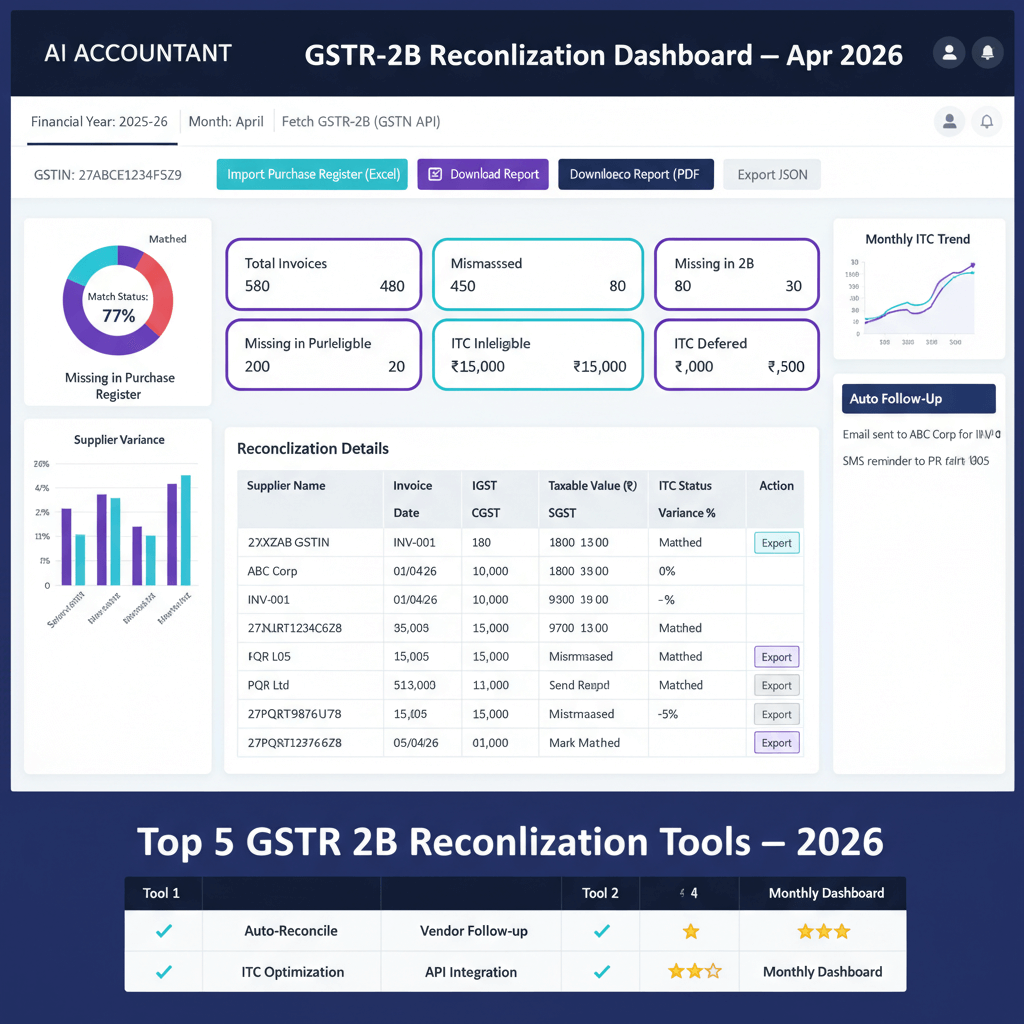
- monthly dashboard clarity on ITC available versus claimed, vendor wise aging, and trend analysis.
- Drill downs from high level KPIs into invoice detail, with export ready reports for CFOs and partners.
Your Step by Step Reconciliation Workflow
Step 1: Import Your Data
Load GSTR 2B via JSON or auto fetch, then upload purchase registers and credit notes. The system performs pre checks immediately, duplicates and invalid GSTINs surface before matching begins.
Fix early, reconcile faster.
Step 2: Automatic Matching
Exact matches resolve first, fuzzy logic resolves near matches next. Results auto bucket into matched, partially matched, and unmatched. Match scores make review decisions simple.
Step 3: Handle Exceptions
For purchase register only items, defer ITC and trigger vendor reminders with specific invoice lists. For GSTR 2B only items, investigate timing differences or book the missed entry, then queue for next month if needed.
Step 4: Optimize ITC Claims
Apply eligibility rules, mark ineligible or on hold where required, and generate GSTR 3B workings with notes. You see what is claimed today, what is deferred, and why.
Step 5: Sync and Lock
Push reconciled outcomes to Zoho Books or Tally, ensure two way consistency, then lock the period and preserve audit trails.
Step 6: Review and Report
Use the monthly dashboard for a quick health check, share vendor compliance snapshots, and export reports for management.
Must Have vs Nice to Have Features
Must Have Features
- Robust multi rule matching to reliably match purchase register data with GSTR 2B.
- Two way exception detection to identify missing invoices, with automated follow ups.
- ITC claim optimisation, monthly dashboards, and seamless integration with Zoho Books or Tally.
- Security readiness, ISO 27001 and SOC 2 Type II, plus comprehensive audit trails and multi org support.
Nice to Have Features
- Supplier scoring, WhatsApp messaging, and anomaly detection using AI.
- API access and rule configurators for power users, helpful but not essential for most SMEs.
Edge Cases That Trip Up Basic Tools
Multi GSTIN structures where head office invoices and branches consume, cross branch credits, and period spanning credit notes expose weak matching engines. E invoice cancellations and amendments require IRN aware logic. RCM transactions and imports demand separate rules, while back dated 2B updates require disciplined deferral and reversal handling. OCR variance on scanned bills can also skew results, so test with real world samples before buying.
Building Your ROI Business Case
Most SMEs report 50 to 80 percent time saved. A 20 hour monthly process per GSTIN drops to 4 or 5 hours. At ₹500 per hour, that is roughly ₹8,000 saved in labor per GSTIN per month. ITC recovery improves by 5 to 15 percent. On ₹50 lakh monthly purchases, recovering 10 percent of previously missed ITC yields about ₹50,000 extra working capital each month.
- Time saved, 15 hours at ₹500, ₹7,500
- Additional ITC recovered, ₹40,000 average
- Penalty avoidance, ₹5,000 estimated
- Total monthly benefit, ₹52,500
Against a tool cost near ₹5,000 to ₹10,000 per month, payback arrives within weeks, not months.
Top GSTR 2B Reconciliation Tools for 2026
1. AI Accountant
End to end automation from data ingestion to vendor follow up, with a reliable fuzzy matching engine that tolerates noisy vendor data. Strong ITC optimisation, clean GSTR 3B mapping, and straightforward monthly dashboards. Integrations with Zoho Books and Tally are native. The platform has processed hundreds of millions of transactions and maintains ISO 27001 and SOC 2 Type II certifications.
2. Octa GST
Focused GST workflows with supplier dashboards and strong handling for international transactions. Direct GSTN fetch and multi channel reminders help at scale.
3. RealBooks
Reconciliation within a broader accounting suite, audit trails are comprehensive, and month end close accelerates through automation.
4. TaxBuddy
AI powered fuzzy matching, direct portal fetches, and optional expert review for complex reconciliations. Scales for enterprises.
5. Vyapar TaxOne
SME friendly pricing and templates, simple to adopt, covers the core reconciliation and follow up needs without heavy configuration.
Your 7 Day Pilot Plan
Days 1 to 2: Setup and Import
Load the last three months of GSTR 2B and purchase data, configure tolerances, map ledgers, and prepare vendor templates.
Days 3 to 4: Test Core Features
Run reconciliation, inspect fuzzy matches, validate eligibility tagging, and send sample vendor reminders. Try bulk corrections to gauge throughput.
Day 5: Integration Testing
Post adjustments to your accounting system, verify mirrored balances, and generate GSTR 3B workings with audit trails.
Day 6: Reporting and Analysis
Review the monthly dashboard, export management reports, and compare against your current baseline.
Day 7: Evaluation and Decision
Score against must haves, quantify hours saved and ITC recovered, collect user feedback, and decide go or no go. If go, plan a phased rollout, if not, iterate with the next tool using these learnings.
Important Compliance Note
Tools streamline compliance, they do not replace professional judgment. ITC requires receipt of goods or services, supplier payment, and business use conditions in addition to appearance in GSTR 2B. Always review edge cases, document positions, and consult a qualified tax advisor for complex scenarios.
Moving Forward with Confidence
The right platform will match purchase register entries accurately, identify missing invoices quickly, and automate vendor follow up consistently. With ITC claim optimisation and a clear monthly dashboard, your team spends time on analysis rather than data wrangling. Start a focused pilot, measure results, and scale with confidence.
FAQ
How do GSTR 2B reconciliation tools differ from Excel based checking for a CA firm?
Excel relies on manual entry and VLOOKUPs, which are error prone and slow. A reconciliation tool automates data fetch and import, applies configurable matching rules, and preserves audit trails. Vendor reminders go out automatically, dashboards update instantly, and accuracy improves significantly. Firms using AI Accountant report faster close cycles and fewer reversals.
What matching logic is optimal for Indian GST, given timing differences between GSTR 1 and 2B?
Layered logic works best, exact GSTIN and invoice number first, then fuzzy rules for names, dates, and small amount tolerances, with date proximity windows for month end timing shifts. Configurability is key, CA firms can tune tolerances by client risk profile. AI Accountant supports rule templates per client, which standardizes outcomes across portfolios.
How should I treat invoices present in the purchase register but missing in GSTR 2B this month?
Defer ITC for those invoices, trigger automated supplier reminders listing invoice numbers, amounts, and dates, and track responses. Reconcile again after the vendor files, then claim deferred ITC with documentation. Tools like AI Accountant automate deferral tagging and reminder cadences, which reduces misses.
Can vendor follow ups be fully automated without losing control over tone and content?
Yes, modern tools provide customizable templates, sender controls, and escalation ladders. You can vary tone for first, second, and final reminders, include invoice tables, and route disputes to a shared mailbox. AI Accountant supports email, SMS, and optional WhatsApp, with reply tracking and vendor health scores.
What dashboard metrics do CFOs and engagement partners usually want to see every month?
Top metrics include ITC available versus claimed, deferred ITC aging, vendor wise non filing rates, mismatch trends, and reconciliation cycle time. Drill downs to invoice detail are essential for board packs. AI Accountant provides exportable summaries and client wise views for CA firms.
How do tools handle credit notes, amendments, and IRN cancellations across periods?
Advanced systems map references to original invoices, apply netting rules by period, and flag cross period effects that impact GSTR 3B. They track IRN linkages and generate audit notes. AI Accountant maintains a chain of custody for changes, which simplifies assessments.
What about RCM and import transactions, do they need a separate workflow?
Yes, RCM and imports follow distinct eligibility and timing rules. A good tool recognizes such lines during ingestion, routes them to dedicated buckets, and prepares separate working papers. AI Accountant includes RCM specific checks so nothing gets mixed with regular credits.
Is ISO 27001 or SOC 2 certification necessary for GST data processing tools?
For CA firms handling multiple clients, security certification is now expected. It reduces vendor risk and accelerates client onboarding reviews. AI Accountant holds ISO 27001 and SOC 2 Type II, which aligns with enterprise security checklists.
How can a CA quantify ROI to justify switching from manual reconciliation?
Measure three drivers, time saved per GSTIN per month, incremental ITC recovered, and penalties avoided. Add soft benefits like faster close and lower review fatigue. AI Accountant users often see 50 to 80 percent time savings, plus steady ITC uplift from systematic vendor follow up.
Can AI powered anomaly detection replace human review in reconciliation?
It can prioritize risk and highlight unusual patterns, yet it should not replace professional judgment. Use AI signals to focus reviewer time where it matters, for example high value mismatches or chronic vendor lapses. AI Accountant blends AI scoring with rule based matching, then keeps a human in the loop for final sign off.
What is the best way to pilot a reconciliation tool across multiple GSTINs in a CA practice?
Pick two or three representative clients, import three recent months, tune tolerances, and run a full cycle including vendor follow ups and 3B workings. Track time taken and issues surfaced. With AI Accountant, firms typically complete a meaningful pilot in seven days, then roll out in waves per industry vertical.
How does two way sync with Tally or Zoho Books reduce rework for accountants?
Once reconciled, adjustments and deferrals push back automatically, ledger mapping remains consistent, and closed periods stay locked. This prevents duplicate entries and last minute surprises. AI Accountant supports push and pull sync, which keeps the GL aligned with reconciliation status throughout the month.

Rohan Sinha is a fintech and growth leader building aiaccountant.com, focused on simplifying accounting and compliance for Indian businesses through automation. An IIT BHU alumnus, he brings hands-on experience across 0 to 1 product building, growth, and strategy in B2B SaaS and fintech.