-01%201.svg)
Key takeaways
- GSTR-2B is the static, authoritative source for ITC, GSTR-2A is dynamic and best for early warnings, reconcile with 2B for final claims.
- Must have capabilities include accurate match of purchase register, rapid identification of missing invoices, ITC claim optimisation, vendor follow up automation, and a decision ready monthly dashboard.
- Modern tools convert chaos into clarity through fuzzy matching, reason codes, and audit trails, saving time, recovering ITC, and reducing risk.
- CA firms and SMEs benefit the most, especially when handling multi GSTIN operations, amendments, ISD, and RCM complexities.
- Use an evaluation checklist covering coverage, matching accuracy, ITC controls, vendor workflows, dashboards, integrations, scale, governance, security, implementation support, and pricing.
- Standout options for 2026 include AI Accountant, ClearTax, EasyGST, Zoho Books, expressGST, LEDGERS, and uBOOKS.
Introduction
Picture this, it is the 15th, you are racing to reconcile thousands of purchase invoices against GSTR-2B before filing. Monthly reconciliation is mission critical for accurate ITC and cash flow. Since GSTR-2B is the static, authoritative snapshot of supplier reported credits, it dictates what you can actually claim.
Without reliable tooling, delays become routine, mismatches erode working capital, and vendor disputes flare up. The right platform can flip that script, automating the match of purchase register entries, surfacing missing invoices, enabling ITC claim optimisation, orchestrating vendor follow ups, and presenting a crisp monthly dashboard for control.
The promise, fewer clicks, faster closes, higher ITC realization, and cleaner audits.
GSTR-2B vs GSTR-2A, the key primer
GSTR-2B is generated on the 12th, a static picture that does not change. Claim ITC with reference to 2B. GSTR-2A is a real time feed that keeps updating as suppliers file or amend returns. Useful for monitoring, not for final claims.
Reconciliation ensures your claims mirror 2B, and it also separates eligible, ineligible, and deferred credits, including blocked credits under Section 17(5). The outcome, accurate claims today, fewer reversals tomorrow, a confident audit trail always.
Core problems these tools solve
The data chaos problem
Purchase data sprawls across ERPs and spreadsheets, vendor GSTINs contain typos, invoice formats vary. Consolidation feels like assembling a puzzle from mixed boxes.
The manual matching nightmare
Excel based VLOOKUPs and filters buckle under volume, tiny mistakes cause big ITC misses, fatigue multiplies errors.
The vendor chase game
Generic reminders do not work. You need invoice level diagnostics, what is missing, why it is missing, what action the vendor must take, and by when.
The visibility gap
Month end questions go unanswered, what is eligible, what is blocked, what is deferred, what changed since last month. Without a unified view, you fly blind.
Must have capabilities in a GSTR-2B reconciliation tool
Match purchase register
Auto ingest PR, JVs, credit and debit notes from ERPs and files, normalize formats, then apply multi key fuzzy matching on GSTIN, invoice number, date, taxable and tax values. Smart tolerance handles rounding, minor date drift, and small amendments without false mismatches.
Example, your books show ₹1,18,000, 2B shows ₹1,17,999, the engine tags it as matched with a rounding note, not a mismatch.
Identify missing invoices
Spot invoices present in PR but absent in 2B, and vice versa. Diagnose root causes, supplier non filing, wrong GSTIN in master, period mismatch, pending amendment. Add aging, financial impact, and status tags such as Matched, Mismatched, Missing, for laser focused action.
ITC claim optimisation
Classify eligible, ineligible, and deferred credits. Apply rules for sequence of claims, handle amendments and CN or DN impacts, maintain a claim log so you never over claim. Generate regulatory ready ITC reports for management and audit.
Vendor follow up automation
Issue lists per vendor with invoice numbers, dates, amounts, and reasons. Automate reminders by email or WhatsApp, track acknowledgments, escalate based on SLA, and publish vendor scorecards on timeliness and impact on your ITC.
Monthly dashboard
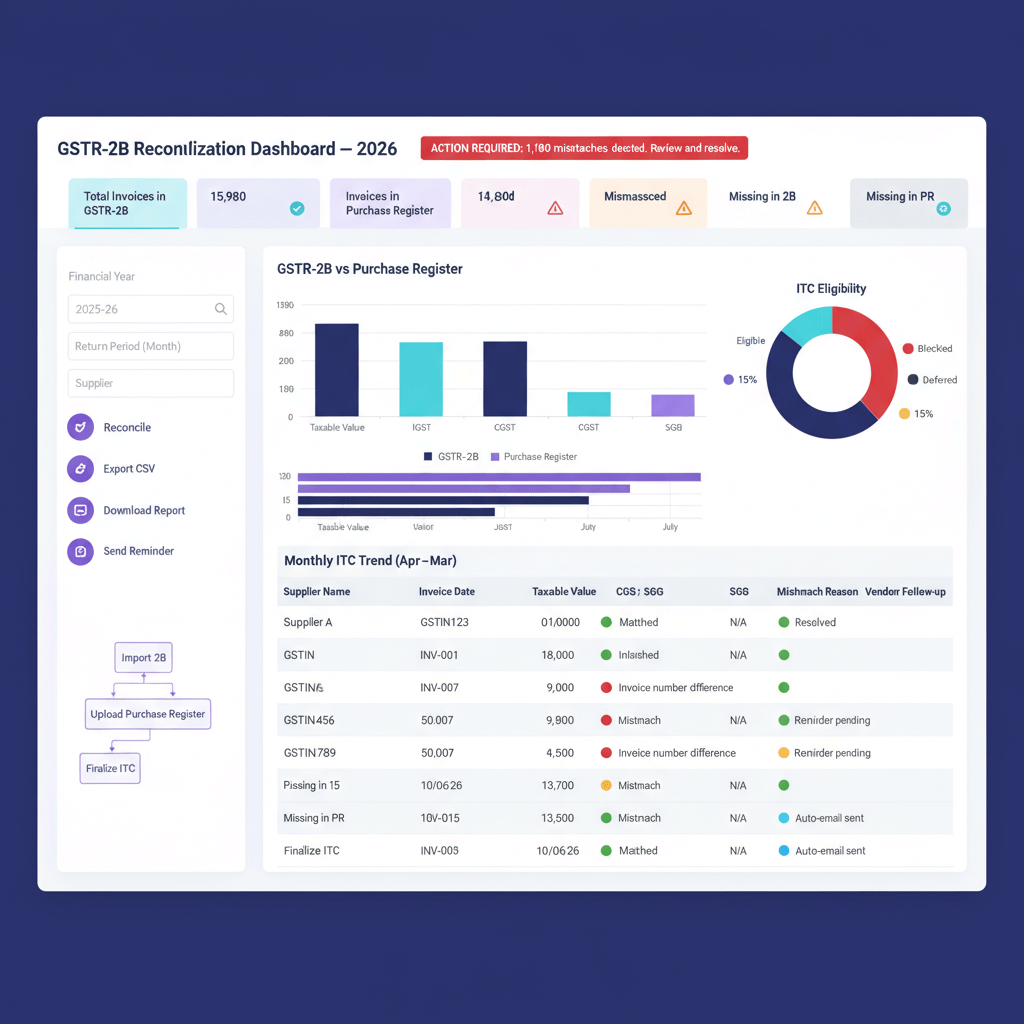
Your command center, a monthly dashboard that shows eligible, ineligible, deferred ITC, trends, variances, high risk vendors, and missing invoice counts and values. Click through from summary to transaction to close gaps quickly.
Integrations and data handling
Sync with Zoho Books and Tally, handle CSV or Excel, maintain end to end audit trails, enable maker checker, role based access, and multi organization management for CA firms. Security should include encryption, ISO 27001, and SOC 2.
Top GSTR-2B reconciliation tools for 2026
1. AI Accountant
Intelligent automation for 2B reconciliation, with seamless Zoho Books and Tally sync. High accuracy PR matching, deep root cause for missing invoices, strong eligibility and deferral logic, automated vendor follow up, and a powerful monthly dashboard. Built for multi org CA operations, with ISO 27001 and SOC 2 Type II, and large scale throughput.
2. ClearTax
Comprehensive GST compliance with robust reconciliation, strong reporting, validation against returns, and support for complex scenarios such as ISD and RCM. Good audit trails and vendor communication tools.
3. EasyGST
Designed for CA firms that need scale and simplicity. Clear Matched or Mismatched or Missing statuses, quick exception handling, and smooth delegation to junior staff.
4. Zoho Books
Great fit for the Zoho ecosystem. Integrated PR matching, reconciliation dashboards, and cohesive workflows across finance apps.
5. expressGST
Speed focused filing and reconciliation, quick 2A or 2B mismatch reminders, and brisk workflows for teams that prize turnaround time.
6. LEDGERS
Accurate PR to 2B matching with solid normalization across invoice formats. Straightforward flows for SME requirements.
7. uBOOKS
Dashboard driven reconciliation with helpful visual drill downs. Multi level views to analyze discrepancies by vendor, category, or period.
Evaluation checklist for choosing your tool
Coverage requirements
- PR, JV, CN or DN, ISD, RCM coverage.
- Handles cross period amendments.
- Performance at your transaction volumes.
Matching accuracy
- Configurable rules and tolerances.
- Exception UI for edge cases.
- Bulk actions for mass resolution.
ITC control features
- Industry specific eligibility rules.
- Clear 17(5) blocked credit tagging.
- Customizable deferral logic.
Vendor workflow capabilities
- Customizable message templates.
- SLA tracking and escalations.
- Evidence archive of communications.
Dashboard and reporting
- Decision ready monthly dashboard.
- Comprehensive MIS with exports.
- Drill down from summary to line item.
Integration ecosystem
- Native Zoho Books and Tally sync.
- APIs for custom integrations.
- Legacy data imports without friction.
Scale and performance
- High monthly transaction ceilings.
- Low latency on large datasets.
- No slowdowns during filing peaks.
Governance features
- Immutable audit logs.
- Role based access aligned to your org.
- Configurable maker checker workflows.
Security standards
- ISO 27001 certification.
- SOC 2 Type II compliance.
- End to end encryption at rest and in transit.
Implementation support
- Clear onboarding plan and timeline.
- Team training and enablement.
- Responsive support, chat, email, phone.
Pricing structure
- Per entity or usage based pricing clarity.
- No hidden fees for key features.
- Transparent base versus add on matrix.
End to end workflow example
Step 1, data import
On the 12th, import your PR from ERP, fetch GSTR 2B automatically from the portal, or upload the JSON, ready to reconcile.
Step 2, automated matching
Run the matching engine, thousands of invoices matched in minutes, categorized with reasons and confidence scores.
Step 3, exception review
Work the exceptions queue, focus on mismatched and missing, each with root cause diagnostics and recommended actions.
Step 4, vendor communication
Trigger vendor follow ups with invoice specifics, automate reminders and escalations, track acknowledgments.
Step 5, ITC optimisation
Apply rules to finalize eligible and deferred ITC, ensure no over claim, prepare claim logs and reports.
Step 6, posting and closure
Post reconciled entries back to Tally or Zoho Books, lock the period, preserve the audit trail.
Step 7, management review
Present the monthly dashboard, analyze trends, assign actions, and improve next month’s plan.
ROI and business case
Time savings
Manual matching averages 2 minutes per transaction. At 5,000 invoices, that is 167 hours. At ₹500 per hour, you spend ₹83,500. Automation cuts 80 to 90 percent, saving ₹66,800 to ₹75,150 monthly.
ITC recovery
Businesses often miss 3 to 8 percent of eligible ITC. On ₹10 lakh monthly ITC, a 5 percent recovery unlocks ₹50,000 of working capital, month after month.
Faster closes and lower risk
Close 3 to 5 days faster, improve reporting confidence, and avoid interest or penalties through accurate, documented claims.
Mini case study
A Bangalore based CA firm handling 25 SMEs moved from spreadsheets to a modern platform. Reconciliation time fell 60 percent, ITC recovered increased 15 percent via systematic vendor nudges, and closes moved up by 5 days. The monthly dashboard reframed client conversations from firefighting to strategy.
Implementation tips for success
Start with clean data
Fix vendor masters, verify GSTINs, standardize names. Clean inputs cut exception noise dramatically.
Configure thoughtfully
Set tolerances that avoid false mismatches yet catch real discrepancies. Test with real data before scaling.
Standardize communication
Templates for missing invoices, amendments, and GSTIN corrections lead to faster vendor action.
Pilot before scaling
Begin with one entity, refine, then roll out. Adoption improves when wins are visible early.
Train your team
Tools amplify skilled users, invest in training on both product and GST rules.
Compliance note
Automation does not replace professional judgment. Complex reversals, proportionate credits, or nuanced 17(5) interpretations still need an expert review. Tools align claims to 2B, you remain responsible for compliance.
Future of GSTR-2B reconciliation
AI powered predictions
Models will forecast vendor filing behavior so you can preempt ITC leakages.
Real time reconciliation
Continuous checks will surface gaps during the month, not after the 12th.
Integrated compliance
Unified platforms will connect e invoicing, reconciliation, and returns in one flow.
Blockchain verification
Instant invoice authenticity checks could shrink reconciliation timelines further.
Conclusion
Reconciliation need not be a monthly scramble. The right toolset matches purchase registers accurately, flags and fixes missing invoices, enables ITC claim optimisation, automates vendor follow up, and informs decisions with a powerful monthly dashboard.
Use the checklist, run a pilot, then scale confidently. If you want to see what great looks like, book a 30 minute walkthrough of AI Accountant for your data. Every day you delay is potential ITC sitting unclaimed, act now, your cash flow will thank you.
FAQ
How often should a CA firm reconcile PR with GSTR-2B across multiple GSTINs?
Run a mid month preliminary pass using 2A for directional insight, then finalize after the 12th with 2B for actual ITC claims. For multi GSTIN clients, consolidate for management review while keeping GSTIN wise ledgers separate for filing and audit. AI Accountant supports both consolidated and GSTIN wise views, making this cadence smooth.
What matching tolerances are acceptable for invoice value differences, for example rounding by ₹1 or ₹2?
Most practitioners allow small absolute tolerances for rounding, for example up to ₹2 on line or header totals, plus date variances of a few days if tax periods still align. Configure tolerances conservatively, review exceptions, and document policy in your SOP. AI Accountant lets you set field wise tolerances and records the rationale in the audit trail.
How do I treat amendments, B2BA, and credit or debit notes when reconciling with 2B?
Link amendments to the original invoice, recompute net taxable and tax amounts, and ensure the net claim equals the sum of the original plus or minus adjustments. Good tools automatically stitch the chain, present a single view, and prevent double counting. AI Accountant maps amendment references and shows a single net position for ITC decisions.
What is the recommended approach for ITC reversals under Rule 37, 42, and 43 in a monthly close?
Segregate reversals from 2B based eligibility. Rule 37 relates to non payment to vendors within 180 days, Rule 42 and 43 address common credits and capital goods. Maintain separate working papers with formulas, and automate if your tool supports it. AI Accountant provides rule driven schedules that post adjustments and track reclaims when conditions are met.
How should I handle ISD and RCM transactions in reconciliation and ITC claim control?
ISD credits should flow to the correct recipient GSTIN with proper document mapping. RCM liabilities must be paid in cash before ITC is availed. Use a tool that isolates these categories and validates prerequisites. For RCM concepts and workflows, see Input Service Distributor (ISD) and Reverse Charge Mechanism (RCM), and consider AI Accountant’s dedicated ISD and RCM modules for automated checks.
What evidence should I maintain for vendor non compliance to defend my ITC position?
Maintain invoice copies, proof of receipt of goods or services, payment proofs, and a complete trail of vendor communication with timestamps and message content. A system that archives reminders and acknowledgments creates strong audit defense. AI Accountant retains vendor notices, read receipts where available, and escalation logs for this purpose.
How does AI Accountant automate vendor follow ups, and can it use WhatsApp or email with SLAs?
AI Accountant generates vendor wise exception lists, sends targeted WhatsApp or email reminders with invoice details, tracks delivery and reads when supported, and escalates based on SLA tiers. It also builds vendor scorecards highlighting chronic delays, helping you drive supplier governance with data.
What is the minimal audit trail a GST auditor expects from a reconciliation tool?
Expect user, timestamp, action, before and after values, and a reason or comment for overrides. The trail should be immutable and exportable. Attachments for supporting documents strengthen the record. AI Accountant maintains a line item level ledger of changes with exportable logs, meeting typical audit expectations.
How do I book deferred ITC when invoices are in PR but not reflected in 2B for the month?
Post the expense, park the ITC in a deferred account, claim only when it appears in 2B, and reconcile the movement. Your tool should tag such invoices automatically and generate a deferred ITC schedule. AI Accountant automates deferral tagging and posts schedules that are easy to review and reverse when eligible.
Can I integrate reconciliation with Tally and Zoho Books without manual file handling?
Yes, choose a tool with secure connectors and APIs. Schedule syncs on the 12th and during close, push reconciled adjustments back to the ERP, and lock periods. AI Accountant offers native integrations for Tally and Zoho Books, along with API endpoints for custom flows.
What KPIs should a CA track on the monthly dashboard to manage ITC risk?
Track eligible versus ineligible versus deferred ITC, month on month variance, missing invoice count and value by age buckets, top risky vendors, and exception clearance time. AI Accountant’s dashboard highlights these KPIs with drill downs so partners and managers can act quickly.
How should I pilot a reconciliation tool for a multi entity client portfolio?
Select one entity with representative complexity, define success metrics, for example time saved, ITC recovered, exception backlog cleared, run for two cycles, document SOPs, then roll out. Include training, vendor communication templates, and governance checks. AI Accountant provides a pilot playbook to accelerate this journey.

Rohan Sinha is a fintech and growth leader building aiaccountant.com, focused on simplifying accounting and compliance for Indian businesses through automation. An IIT BHU alumnus, he brings hands-on experience across 0 to 1 product building, growth, and strategy in B2B SaaS and fintech.