-01%201.svg)
Key takeaways
- Automating GSTR 1 turns last minute firefighting into a predictable, review first workflow that cuts late fees and errors dramatically.
- Automated validations for GSTIN, HSN, tax rates, and place of supply prevent portal rejections before they happen, improving Input Tax Credit confidence for your customers.
- Continuous invoice number reconciliation catches gaps and duplicates early, saving hours of manual checks across months.
- Push invoices to portal through JSON and API upload, with automatic retries and complete audit trail for every action.
- Build a maker checker review with CA sign off so exceptions are resolved quickly, not on the filing deadline.
- Use alerts from a robust GST return calendar with reminders to eliminate avoidable penalties.
- The right GSTR 1 automation software pays for itself through time savings, fewer notices, and better customer ITC outcomes.
Quick primer on GSTR 1 for startups
GSTR 1 is your monthly report to the government about outward supplies, it feeds your customer’s GSTR 2A and impacts their ITC. Accuracy is non negotiable because mismatches can block credit and trigger disputes.
Miss the deadline and late fees start at Rs 200 per day, which compounds when you manage multiple GSTINs or miss credit note adjustments. The usual culprits are invalid GSTIN formats, B2B posted as B2C, gaps in invoice sequences, and HSN rate mismatches.
Think of automation as a safety net that validates every invoice, reconciles sequences, and pushes only clean data to the portal, so your team reviews exceptions rather than firefights failures.
If you are evaluating options, this overview of best GST software in India and a deep dive into GSTR 1 automation software will help set a benchmark for features and outcomes.
What good GSTR 1 automation looks like
Practical automation starts with clean ingestion, continues with rigorous validations, and ends with a seamless push to the portal, all under CA review.
- Direct ingestion from Tally, Zoho Books, and spreadsheets, everything normalized to standard fields.
- Automated validations for GSTIN checksum, place of supply, HSN to tax rate mapping, and correct section classification for B2B, B2C Large, and exports.
- Invoice sequence reconciliation, catch gaps instantly, link credit notes and amendments to originals, and flag duplicates across periods.
- Maker checker workflow, accountants prepare while CAs review, comment, and approve, with complete audit trail.
- Push via JSON or GSP APIs with auto retry, status tracking, and failure handling, guided by proven approaches such as GSTR 1 filing reconciliation automation and automate GSTR 1 filing with GST API integration.
- Proactive alerts from a GST return calendar with reminders so deadlines never slip.
For alternatives and comparisons, explore smart GST automation guide alongside the best GST software in India round up.
Step by step workflow blueprint
Step 1, connect your books
Sync Tally or Zoho Books so customers, items, and tax masters flow in automatically, creating a single source of truth.
Step 2, ingest all invoices
Pull sales from ERP, exports from shipping docs, and ad hoc Excel files, then auto bucket into B2B, B2C, and export categories.
Step 3, reconcile invoice numbers
Scan sequences across months, flag gaps and duplicates, and auto link amendments and credit notes. If you use e invoicing, consult this e invoice IRN and QR integration guide to catch IRN mismatches early.
Step 4, run pre filing validations
Validate GSTIN formats and checksums, HSN mapping to tax rates, and place of supply, then bulk fix errors with reasons captured for audit.
Step 5, set up CA review workflow
Use maker checker controls, keep comments on specific line items, and lock the period once sign off is complete.
Step 6, push invoices to portal
Generate JSON, upload via API, and auto retry only failed items, not the entire batch.
Step 7, follow a monthly checklist
Close books by the 5th, reconcile invoice numbers, run validations, review summaries, get CA sign off, push to portal, then verify filing against GSTR 3B using this guide to match GSTR 1 with GSTR 3B totals. Archive acknowledgments and JSON files.
Tool recommendations for GSTR 1 automation
- AI Accountant, Complete GSTR 1 automation, deep Tally and Zoho Books integration, live reconciliation, and CA review workflows.
- ClearTax, A comprehensive GST suite with bulk uploads and reconciliation, suitable for broad compliance coverage.
- Zoho GST, Best if you are already on Zoho Books, smooth data flow for single stack setups.
- TaxPro GST, Strong reconciliation and portal integration, preferred by CA firms managing many clients.
- Masters India, Reliable for high volume filers with robust API support and validations.
- Gen GST, Budget friendly for small startups, workable with Excel based workflows.
Cross check features using this practical overview of best GST software in India and this hands on guide to GSTR 1 automation software.
How AI Accountant fits in
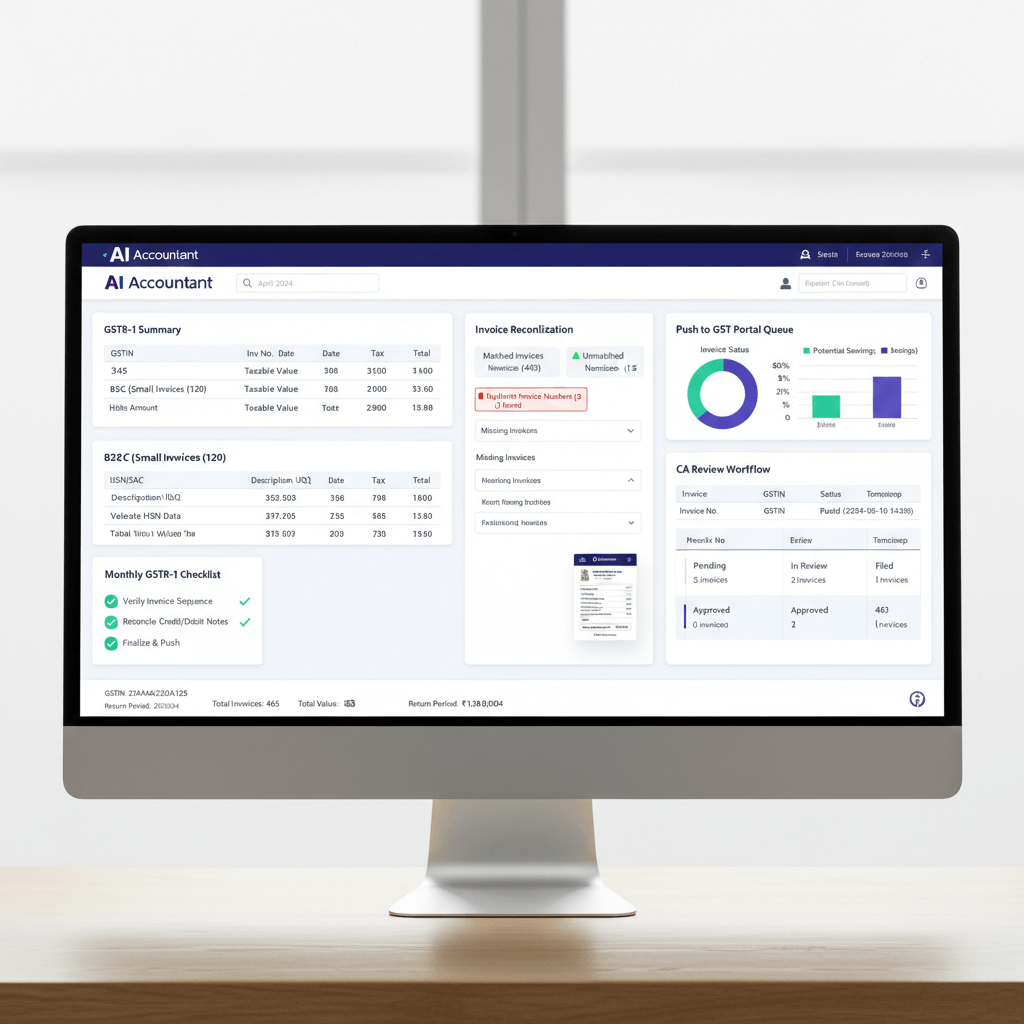
AI Accountant connects to Zoho Books and Tally, ingests CSVs and Excel files, and normalizes everything into a clean dataset ready for filing. The platform continuously reconciles invoice numbers, links credit notes to originals, and flags duplicates across periods.
Exceptions can be bulk edited, every change is logged for audit. When ready, the system generates portal ready JSON, pushes via API, tracks status, and retries only failed items. CA review is built in with multi org support and automated reminders to reduce late fees.
Learn more in this deep dive on GSTR 1 automation software.
Edge cases and best practices
Credit and debit notes
Always link credit notes to original invoices, track cancellations separately when e invoicing is involved, and preserve the audit trail for amendments.
Export and SEZ supplies
Validate LUT or bond details, capture shipping bill numbers, and ensure correct zero rated treatment for SEZ with documentation pre verified.
B2C threshold management
Auto split B2C Large above Rs 2.5 lakh at state level, keep state wise buckets to avoid reconciliation issues later.
Advance receipts and reverse charge
Track advances distinctly, auto adjust them when the invoice is raised, and maintain a reverse charge register for clarity during filing.
Period locking
Lock the period after filing, avoid backdated edits, and archive JSON plus acknowledgments for assessments and audits. For deeper automation options, see GSTR 1 filing reconciliation automation and automate GSTR 1 filing with GST API integration.
ROI and timing
Most startups processing 500 to 1000 invoices spend 3 to 5 days on manual prep, automation brings that down to a few hours of review and approval.
- Time savings, often 60 to 80% within the first cycle.
- Error reduction, validations push error rates under 5% from the typical 15 to 20% in manual runs.
- Reconciliation accuracy, more than 95% of invoice numbering issues caught before filing.
- Penalty avoidance, fewer rejections and faster closure reduce late fees significantly.
Start with a one month sandbox, validate outputs against your manual filings, then roll out entity by entity. For market context and adoption stories, explore smart GST automation guide and how tax tech adoption is accelerating in how India’s tax tech startups are rising.
Buyer’s checklist
Must have features
- Invoice number reconciliation across periods, without this, manual checks persist.
- Strong validations for GSTIN, HSN, tax rates, and section classification.
- Maker checker CA workflow with role based access and full audit trail.
- Direct JSON and API push to portal with automatic retry and status tracking.
Good to have features
- Confidence scores on auto classifications so reviewers focus on high risk items.
- Granular permissions, automated reminders, and escalations to cut late fees.
- Native connectors for Tally and Zoho Books, plus flexible JSON import and export.
Integration requirements
- Compatibility with your ERP and invoice data formats, including CSV and Excel.
- APIs and webhooks for custom flows, with support for complex scenarios like SEZ or composition.
Evaluation framework
- Test with your real data for a full cycle, ingestion to portal upload to acknowledgment.
- Compare pricing models, per invoice versus flat fee, and include implementation effort.
- Benchmark against references like GSTR 1 automation software and this best GST software in India overview.
FAQ
As a CA managing multiple GSTINs, how do I reconcile invoice numbers across months without spreadsheets?
Use an automation platform that continuously scans sequences at source, not after export. The system should flag missing numbers, duplicates across periods, and link amendments and credit notes to the original invoice. Tools like AI Accountant maintain a real time register, so you review exceptions rather than running ad hoc Excel checks.
How do I push invoices to the GST portal via API without creating duplicates or partial uploads?
Follow a strict pre upload flow, validate GSTIN, HSN, tax amounts, and sections, generate JSON with unique batch identifiers, and use an API uploader that tracks item level status. If an upload fails mid batch, the system retries only failed items. For method options, review automate GSTR 1 filing with GST API integration.
What maker checker controls are adequate for audit readiness?
Separate preparer and reviewer roles, enforce CA sign off before upload, keep inline comments on line items, and lock the period after filing. Every edit should carry user, timestamp, and reason, forming a defensible audit trail. AI Accountant implements this with queue based reviews and period locking.
How should I structure a monthly GSTR 1 checklist for my startup clients?
Day 1 to 5, close books and confirm all documents. Day 6 to 7, run invoice sequence reconciliation and fix gaps. Day 8, validate GSTIN, HSN, tax rates, and place of supply. Day 9, review section wise summaries. Day 10, CA sign off and API push. Day 11, verify and archive acknowledgments. Align reminders with this GST return calendar with reminders.
Can automation handle B2C Large splits state wise and avoid misclassification?
Yes, modern tools auto classify B2C Large above Rs 2.5 lakh and maintain state buckets. During review, you can filter by state and value thresholds to fix outliers quickly. AI Accountant provides this classification with confidence flags so reviewers focus on edge cases.
How do I verify that GSTR 1 aligns with GSTR 3B totals before filing?
Use a reconciliation that maps section wise GSTR 1 data to 3B buckets and highlights deltas by tax rate and place of supply. Resolve exceptions, then re run the check. This walkthrough on how to match GSTR 1 with GSTR 3B totals is a reliable reference.
What is the recommended approach to e invoicing validations in the GSTR 1 workflow?
Validate IRN presence, verify QR code meta, and ensure cancellations and credit notes are linked to the original IRN. Mismatches should block filing until corrected. See the e invoice IRN and QR integration guide for a practical checklist.
How does automation actually reduce late fees for clients with frequent exceptions?
Three levers drive results, reminder driven starts, faster exception handling with bulk corrections, and fewer portal rejections due to pre validations. Firms adopting AI Accountant typically report a sharp fall in last day fixes, which directly reduces penalties.
Can I manage exports and SEZ supplies without manual cross checks?
Yes, set rules to require LUT or bond numbers, capture shipping bill numbers, and verify zero rated treatment before upload. The system should flag missing documents and prevent misclassification. Platforms that follow the guardrails in GSTR 1 filing reconciliation automation handle these reliably.
What is a realistic implementation timeline for a single entity on Tally or Zoho Books?
Most go live in 3 to 5 days, day 1 integration, day 2 historical import and validations, day 3 workflow configuration and user training, day 4 to 5 parallel run and production filing. Multi entity or custom flows may need 2 to 3 weeks. AI Accountant provides guided onboarding to compress timelines.
How do I prevent backdated changes from breaking parity with filed returns?
Lock the period after filing, and require an explicit unlock permission with reasons captured if a change is unavoidable. Maintain archived JSON and acknowledgments for every filing. This protects you during assessments and avoids drift between books and portal.
Which references should I use to benchmark reconciliation and API capabilities?
Combine practitioner focused guides like smart GST automation guide, market roundups such as best GST software in India, and platform explainers like GSTR 1 automation software so you assess both features and field outcomes.
Getting started with GSTR 1 automation
Start where pain is highest, invoice number reconciliation or validation errors, then expand to a full maker checker and API push workflow. A one month sandbox will prove time savings, accuracy gains, and penalty reduction within your first filing cycle.
The goal is a reliable, scalable process that grows with your business, where reconciliations are continuous, validations are automatic, and filings are timely without heroics. If you want a guided pilot, book a GSTR 1 automation mapping session and dry run your historical data to see how much rework and late fee risk you can eliminate with modern automation. For a comprehensive overview, review this guide to GSTR 1 automation software before you choose a tool.

Rohan Sinha is a fintech and growth leader building aiaccountant.com, focused on simplifying accounting and compliance for Indian businesses through automation. An IIT BHU alumnus, he brings hands-on experience across 0 to 1 product building, growth, and strategy in B2B SaaS and fintech.