-01%201.svg)
Key takeaways
- An API for accounting automation connects banks, gateways, ledgers, and government portals, it moves data securely and reduces manual work.
- Core methods include REST or GraphQL, webhooks for real time events, OAuth2, and idempotency keys to prevent duplicates.
- Automations handle ingestion, journals, e invoicing, reconciliations, GST and TDS, compliance tracking, documents, and AI driven alerts.
- Adopt clean charts, canonical tax models, event driven flows, and a hub and spoke pattern as your stack grows.
- Measure outcomes with days to close, auto match rate, error rates, filing timeliness, and burn accuracy.
- In India, APIs help with e invoicing, GSTR flows, 2B reconciliation, TDS challans and returns, advance tax, and ROC tasks.
- AI Accountant delivers a CA led Virtual Accounting service that implements these APIs end to end, with a single dashboard for books, filings, documents, and chat.
API for Accounting Automation That Simplifies GST, TDS, and Bookkeeping
If you run a young company or freelance practice, you know the pain. Bank statements arrive late, invoices sit in email, GST and TDS dates creep up. Small errors turn into penalties. An API for accounting automation fixes this, it moves data between systems without manual work, helps you close books faster, improves accuracy, and gives you real time visibility. AI Accountant uses this approach in our CA led Virtual Accounting service and dashboard. This guide shows you how it works and how to start.
What is an API for accounting automation
An API for accounting automation lets systems talk to each other. It allows software to create, read, update, and delete financial data, moving records between your accounting system, bank, payment gateway, and even government portals, in a secure and repeatable way.
Common methods and types
- Methods: REST or GraphQL for reading and writing data, webhooks for real time events such as payment received, OAuth2 for safe sign in and permissions, idempotency keys to avoid duplicates on retries.
- Types: Accounting software APIs for journals, ledgers, invoices, and bills, financial data APIs from banks and payment gateways for transactions, fees, refunds, and settlements, government or compliance APIs including e invoice and e way bill systems where rules allow, internal service APIs for documents, storage, and user authorization.
Used well, APIs connect the dots across your finance stack, you get one flow from transaction to ledger to filing.
Further reading: Klamp on APIs in accounting, Bill on accounting APIs, Madras Accountancy on API integration.
Core capabilities enabled by an accounting API
- Data ingestion and normalization from bank statements and gateways, with cleaning and field mapping.
- Automated journal entries for AR, AP, accruals, and adjustments.
- Invoice creation and e invoicing, drafting invoices, pushing to the IRP where required, returning an IRN.
- Bank reconciliations, matching bank lines to invoices, bills, and payouts, flagging exceptions.
- Tax computations for GST place of supply, RCM, and HSN or SAC, plus TDS logic.
- Compliance tracking for GSTR 1, GSTR 3B, and GSTR 9, TDS returns, income tax tasks, and ROC items for small companies.
- Document capture and storage with audit trails.
- AI driven alerts that flag anomalies and late filings.
These features support the full cycle from transaction to report to filing.
Sources: Klamp, Bill, Madras Accountancy, Accounting Seed, Tipalti.
Benefits and outcomes from API for accounting automation
- Faster month end close, with daily data flow and rolling reconciliations.
- Fewer errors, consistent mappings, and duplicate prevention.
- Real time visibility into revenue, expenses, cash, and runway.
- Proactive compliance that avoids penalties.
- Lower cost through reduced manual work and rework.
- Better cash flow planning with current data.
- Scales smoothly as you add banks, gateways, and GSTINs.
Teams that automate see close time drop, error rates fall, and compliance stay on track, even as volume grows.
Sources: Klamp, Bill, Madras Accountancy, Tipalti, Accounting Seed.
Architecture patterns for accounting API integration
Your setup shapes how you wire systems together. See a related guide: Cloud accounting integration in India.
- Point to point for simple stacks, one ledger and one or two banks.
- Hub and spoke or iPaaS for complex stacks, a central hub routes data between many apps across entities and GSTINs.
- Event driven flows, prefer webhooks over polling.
- Canonical data models, one standard chart and tax schema, map all sources to it.
- Single pane dashboards for financials, compliance dates, documents, and CA chat.
Sources: Klamp, Madras Accountancy.
Implementation blueprint for API for accounting automation
Use a phased plan, keep it simple, test as you go.
Step 1. Map requirements
- List ledgers and entities.
- List GSTINs, bank accounts, and gateways.
- Note payroll inputs and outputs.
Step 2. Standardize your structure
- Lock a clean chart of accounts.
- Define tax configs, HSN or SAC, place of supply, RCM rules.
- Set naming rules for items and contacts.
Step 3. Select vendors and connectors
- Choose accounting software with a strong API.
- Pick bank aggregators or direct bank APIs.
- For India, connect to the IRP for e invoicing if applicable.
Step 4. Secure your stack
- Use OAuth2 for sign in.
- Encrypt data at rest and in transit.
- Follow data residency rules as needed.
Step 5. Build and test in sandboxes
- Use idempotent requests to avoid duplicates.
- Add retries for transient failures.
- Validate with sample invoices, bills, and bank files.
Step 6. Monitor and support
- Track latency, error rates, and backlog.
- Watch filing deadlines and webhook status.
- Set alerts for exceptions.
Sources: Madras Accountancy, Klamp, Bill, Tipalti.
India specific compliance automation with accounting APIs
- GST, generate e invoices via IRP where required, reconcile GSTR 2B against purchase data, prepare and file GSTR 1, GSTR 3B, and GSTR 9. Deep dive: GST reconciliation services for SMEs.
- TDS, compute TDS, create challans, and file 24Q or 26Q, keep records ready for checks.
- Income tax, calculate advance tax, prepare returns, create 15CA where applicable.
- ROC for small companies, prepare MGT 7, AOC 4, and DIR 3 KYC.
Edge cases arise, validate place of supply, RCM exemptions, state differences, and rate changes. When a CA led team monitors this, you get both automation and judgment. AI Accountant flags timelines and status in one dashboard.
Sources: Madras Accountancy, Accounting Seed.
Automation recipes using an API for accounting automation
Bank feed to reconciliation
- Fetch bank transactions daily.
- Categorize lines using rules.
- Match to invoices and bills.
- Post journals for matched items.
- Flag exceptions for review.
Invoice to cash with e invoicing
- Create invoice in the ledger.
- Push to IRP to generate e invoice if required.
- Send polite reminders on due dates.
- Record receipt and update AR.
- Roll up GST reports.
Procure to pay with RCM
- Ingest vendor bills.
- Validate HSN and place of supply.
- Accrue RCM where applicable.
- Process payment.
- Reflect tax impact in GSTR 3B.
Payroll to TDS
- Calculate monthly TDS for payroll.
- Generate challan.
- File 24Q on time.
- Publish payslips with final values.
Gateway settlements
- Fetch settlement reports.
- Account for fees and chargebacks.
- Reconcile with sales and bank credits.
Sources: Klamp, Bill, Madras Accountancy.
Security, risk, and compliance controls for accounting API
- Role based access for view, create, approve, and post.
- Maker checker approvals for sensitive actions.
- Idempotency to prevent duplicates on retries.
- PII protection with masking or encryption.
- Audit logs for every action and change.
- Vendor due diligence, prefer SOC 2 or ISO 27001 certified partners.
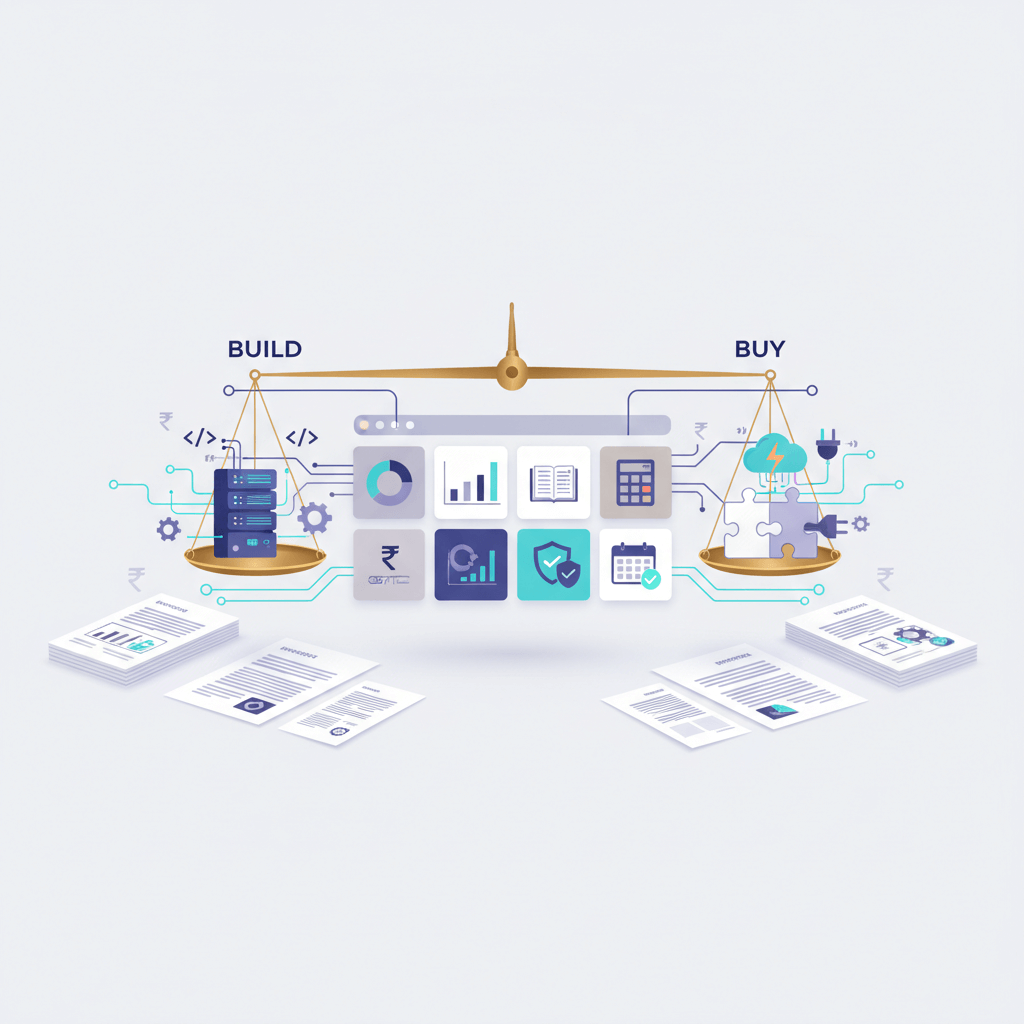
Build versus buy for API for accounting automation
Build in house
- Good if you have strong engineers and a clear roadmap.
- You control the flow and the code.
- You must maintain connectors and keep up with GST and TDS changes.
- Upkeep grows with your stack.
Buy a managed service
- Faster to value.
- CA led teams handle GST, TDS, and income tax daily.
- A dashboard unifies books, filings, and documents.
- Lower risk from changing rules.
AI Accountant offers CA led Virtual Accounting that uses APIs for bookkeeping, reconciliations, and filings, with one dashboard for financial data, compliance timelines, documents, and CA chat.
Source: Madras Accountancy.
Evaluation checklist for choosing an API for accounting automation
- Coverage across banks, gateways, GST, TDS, ROC, and payroll.
- Docs and SDKs with sandbox, samples, and clear versioning.
- Reliability with webhooks, retries, idempotency, and clear errors.
- Config for COA mapping and tax rules including HSN and RCM.
- Security with OAuth, logs, certification, and residency support.
- Support with engineering help and transparent pricing.
Sources: Madras Accountancy, Klamp, Bill, Tipalti.
KPIs to track after you implement an accounting API
- Days to close, aim to cut this quickly.
- Auto match rate for bank lines without human work.
- Error rates for failed posts and duplicates.
- Filing timeliness for GST, TDS, and other returns.
- Penalty avoidance, keep this at zero.
- Burn rate accuracy, compare forecast to actuals.
Sources: Bill, Tipalti, Accounting Seed, Klamp.
Common pitfalls and how to avoid them
- Non standard chart of accounts, enforce a canonical model before you integrate.
- Duplicate entries, use idempotency keys and safe retry logic.
- GST misconfigurations, validate HSN, place of supply, and RCM on input.
- Webhook misuse, verify signatures, handle replays and timeouts.
- Payment edge cases, test refunds, disputes, and chargebacks.
- No audit trails, require logs and approvals for sensitive actions.
Sources: Madras Accountancy, Klamp, Bill, Tipalti.
How AI Accountant operationalizes an API for accounting automation
AI Accountant delivers Virtual Accounting as a managed service, CA led, and powered by APIs for bookkeeping, tax, and filings. The dashboard gives a live view of revenue, expenses, cash, and profit or loss, category trends, burn and runway, GST and TDS timelines, income tax and ROC status, documents, audit trails, and secure CA chat.
Behind the scenes, APIs automate bank and gateway reconciliations, e invoicing and GST reporting, TDS calculations, challans and returns, income tax tasks like advance tax and returns, ledger clean up, year end closing, and MIS reports. This replaces disconnected emails and spreadsheets with structure and clarity.
Sources: Klamp, Madras Accountancy.
Mini case vignette
A startup with several GSTINs had a slow close, it took 12 days to finish month end. After connecting bank, gateway, and ledger through APIs and adding a dashboard, close time dropped from 12 days to 4 days, auto matching reached 85 percent, and late fees were zero for 12 months. The team could trust the numbers, founders could plan hiring with confidence.
Source: Madras Accountancy.
Tools that support API for accounting automation
- AI Accountant, CA led Virtual Accounting with APIs for bookkeeping, reconciliations, GST, TDS, income tax, and ROC.
- QuickBooks Online, ledger with API for journals, invoices, and reports.
- Xero, cloud accounting with a broad API and connectors.
- Zoho Books, popular in India with API coverage for common workflows.
- Tally with connectors, widely used by SMEs with partner integrations.
- Bill, payables automation and finance developer resources.
Sources: Bill, Madras Accountancy, Klamp. For payment flows, see: Payment gateway integration for accounting.
RPA, data, and AI in an API first approach
Robotic process automation helps with legacy systems that lack APIs, yet prefer native APIs wherever possible, they are safer and easier to monitor. Pair APIs with AI for anomaly detection, coding suggestions, and forecast checks, and use bank and gateway data to improve cash predictions. Keep models simple and controlled, and keep a CA in the loop for tax judgment calls.
Step by step starter plan for freelancers and startups
- Week 1, finalize your chart of accounts and tax settings, list GSTINs, banks, and gateways.
- Week 2, connect ledger and bank feeds in a sandbox, move a small sample, test idempotency and error handling.
- Week 3, add invoice to cash and bank reconciliation recipes, set up webhooks and alerts.
- Week 4, add GST and TDS checks, pilot e invoicing if needed, review KPIs and adjust.
If you want help, AI Accountant can run this for you, you keep visibility, we do the heavy lifting.
Sources: Klamp, Madras Accountancy, Bill.
Closing thoughts and next steps
An API for accounting automation gives you cleaner books, on time compliance, and live cash insight. It cuts close time and lowers risk. Combine automation with a CA led service and a dashboard, you get speed and accuracy together.
If you want a simple path, AI Accountant offers Virtual Accounting that applies this model end to end. Bookkeeping, GST, TDS, income tax, and ROC appear in one dashboard with live financials, compliance timelines, documents, and insights. Book a demo, and we will run a quick GST and TDS health check to spot easy wins.
Sources: Klamp, Madras Accountancy, Bill, Accounting Seed, Tipalti.
FAQ
Do we need in house engineers to leverage an accounting API, or can a managed service own the stack
You do not always need engineers. A managed service like AI Accountant implements connectors, configures mappings, and monitors webhooks and filings. You get outcomes, faster close and on time GST or TDS, while your team focuses on revenue and ops.
How does this work with Tally, Zoho Books, or QuickBooks, and what breaks in multi entity scenarios
These ledgers expose APIs or partner connectors for journals, invoices, bills, and reports. Multi entity works well when you enforce a canonical chart and tax schema, map GSTINs clearly, and use idempotency to prevent duplicate posts during retries.
Can an API first setup handle many GSTINs, cost centers, and project level reporting
Yes, design the canonical model with entity, GSTIN, cost center, and project dimensions, then map sources to this model. AI Accountant enforces these mappings and validates that every transaction carries the right dimensions.
What controls ensure audit readiness, especially for GST and TDS
Enable maker checker approvals, maintain immutable audit logs, validate HSN or SAC and place of supply at ingestion, lock posting periods, and archive challans, IRNs, and acknowledgments. AI Accountant keeps document trails linked to ledger entries.
How do webhooks, retries, and idempotency prevent duplicates and missing entries
Use signed webhooks to receive events, apply idempotency keys on create or update calls, and implement retry with backoff. The system should detect replays and ignore them, while reconciling counts daily to catch any gap.
Will this reduce month end close from weeks to days, what KPIs should we track
Typical wins include faster close, higher auto match rates, and zero late fees. Track days to close, auto match rate, error or retry rates, filing timeliness, and burn accuracy. Many clients see a move from 10 to 15 days down to 3 to 5 days.
How does e invoicing integrate into invoice to cash, and what happens when IRP is down
Create the invoice, push to IRP, store the IRN and QR, then issue to the customer. If IRP is down, queue requests with idempotency and alert the finance owner. The ledger should not post tax until IRN is confirmed.
Can AI help with anomaly detection and coding accuracy without creating black box risks
Yes, use AI for suggestions and outlier flags, not final posting. Keep rules transparent, require human approval for high risk items, and log every decision. AI Accountant uses AI to flag mismatches, while CAs approve sensitive postings.
What security certifications and data residency practices should we demand from vendors
Prefer SOC 2 or ISO 27001, enforce OAuth2, encrypt data in transit and at rest, and ensure data residency within required regions. Review audit reports, breach history, and access controls before onboarding.
How do we reconcile payment gateway settlements, refunds, fees, and chargebacks reliably
Pull gateway reports daily, map fees and taxes, match payouts to bank credits, and reconcile refunds or chargebacks to sales. See a practical primer: Payment gateway integration for accounting. AI Accountant automates this and surfaces exceptions for review.
What is the fastest way to start in 30 days without risking production data
Run a sandbox pilot, finalize your chart and tax rules in week one, connect bank feeds and post sample transactions in week two, add invoice to cash and reconciliation in week three, and enable GST or TDS checks in week four. Review KPIs weekly and expand scope gradually.
Build versus buy, how do founders and finance heads evaluate ROI objectively
Quantify engineering time, maintenance of connectors, and compliance risk, compare to a managed service fee. If time to value and risk reduction matter more than custom features, buying from a CA led service like AI Accountant usually wins on ROI and speed.