-01%201.svg)
Key takeaways
- Paisy suits very small, simple Indian books, but most CA firms and SMEs outgrow it when volumes and GST complexity rise.
- Hidden costs matter, manual cleanup, Excel reconciliations, and CSV juggling often wipe out any subscription savings.
- When you cross 1,000 transactions monthly, or run multiple entities, look for a Paisy alternative purpose built for India.
- AI Accountant delivers bidirectional Zoho Books and Tally sync, deep GSTR-2B reconciliation, and multi-organization control that Paisy lacks.
- At scale, users report 60–70% workload reduction with AI Accountant, versus 20–30% with basic tools.
- Evaluate total cost of ownership, not just sticker price, including manual hours, compliance risks, and growth limits.
- Run a parallel trial with your real data, measure close time, accuracy, and exception rates before deciding.
What is Paisy? Understanding Its Core Purpose and Limitations
Paisy presents itself as a simple bookkeeping automation app for low volume workflows. Think basic invoice entry, bank statement imports, and rule based categorization, designed to help tiny SMBs reduce manual data entry.
It works for a narrow band of use cases, but Indian compliance is unforgiving. GST 2B reconciliation, e invoicing bridges, TDS, and deep Zoho Books or Tally syncing are weak or absent, so growing CA firms and SMEs often hit a ceiling within months.
If your books stay simple, Paisy stays fine. Indian businesses rarely stay simple for long.
For a deeper perspective, see the Paisy vs AI Accountant India analysis.
Paisy Bookkeeping Review: Strengths, Weaknesses, and Real User Feedback
What Paisy Does Well
Setup is quick, the interface is friendly, and for under 1,000 transactions monthly it handles imports and basic rules acceptably. For repetitive vendors and predictable spend, users can get by with minimal training.
Where Paisy Falls Short
Scale exposes accuracy gaps and painful workflows. Indian bank statement formats differ wildly across HDFC, SBI, ICICI, and others, so parsers misread lines, forcing manual fixes. Integrations are mostly one way exports, not true sync. Bulk reclassification is tedious, and GSTR 2B reconciliation at volume pushes teams back to Excel.
India Specific Support Gaps
Support is basic, response times vary, and India specific scenarios need more hand holding. Without dedicated India centric support, teams struggle on GST edge cases and month end cutoffs.
The Verdict
Paisy can fit a freelancer or a micro business, but it is not architected for Indian scale or compliance depth. Most CA firms and multi entity SMEs will outgrow it fast. For full findings, review the Paisy vs AI Accountant comparison.
Paisy Pricing India: Understanding Costs Beyond the Sticker Price
Direct Pricing Structure
Pricing tiers look attractive at first, but limits on documents or transactions trigger overages quickly. Add ons for GST features and priority support increase the bill. Always validate current rates, then model your real monthly volumes.
Hidden Costs That Add Up
Manual cleanup time is the silent cost center. When parsers misread statements, or when GST reconciliations fail, your team pays in hours. One CA firm logged 15 hours monthly fixing Paisy outputs, dwarfing the subscription value.
Scaling Economics
As entities and volumes grow, tiers jump, but the manual workload persists. For CA practices, lack of multi organization discounts makes per client economics tough. Read the detailed breakdown in Paisy pricing India.
When Should You Look for a Paisy Alternative India?
Volume Thresholds
Past 1,000 transactions monthly, friction shows daily. At 5,000 and beyond, bulk operations and accuracy often break down, and multiple entities become unmanageable across separate logins.
Compliance Complexity
Indian GST is non negotiable. For GSTR-2B reconciliation at scale, manual Excel stops being a stopgap and becomes a liability. E way bills, TDS, and multi GSTIN books amplify the pain.
Integration Requirements
One way CSV exports are not automation. You need bidirectional sync with Zoho Books or Tally, so masters, open items, and ledgers flow cleanly in both directions.
Business Growth Indicators
- Founders ask for live cash dashboards, not weekly reports
- Month end close stretches beyond three days
- Data quality issues cause compliance notices
- Your team fixes automation more than it benefits from it
For a structured decision path, see this Paisy alternative India guide.
Best Paisy Alternative in India: Comprehensive Options Compared
1. AI Accountant
Built for Indian CA firms and SMEs on Zoho Books or Tally, AI Accountant covers bill parsing, deep GST 2B reconciliation, true bidirectional sync, and multi org management. It learns Indian patterns like TDS deductions, vendor name variations, and GSTIN validations, then automates at scale. Enterprise security includes ISO 27001 and SOC 2 Type II.
2. Zoho Books Native Automation
Great for keeping everything in one system, decent rules and feeds, but shallow on intelligent reconciliation and high volume document processing. Works for simple, single entity books.
3. Tally with Third Party Plugins
Familiar workflows remain, but plugin quality varies, and AI depth is limited. You are effectively maintaining a custom stack.
4. Clear
Excellent for GST filings, reconciliation, and e invoicing, but you will still need separate tools for broad bookkeeping automation and AP workflows.
5. QuickBooks Online
Global features, but India specific GST is limited and local support is lighter, so value often trails India native options.
Explore a feature by feature deep dive for a fuller view.
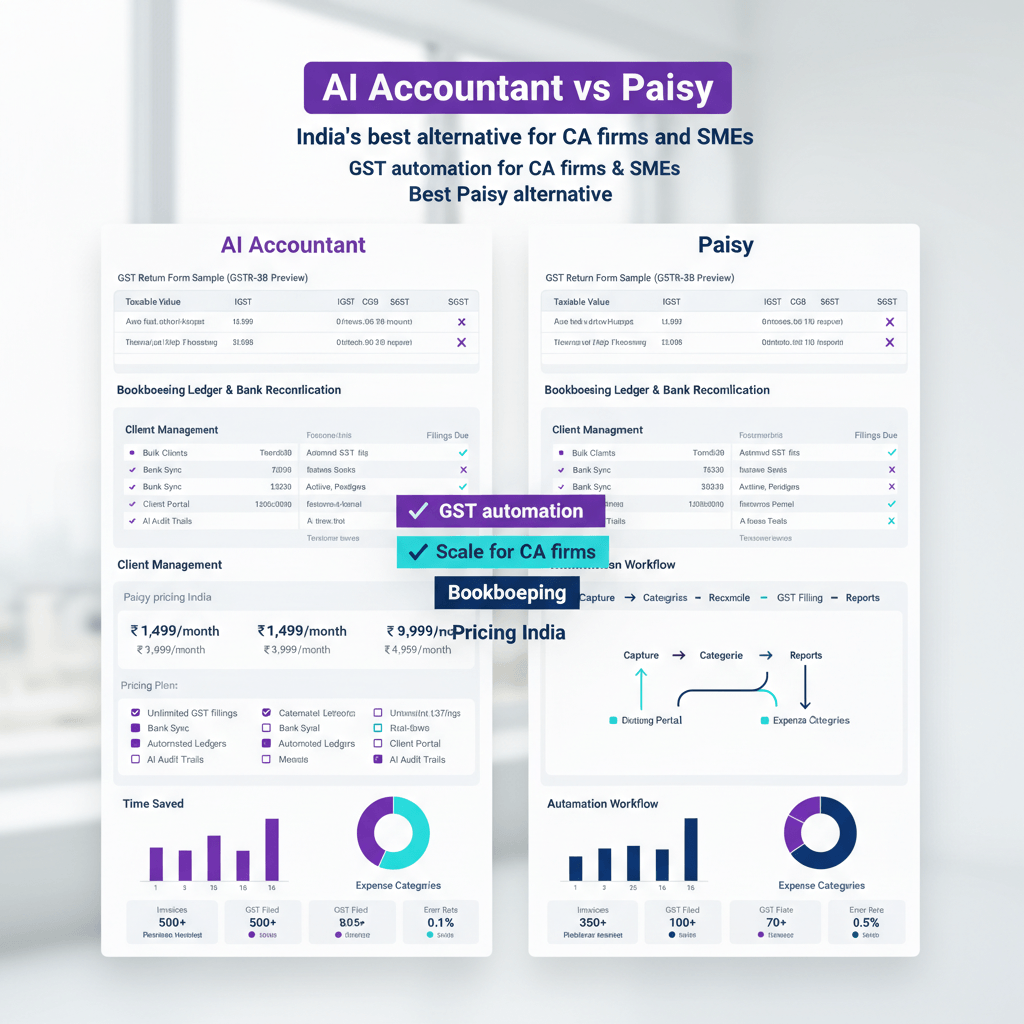
Paisy vs AI Accountant: Feature by Feature Deep Dive
AP and Bills Automation
Paisy: Basic field extraction, manual verification, struggles with multi rate invoices and vendor variants.
AI Accountant: High accuracy extraction at scale, auto GSTIN checks, vendor normalization, and smart exception queues. Many firms cut AP effort by 75%.
Bank and Credit Card Processing
Paisy: Imports work, but categorization is manual heavy, and format variance creates errors.
AI Accountant: Normalizes any Indian bank, predicts categories with strong accuracy, and learns quickly from corrections.
Transaction Matching and Reconciliation
Paisy: Rules miss edge cases, partials and splits need manual handling, and inter account transfers are clunky. See how Matching payments to bills should work at scale.
AI Accountant: Smart linking across bills and payments, handles partials, splits, and transfers, bulk edits in one pass.
GST Reconciliation Capabilities
Paisy: Captures basic fields, but large scale 2B reconciliation devolves to Excel.
AI Accountant: Industrial grade matching across PR, JVs, CNs, and 2B, with status tracking and discrepancy workflows.
Integration Depth
Paisy: One way CSV exports.
AI Accountant: Bidirectional sync to Zoho Books and Tally, pulling masters and open items, pushing clean entries back automatically.
Management Dashboards
Paisy: Basic static reports.
AI Accountant: Live cash, AR, AP, and spend insights that founders actually use.
Multi Organization Management
Paisy: Separate logins, no shared learning.
AI Accountant: Unlimited orgs under one login, role based access, org specific learning that scales for CA practices.
Scale and Reliability
Paisy: Slows beyond moderate volumes.
AI Accountant: Proven at hundreds of millions of transactions monthly across Indian customers.
Security and Compliance
Paisy: Basic security.
AI Accountant: ISO 27001, SOC 2 Type II, encryption in transit and at rest, audit ready logs.
Implementation and Time to Value Comparison
Getting Started
Paisy: Very quick to start, but gaps force ongoing workarounds.
AI Accountant: Structured onboarding in days, AI learning ramps to useful accuracy within weeks, leading to sustained reductions in manual work.
Training and Adoption
Paisy: Easy to learn, but you also learn the limitations.
AI Accountant: Slightly deeper training, far fewer workarounds, teams shift from data entry to exception handling and analysis.
ROI Timeline
Paisy: Early gains plateau, negative ROI at scale is common after manual hours are counted.
AI Accountant: CA firms processing 5,000 plus transactions often break even in 2 to 3 months through labor savings and faster closes. For a richer analysis, read the in depth comparison.
Real Implementation Stories: Indian Context Examples
Month End Success with AI Accountant
A Mumbai trading company moved from a five day close with three full time staff to a one and a half day close managed by one person. Bills flow from email, banks sync daily, GST matches automatically, clean data posts to Tally, and dashboards update for leadership reviews.
CA Firm Scaling Story
A Bangalore CA firm with 35 clients saw separate logins, Excel reconciliations, and overtime costs crush margins. After moving to AI Accountant, they switched clients instantly under one login, automated 2B reconciliation, cut report turnaround by 70 percent, and scaled to 50 plus clients with the same team.
SME Transformation
A Pune manufacturer gained daily cash visibility, cleared a three day AP backlog, found ₹2L in monthly spend reductions, and prevented cash crunches through vendor payment scheduling.
The Switch That Failed
A small services firm with 200 transactions monthly tried AI Accountant and found it over scoped for their needs, so they reverted to simpler tools. Lesson learned, match the tool to real volumes and complexity.
Decision Framework: Choosing Your Best Paisy Alternative India
Must Have Checklist
For CA Firms:
- Multi client under one login
- Bulk document processing at 100 plus per session
- GSTR 2B reconciliation at scale
- Role based access
- Client specific learning
For SMEs:
- Bidirectional Zoho Books or Tally sync
- Real time dashboards
- Vendor payment tracking
- Multi user collaboration
- Mobile friendly approvals
For Everyone:
- ISO or SOC certifications
- Indian bank format support
- GST compliance features
- Local support
- Transparent scaling pricing
Volume and Complexity Thresholds
Stay with Paisy if: Under 500 monthly transactions, single entity, basic GST, no integrations, and cost only focus.
Consider alternatives at: 1,000 plus transactions, multi entity, complex GST, Zoho or Tally sync needs, and close time beyond three days.
Definitely switch at: 5,000 plus transactions, multi client operations, compliance risks from data quality, and negative ROI from manual rework.
Total Cost of Ownership Calculation
Model direct fees and overages, then add manual hours, delayed closes, penalty risk, lost growth, and staff overtime. Balance against time saved, accuracy gains, faster decisions, happier clients, and added capacity.
Evaluation Process
- Document pains with metrics
- Quantify volumes now and 12 months out
- List integrations needed
- Compute true costs including cleanup
- Demo shortlists on your data
- Run parallel trials
- Measure time, accuracy, and exceptions
- Choose with evidence, not promises
For an end to end walkthrough, explore this decision guide.
FAQ
Is Paisy good for bookkeeping in India for a CA firm client base?
Paisy can work for micro clients with under 500 transactions monthly, single GSTIN, and simple needs, but CA firms quickly run into limits on multi org management, GSTR 2B reconciliation, and bulk edits. An AI first tool like AI Accountant is better when you manage many client books and need scale with controls.
How does AI Accountant compare to Paisy for GSTR-2B reconciliation at volume?
Paisy provides basic GST fields but 2B reconciliation at volume often ends up in Excel. AI Accountant ingests purchase registers, JVs, CNs, and 2B, auto matches, flags mismatches by reason code, and maintains statuses for audit. Many Indian teams cut reconciliation time from days to hours with AI Accountant.
What is the real Paisy pricing India picture once overages and add ons are included?
Sticker price looks low, but document or transaction caps trigger overages, and GST modules or priority support add more. The bigger cost is manual rework when parsing fails or GST matching breaks. Model subscription plus hidden hours to avoid surprises.
Can we migrate from Paisy to AI Accountant without losing historical context?
Yes, export Paisy data, then configure AI Accountant with Zoho Books or Tally bidirectional sync. The onboarding team maps masters, vendors, and charts, and the AI learns your categorization patterns quickly. Many firms run a two week parallel to validate outputs before cutover.
Does AI Accountant replace the role of a CA or in house accountant?
No, AI Accountant removes repetitive data entry and matching, while your CA focuses on advisory, controls, and compliance. Think of it as an “AI Accountant” assistant that handles routine work so your experts can handle analysis and decision support.
What volumes justify moving off Paisy to an AI first platform?
At 1,000 plus transactions monthly, or any multi entity setup, the friction becomes material. At 5,000 plus, most teams see negative ROI staying on basic tools. If month end exceeds three days or Excel dominates reconciliation, it is time to switch.
Does AI Accountant support multiple GSTINs, e-invoicing, and TDS edge cases common in India?
Yes, AI Accountant validates GSTINs, automates cross checks with 2B, and handles multi GSTIN books. It captures TDS patterns and vendor variants, and integrates with Zoho Books or Tally so e invoicing and downstream postings remain consistent.
How does bidirectional sync with Zoho Books or Tally improve outcomes versus CSV exports?
With CSVs, you duplicate work and introduce errors. With AI Accountant, masters, open bills, and ledgers are pulled in, transactions are processed with context, and clean entries push back automatically. Books stay aligned, audits become easier, and you stop reconciling systems to each other.
What security assurances do we have for client financial data?
AI Accountant implements ISO 27001 and SOC 2 Type II controls, encrypts data in transit and at rest, and maintains audit trails. For CA firms holding multiple client datasets, this level of assurance is critical. Paisy offers basic protections but not enterprise certifications.
How quickly do teams see ROI after adopting AI Accountant?
Most Indian teams reach useful accuracy within two weeks, with 60–70% workload reductions by the first month for AP, bank processing, and 2B reconciliation. Measured outcomes include faster closes, fewer notices, and capacity to onboard more clients without hiring.
Does AI Accountant help with founder friendly visibility, like real time cash and payables?
Yes, AI Accountant maintains live dashboards for cash, AR aging, payables due, and spend trends, so founders see the picture without waiting for month end. Many CA firms share dashboard snapshots with clients to improve decision speed.
What is a practical evaluation plan for a CA practice comparing Paisy and AI Accountant?
Pick two clients, one simple and one complex. Run both tools in parallel for one close. Measure hours on AP, bank matching, 2B reconciliation, error rates, and rework. Compare close time and client report delivery. This evidence based approach makes the choice obvious.
Can AI Accountant handle multi organization management under one login, with role based access for staff?
Yes, unlimited orgs under one login, with granular access control. The AI learns org specific patterns, for example similar vendor names mapping differently across clients, which is a must have for CA firms scaling to dozens of books.
What happens if our volumes spike during seasonality, will processing slow down?
AI Accountant processes very large volumes reliably, so whether you have 10 or 10,000 transactions on a given day, throughput remains consistent. Teams no longer split work into batches to avoid timeouts, which is common with basic tools.
How should we calculate total cost of ownership before committing?
Combine subscription, overages, and add ons, then add hidden costs, hours spent on cleanup, Excel reconciliations, delayed closes, risk of penalties, and overtime. Subtract value gains from time saved, accuracy improvements, faster decisions, and capacity to grow. For most Indian teams at scale, AI Accountant wins clearly on TCO.
Conclusion: Making the Right Choice for Your Indian Accounting Needs
Paisy fits micro, stable setups, but it is not built for Indian scale or compliance depth. If you manage multiple clients, multiple GSTINs, or 1,000 plus transactions monthly, the ceiling arrives fast. An India focused platform like AI Accountant delivers the automation depth, integrations, and controls modern CA firms and SMEs need.
Investing in proper automation pays back quickly, reducing manual hours, cutting errors, and freeing your team for advisory work. Your accounting deserves more than basic imports and CSV shuffles, it deserves automation that scales with your ambition.
Ready to validate with your data? Start with a focused pilot, measure time saved and accuracy, then expand. When you are comparing options, this feature by feature breakdown is a solid next step.

Rohan Sinha is a fintech and growth leader building aiaccountant.com, focused on simplifying accounting and compliance for Indian businesses through automation. An IIT BHU alumnus, he brings hands-on experience across 0 to 1 product building, growth, and strategy in B2B SaaS and fintech.