-01%201.svg)
Key takeaways
- Paisy suits very small teams with simple bookkeeping, once volumes scale, limitations appear quickly.
- Total cost of ownership often exceeds sticker price, factor add ons, setup time, and manual effort.
- Evaluate alternatives on AP automation, bank normalization, GST reconciliation, integration depth, dashboards, and multi entity controls.
- Automation is the tipping point for Indian workflows, especially GSTR-2B matching and Zoho or Tally sync.
- Real world head to head findings in Paisy vs AI Accountant show sharp differences at scale.
- Top alternatives include an automation layer like AI Accountant, or full suites such as Zoho Books, TallyPrime, Busy, HostBooks, Vyapar, and Clear GST.
- Teams processing 5,000 plus transactions monthly see faster closes, fewer errors, and quick ROI with automation.
What is Paisy?
Paisy is basic bookkeeping software for fundamentals, invoicing, expense capture, and simple bank reconciliation. It is an entry point for small businesses or solo users with low transaction volumes.
Typical users include startups and freelancers managing straightforward workflows, where you issue a few dozen invoices monthly, track expenses, and do not need multi entity controls.
The core modules cover what you expect. Invoicing to create and send bills, expense tracking to monitor spend, and basic reconciliation to match bank transactions. It is simple, it works for simple needs.
Features evolve, so verify current capabilities on the vendor site before deciding.
Paisy bookkeeping review
Where Paisy helps
Simplicity is the standout. Teams onboard quickly, there is minimal setup, and you can start issuing invoices within minutes. For limited workflows, recording expenses and basic reconciliation feel intuitive.
Where Paisy struggles
AP extraction is manual and tedious at volume. If you process hundreds of vendor bills, you will spend time on data entry. Bulk statement ingestion is not built for scale.
Categorization accuracy declines as transaction counts rise. What is fine for a few hundred entries becomes inconsistent in the thousands, the system does not adapt to your context well.
GST reconciliation, especially GSTR-2B, lacks the depth Indian businesses need. Expect frequent spreadsheet exports and manual matching.
Multi entity support is very limited. CA firms, or groups running multiple companies, will juggle separate logins without consolidated views.
Integration depth disappoints. Claimed Zoho or Tally connectivity often means one way data flows, no reliable push back of cleaned data, and lingering double entry.
Verdict: Paisy fits tiny teams under 500 monthly transactions. Beyond 5,000, or when automation becomes mandatory, most teams outgrow it.
Before committing, run the public demo with your real scenarios. Upload sample bills, try bulk operations, test GST features, and confirm constraints upfront.
Paisy pricing India
Looking at Paisy pricing India only by the sticker can mislead. The base license is attractive, the add ons and hidden effort are not.
Total cost of ownership checklist
- Base license: often ₹500 to ₹2,000 per organization monthly.
- Add ons: GST tools, bulk processing, extra users, and storage can double or triple the base.
- Implementation: budget one to two weeks for migration and training, consultants may add ₹15,000 to ₹30,000.
- Ongoing effort: invisible labor for manual fixes, workarounds, and cleanup often exceeds license fees.
Use a simple calculator: (Monthly transactions × hours saved via automation) minus (Error fixes × hourly rate) plus license fees. For example, at 10,000 transactions, manual work can add ₹10,000 plus monthly in labor, which makes robust automation look inexpensive.
Always confirm current 2026 rates with sales, pricing changes frequently.
How to evaluate a Paisy alternative India
Automation and ingestion
- AP and bills automation: bulk ingestion from PDFs, images, CSVs, and Excel, with vendor mismatch alerts.
- Bank and card processing: normalization across formats and banks, proven performance at 50,000 lines and above.
Classification, matching, and GST
- Transaction mapping: AI predictions for ledgers and taxes, bulk edits, automatic invoice and payment linking.
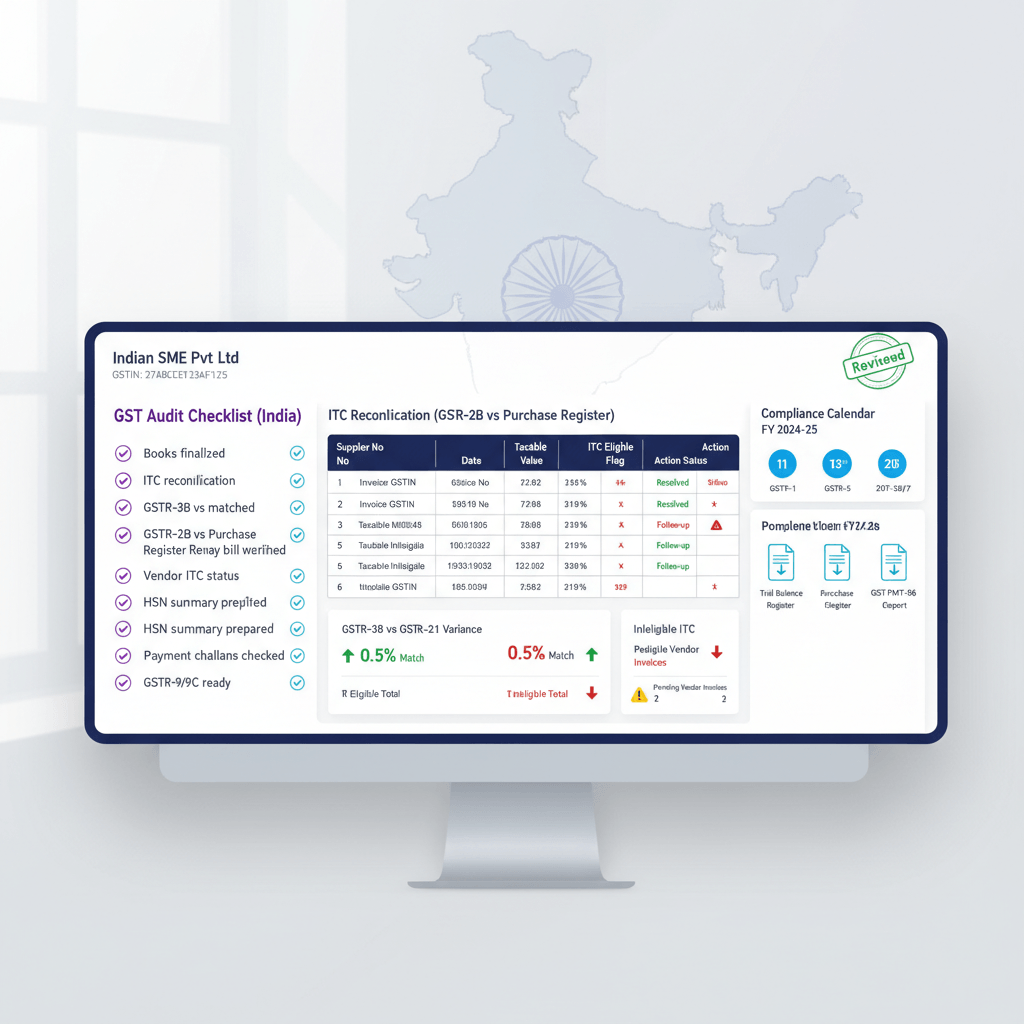
- GST reconciliation: automatic GSTR-2B matching, compliance status tracking, and exports that match government templates.
Integrations, control, and security
- Integration depth: true bi directional sync with Zoho Books and Tally, not just imports.
- Dashboards: cash flow, AR or AP aging, and working capital views that update continuously.
- Multi organization: single login, role based permissions, and per entity learning patterns.
- Security: encryption in transit and at rest, ISO 27001, SOC 2 Type II.
Weigh these by your GST volumes, Zoho or Tally footprint, and the scale of your monthly transactions.
Paisy vs AI Accountant
Let us compare practical realities in Paisy vs AI Accountant.
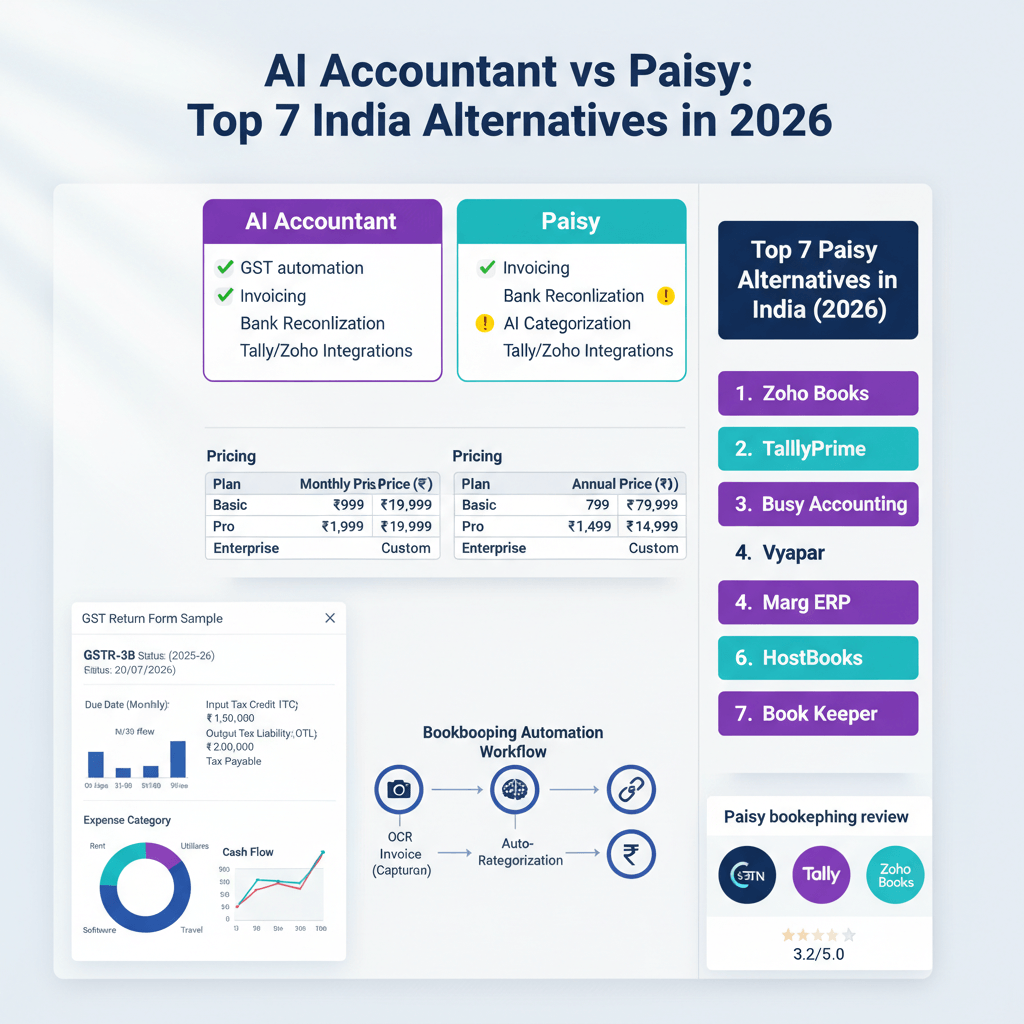
| Feature | Paisy | AI Accountant |
|---|---|---|
| AP or bills automation | Manual entry, limited bulk | Bulk extraction across formats, validations, vendor mismatch detection |
| Bank or card ingestion | Limited scale | High volume normalization across multiple sources |
| Categorization or matching | Rules, accuracy drops at scale | AI predictions with context learning, bulk edits, automatic linking |
| GST reconciliation | Basic GSTR support | Full GSTR 2B matching with status workflows |
| Integrations | One way, shallow | Zoho or Tally bi directional sync |
| Dashboards | Simple reports | Real time cash, AR or AP, working capital views |
| Multi organization | Not available | Single login, per entity learning |
| Security | Standard | ISO 27001, SOC 2 Type II |
Choose Paisy if you want minimal automation and expect to stay small. Choose AI Accountant if you run Zoho or Tally and process 5,000 plus transactions monthly, where time savings and accuracy gains compound fast.
Users report 50 percent faster month end closes with fewer errors, paying back the automation investment within two to three months.
Top 7 Paisy alternative India
- AI Accountant
Best for CA firms and SMEs on Zoho Books or Tally seeking serious automation. Proven with 300M plus transactions and 100 plus CA firms, keep your accounting system, add powerful automation. - Zoho Books
Full cloud accounting with GST, good if you plan to replace your entire stack, includes inventory and projects. - TallyPrime
The India staple for compliance, pairs well with an automation layer for reconciliation and data processing. - Busy Accounting Software
On premise or cloud hybrid with strong GST, useful for specific compliance needs or desktop to cloud transitions. - HostBooks
Cloud first, GST focused, practical for greenfield deployments without legacy constraints. - Vyapar
For very small businesses that need simple billing and basic inventory. - Clear GST
Excellent for GST filing and e invoicing, works as an adjunct to your core accounting system.
Mix layers for results. Use TallyPrime or Zoho Books as your core, then add AI Accountant for automation, plus Clear for specialized GST filing.
How AI Accountant works with your existing books, Zoho or Tally
AI Accountant begins by syncing masters, vendors, customers, chart of accounts, and cost centers. That enables intelligent processing.
Next, ingest data in bulk. Upload vendor bills in PDFs, images, or spreadsheets. Fields are auto extracted, validated against masters, and mismatches are flagged for review.
Bank and card statements are normalized regardless of source format. Multiple banks, multiple templates, one standard pipeline.
AI mapping predicts ledgers, detects vendor names from narration, and suggests GST treatment. Bulk review tools let you approve hundreds of entries in minutes.
Then comes sync back, the cleaned and matched data flows directly into Zoho Books or Tally, without double entry.
GSTR 2B reconciliation runs continuously. The system compares your purchase register with government data, tracks status, flags mismatches, and exports in required formats with suggestions to resolve issues.
Dashboards refresh in real time, cash position, receivables aging, and payables due remain current without manual reporting.
Multi organization management is built in. Switch entities instantly, each one learns and improves accuracy over time.
Onboarding usually completes in one week.
Pro tip: start with one entity, run a full month end, measure accuracy and time saved, then scale across clients.
ROI and proof points
Track these to quantify value:
- Hours saved monthly: often 40 plus for 10,000 transactions, that is a full work week reclaimed.
- Error reduction: 30 percent or better, which means less rework and smoother audits.
- Faster close: books closed by the third, not the sixth.
- Vendor protection: GSTIN mismatches, duplicates, and rate errors caught before payment.
Scale signals:
- 300M plus transactions processed.
- 30 percent month over month ingestion growth.
- ISO 27001 and SOC 2 Type II certifications.
- 450 plus organizations, including 100 plus CA firms onboarding clients in bulk.
Moving forward with the right choice
Choosing among Paisy alternatives in India is about fit, not flash. If you face growing volumes, recurring GST headaches, or manual data entry overload, automation becomes essential.
For teams invested in Zoho Books or Tally, AI Accountant enhances your current system instead of replacing it. You keep familiar processes while removing manual friction.
Next steps:
- Download an evaluation checklist to score features and total cost of ownership.
- Book a 30 minute demo tailored to your Zoho or Tally setup, see automation on your workflows.
- Run a free pilot on one entity, process real documents, measure time saved, then scale.
Validate features and pricing on vendor pages, the landscape evolves quickly. What is accurate today can change tomorrow. The shift from manual bookkeeping to intelligent automation frees finance teams for analysis, strategy, and growth.
FAQ
Is Paisy good enough for routine bookkeeping in India, or should a CA push clients to an alternative?
Paisy is fine for micro setups with simple invoicing and basic reconciliation. For CA managed entities with 1,000 plus monthly transactions, multi GSTIN needs, or regular GSTR 2B reconciliation, a Paisy alternative is more practical. An AI layer like AI Accountant automates ingestion, matching, and GST checks, which reduces your review cycles materially.
Which Paisy alternative works best for a CA firm running Tally across 50 clients?
AI Accountant fits this pattern. It plugs into Tally, standardizes bank or card statements, auto maps ledgers, and syncs cleaned entries back. CA firms use a single login to jump across clients, accuracy improves as each entity learns, and month end review time drops.
How does Paisy pricing in India compare with automation tools on ROI for a finance team?
Paisy looks cheaper on license cost, but once you price the manual work, it becomes expensive. With AI Accountant, the time saved on AP capture, bank matching, and GSTR 2B reconciliation usually pays back within two to three months. Use a TCO model that multiplies hours saved by staff rates, then add license fees for a realistic view.
For GST, can I automate end to end GSTR 2B reconciliation without exporting to Excel?
Yes, that is the point of automation. Tools like AI Accountant continuously match your purchase register against GSTR 2B, flag mismatches, track resolution status, and export government ready formats. This removes manual VLOOKUPs and reduces filing errors.
How difficult is migration from Paisy to Zoho Books or Tally with an automation layer in between?
The critical path is data cleaning, not the tool switch. Export CSVs from Paisy, map fields to your target system, and let AI Accountant ingest historical bills and bank lines in bulk. Most migrations complete in one to two weeks, with the last mile being vendor master and tax code normalization.
Does AI Accountant support multi entity, multi GSTIN, and role based access for CA firms?
Yes, CA firms use a single login to switch entities, assign roles, and manage per client rules. Each organization maintains its own learning patterns, which improves classification accuracy, vendor detection, and GST applicability over time.
What is the accuracy I can expect on Indian vendor bills, especially scanned PDFs, and how is review handled?
On clear PDFs, extraction accuracy is high. For scanned or low quality images, the tool flags low confidence fields for review. AI Accountant batches these into review queues so one reviewer can clear hundreds of entries quickly, with vendor and GST validations reducing back and forth.
Can an AI tool handle Indian bank narration quirks for ledger mapping in Tally or Zoho?
Yes, AI Accountant is trained on Indian narrations, it identifies counterparties from text, predicts the correct ledger, and links payments to bills automatically. Bulk edit flows let you confirm or correct predictions at scale before sync back.
How do I quantify month end acceleration for management reporting?
Track cutoff time for AP posting, bank reconciliation completion, and GST mismatch clearance. Teams using AI Accountant report closing by the third business day instead of the sixth, which pulls MIS and cash forecasts forward without adding staff.
What about audit readiness, can auditors trace every change with a proper trail?
Automation does not remove audit trails, it enhances them. AI Accountant keeps document links, extraction snapshots, reviewer actions, and sync logs. Auditors can sample entries, trace source files, and verify approvals without manual email hunts.
If a client insists on staying in Paisy, can I still reduce my manual workload as a CA?
Partially. You can use AI Accountant to process bank statements and vendor bills, then export standardized journals for import where supported. You will still face Paisy limits on integrations, but your data prep time drops significantly.
We run Zoho Books for accounting, Clear for e invoicing, and Tally for a legacy unit. Will an AI layer unify these flows?
AI Accountant typically anchors on Zoho Books or Tally for sync. It ingests documents once, applies common masters, and posts clean entries back to each system as configured. For Clear, you continue using it for filings while the AI layer ensures your purchase register and GSTR 2B are aligned, reducing carry forward issues and credit loss.

Rohan Sinha is a fintech and growth leader building aiaccountant.com, focused on simplifying accounting and compliance for Indian businesses through automation. An IIT BHU alumnus, he brings hands-on experience across 0 to 1 product building, growth, and strategy in B2B SaaS and fintech.