-01%201.svg)
Key takeaways
- Know the threshold, if your turnover exceeds ₹5 crores, GSTR 9 and GSTR 9C are mandatory, but audits can still happen below the threshold through risk based selection
- Make monthly reconciliations non negotiable, books with GSTR 1, GSTR 3B, and GSTR 2B should match with documented explanations for variances
- Keep airtight documentation, invoices, e way bills, bank statements, agreements, and ITC proofs, all readily accessible and organized by tax period
- Watch red flags early, return mismatches, excess ITC over GSTR 2B, incorrect HSNs, late filings, and weak RCM compliance
- Build systems, not scramble, digitize records, run internal reviews quarterly, train teams, and use standardized SOPs
- Leverage virtual accounting for scalability, automated reconciliation, and real time dashboards to stay audit ready year round
- Act fast post audit, respond with organized evidence, pay dues promptly, fix root causes, and monitor improvements
How to Prepare for a GST Audit: A Complete Guide for Indian SMEs
Every Indian SME owner knows that sinking feeling when they hear the words GST audit. Your mind races through endless questions. Are my books in order? Did we file everything correctly? Where are those invoices from last quarter?
Here is the thing, a GST audit does not have to be scary. With the right preparation and systems in place, you can face any audit with confidence. Whether you are dealing with a routine GSTR 9C filing or responding to a departmental notice, this guide walks you through everything you need to know.
Understanding GST Audit Requirements in India
Not every business needs a GST audit. As of now, if your annual turnover exceeds ₹5 crores, you must get your accounts audited by a Chartered Accountant and file GSTR 9C along with GSTR 9. Even below this threshold, the department can still select you for audit using risk parameters, data analytics, and random selection, so being prepared is essential.
The audit focuses on three pillars, reconciliation of books with returns, verification of Input Tax Credit, and examination of legal compliance. Auditors check whether turnover in the annual return matches audited financials, whether ineligible ITC is reversed, and whether taxes are paid on time with proper documentation.
Think of it like a health checkup, do not wait for symptoms, build strong compliance habits and you will be ready any day.
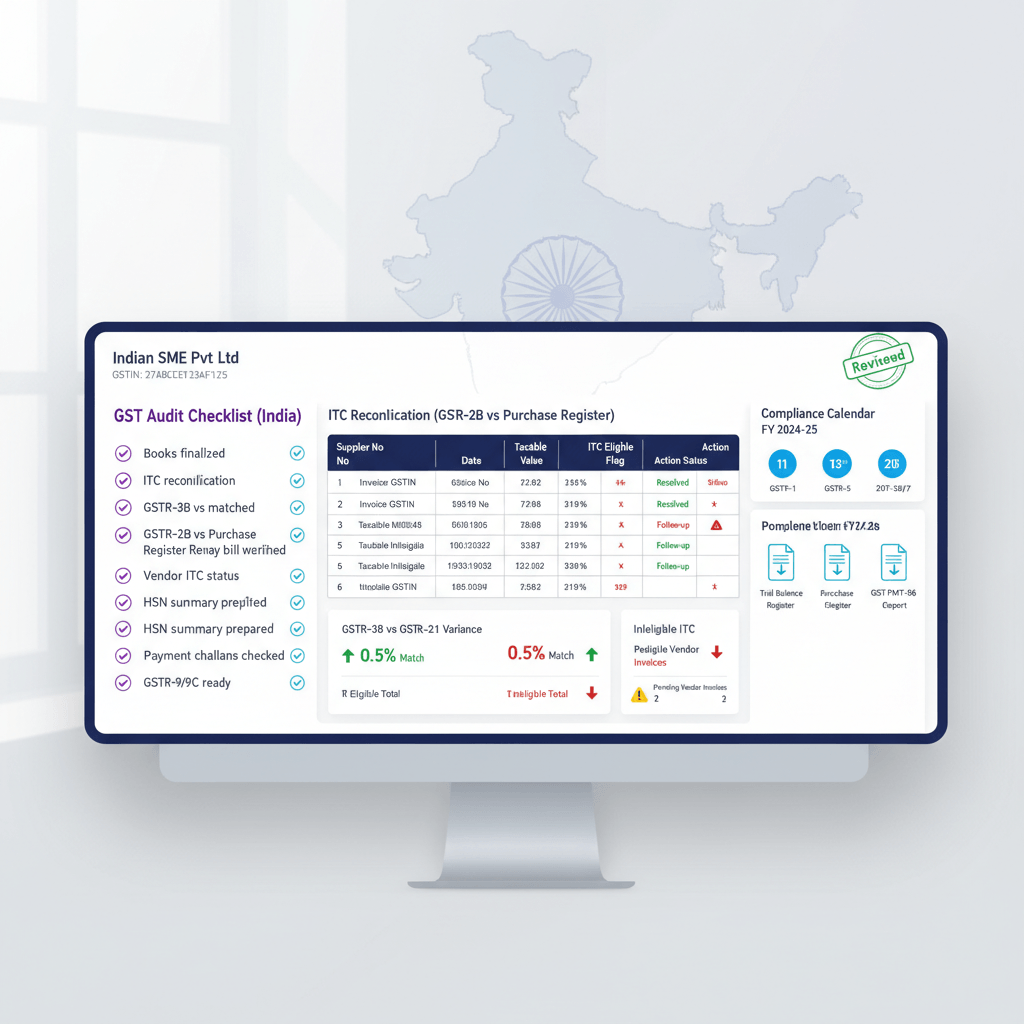
Essential GST Audit Checklist for SMEs
Documentation Requirements
- GST registration certificate, copies of all returns, GSTR 1, GSTR 3B, and annual returns with payment challans and acknowledgments
- Sales invoices with sequential numbering, GSTIN, HSN codes, tax breakup, and correct place of supply
- Purchase invoices with valid supplier GSTIN, matching vendor master, and e invoices if applicable
- Bank statements for all business accounts, to trace GST payments and refunds
- E way bills for applicable movements, especially interstate consignments above ₹50,000
Compliance Verification Points
- On time filing of all returns, verify GSTR 1 vs GSTR 3B for exact match
- ITC eligibility checks, valid tax invoices, supplier filings, and blocked credits under Section 17(5) tracked separately
- Reverse charge mechanism compliance for specified supplies and imported services, with correct payment and ITC claim
Record Keeping Best Practices
- Digitize everything, maintain secure cloud backups, and ensure documents are searchable
- Organize by Tax Period, then by Document Type, sales, purchases, debit or credit notes, receipts
- Maintain a reconciliation register with reasons for each variance, and closure notes when resolved
Monthly GST Reconciliation Process
Reconciling Books with GST Returns
Match your sales register with GSTR 1, quantities, values, and tax amounts should mirror your reports. Tie purchase register to GSTR 2B, follow up missing credits with vendors immediately. Cross verify tax payments in GSTR 3B with challans, payment linkages must be clean.
Sales and Purchase Register Reconciliation
Ensure sales tie to customer ledgers and bank receipts, track advances and adjust against invoices. For purchases, use three way matching, purchase order, goods receipt note, and invoice, to avoid duplicate payments and wrong ITC.
ITC Reconciliation Steps
- Prepare a monthly ITC roll forward, opening balance, eligible credits, reversals, utilization, closing balance
- Isolate ineligible credits like food, travel, and works contract related to construction
- Monitor Rule 36(4) compliance, do not exceed 105 percent of the ITC reflected in GSTR 2B
Common GST Audit Red Flags to Avoid
Mismatch Issues
- Differences between GSTR 1 and GSTR 3B for outward supplies
- ITC claimed beyond GSTR 2B availability limits
- E way bill values not aligning with GSTR 1 reported turnovers
Documentation Gaps
- Missing invoices or incomplete mandatory fields
- Service transactions without contracts or work orders
- Absence of delivery challans for goods movement
Compliance Violations
- Chronic late filings and delayed tax payments
- No proportionate reversal of ITC on exempt or non business use
- Incorrect HSN or place of supply classifications, affecting rates and liability
Building a GST Audit Ready Accounting System
Digital Document Management
Implement cloud storage, mirror compliance needs in your folder structure, and enable OCR for quick retrieval. Schedule automatic backups, because system failures do not delay audits.
Regular Internal Audits
Run quarterly compliance reviews, returns filed, payments reconciled, ITC eligibility checked, documents complete. Use standardized checklists and rotate reviewers to catch blind spots.
Team Training and SOPs
Document SOPs for invoicing, return filing, payments, reconciliations. Train sales, purchase, and warehouse teams on GST essentials, and refresh monthly since laws evolve rapidly.
The best audit preparation happens before you need it, build systems today and skip the scramble tomorrow.
Working with Virtual Accounting Services
Benefits of Virtual Accounting for GST Compliance
Virtual accounting services transform compliance from burden to breeze. Consider your options and choose based on scale, speed, and visibility.
- Virtual Accounting by AI Accountant offers comprehensive GST filing, reconciliation, and audit support with real time dashboards and dedicated CA teams
- Traditional CA firms provide personalized service, but may lack technology integration
- DIY software demands internal expertise and disciplined processes
- Big 4 firms suit complex enterprises with larger budgets
- Local consultants are affordable, yet often manual and reactive
Technology Driven Reconciliation
Automated invoice matching reduces manual errors and saves time, while AI flags anomalies like sudden ITC spikes or unusual vendor patterns. Direct API integrations minimize data entry mistakes and portal mismatches.
Real-time Compliance Monitoring
Dashboards show pending tasks and due dates, alerts prevent misses, and predictive tax estimates help plan cash flows to avoid interest.
Professional Support for GST Audit Preparation
Choosing the Right CA Firm
Evaluate industry experience, GST specialization, bandwidth during peak season, and tooling. Cloud workpapers and automated reconciliation should be standard features, not premium extras.
Virtual CFO Services for SMEs
Virtual CFOs bring strategic oversight without full time cost. They design processes, guide reconciliations, and plan taxes proactively, which reduces audit risks and improves outcomes.
Outsourced Bookkeeping Solutions
Accurate bookkeeping is the foundation. Outsourced teams ensure segregation of duties, consistent documentation, and standardized reports that auditors trust.
Timeline for GST Audit Preparation
Year-round Preparation Strategy
Adopt a continuous cadence, monthly reconciliations, quarterly internal reviews, and living SOPs. Maintain a shared compliance calendar with reminders for filings and payments.
Critical Deadlines and Milestones
Work backward from statutory due dates. Start annual return preparation in October, complete draft in November, finalize and file in December. Book your auditor early to secure their time.
Last Minute Preparation Tips
- File pending returns immediately, even if imperfect, then correct
- Triage material items first, large invoices and high risk areas
- Document known issues and planned fixes, show good faith and control
Post GST Audit Action Items
Addressing Audit Findings
Respond quickly with complete documentation, label exhibits clearly, and keep communication factual. If amounts are payable, settle early to minimize interest and demonstrate intent.
Implementing Corrective Measures
Fix causes, not symptoms. Strengthen document workflows, upgrade reconciliations, and enforce vendor compliance checks. Assign owners, set timelines, and track progress.
Continuous Improvement Process
Treat every audit as a learning loop. Capture lessons, update SOPs, train teams, and monitor KPIs like mismatch counts, filing timeliness, and ITC variance rates.
Conclusion
GST audit preparation is not about perfection, it is about consistent compliance and organized records. Reconcile monthly, digitize evidence, and build resilient processes. Engage expert help when capacity is tight, and stay proactive rather than reactive.
When the audit notice arrives, you will be ready, with clean books, clear reconciliations, and confident answers. That peace of mind is the payoff for disciplined preparation today.
FAQ
My startup is below ₹5 crores, can I still get audited and how do I stay ready without overspending?
Yes, audits can be risk based or random regardless of turnover. Focus on monthly reconciliations, digitized invoices, and vendor compliance tracking. If budget is tight, begin with essentials, sales versus GSTR 1 matching, GSTR 3B payments tie outs, and GSTR 2B ITC checks. A scalable option is Virtual Accounting by AI Accountant, which you can adopt in phases.
What are the first five documents auditors usually ask for?
GST registration and authorization, GSTR 1, GSTR 3B, GSTR 9 or 9C, sales and purchase registers, and bank statements with payment challans. Keep e way bills and key contracts handy as second line support.
How do I handle ITC mismatches between books and GSTR 2B without disrupting operations?
Segment mismatches into vendor non filing, timing differences, and ineligible claims. For vendor issues, follow up with a cut off timeline and hold payments if needed. For timing gaps, document and claim when 2B reflects. For ineligible credits, reverse with interest where applicable, and update SOPs to prevent repeats.
What if a supplier has not filed, can I still claim ITC?
If ITC does not appear in GSTR 2B, your claim can get challenged. Escalate to the supplier, set contractual clauses tying payment release to timely filings, and maintain a vendor compliance scorecard. If essential, consider provisional planning but be prepared to reverse if 2B never reflects.
How quickly can I become audit ready if I start today?
In 30 days you can digitize documents, align registers with returns, and resolve high value mismatches. Day 1 to 10, gather and digitize, Day 11 to 20, reconcile and document variances, Day 21 to 30, fix root causes and lock SOPs. A managed service like Virtual Accounting by AI Accountant accelerates this with ready playbooks.
What triggers a departmental query most often for SMEs?
GSTR 1 versus 3B mismatches, ITC exceeding GSTR 2B, frequent late filings, and e way bill variances. Implement automated checks monthly, and keep a reconciliation register with reasons and closure notes for every variance.
How should I prepare for RCM compliance without missing entries?
Maintain an RCM matrix by expense type, vendor type, and place of supply. Post self invoices monthly, pay via 3B, and claim ITC where eligible in the same or subsequent month. Reconcile RCM ledgers to expense lines to catch leaks.
Do I need a CA firm or is virtual accounting enough for audits?
Many SMEs use a hybrid. Virtual accounting handles day to day books, reconciliations, and documentation, while a CA signs off on 9C and handles complex interpretations. This model reduces cost, improves speed, and keeps audit files consistent all year.
What can I do if I receive a departmental notice right now?
Do not panic. Read the scope carefully, assemble the exact asked documents, and prepare a concise, factual reply with organized annexures. If gaps exist, disclose with remediation steps. Consider onboarding Virtual Accounting by AI Accountant to centralize data quickly and craft a clean response.
How do I ensure e way bills match returns each month?
Run a monthly e way bill to GSTR 1 reconciliation by value and by document count. Investigate gaps immediately, common causes include returns, cancelled consignments, and split shipments. Document findings and corrective entries before filing 3B.
We are a SaaS startup, do HSN and place of supply really matter for us?
Yes, service classification and place of supply drive tax rate, registration needs, and B2B versus B2C reporting. For SaaS, verify customer location proofs, billing address, and GSTIN validation to ensure correct IGST or CGST plus SGST application.
What is the most effective way to prevent repeat audit observations year over year?
Create a post audit action plan with owners and dates, update SOPs, train the teams involved, and monitor KPIs monthly. Convert each observation into a control, for example, a system rule that blocks invoice posting without HSN or GSTIN, and audit that control quarterly.

A results-driven finance and sales professional with hands-on experience through finance internships and a fast-paced sales role. With a strong interest in accounting and business finance, Harsh focuses on turning complex topics into clear, practical takeaways for founders and finance teams.