-01%201.svg)
Key takeaways
- If your needs are simple and volumes are tiny, Paisy can work, but Indian GST and scale expose gaps quickly.
- For CA firms and SMEs on Tally or Zoho Books, AI Accountant delivers deeper automation, better accuracy, and faster month ends.
- Real world teams report 60 to 70 percent manual workload reduction, with payback in 2 to 3 months when volumes exceed 5,000 transactions monthly.
- Look beyond headline rates when evaluating paisy pricing india, overages and manual cleanup often erase sticker price savings.
- For a practical paisy alternative india, prioritize GSTR 2B reconciliation, bidirectional Tally Zoho sync, and multi entity controls.
Quick Decision Guide for Busy Finance Leaders
Pick Paisy for a tiny setup running under 1,000 transactions monthly, where compliance needs are light, and invoice entry plus basic categorization is enough.
Pick AI Accountant if your CA practice or SME runs on Zoho Books or Tally, manages multiple entities, or crosses 5,000 transactions monthly. The core difference is automation depth and accuracy, with AI driven predictions that keep learning.
Bottom line, choose the tool that saves hours during GST filing and month end, not just the one that seems cheaper upfront.
For a deeper breakdown, see the AI Accountant vs Paisy breakdown, the detailed India comparison, and the latest overview.
Understanding Paisy Bookkeeping Software
Paisy positions itself as a bookkeeping automation tool to cut data entry time. It focuses on accounts payable, bank feeds, and simple categorization for small teams. Typical users include solo bookkeepers or tiny SMEs handling basic workflows.
The platform uses a cloud first approach with basic connections, often one way exports. Always verify current integrations on the vendor site. This summary is based on public comparisons as of early 2026, cross check details before deciding. Review independent notes in the AI Accountant vs Paisy breakdown and the India focused analysis.
Detailed Paisy Bookkeeping Review for Indian Context
What works: Quick setup, a simple interface that non technical users can adopt, and basic rules that help with repetitive transactions.
Where it struggles for India:
- GST reconciliation remains shallow, with limited GSTR 2B handling and weak status tracking, which means manual follow ups.
- Tally and Zoho paths are one way and basic, forcing repeated export, import, and manual fixes.
- High volume operations expose gaps in bulk edits, splits and transfers, and multi bank statement processing.
- CA firms hit separate logins per client and reliability friction beyond small document counts, which hurts productivity.
- Exception handling becomes time consuming, eroding the early time savings from simple rules.
Read a neutral take in the feature comparison, the India review, and this extended assessment.
Breaking Down Paisy Pricing India
Understanding paisy pricing india means looking past advertised tiers. Expect per user, per entity, and per transaction factors, with GST modules often added separately. Overage charges can trigger quickly, add ons drive up actual spend.
Typical scenarios:
- CA firm with 10 clients and 5,000 transactions monthly, base fees plus overages tend to reduce labor savings, net costs can overshoot forecasts.
- Single entity SME with low volume, cheaper upfront, yet persistent manual work still accumulates into a material cost.
Always confirm current pricing, and review this side by side comparison, the India pricing notes, and the 2026 buyer update before you commit.
Paisy vs AI Accountant: Feature by Feature Comparison
Accounts Payable and Bill Processing
Paisy handles manual or small batch ingestion with limited extraction, which needs user effort. AI Accountant automates bulk PDF, Excel, and image extraction, validates vendor name, GSTIN, and address, flags mismatches before they hit your ledgers.
Bank and Credit Card Processing
Paisy pushes more manual tagging and per bank uploads. AI Accountant ingests high volumes from all major banks at once, with AI ready categorization. Explore the bank statement parser for India to see how high volume normalization works.
Transaction Matching and Categorization
Paisy depends on rules that break as complexity rises. AI Accountant uses predictions for ledger and vendor matching, bulk edits, automatic bill links, and proper splits and transfers, which reduce weekly grunt work.
GST Reconciliation Capabilities
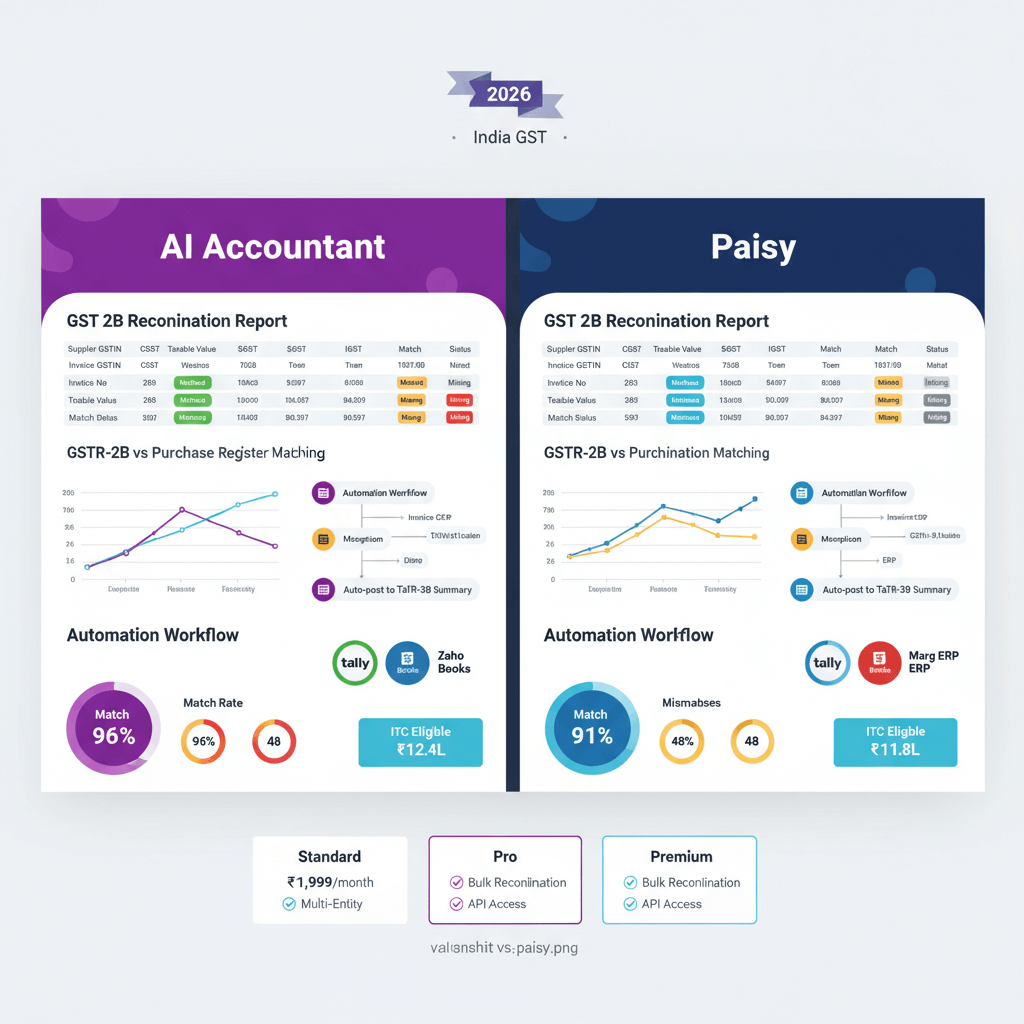
Paisy offers basic GSTR routines, still manual heavy. AI Accountant provides full GSTR 2B reconciliation with status workflows that hold up during filing rush.
Management Dashboards
Paisy provides basic static views. AI Accountant gives cash flow, receivables, and payables aging dashboards, updated continuously for instant visibility.
Multi Organization Support
Paisy requires separate logins and lacks a consolidated view. AI Accountant supports unlimited organizations with role based access and per entity learning.
For a cross check, read the feature comparison, the India edition, the 2026 update, and the extended assessment.
Top Accounting Automation Tools for Indian Businesses
- AI Accountant, purpose built for Indian CA firms and SMEs, deep Tally and Zoho integrations, GSTR 2B reconciliation, AI powered workflows, proven at 300M plus transactions
- QuickBooks Online, strong global tool with Indian GST features, lighter on deep local ERP sync
- Zoho Books, Indian native platform with built in GST compliance and accessible pricing
- Tally Prime, the Indian standard for accounting and GST, strong offline and on premise presence
- Xero, modern cloud accounting with growing India footprint and solid automation
- FreshBooks, friendly for freelancers and small teams, fewer India specific capabilities
For CA firms or SMEs already on Tally or Zoho Books, AI Accountant usually delivers the deepest automation and India first capabilities.
Integration Depth and India Ecosystem Support
Paisy uses shallow, one way paths, which means downloading and uploading files, and reconciling mismatched masters. By contrast, AI Accountant offers bidirectional sync that pulls masters and pushes cleaned data back without file juggling. See how this works in the Tally integration with AI Accountant note.
This depth affects GST correctness, month end closing speed, and multi entity control. Ecosystem awareness matters, correct GST fields, correct ledger mappings, and predictable syncs reduce rework dramatically.
Result, fewer surprises, cleaner books, faster filings.
For further reading, consult the India comparison, the 2026 buyer update, and the extended assessment.
Scalability, Accuracy, and Processing Speed
Paisy slows down during month end, accuracy drops as volume rises, and exceptions stack up. AI Accountant keeps pace with hundreds of documents in parallel, adapts as patterns change, and maintains accuracy under load. Security is handled with enterprise practices, including ISO 27001 and SOC 2 Type II, and encryption in transit and at rest.
Implementation differs as well. Paisy is simple to start but rigid at scale. AI Accountant involves light configuration for syncs and roles, then grants powerful flexibility in dashboards and workflows. See current guidance in the India comparison and the 2026 buyer update.
Why AI Accountant Stands Out as a Paisy Alternative India
AI Accountant processes 300M plus transactions across 450 plus customers, including 100 plus CA firms. This paisy alternative india focuses on Indian realities, GSTR 2B reconciliation at scale, bidirectional Tally and Zoho sync, and multi entity access that CAs need every day.
Teams report 60 to 70 percent manual reduction and 50 to 70 percent faster month ends. AI validations catch vendor and GST mismatches early, which protects data quality and reduces rework.
Explore the evidence in the feature comparison, the India focused review, and the 2026 buyer update.
Decision Framework: Choosing the Right Platform
Choose Paisy when: volumes stay under 1,000 transactions monthly, GST work is basic, and no multi entity complexity exists. Budgets are tight, and you accept more manual effort.
Choose AI Accountant when: you already run Tally or Zoho Books, volumes exceed 5,000 transactions monthly, GST reconciliation strains the team, multi entity control is mandatory, and month end SLAs are non negotiable.
Growth trajectory matters, if you are scaling, start with automation that will not force a disruptive migration later. Compare perspectives in the feature comparison, the India overview, the 2026 update, and the extended assessment.
Real ROI Examples from Indian Businesses
CA Firm with 25 clients: AP entry and GST reconciliation time fell from 40 hours to 12 hours per month, a 70 percent reduction, payback in under two months compared to legacy effort.
SME at 8,000 transactions monthly: Categorization and matching dropped from 25 hours to 10 hours, a 60 percent reduction, which freed analysts for variance reviews instead of data entry.
Manufacturing group with 5 entities: Staffing fell from 3 to 1.5 FTEs while accuracy improved, a 50 percent labor saving with cleaner ledgers and steadier filings.
More examples appear in the feature comparison, the India review, and the extended assessment.
Migration Guide: Moving from Paisy to AI Accountant
- Export bills, masters, and mappings from Paisy, import directly into AI Accountant without complex transforms.
- Run parallel for one cycle, target a 95 percent match rate before full cutover.
- Sync masters from Zoho Books or Tally, let AI build a baseline from historicals, then push cleaned entries back to verify loop integrity.
- Train users for one to two days, assign roles, and finalize maker checker controls.
Most implementations complete within one to two weeks, multi client CA practices may need an extra week. Guidance available in the India migration notes and the 2026 update.
FAQ
Which paisy alternative india should a mid size CA firm on Tally choose if monthly purchases exceed 6,000 entries?
Choose AI Accountant for that profile, it handles high volume AP extraction, bulk validations, and full GSTR 2B reconciliation. CA firms benefit from multi entity, role based access, and bidirectional Tally sync that reduces manual exports. In practice, teams using AI Accountant report 60 to 70 percent manual reduction, with steady month end close times.
How does AI Accountant handle GST 2B mismatches, can it auto identify ITC eligibility scenarios with examples?
AI Accountant compares purchase register data with GSTR 2B line items, flags vendor GSTIN mismatches, missing invoices, and tax rate inconsistencies. It segments items by ITC eligibility such as blocked credit or reverse charge, and prepares status queues for follow up. Example, if a vendor uploaded an invoice with a different GSTIN format, the system flags it, suggests the correct ledger and vendor, then routes to a checker for one click confirmation.
What is a realistic implementation timeline to migrate from Paisy to AI Accountant for a 12 entity group?
Plan one to two weeks end to end. Day 1 to 2 for exports and imports, Day 3 to 6 for parallel run and match rate tuning, Day 7 to 10 for role setups, maker checker controls, and go live. Complex master mapping or custom voucher types may add two or three days, but most groups finish within the fortnight.
Does AI Accountant support maker checker approvals and auditable logs suitable for statutory audit trails?
Yes, maker checker is native, with granular roles for upload, classify, approve, and post. Every action is time stamped with user identity, which feeds exportable audit logs that your statutory auditors can review. This reduces sampling exceptions, and simplifies walkthroughs.
Can AI Accountant push approved transactions back to Tally with correct voucher types, cost centers, and GST fields?
Yes, bidirectional sync supports voucher type mapping, cost center allocation, and GST fields such as place of supply, tax rate, and GSTIN validation. The system posts only after checker approval when maker checker is active, which keeps your Tally clean while maintaining tight control.
How accurate are AI predictions compared to rules, and how does the learning loop work in production?
AI Accountant typically starts at 80 percent plus accuracy on categorization and matching, then improves as users accept or correct suggestions. The system learns from corrections at the vendor ledger level and at the pattern level, so recurring vendors, narrations, and tax patterns converge quickly, reducing manual touches over the first month.
What about data security, certifications, and encryption standards for financial data processed at scale?
AI Accountant follows enterprise security practices, including ISO 27001 and SOC 2 Type II verification, least privilege access, and encryption in transit and at rest. CA firms handling PAN, GSTIN, and bank data can rely on documented controls and audit ready evidence for client governance requirements.
How does pricing compare for a CA firm handling 10,000 transactions monthly across eight clients, including GST workflows?
Paisy may present a lower sticker price, but overages and manual cleanup typically erase savings at that volume. AI Accountant uses volume aligned pricing that preserves net savings once manual hours drop 60 percent or more. Most such firms see payback within two to three months, depending on staffing rates and seasonality.
Can AI Accountant handle multi bank statements in one pass, with splits, transfers, and automatic bill links?
Yes, it ingests multiple bank sources in parallel, identifies intra account transfers, handles splits for GST and non GST components, and links payments to bills automatically. This eliminates the per bank per file grind, which is a common pain area for CA closing teams.
What SLAs and support model are suitable for month end crunch, especially during GST filing periods?
AI Accountant provides responsive support aligned to Indian filing calendars, with guided onboarding, priority queues during month end, and configuration help for bulk reconciliations. Many CA firms schedule assisted sessions during filing weeks to clear exceptions quickly.
Does AI Accountant offer APIs for custom workflows, or do we have to rely only on the UI?
APIs are available for ingestion, status retrieval, and posting triggers. This lets CA firms automate bespoke workflows such as nightly fetch of vendor docs, or custom dashboards for partner level oversight. The UI remains the primary surface for review and approvals, while APIs extend automation into your practice management stack.
How does AI Accountant compare to a rules only tool when exceptions spike, for example new vendors, seasonal promotions, or partial payments?
Rules only tools require ongoing maintenance and quickly break when patterns change. AI Accountant adapts through predictions and validations, catching new vendor patterns, tax anomalies, and partial payment behavior, then suggests likely matches with confidence. Over time, the exception pool shrinks, and reviews concentrate on true outliers rather than routine noise.

Rohan Sinha is a fintech and growth leader building aiaccountant.com, focused on simplifying accounting and compliance for Indian businesses through automation. An IIT BHU alumnus, he brings hands-on experience across 0 to 1 product building, growth, and strategy in B2B SaaS and fintech.