-01%201.svg)
Key takeaways
- AI Accountant is a strong paisy alternative India firms can adopt for GST workflows, Zoho or Tally sync, and month-end automation.
- Look for two-way integrations, automated GSTR-2B matching, and multi-entity management that reflects real CA-firm operations.
- True ROI comes from reducing manual work by 60 percent or more, improving data quality, and closing books faster with reliable dashboards.
- Beware of pricing models with document caps, overages, and add-ons for essentials like GST reconciliation, evaluate total cost of ownership, not headline price.
- A structured four-week migration playbook de-risks the switch from Paisy to AI Accountant, run a pilot on live data before full rollout.
- External analyses like the India Today perspective on AI vs CAs and the CAclubindia guide to staying relevant in the AI era reinforce why intelligent automation matters now.
Why Indian teams seek a better Paisy alternative
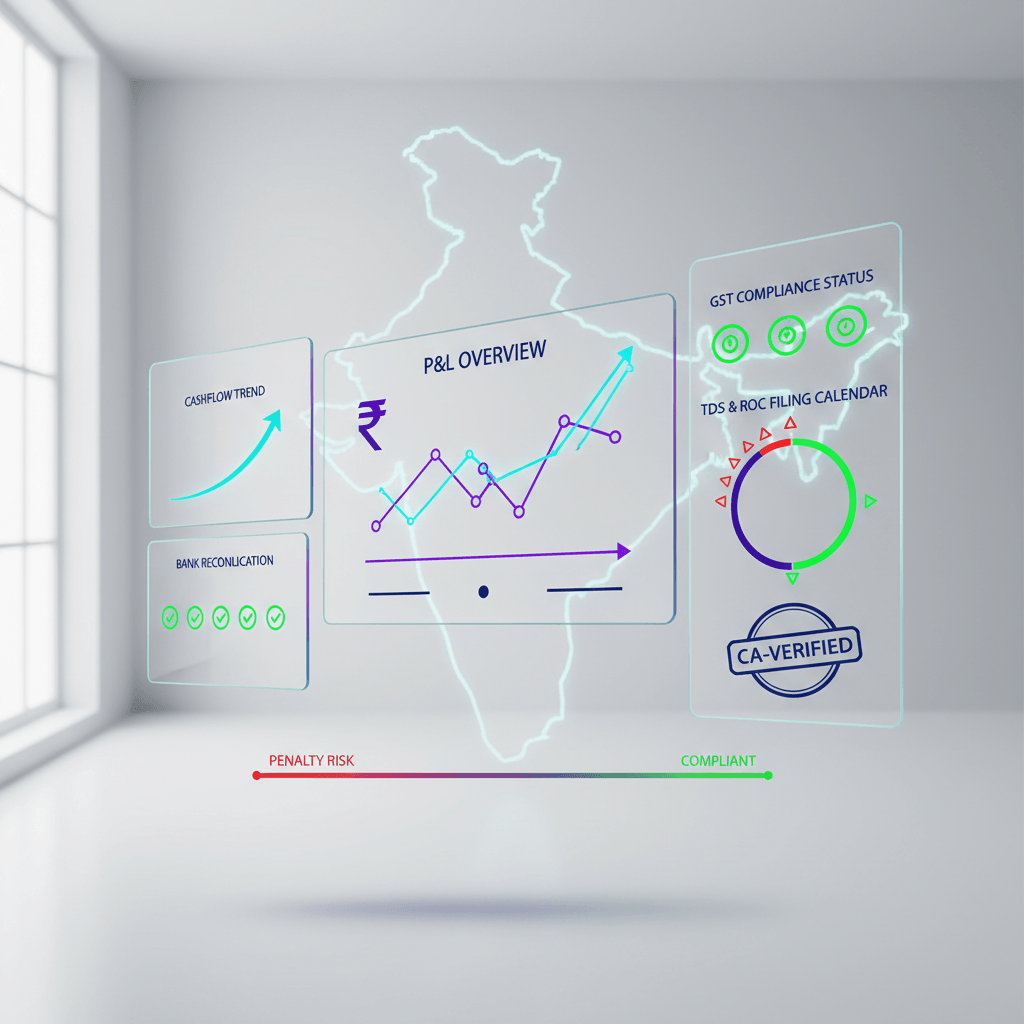
Looking for a paisy alternative in India is increasingly common. CA firms and finance teams need more than basic bookkeeping, they need AI-backed automation that understands Indian compliance, reconciles data reliably, and works with existing ledgers. Instead of replacing accountants, AI elevates them, by taking over repetitive reconciliation, anomaly detection, and validation, so professionals can focus on advisory and analysis.
The bottom line, your tool must handle GST complexity end to end, sync cleanly with Zoho or Tally, and slash manual work, not add to it. That is where AI Accountant stands out as a practical paisy alternative India businesses can trust.
Quick Buyer Snapshot: Who should consider a Paisy alternative
- Multi-entity management is chaotic, you juggle separate logins, inconsistent formats, and hours of consolidation.
- Month-end drags for days, manual categorization and statement matching consume valuable time.
- GST reconciliation is a monthly grind, automatic matching with GSTR-2B is missing, vendor mismatches pile up.
- Bank and credit card statement processing remains copy paste heavy, formats vary, and errors creep in.
- Zoho Books or Tally sync is shallow, you still re-enter data and maintain two sources manually.
- Dashboards and cash visibility are weak, leadership requests trigger a scramble for reports.
The right outcome: at least 60 percent manual workload reduction, accelerated month-end, better data quality with validations, and real-time dashboards that leadership can trust.
These are not nice-to-haves, they are essential for CA firms handling many clients and SMEs scaling responsibly. For broader context on AI’s impact on the profession, see the India Today analysis on AI vs CAs and the CAclubindia article on staying relevant in the AI era.
Paisy Bookkeeping Review
This paisy bookkeeping review focuses on practical criteria for Indian businesses and CA firms.
- Core automation: Beyond invoices and expenses, assess bulk bill handling, auto categorization, exception management, and learning from your patterns over time.
- India compliance: GST is complex, the tool must match purchase registers and GSTR-2B natively, flag mismatches, and manage ITC tracking and GST-compliant invoicing.
- Integration depth: You need two-way sync with Zoho Books or Tally, masters in, cleaned and categorized transactions out, with journal entries handled cleanly.
- Data quality: Built-in validations, duplicate detection, anomaly flags, and complete audit trails are critical for audit readiness.
- Scale for CA firms: True multi-organization management, role-based access, client-specific learning, and consolidated reporting across entities.
- Responsive support: India time zone coverage, knowledgeable support, and fast responses around filing deadlines matter daily.
AI-driven reconciliation and ledger checks now reduce grunt work significantly, letting CAs move up the value chain. For skills and career implications, review the CAclubindia perspective on leveraging AI.
Paisy Pricing India
Understanding paisy pricing india means going beyond sticker price. Consider usage caps, overages, add-ons for essentials, implementation, and training costs, then compare against hours saved and reduced rework.
- Pricing constructs: Per organization, per user, or per document models behave very differently at scale, especially with high bill volumes.
- Overages: Document caps, statement-line limits, and API quotas can spike bills during busy months.
- Add-ons: GST reconciliation modules, advanced reporting, and integrations often incur extra charges, they are not optional for Indian teams.
- Implementation: Setup, migration, and training fees add to upfront costs, particularly for multi-entity CA firms.
- TCO math: Compare subscription outlay to time saved and error avoidance. Factor in rework risk and delay costs, not just list price.
Always verify current paisy pricing india on the vendor site. AI Accountant uses transparent, volume-aligned tiers that scale predictably with your actual usage. As AI reduces manual reconciliation and errors, the ROI often pays for itself. For a broader view of AI’s economic impact on accounting work, see this CAclubindia deep dive.
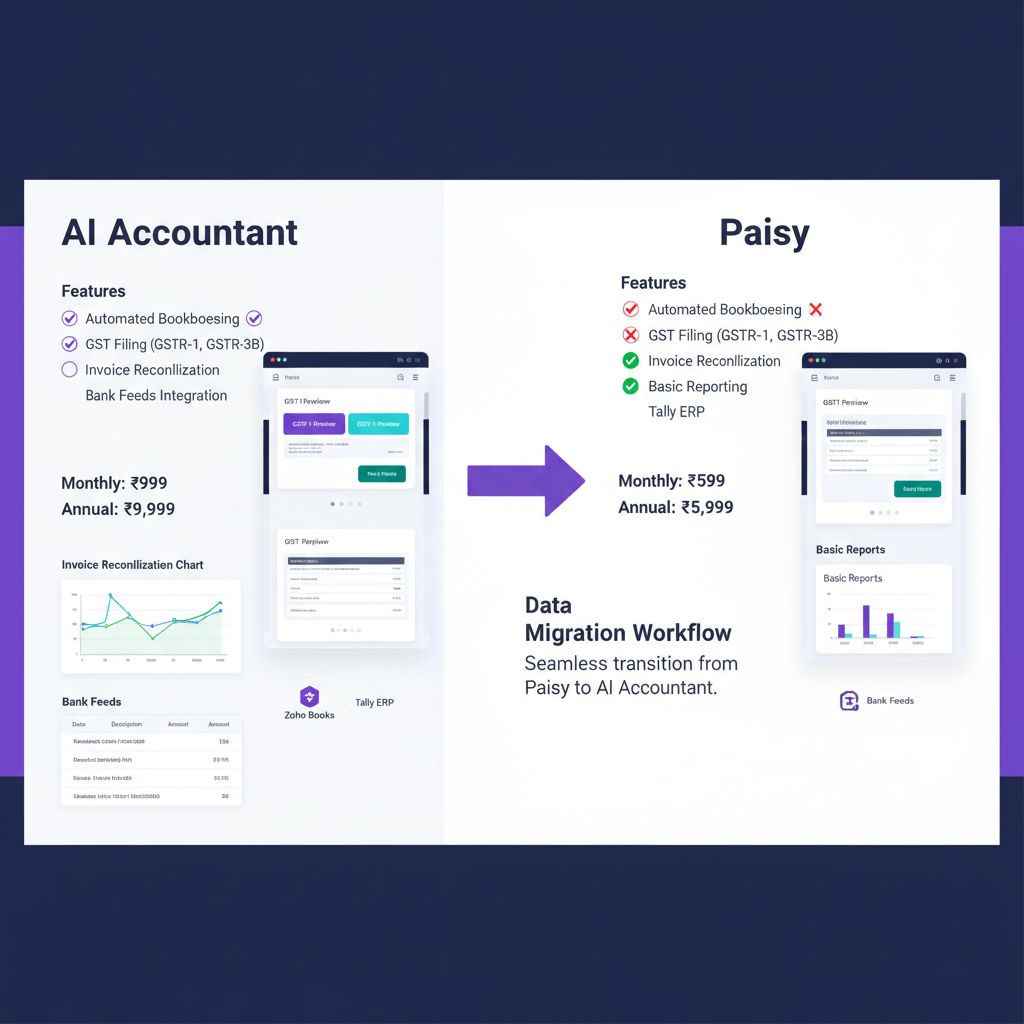
Paisy vs AI Accountant
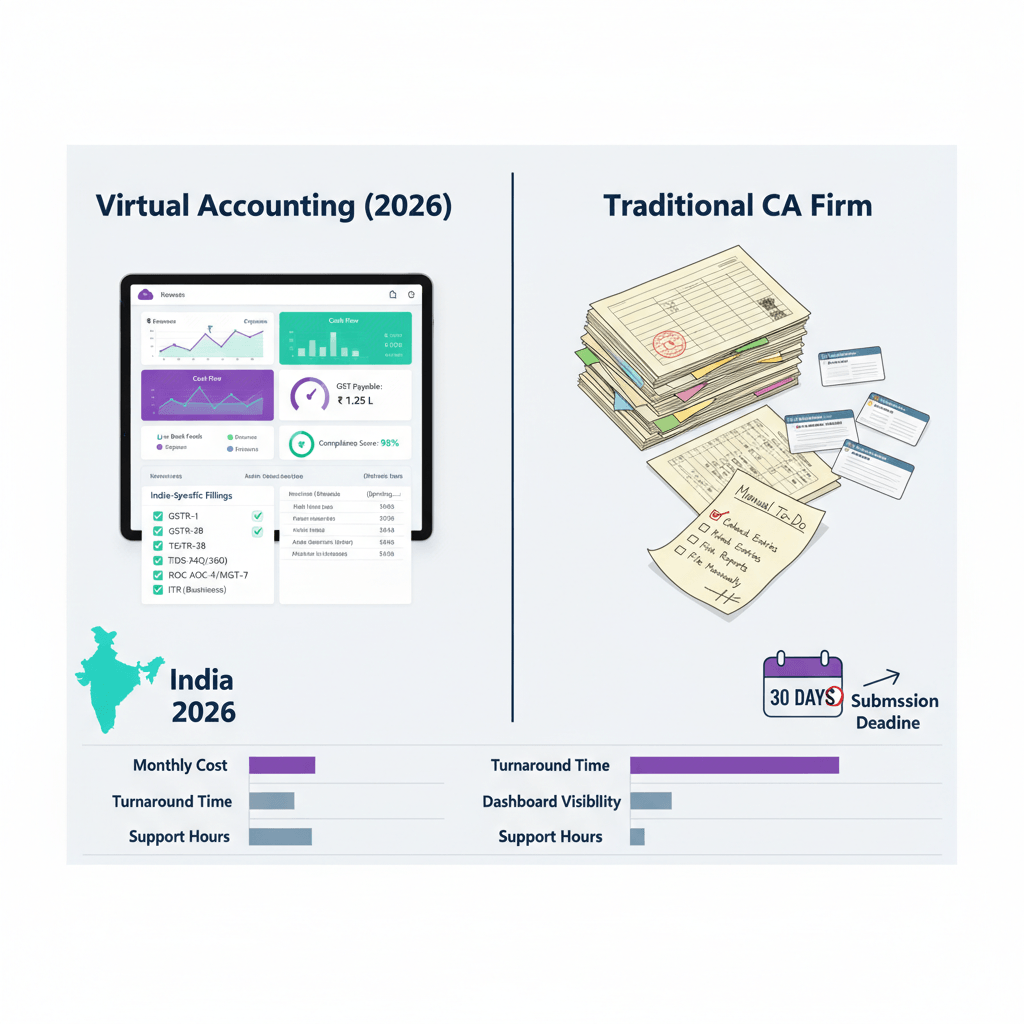
This paisy vs ai accountant comparison focuses on India-first workflows that drive daily outcomes.
| Feature | Paisy (Verify on Site) | AI Accountant (India-Optimized) |
|---|---|---|
| AP/Bills Automation | Basic ingestion, export | Bulk PDF, CSV, image extraction, vendor mismatch detection, Excel validations |
| Bank, Card Statements | Manual tagging | Normalized lines across banks, categorization-ready |
| Transaction Matching | Limited prediction | AI predicts ledger, vendor or customer, bulk edits, payment to bill links, splits |
| GST Reconciliation | Standard workflows | Purchase register plus GSTR-2B match at scale, status tracking |
| Zoho or Tally Sync | One-way, basic | Two-way, masters in, cleaned data out, no duplicate entry |
| Dashboards | Basic reporting | Cash, AR, AP visibility for founders and finance leads |
| Multi-Organization | Limited | One login, role-based access, org-specific AI learning |
| Scale and Trust | Vendor claims | 450+ customers including 100+ CA firms, 300M+ transactions, ISO 27001, SOC-2 Type II |
| Pricing | Verify site tiers, overages | Transparent volume-based, sales quote |
Where it matters day to day: AI Accountant processes mixed-source bill uploads at once, standardizes bank formats into clean debits and credits, predicts ledger or contact mapping, and links payments to open bills automatically. GST reconciliation scales across purchase registers and 2B data, showing what matched, what did not, and why. Two-way sync with Zoho Books or Tally closes the loop, eliminating duplicate entry. Security is enterprise grade, with certifications that satisfy demanding clients.
For additional context on why CAs are leaning into AI, review this India Today overview and the CAclubindia guidance.
Best next step, run a pilot on your real data, then measure time saved and error reductions.
India-Context Use Cases
CA firm managing 30 plus clients
A Mumbai firm faced month-end chaos, multiple formats, and unique rules per client. With AI Accountant, one login covers all entities, role-based permissions protect access, and learning-based categorization adapts to each client. Month-end is now 60 percent faster with fewer errors, moving accuracy from 70 percent at start to 90 percent plus within three months of active use.
SME with Zoho Books integration
A Chennai distributor processed 500 plus bills monthly across several bank accounts. AI Accountant’s two-way Zoho sync brings masters in automatically, then pushes back cleaned bills and categorized transactions. Journal corrections dropped sharply, and the same workload now needs half the effort, with better data quality and fewer audit adjustments.
High-volume GST reconciliation
An electronics retailer with 200 plus vendors struggled to match thousands of invoices to 2B monthly. AI Accountant ingests the purchase register and 2B, matches automatically, and tags status clearly. The team focuses on exceptions, not the bulk of correct matches, so filings are on time with higher confidence. See also the broader industry view in this India Today article.
Implementation and Migration: From Paisy to AI Accountant
Week 1: Initial setup and connection
Connect your org, or start with one pilot client if you are a CA firm. Masters from Zoho or Tally sync automatically. Focus on current operations first, historical imports can follow later.
Week 2: Data ingestion and configuration
Ingest one to three months of statements and bills. Upload PDFs, Excel, CSV, or scans together. Configure mappings, approvals, and exception handling. The system learns from your corrections quickly.
Week 3: Pilot month-end close
Run AI Accountant in parallel with your existing process. Process bills, categorize transactions, reconcile banks, and complete GST reconciliation. Push clean data back to your ledger, then verify journals, bills, and allocations.
Week 4: Review and rollout
Validate dashboards, cash views, and AR, AP insights. Measure hours saved, errors avoided, and remaining bottlenecks. Use these metrics to plan phased rollout across entities.
Migration best practices
- Start with one entity, learn fast, then scale out.
- Define exception review protocols upfront, do not let small issues snowball.
- Capture baseline metrics, prove ROI against time saved and error reductions.
- Train for new workflows, not old habits, let AI streamline how you work.
For the talent angle and AI upskilling, the CAclubindia explainer is a helpful reference.
ROI and Risk Reduction Checklist
Time savings metrics
- Hours saved on bulk bill processing, 70 percent reduction is common.
- Fewer categorization errors, often dropping by 80 percent or more.
- Faster month-end close, three to five day gains for SMEs, more for CA firms.
- Auto-categorization rate trending from 70 percent to 90 percent plus within three months.
- GST reconciliation time cut by up to 90 percent in high-volume environments.
Compliance and audit benefits
- Standardized data across banks and vendors enables quick audit response.
- Complete transaction traceability, every change and approval is logged.
- Fewer manual touches, fewer human errors, fewer audit adjustments.
- Proactive anomaly flags ensure exceptions do not slip through.
Who should switch: Decision checklist
- CA firms with 10 plus client entities needing unified access and faster reconciliations.
- SMEs wanting deeper Zoho or Tally automation with two-way sync.
- Teams prioritizing GST compliance at scale, where generic tools fall short.
- Leaders needing live dashboards for cash, AR, AP, and spend visibility.
- Growing businesses hitting limits on users, entities, or volumes.
For a macro view on automation trends, consider the India Today report.
Best Accounting Automation Tools for Indian Businesses
- AI Accountant – Purpose-built for Indian CA firms and SMEs, excels at GST reconciliation, Zoho or Tally integration, and multi-entity management, proven with 450 plus customers and 300M plus transactions.
- QuickBooks Online – Global footprint with some India localization, suitable for basics, limited in deep GST and Indian integrations.
- Zoho Books – Native Indian GST support, great for small businesses, may need add-ons for heavy automation.
- Tally Prime – Deep Indian compliance expertise, often paired with automation layers for modern workflows.
- Xero – Strong ecosystem, Indian GST features maturing for complex needs.
- FreshBooks – Simple for freelancers, limited for multi-entity CA use cases.
Ready to evaluate your Paisy alternative
Choosing between paisy vs ai accountant is best done on your real data. Upload a sample month of statements and bills, then compare categorization accuracy, reconciliation speed, and integration depth side by side.
Book a demo and a pricing consultation to understand total cost of ownership for your context. As your paisy alternative India choice, AI Accountant delivers AI-powered efficiency that respects Indian workflows and compliance. Join 450 plus businesses already transforming month-end and GST processes with intelligent automation.
The future of accounting augments human judgment, AI handles the repetitive work, while you focus on strategy, advisory, and growth.
FAQs
Is AI Accountant a good paisy alternative for India CA firms?
Yes. AI Accountant addresses CA-firm realities, multi-entity access in one login, role-based permissions, India-specific GST reconciliation, and detailed audit trails. It moves teams from manual data entry to review and advisory, improving margins without sacrificing control.
How does Paisy vs AI Accountant differ for Zoho Books and Tally users?
Integration depth is the key. AI Accountant pulls masters and reference data from Zoho or Tally, processes everything, then pushes back cleaned bills, journals, and categorized transactions. This two-way loop eliminates duplicate entry and sync gaps, which is where most teams lose time.
What about paisy pricing india versus AI Accountant’s cost structure?
Pricing models vary widely. Always verify Paisy’s current tiers and overages on their site. AI Accountant uses transparent, volume-aligned tiers that scale predictably with your usage. Evaluate total cost of ownership, including hours saved and error reduction, not only subscription fees.
How secure is financial data on AI Accountant?
AI Accountant follows enterprise-grade controls, ISO 27001 and SOC-2 Type II. Data is encrypted in transit and at rest, with role-based access and audit logs. These controls satisfy demanding enterprise and audit requirements.
What is the typical implementation timeline for a mid-size CA firm?
Most teams achieve productivity within one to two weeks. Week one covers connections, masters sync, and initial ingestion. Week two runs a pilot close with reconciliations and GST matching. Multi-client rollouts usually complete in three to four weeks with phased onboarding.
Can AI Accountant process complex Indian invoices with multiple tax rates and cess?
Yes. AI Accountant extracts fields from PDFs, scans, Excel, and CSV, handles multiple GST rates and cess, and flags vendor or GSTIN mismatches. The system learns from your approvals and corrections, improving accuracy over time.
What happens to historical transactions when switching from Paisy?
Keep history in your current ledger initially, prioritize go-forward automation to realize value faster. You can import historical data later for trend analysis or audits. From day one, AI Accountant preserves complete audit trails on all processed data.
How does AI Accountant learn my client-specific categorization rules?
Learning is organization specific. The AI notes your edits and approvals, then predicts categories, ledgers, and contacts accordingly. CA firms benefit because each client’s model evolves independently, maintaining unique preferences and vendors.
Can AI Accountant reduce GST 2B reconciliation time for high-volume clients?
Yes. The platform ingests purchase registers and 2B, matches automatically at scale, and tags statuses like matched, mismatch, or needs review. Many high-volume teams report up to 90 percent time reduction compared to manual methods.
How does AI Accountant improve month-end close for multi-entity CA firms?
One login across entities, role-based access for staff, standardized bank normalization, and predictive categorization reduce touchpoints dramatically. With two-way sync to Zoho or Tally, clean data flows back automatically, which shortens close cycles by several days.
What is the best way to pilot AI Accountant before full migration?
Run a parallel month on one entity. Ingest one to three months of bills and statements, configure approvals and exceptions, complete GST reconciliation, then push back to your ledger. Compare hours saved, auto-categorization rate, and error counts with your current baseline.
Can AI Accountant help with audit readiness and evidence trails?
Yes. Every change, approval, and exception resolution is logged, which simplifies PBC requests and reduces back-and-forth during audits. Many CA firms use AI Accountant to standardize data and produce consistent evidence quickly.

Rohan Sinha is a fintech and growth leader building aiaccountant.com, focused on simplifying accounting and compliance for Indian businesses through automation. An IIT BHU alumnus, he brings hands-on experience across 0 to 1 product building, growth, and strategy in B2B SaaS and fintech.