-01%201.svg)
Key takeaways
- Integrated accounting solutions combine a CA led service and a live dashboard, so books, filings, and documents stay in one clean flow.
- You get real time visibility into cash, burn, runway, and compliance status, while a CA team executes GST, TDS, income tax, and ROC end to end.
- In India, this model reduces penalties, speeds up month end close, and improves investor grade MIS, with fewer tools and lower coordination effort.
- A strong checklist spans bookkeeping, reconciliations, tax engines, payroll, ROC, audit trails, and a compliance calendar, all on one system.
- AI Accountant delivers this model with a simple dashboard and a dedicated CA team, giving you both control and relief.
What are integrated accounting solutions
Integrated accounting solutions blend expert CA services and smart software into one managed service. Software alone cannot file your GST or prepare your TDS returns correctly, and a CA team alone cannot give you live visibility. Together, they solve both needs with one source of truth and one operating rhythm.
In a strong integrated model you get
- General ledger that captures every transaction across sales, purchases, expenses, assets, and journals.
- Accounts receivable and accounts payable with aging and reminders.
- Bank feeds for all accounts and gateways and clean reconciliations.
- Inventory and fixed asset registers with schedules and depreciation.
- Payroll calculations and payroll TDS where needed.
- Tax engines for GST and TDS and income tax workflows.
- E invoice enablement and a secure document repository.
- A compliance calendar that tracks due dates and filing status.
- A central chat space to talk to your CA team and resolve queries.
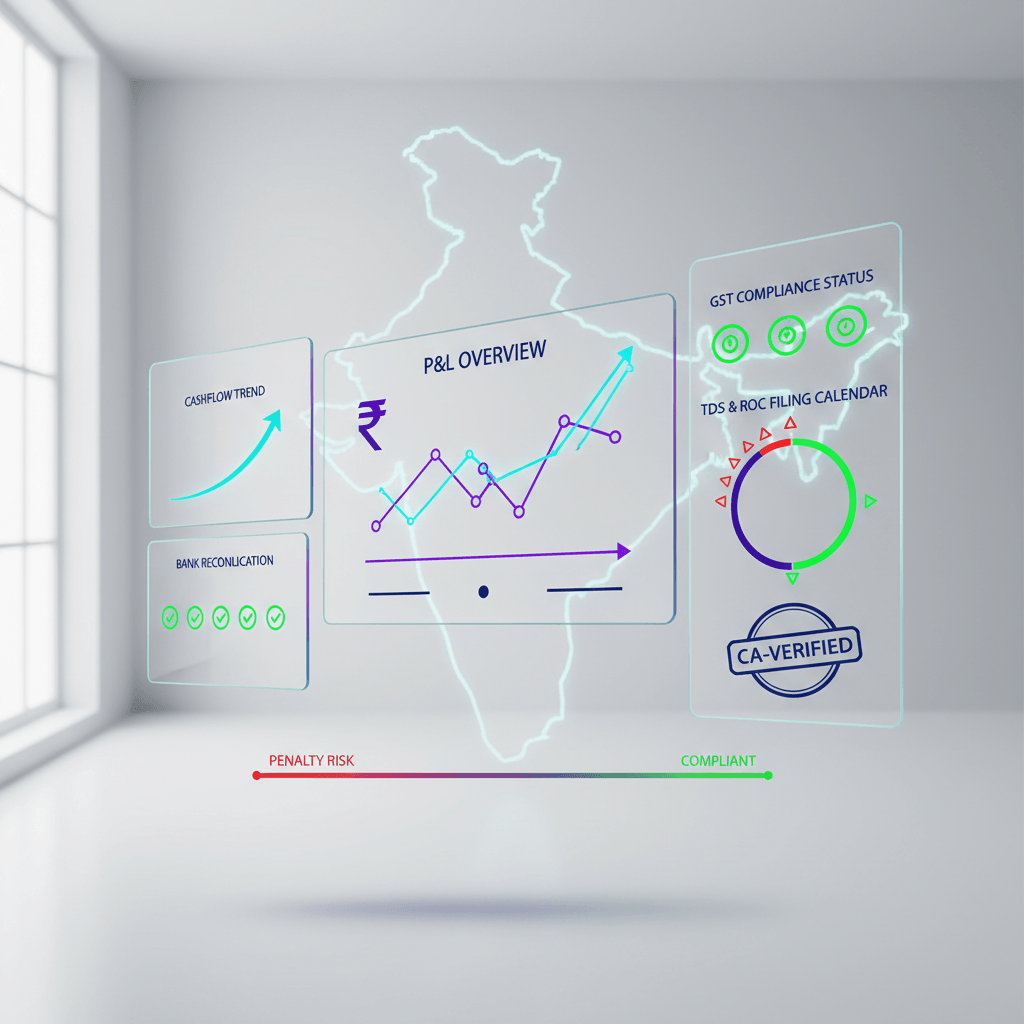
All of this runs on one dashboard. You see revenue, expenses, profit or loss, cash flow trends, burn rate, and runway, with AI driven insights and alerts. You see recent transactions and filing status without chasing anyone. Manual errors drop, guesswork disappears.
Sources: Hubifi, AccountsIQ, Algebra India, ConnectPointz, Successware, AI Accountant overview
Benefits of integrated accounting solutions in India
The biggest win is a single source of truth. Books, filings, and documents sit in one place. No more back and forth, no more version chaos, faster closes and fewer fines.
- Real time visibility into cash burn and runway so you make better decisions.
- Faster month end close and audit readiness with proper schedules.
- Fewer penalties and interest since GST, TDS, income tax, and ROC stay on time.
- Cost savings by replacing many vendors and tools with one managed service.
- Scalability from freelancer to growth stage company without a big ERP.
- Better investor updates and lender trust with clean MIS and aging reports.
Sources: Hubifi, Algebra India, Successware, AccountsIQ
Integrated accounting solution capabilities checklist
Accounting and bookkeeping
- Monthly bookkeeping for sales, purchases, expenses, and bank entries.
- Ledger scrutiny and clean up to remove duplicates and misposts.
- Year end closing and schedules for audit readiness.
- Fixed asset register with additions, disposals, and depreciation.
- Inventory records and reconciliation for goods and D2C use cases.
- Accounts receivable and accounts payable management with aging.
- Bank and payment gateway reconciliations across UPI, cards, and wallets.
- Cash flow preparation and MIS reporting with variance views.
- Support in coordination with your statutory auditor where required.
Taxation and compliance
- GST registration and advisory on place of supply, RCM, HSN, and tax rates.
- Monthly or quarterly filings for GSTR 1 and GSTR 3B.
- Annual filings for GSTR 9 and where applicable GSTR 9C readiness.
- E invoice enablement and reconciliation health checks.
- TDS advisory and compliance including challan payments.
- Filing of Forms 26Q, 24Q, 27Q, 26QB, 26QC, and 26QD as applicable.
- Income tax return filing for individuals, partnerships, and companies.
- Advance tax calculation and payment tracking.
- Tax audit preparation support, non attest scope.
- International tax and expat tax advisory where relevant.
- 15CA preparation when payments require it.
Payroll and ROC
- Payroll TDS calculation.
- Advisory on tax efficient salary structuring for employees.
- Annual ROC compliance for small companies such as MGT 7 and AOC 4.
- DIR 3 KYC, MSME filing to MCA, DIN and director changes.
- Event based MCA filings as needed.
System and process
- Document repository with searchable access.
- Compliance calendar with due dates and filing status.
- AI insights and alerts on spikes and anomalies.
- Centralised communication with the CA team for queries and approvals.
Sources: Hubifi, ConnectPointz
Integrated accounting solutions vs alternatives
Spreadsheets with an ad hoc CA
- Low visibility across ledgers and filings leads to misses.
- High error risk from manual work and copy paste.
- Deadlines slip since ownership is unclear.
Integrated solutions bring one workflow with alerts and review steps, and a clear owner who files on time.
Standalone software
- Software records data but does not file returns or prepare reconciliations.
- You still need a CA to manage GST, TDS, income tax, and ROC.
Integrated solutions pair software with a CA led team, so you get both automation and execution. See a quick overview here: AI Accountant guide.
Outsourced bookkeeping only
- Books may be clean but tax and ROC gaps remain.
- You still chase vendors for filings and documents.
Integrated solutions give end to end coverage from entries to filings.
Full ERP for SMBs
- Cost is high and setup is slow.
- Teams need long training and change management.
Integrated solutions offer speed to value and scale as you grow without big overhead.
Sources: Successware, Hubifi, AccountsIQ, Algebra India, ConnectPointz
Who needs integrated accounting solutions
- You manage many payment gateways and UPI sources, and invoice volumes are growing.
- You handle GST and TDS every month, and vendor reconciliations take too long.
- Founders or finance leads spend more than five hours a week on coordination and chasing.
- You have faced penalties or data mismatches, or are preparing for audit or fundraising.
If you check even one box, it is time to unify your books and compliance into one system and service.
Sources: Hubifi, Successware
India compliance deep dive with integrated accounting solutions
GST
- Advisory for place of supply, inter and intra state, and export rules.
- Reverse charge mechanism checks and vendor classification.
- Correct HSN mapping and rate selection.
- E invoice rules and portal workflows where applicable.
- Monthly or quarterly GSTR 1 and GSTR 3B with reconciliation to books.
- Annual GSTR 9, and readiness for GSTR 9C where audit is applicable.
- Health checks for GSTR 2B credits, vendor follow up, and mismatch fixes.
TDS
- Identify sections and rates for vendor and payroll TDS.
- Track challan payments with typical due date on the seventh of the next month.
- File Form 24Q for salaries, 26Q for domestic vendors, 27Q for non residents, and 26QB, 26QC, 26QD for property, rent, and contractor payments as relevant.
- Avoid late fees and interest, including Section 234E fees.
- Maintain records for correction statements and reconciliations.
Income tax
- File ITR for individuals, partnerships, and companies as per your structure.
- Plan and pay advance tax across the four quarters.
- Prepare for tax audit where applicable with non attest support.
- Cover international tax cases and expat payroll where needed.
- Prepare Form 15CA when remittances require it.
ROC for small companies
- File annual MGT 7 and AOC 4 on time.
- Manage DIR 3 KYC and director changes.
- Maintain statutory registers and minutes.
- Handle event based filings such as capital increase and share allotment.
Note: Relevant extracts for a small company per AI Accountant service scope include turnover below 100 crore, paid up share capital below 10 crore, and not being a holding or a subsidiary.
Sources: Hubifi, AccountsIQ, ConnectPointz
Implementation roadmap for integrated accounting solutions
- Diagnostic: Review your current tools, map your chart of accounts, list every compliance due, note gaps in books and filings.
- Migration: Clean ledgers, post opening balances, bring in prior year schedules, organise documents and contracts in a central drive.
- Integrations: Connect bank feeds, link payment gateways and UPI sources, set up GSTN e invoice and MCA access, link payroll and HRMS if any.
- Processes: Define maker checker flows for payments, filings, and journals, publish a monthly closing calendar, fix approval rules for POs and invoices.
- Onboarding: Set user roles, train your team on the dashboard, confirm SLAs, communication channels, and TATs.
- Go live: Run first reconciliations, file your first returns under the new flow, review variances and fix teething issues.
- Ongoing: Close monthly, monitor the compliance calendar, track SLA adherence and keep a steady cadence.
Keep it simple, document each step, celebrate the first close.
Sources: Hubifi, AccountsIQ
Integrations ecosystem for integrated accounting solutions
Look for API first connections so data flows with no manual imports. The goal is simple, zero copy paste, maximum traceability.
- Banks and payment gateways such as Razorpay and leading acquirers.
- GSTN e invoice and MCA portals for status and reference.
- Payroll and HRMS and invoicing tools that fit your team.
- OCR and document capture tools for bills and expenses.
- Communication tools so approvals and chats sit in one thread.
Sources: AccountsIQ, ConnectPointz, AI Accountant integrations
Governance security and controls in integrated accounting solutions
- User roles and permissions by function and entity.
- Audit trails on every change and every filing.
- Automated backups and safe storage of documents and reports.
- Maker checker for payments, journals, and filings.
- Evidence management so audits and diligence go smoothly.
Controls protect you, and they also cut review time in audits and fundraising.
Sources: Hubifi, IAS Indiana
Metrics and reporting that matter in integrated accounting solutions
- Profit and loss with gross margin and net margin trends.
- Cash flow with burn rate and runway for founders and boards.
- Accounts receivable and accounts payable aging with DSO and DPO.
- Filing timeliness and exception counts.
- Month end close cycle time.
- SLA adherence for query response and reconciliation TAT.
- Variance analysis on revenue, expenses, and cash.
Sources: Hubifi, ConnectPointz, Successware
Cost and ROI of integrated accounting solutions
Fragmented setups feel cheap at first, but you pay in hidden ways, extra hours, duplicate vendors, late fees, interest, slower decisions, and lower trust in numbers. Integrated solutions use tiered pricing by volume and complexity, and the ROI stacks up fast.
- Avoided penalties and interest.
- Faster cash collection and better working capital control.
- Cleaner MIS for better decisions.
- Less founder time on coordination.
- Smoother audits and diligence that protect value.
Source: Algebra India
Mini case sketches powered by integrated accounting solutions
Freelancer
A solo designer moves from spreadsheets to a managed setup. GST is filed on time, TDS challans are tracked, cash flow is clear. Time spent on finance drops to under one hour a week.
D2C brand
A consumer brand sells across marketplaces and its own site with multiple gateways. Payment gateway reconciliations catch refunds and chargebacks fast, revenue leakage falls, inventory and AR stay in sync.
SaaS startup
A seed stage startup needs runway tracking and investor MIS. The dashboard shows burn and unit economics in real time, monthly closes happen in five days, the next round data room is ready in weeks.
Sources: Hubifi, Successware
Common pitfalls and how to avoid them in integrated accounting solutions
- Partial integrations that rely on manual imports: Fix with full API syncs and clear data ownership.
- A weak chart of accounts or SOPs: Design them upfront and stick to them.
- Delayed reconciliations: Reconcile weekly for gateways and monthly for banks at a minimum.
- Missing documents: Capture every invoice, contract, and challan, and store with the entry.
- Software without CA execution: Pair the system with a CA team that owns filings and reviews.
Sources: Hubifi, AccountsIQ
How AI Accountant delivers integrated accounting solutions
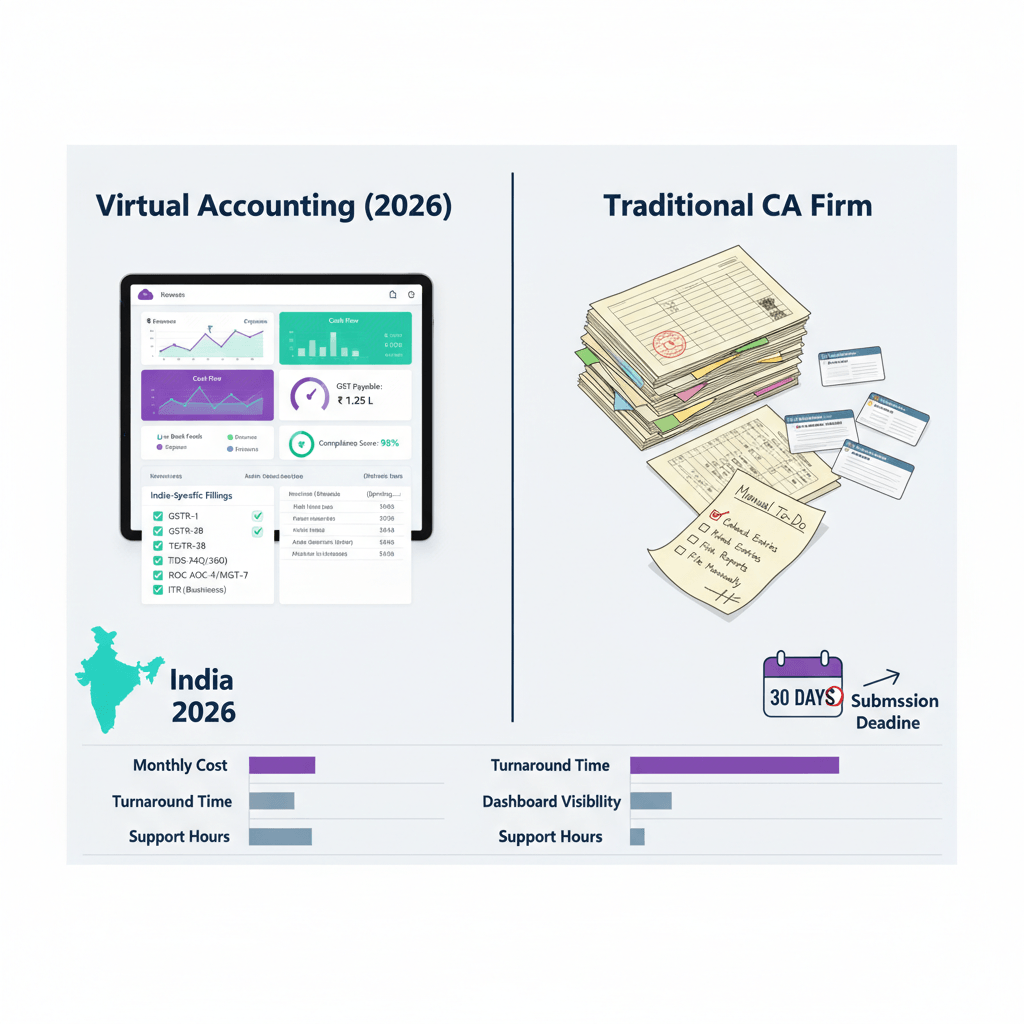
AI Accountant Virtual Accounting is a CA led managed service with a live dashboard. It replaces scattered tools and chat threads with a clean system and a dedicated team that handles bookkeeping and compliance, while you see everything in real time.
What you get
- Monthly bookkeeping with ledger scrutiny and clean up.
- AR and AP, and bank and payment gateway reconciliations.
- Cash flow MIS and AI generated insights and alerts.
- GST advisory and filings including GSTR 1, GSTR 3B, and GSTR 9, and e invoice enablement and reconciliations.
- TDS advisory, challan support, and filings for 26Q, 24Q, 27Q, 26QB, 26QC, and 26QD.
- Income tax returns for individuals, partnerships, and companies with advance tax and 15CA preparation, and non attest audit prep.
- Payroll TDS and salary structuring advisory.
- ROC and MCA filings for small companies such as MGT 7, AOC 4, DIR 3 KYC, MSME filing, and event based support.
- A document repository, compliance calendar, and a central communication hub with the CA team.
Who it suits
- Freelancers who want simple and compliant accounting without juggling portals.
- Startups and growth stage teams that need real time visibility and tight controls.
- Small companies that need full ROC and MCA coverage along with tax and books.
Scope note
AI Accountant operates on a non attest model and coordinates with your statutory auditor when you need certificates or audits.
Sources: Hubifi, AccountsIQ, ConnectPointz
Buyers checklist for integrated accounting solutions
- Do you cover full GST, TDS, income tax, and ROC scope for my entity type
- Will a qualified CA oversee my account and sign off on filings
- What SLAs do you commit to for reconciliations, filings, and query responses
- How will you migrate my data and lead my first monthly close
- What integrations do you support for banks, gateways, GSTN e invoice, and MCA
- Do you have audit trails, maker checker, and evidence management
- What reporting and AI insights do you provide by default
- How is pricing structured and what happens when I scale
- Who owns the data and how is it backed up and secured
Sources: Hubifi, AccountsIQ
Next steps to try integrated accounting solutions with AI Accountant
If you want your books and filings to run as one clean flow, integrated accounting solutions are the way forward. With AI Accountant you get a dedicated CA team and a dashboard that shows your world in real time. No more chasing, no more guesswork, just clear numbers and on time compliance.
Book a demo and see how the model fits your business in India today: AI Accountant.
Further reading: Hubifi, AccountsIQ, ConnectPointz, Successware, Algebra India
FAQ
How is an integrated CA led model different from hiring a bookkeeper plus a separate CA on retainer
A bookkeeper records data, a retainer CA advises on tax, but ownership of reconciliations and filings often falls through the cracks. An integrated model assigns one accountable CA led team that handles entries, reconciliations, GST, TDS, income tax, and ROC in one workflow with audit trails. A platform like AI Accountant adds a live dashboard so founders and finance heads see burn, runway, and filing status in real time.
What implementation timeline can I plan for, and what artefacts must I provide up front
Most SMBs and startups complete rollout in four to six weeks. You provide trial balance and ledgers, opening balances, prior GST, TDS, and income tax filings, bank and gateway statements, signed engagement details, PAN, TAN, and GST credentials, and any fixed asset and inventory schedules. AI Accountant typically completes migration, integrations, and first close within that window.
How do you ensure GST accuracy across multiple registrations and mixed supplies
The CA team maps place of supply, inter and intra state logic, HSN codes, RCM vendors, and e invoice applicability up front. The system enforces tax rate rules, validates GSTR 1 and GSTR 3B against books, and runs GSTR 2B credit health checks with vendor follow ups. For example, AI Accountant sets review points before filing and stores evidence with each return.
What is the reconciliation approach for payment gateways like Razorpay versus bank credits
Gateways are reconciled at the transaction level, matching orders, refunds, chargebacks, fees, and GST on fees to settlements. Bank feeds confirm net credits by date, while a fee ledger and clearing ledger bridge timing gaps. Weekly gateway recos and monthly bank recos keep AR and revenue leakage in control. AI Accountant automates the mapping and flags exceptions for CA review.
Can an integrated service support due diligence or statutory audit without providing attest services
Yes. In a non attest model, the team prepares schedules, reconciliations, audit trails, and a complete document repository, then coordinates with your statutory auditor. You get faster PBC turnaround times, cleaner variance explains, and a ready data room. AI Accountant follows this model while keeping attest work with your auditor.
How are TDS obligations tracked to avoid late fees and interest
The compliance calendar lists due dates, the system tracks challans, and the CA team files Forms 24Q, 26Q, 27Q, 26QB, 26QC, and 26QD as applicable. Section wise rate checks and PAN validations reduce errors. Exceptions are escalated before the seventh of the next month. AI Accountant also maintains correction statements where needed and logs evidence against each filing.
What reporting pack do founders and boards typically see each month
A standard pack includes P and L with gross and net margins, cash flow, burn and runway, AR and AP aging with DSO and DPO, month end close status, filing timeliness, and key variances on revenue, expenses, and cash. AI Accountant adds AI generated anomaly alerts and a simple runway widget for quick decisions.
How do you handle prior period clean up, reclassifications, and opening balance alignment
The team performs ledger scrutiny, identifies duplicates and misposts, prepares a reclass journal set, and aligns opening balances to audited numbers. Reconciliation workpapers are stored against each adjustment. AI Accountant documents every change in an audit trail so your statutory auditor can review with minimal back and forth.
What SLAs are realistic for reconciliations, filings, and query response
Typical SLAs are weekly gateway recos, monthly bank recos within five working days of month close, GSTR 1 and GSTR 3B as per due dates with two step reviews, and 24 to 48 hour first response on queries. AI Accountant publishes SLAs at onboarding and tracks adherence on the dashboard.
How does the maker checker control work for payments, journals, and filings
Roles separate data entry, review, and approval. Journals and returns are created by preparers, reviewed by a senior, and signed off by a CA. Evidence, such as challans and reconciliations, is attached to each item. AI Accountant enforces these stages and logs every action in an immutable trail.
Can the platform handle international payments, 15CA, and foreign vendor TDS
Yes, with a CA led review. The system flags foreign remittances that need 15CA, applies treaty or domestic rates for 27Q where relevant, and records bank charges and FX effects. AI Accountant provides the workflow and documentation while your CA validates sections and rates.
What does pricing look like, and how do I evaluate ROI versus my current setup
Pricing is tiered by volume, entities, and complexity. To assess ROI, add avoided penalties and interest, faster collections, time saved by founders and finance staff, reduced software sprawl, and audit readiness benefits. AI Accountant often replaces multiple vendors and tools, delivering net savings while upgrading control and speed.
How does AI enhance the service without compromising compliance quality
AI surfaces anomalies, classifies transactions, and drafts variance explains, while the CA team owns reviews and filings. This combination speeds the close, reduces noise, and keeps expert judgment at each control point. AI Accountant uses AI for insights and triage, and a CA signs off before any filing.
Who owns the data, and how quickly can I export if I ever need to switch
You own the data. Exports of ledgers, trial balance, documents, and evidence logs are provided on request. AI Accountant maintains backups and audit trails, and supports structured handovers within agreed timelines to avoid disruption.