-01%201.svg)
Key takeaways
- For most founders in 2026, virtual accounting delivers faster responses, higher accuracy, and lower total cost than traditional CA firms.
- Predictable subscriptions replace variable retainers and ad hoc charges, significantly reducing surprise bills and penalty risk.
- Real time dashboards, AI alerts, and compliance calendars keep filings on track and provide investor ready numbers at all times.
- Penalties from delayed filings drop when you move to proactive workflows that prevent misses by design, especially for GST and TDS penalties.
- End to end coverage in one platform, from books to GST, TDS, ITR, payroll, and ROC, removes vendor fragmentation and saves founder time.
- Migration is structured and low risk, with a quick health check, clean handover, parallel run, and a clear monthly cadence.
- Most Indian startups, SMEs, and solopreneurs should choose virtual accounting now, keeping traditional CAs only for statutory audits when required.
The real problems founders face with traditional CAs
You know that sinking feeling when a penalty notice lands just before payroll, or when a response arrives days after a filing deadline. The common pain points are clear, delayed filings that trigger GST and TDS penalties, unpredictable hourly and per filing fees, and poor visibility caused by scattered email and chat threads. These are not small annoyances, they create cash flow errors, audit exposure, and even derail fundraising timelines.
Modern Indian businesses need continuous accounting, not episodic, manual, offline work that breaks under scale.
What is a traditional CA firm in India
A traditional CA firm typically operates through episodic engagements at local offices. You pay a retainer, then extra charges for each filing and additional advisory. Communication lives in email and messaging apps, workflows are manual, and different vendors or individuals handle GST, TDS, ITR, payroll, and ROC separately. In a world demanding speed and real time numbers, this approach creates delays and blind spots.
What is virtual accounting
Virtual accounting combines a dedicated CA team, automation, and a single cloud platform for continuous service. You get live financials, a compliance calendar, AI based anomaly detection, and in app expert access, all in one place. Everything from bookkeeping to GST, TDS, ITR, and ROC runs end to end without founder firefighting.
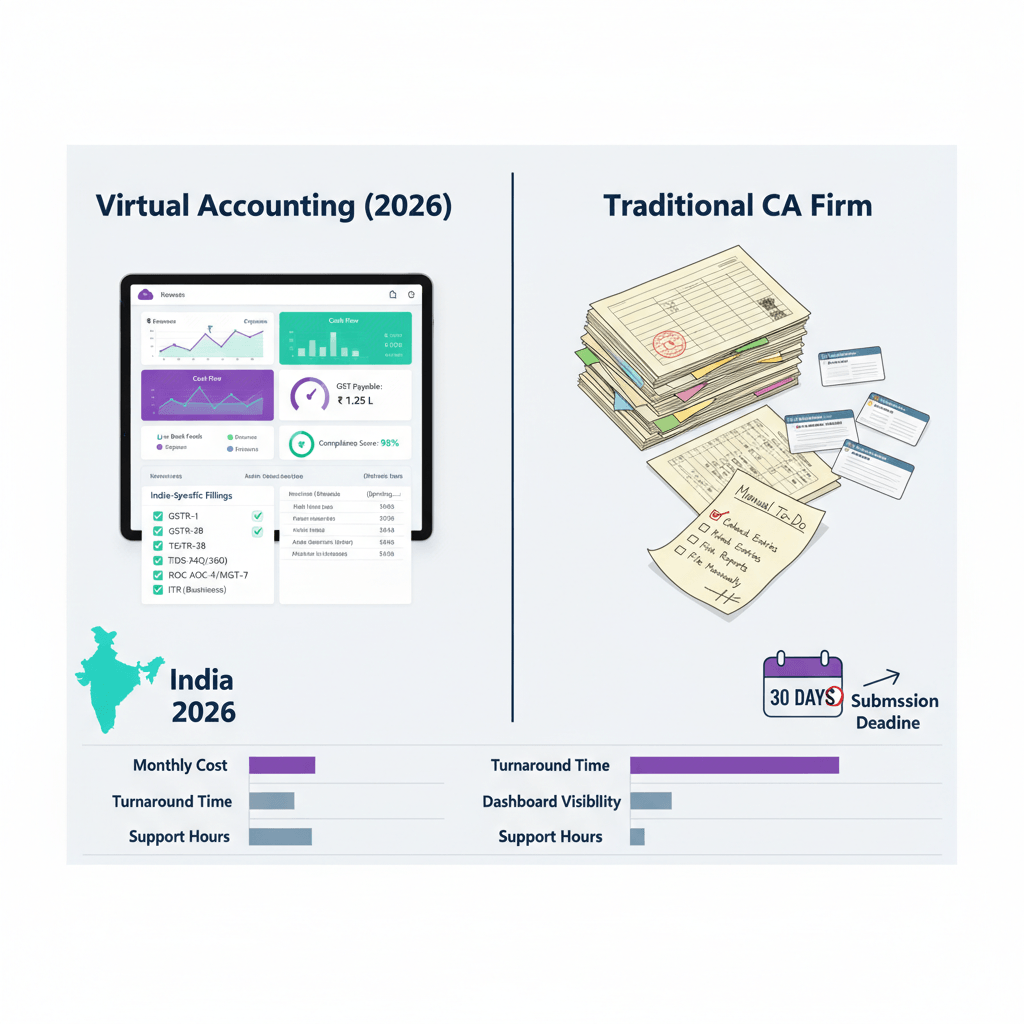
Virtual accounting vs traditional CA firm India, the complete comparison
Cost and predictability
Traditional firms mix retainers with hourly and per filing fees, which makes budgeting uncertain. Digital services provide bundled plans that include books, compliances, and MIS reporting, reducing penalties and removing surprises.
Speed and responsiveness
With offline workflows, responses arrive slowly during crunch periods. Virtual teams answer within set service levels, and chat first collaboration cuts turnaround to hours.
Financial visibility
Static, late reports keep you flying blind. Cloud dashboards show live P and L, balance sheet, and cash flow, while alerts surface issues before they become crises.
Accuracy and audit readiness
Manual reconciliations allow errors to slip through. Automated reconciliations, checklists, and version control produce clean audit trails and fewer mistakes.
Scalability for growth
Manual processes struggle with more entities or transaction spikes. Cloud teams scale with your volume, supporting remote operations without friction.
Scope coverage
Traditional setups fragment GST, TDS, ITR, payroll, and ROC across vendors. Modern platforms bundle everything under one roof, with one accountable team.
Compliance reliability
Reminder driven systems fail when humans miss pings. Proactive calendars and automated nudges keep filings on time, preventing penalties by design.
Data security
Shared spreadsheets and local storage create risk. Cloud platforms enforce access controls, backups, and detailed audit logs.
Founder time saved
Chasing updates and compiling documents can burn 10 or more hours each month. Automated ingestion and self service dashboards save 20 to 30 hours monthly.
How Indian businesses actually use each model
GST filing workflows
Virtual platforms automate GSTR 1, GSTR 3B, and GSTR 9 reconciliation with direct portal data, turning deadline misses into rare exceptions. Manual compilation in traditional setups increases error risk.
TDS and payroll management
Digital systems compute monthly TDS, optimize salary structures for tax efficiency, and file on time. Offline workflows take longer and invite slippage.
Year end closures and ITR filing
Online platforms close books in seven days with investor ready MIS, while traditional methods often take a month or more.
ROC and secretarial compliance
AOC 4, MGT 7, and AGM filings run with live status tracking in modern systems, replacing offline processes with transparent progress.
Banking and reconciliation
Automated bank feeds and rules streamline receivables, payables, inventory, and fixed assets, cutting error rates dramatically compared to manual processes.
Pricing comparison, traditional CA vs virtual accounting
Traditional CA retainers often range from fifteen thousand to fifty thousand rupees monthly, with extra per filing fees and advisory charges pushing total costs to twenty five thousand to over one lakh monthly for startups. Virtual accounting tiers offer predictable monthly plans that bundle books, GST, TDS, ITR, ROC, payroll, and MIS, eliminating per filing surprises.
Real startup cost comparison
At one hundred fifty transactions monthly, traditional outlay near thirty five thousand versus about eighteen thousand for virtual, saving roughly seventeen thousand through penalty prevention and clean audits. At three hundred fifty transactions, traditional can reach sixty thousand, while virtual averages about twenty five thousand, saving thirty five thousand.
CA firm vs online accounting India, understanding delivery models
Offline and hybrid CAs rely on physical paperwork and manual approvals, which slow everything down. Online accounting uses cloud workflows and direct integrations with GST, Income Tax, and MCA, enabling seven day book closures and seamless collaboration across distributed teams.
Why founders switch from CA to virtual accounting
Common triggers include sudden penalty shocks, unresponsive support during critical filings, and messy books discovered during diligence. After switching, penalty incidents drop, MIS turns around in seven days, and costs become fixed and predictable. The return on investment often reaches two to three times through time savings and avoided penalties.
Success stories by business type
- Early stage SaaS, live burn and runway tracking for sharper fundraising narratives.
- D2C brands, automated inventory and receivables management for cash discipline.
- Freelancers and agencies, TDS and ITR on autopilot, zero deadline anxiety.
Virtual accounting features that make the difference
The dashboard experience
Live statements update continuously, cash flow trends highlight direction, alerts flag anomalies and overdue items, bank statements reconcile automatically, documents live in a searchable vault, compliance calendars prevent last minute sprints, and in app CA chat answers questions quickly.
Complete service coverage
Books, GST, TDS, ITR, payroll, and ROC reside in one platform, which removes handoffs and the risk of cross vendor gaps.
Lightning fast onboarding
Begin within twenty four hours, with a working dashboard on day one and a clear plan to backfill history.
Building trust, security and risk management
Strong access controls, automated backups, and segregation from attestation work provide safety. Service continuity beats single CA dependency, teams keep working even when someone is out, and quality assurance checklists maintain consistency.
How to replace CA firm India, your migration roadmap
Step 1, health check
Identify pending GST, TDS, ROC, and data gaps. Clarify priorities for cleanup.
Step 2, smooth handover
Import bank statements, ledgers, GST data, income tax and ROC documents. Everything moves digitally.
Step 3, platform setup
Connect banks and government portals, configure your chart of accounts, define your MIS views.
Step 4, parallel run
Reconcile while both systems run together, validate numbers, then cut over.
Step 5, establish cadence
Lock monthly filing cycles, MIS delivery dates, and quick review meetings.
Common blockers like portal access or data retrieval get handled through structured discovery and escalation.
Addressing common concerns
Will service be generic
No, you get a dedicated CA team with deep India expertise in GST and ROC, who understands your sector specifics and growth stage.
Can they handle complexity
Yes, current implementations cover SaaS, D2C, manufacturing, and services, including multi entity and cross border cases where applicable.
Are there hidden fees
Transparent bundles include the scope upfront, with clear change control if your needs expand.
Is advisory included
Foundational advisory and ongoing guidance come standard via chat and scheduled reviews, with escalation for special cases.
Measurable results from virtual accounting
- Time saved, twenty to thirty hours monthly returned to founders.
- Penalties reduced, proactive alerts and calendars prevent late filings.
- Faster closes, seven day monthly and annual closures versus thirty plus days offline.
- Predictable costs, fixed subscriptions replace variable billing chaos.
Your virtual accounting options in India
- Virtual Accounting by AI Accountant, a complete bookkeeping, compliance, and advisory service with real time dashboards and predictable pricing starting at four thousand rupees monthly
- Traditional CA firms with digital capabilities, established teams adding online workflows while maintaining offices
- Freelance CAs using cloud tools, individual practitioners offering remote service
- DIY accounting platforms, software only tools where you manage compliance yourself
- Big Four advisory services, premium programs for large enterprises with complex needs
- Regional accounting firms, local providers focused on specific geographies
Making your decision, who should choose what
Startups, SMEs, and solopreneurs should pick virtual accounting for live dashboards, fast expert access, transparent pricing, and complete coverage. Only businesses with heavy local attestation needs should stay with traditional firms for day to day work, engaging them solely for statutory audits where required. For most Indian businesses, modern problems call for modern solutions.
Take action today
The gap between compliance chaos and financial clarity is one decision away. Replace your CA firm with virtual accounting in seven days, get a free compliance health check, and go live within twenty four hours. Stop juggling spreadsheets and chasing updates, start making decisions with real time numbers and proactive compliance.
FAQ
Is virtual accounting actually cheaper than my current CA when I factor in penalties and ad hoc advice
Yes, most founders see thirty to fifty percent savings when they include reduced penalties and the removal of per filing charges. Bundled subscriptions cover books, GST, TDS, ITR, payroll, and ROC, which prevents the nickel and dime effect. For example, Virtual Accounting by AI Accountant offers predictable pricing that replaces scattered invoices and interest charges.
How quickly can I switch without risking missed GST or TDS deadlines
A structured five step migration, health check, handover, platform setup, parallel run, cadence, enables a safe switch within one to two weeks. Filings continue during the parallel run, so there is no gap. Providers like Virtual Accounting by AI Accountant commonly complete go live within twenty four hours for the dashboard, then finalize reconciliations.
We are preparing for a fundraise, will virtual accounting make diligence easier
Absolutely, investor ready MIS, seven day closes, and clean audit trails simplify diligence and accelerate responses. Live dashboards give your finance narrative credibility. Many founders use Virtual Accounting by AI Accountant to keep burn, runway, and cohort metrics investor ready.
What if my business has multiple entities and high transaction volume
Cloud workflows and elastic teams scale smoothly across entities and spikes in volume. Automated reconciliations, rules, and checklists maintain accuracy without adding headcount linearly. A provider like Virtual Accounting by AI Accountant routinely handles multi entity consolidations.
Will I still need a traditional CA for audits or certifications
Yes for statutory audits and certain certifications that require attestation. The winning setup is virtual accounting for daily operations and compliance, with an audit firm engaged annually. This separation preserves independence and speed.
How do virtual teams ensure data security and access control
They use role based access, encrypted storage, automated backups, and detailed audit logs. These controls are stronger than shared spreadsheets and local drives. Ask for documentation of controls and backups, providers such as Virtual Accounting by AI Accountant will share their practices.
Can I get on demand advisory without surprise bills
Yes, modern subscriptions include ongoing advisory via chat and scheduled reviews. Clear scopes and change control prevent bill shock. With Virtual Accounting by AI Accountant, founders escalate complex questions through defined expert channels without unpredictable fees.
What measurable results should I expect in the first quarter after switching
Typical outcomes include twenty to thirty hours saved monthly, far fewer late fees, seven day closes, and cleaner receivables and payables. You should also see real time visibility into cash and runway. Providers like Virtual Accounting by AI Accountant highlight these metrics in your dashboard.
How do you handle legacy data mess, unreconciled banks, missing invoices, or partial ledgers
The health check identifies gaps, then a cleanup sprint prioritizes bank reconciliations, GST matching, and ledger normalization. A parallel run validates accuracy before full cutover. This is standard operating procedure for Virtual Accounting by AI Accountant engagements.
We already file on time, what extra value will virtual accounting add
Beyond on time filings, you gain live visibility, faster closes, automated workflows, and decision ready MIS. That means fewer cash surprises, stronger fundraising conversations, and time back for growth. Teams like Virtual Accounting by AI Accountant also reduce founder dependency by institutionalizing processes.
Does virtual accounting support sector specific needs like inventory for D2C or revenue recognition for SaaS
Yes, modern setups adapt charts, rules, and reports for sector workflows. For D2C, inventory and reconciliations across marketplaces are automated, for SaaS, revenue recognition and deferred schedules are standardized. These are common configurations for Virtual Accounting by AI Accountant.
How do you guarantee responsiveness during peak filing periods
Teams plan capacity, enforce service levels, and use in app chat with clear escalation paths. Workloads are distributed across time zones, which keeps answers flowing even at peak times. This is a core promise of providers like Virtual Accounting by AI Accountant.
What happens if a team member leaves or goes on vacation
Virtual models avoid single point dependency by documenting processes, maintaining checklists, and operating as a team. Coverage continues without gaps, unlike single partner dependency in many traditional arrangements.
Which founders should defer switching to virtual accounting
If your operations require constant in person attestations or highly specialized local processes that cannot be digitized, consider a hybrid approach, daily work on a virtual platform, specific attestations with a local firm. For everyone else, the benefits of switching now outweigh waiting.

Rohan Sinha is a fintech and growth leader building aiaccountant.com, focused on simplifying accounting and compliance for Indian businesses through automation. An IIT BHU alumnus, he brings hands-on experience across 0 to 1 product building, growth, and strategy in B2B SaaS and fintech.