-01%201.svg)
Key takeaways
- Unreconciled bill payments quietly distort cash flow, compliance, and vendor trust, small mismatches compound into big risks.
- Bill-to-payment matching across UPI, NEFT, RTGS, IMPS, payment gateways, and cheques, is essential for accurate books, clean audits, and GST, TDS compliance.
- Daily exception reviews, standardized payment references, and clear ownership, prevent aging mismatches from turning into losses.
- Track unreconciled rates, aging buckets, duplicate payments, GST ITC variance, and DPO, DSO distortion, to make risks visible early.
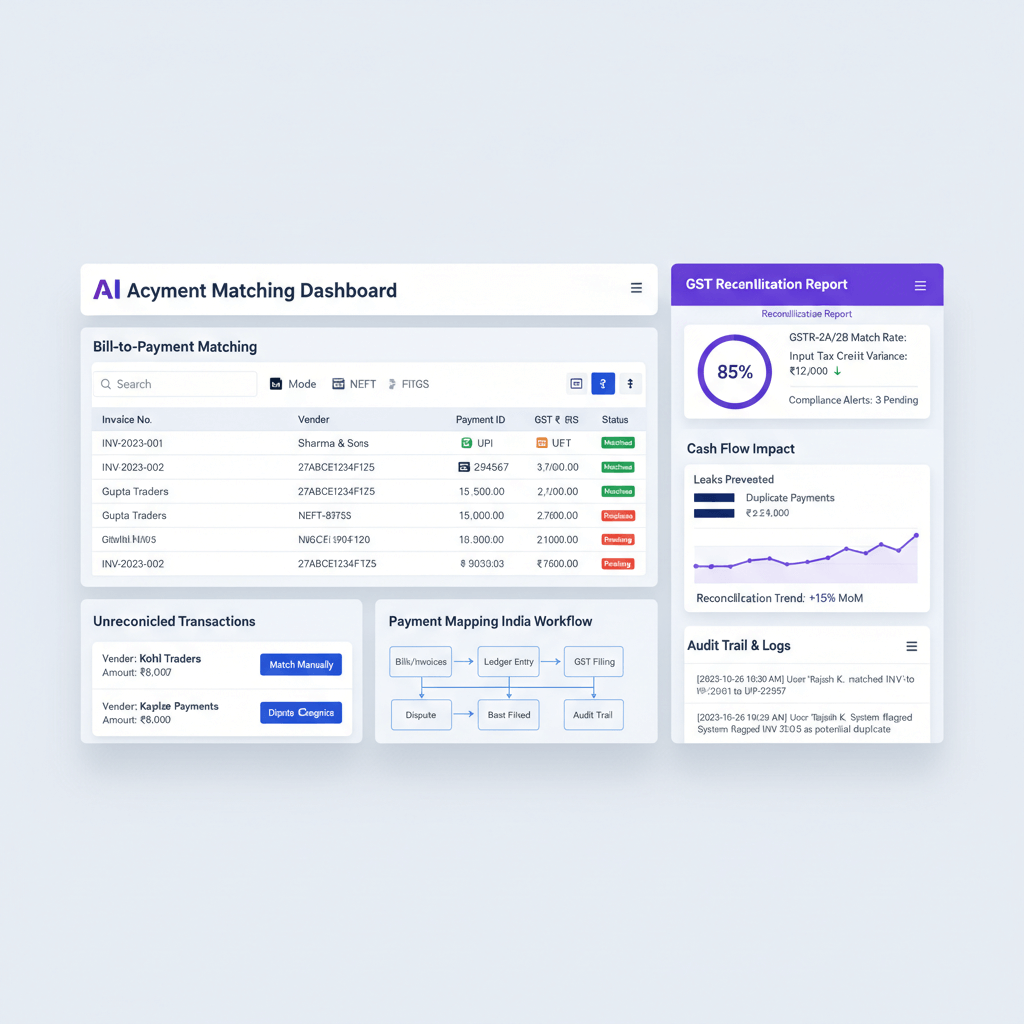
- Automation built for India, for example AI Accountant, accelerates matching, predicts codes, and syncs with Tally or Zoho, enabling real-time clarity.
What Are Unreconciled Bill Payments and Why Should You Care?
Understanding Unreconciled Transactions in the Indian Context
Unreconciled transactions arise when bank entries fail to link to bills, invoices, or ledgers in systems like Tally or Zoho Books. In practice, cryptic UPI remarks such as “PAYMENT123,” or truncated NEFT references, leave accountants guessing. To tame India’s multi-rail payment landscape, you need structured documentation and intelligent parsing, for example, smart narration parsing for Indian statements.
Bill-to-payment matching is your defensive shield, the disciplined process of linking each vendor bill to its exact payment, capturing partials, advances, credit notes, and channel-specific nuances. When done right, reconciliation stops being a monthly firefight, it becomes a daily habit.
The Real Cost of Payment Mapping Failures
Payment mapping gaps spread quietly. Cash positions lie, unallocated advances hide in suspense, bank charges slip by unnoticed, duplicate payments go undetected. Vendor relationships suffer as books show unpaid balances that were cleared weeks ago, discounts vanish, trust erodes. To understand the systemic impact, see difference between manual and auto reconciliation and neglecting payment reconciliation, the hidden threat to business stability and growth.
Bottom line: Reconciliation lapses do not just create accounting noise, they directly bleed cash, compliance, and credibility.
The Hidden Financial Risks Lurking in Your Unmatched Payments
Cash Flow Distortion and Forecasting Failures
Unreconciled bill payments create phantom cash that misleads planning. Forecasts show runway, reality says crunch. Key metrics like DPO become unreliable without accurate paid, unpaid status, profitability looks fine while unrecorded fees eat margins, working capital appears healthy while advances and deposits lock cash you cannot use.
Compliance Nightmares: GST and TDS Disasters
Unmatched payments confuse GST and TDS. ITC claimed on bills marked unpaid risks reversal with interest, mismatched GSTR-2B and purchase registers trigger notices, TDS posted under wrong heads leads to penalties. Robust automated bank reconciliation in India reduces this compliance drag.
Fraud and Revenue Leakage in the Shadows
Reconciliation blind spots invite fraud and leakage. Small unauthorized transfers blend into unmatched noise, duplicate refunds sneak through, expense fraud hides among legitimate but unlinked entries. Spot patterns with payment reconciliation challenges and AI solutions and learn red flags from fraud patterns and red flags for identification and neglecting payment reconciliation, the hidden threat to business stability and growth.
Why Indian SMBs Struggle with Payment Reconciliation
The UPI and Digital Payment Explosion
Bank narrations complicate matching. UPI shows aliases, NEFT cuts references, payment gateways settle net of fees. A single vendor may receive advances via UPI, partials via NEFT, balances via cards, leaving fragments that never form a complete picture without disciplined payment mapping India protocols and tools for smart narration parsing for Indian statements.
Manual Processes and System Limitations
Manual entry delays, siloed teams, and aggregator settlements turn reconciliation into a forensic exercise. Learn how automated bank reconciliation in India addresses these gaps, why SMEs face bottlenecks in top payment processing challenges for SMEs, and how marketplaces complicate ecommerce payment reconciliation.
The Bill-to-Payment Matching Workflow That Actually Works
Setting Up Your Matching Foundation
Start with non-negotiables: every bill carries a unique invoice number, every payment references that number. Build matching logic for real scenarios:
- One-to-one, single bill, single payment, rare in practice.
- One-to-many, a bill cleared via multiple partials.
- Many-to-one, several bills paid via one bulk transfer.
- Complex, include advances, credit notes, short pays, overpayments, bank charges, FX differences.
Pro tip: Tag transactions at source, do not wait for month end, freshness makes matching faster and more accurate.
Managing Exceptions and Review Queues
Design an exceptions workflow, flag unidentified deposits, unexpected bank charges, refunds, and FX variance immediately, guided by reconciliation exception management in India. Implement daily triage with aging buckets, 0-7 days, 8-30 days, 30+, define ownership and deadlines, sync matched results back to your accounting system with references. For marketplace contexts, see ecommerce payment reconciliation.
Governance matters: no orphan transactions, every exception gets an owner, an SLA, and an escalation path.
Payment Mapping Strategies for Indian Payment Methods
Mastering UPI Payment Reconciliation
Mandate structured UPI remarks, for example “VendorName-INV123,” maintain an alias dictionary mapping handles to vendor masters, whitelist business UPI IDs to filter personal transfers. These practices, combined with intelligent parsing, make UPI matching scalable.
NEFT, RTGS, and IMPS Best Practices
Use reference codes that survive truncation, place invoice numbers at the start of narrations, link ERP references to bank narrations the moment payments are initiated, capture and reuse those keys for deterministic matching.
Payment Gateway and Marketplace Settlements
Map settlement files to gross invoices, do not match net settlements to gross sales. Account for fees, refunds, chargebacks separately, guided by settlement file parsing for gateways. Predict settlement timing and amounts, flag variances.
Cheque Payment Tracking
Maintain cheque logs with bill references, issue and expected clearing dates, monitor presented versus cleared, alert on items outstanding beyond normal windows.
Measuring and Monitoring Your Reconciliation Health
Key Metrics for Unreconciled Transactions
Track the unreconciled rate after 7 days, above 5% signals weakness, above 10% indicates crisis. Monitor aging buckets, count duplicate payments by count and value, small frequent duplicates expose process flaws.
Compliance and Risk Indicators
Measure GST ITC variance, compute interest cost of reversals, monitor TDS accuracy and correction frequency, watch unallocated advances, money stuck in suspense is dead capital and a red flag.
Business Impact Metrics
Quantify DPO, DSO distortion caused by reconciliation gaps, track cash forecast error rates, measure vendor dispute frequency. For deeper practices, see automated bank reconciliation in India, ecommerce payment reconciliation, and neglecting payment reconciliation, the hidden threat to business stability and growth.
Real-World Example: How One Indian SMB Fixed Their Payment Chaos
The Problem Scenario
A Bengaluru electronics retailer receives three invoices, ₹50,000, ₹30,000, ₹20,000. The accounts team pays a bulk NEFT of ₹99,500, ₹100,000 less ₹500 bank charges. The bank narration says “BULK PAYMENT TO SUPPLIER,” charges separate. The books show all invoices unpaid, the supplier chases for payment, ITC risks reversal, cash forecasts overstate liquidity.
The Solution Through Systematic Matching
Apply disciplined bill-to-payment matching, split the bulk payment across invoices proportionally or by agreed priority, post ₹500 charges to the correct ledger, apply advances or credit notes, sync back to Tally with transaction IDs and notes. Result, clean vendor balances, correct GST treatment, accurate cash forecasts. Explore templates within automated bank reconciliation in India and ecommerce payment reconciliation.
Your Payment Reconciliation Checklist and SOP
Pre-Payment Controls
- Verify vendor master data, name, GSTIN, bank details.
- Ensure bill numbers sit in payment references, no generic narrations.
- Match payment approvals to bill amounts, document adjustments.
- Capture payment mode, expected settlement timelines, and fees.
Post-Payment Reconciliation
- Tag bank entries with vendor and bill references within 48-72 hours.
- Match payments to bills using your defined logic, one-to-one, one-to-many, many-to-one.
- Flag exceptions for immediate review, charges, unidentified deposits, refunds, FX variance.
- Document partials and remaining balances, no orphan bills or payments.
Month-End Procedures
- Run aging analysis for all unreconciled items.
- Verify GST ITC claims against matched payments.
- Check TDS postings, rates, ledgers.
- Generate duplicate payment reports, investigate root causes.
- Reconcile vendor statements, confirm balances.
Quarterly Deep Dives
- Conduct sample audits of matching accuracy.
- Seek vendor confirmations for high-value accounts.
- Update alias mappings and payment rules.
- Refine exception workflows, retrain teams on updates.
- Reference best practices from ecommerce payment reconciliation and difference between manual and auto reconciliation.
Automation Tools for Payment Reconciliation
Essential Features for Indian SMBs
The right payment reconciliation tool handles Indian formats natively, supports PDF, CSV, Excel, and scanned statements, predicts likely matches, GST codes, and ledger accounts, and syncs bi-directionally with Tally or Zoho Books.
- AI Accountant, built for Indian bank formats, automated bill-to-payment matching, GST code prediction, Tally and Zoho sync.
- QuickBooks, global favorite with basic reconciliation features.
- Xero, cloud-native with bank feeds.
- Zoho Books, GST-compliant with payment tracking.
- FreshBooks, simple for micro businesses.
- Tally Prime, Indian standard with manual reconciliation capabilities.
Integration and Workflow Requirements
Bi-directional sync is non-negotiable, pull bills automatically, push reconciled entries with audit trails, avoid double entry. Exception queues prioritize resolution, dashboards show reconciliation rates and aging in real time. For implementation guidance, see automated bank reconciliation in India and ecommerce payment reconciliation.
Building Your Risk Mitigation Playbook
Standardization and Training
Standardize vendor naming, payment references, acceptable modes, centralize payments, limit channels and accounts. Train teams on downstream impact, a casual “vendor payment” remark costs hours later.
Process Optimization
Set daily reconciliation cadences, assign exception ownership within 24 hours, define SLAs, simple mismatches two days, complex investigations five days, vendor disputes seven days, escalate automatically if SLA breaches.
Continuous Improvement
Review metrics weekly, investigate trends by vendor, mode, account, run post-mortems on failures, update controls quarterly. For frameworks and checklists, revisit difference between manual and auto reconciliation and automated bank reconciliation in India.
Taking Action on Your Payment Reconciliation
Small mismatches in unreconciled bill payments grow into cash gaps, compliance penalties, and bad decisions. Implement disciplined bill-to-payment matching, build payment mapping India routines for UPI, NEFT, and gateways, track metrics that reveal risk early.
Start today: pick your five largest vendors, enforce structured payment references, match within 48 hours, expand from this foundation. When volume outpaces manual processes, adopt automation, for example AI Accountant, to catch duplicates before payout, flag compliance issues before notices, and provide real-time clarity.
Your vendors deserve accurate records, your team deserves sleep, your business deserves reliable numbers. Transform payment chaos into financial clarity, one matched payment at a time.
Frequently Asked Questions About Payment Reconciliation
Is reconciliation the same as bill-to-payment matching, how should a CA differentiate during audits?
Reconciliation aligns books to bank statements, while bill-to-payment matching links individual bills to specific payments with partials, advances, and notes. A CA should ensure both, totals match for reconciliation, and bill-level trails exist for audit evidence, with references, transaction IDs, and dates.
How do I handle partial payments and split allocations across multiple invoices without losing audit traceability?
Maintain a partial payment register that stores bill number, original amount, paid amount, balance, payment dates, and reference IDs. For bulk settlements, allocate by aging or vendor instructions, document the allocation logic, and sync notes back to Tally or Zoho. Tools like AI Accountant can suggest splits based on outstanding amounts and historical patterns.
What is the GST impact when bills remain unmatched or unpaid at period end, how should ITC be treated?
Unmatched bills risk ITC reversal with interest, the GST portal cross-checks GSTR-2B against your purchase register. Claim ITC only on bills with confirmed matching, keep evidence of payment or agreed terms, and reconcile vendor statements monthly. Automation reduces variance and helps retain legitimate ITC.
How should advances and credit notes be recorded to ensure clean matching later?
Record advances in dedicated ledgers against the vendor, not in suspense, link to expected bills, apply oldest first unless agreed otherwise. Record credit notes as negative bills with references to the original invoice, net them against new bills before matching payments. AI Accountant can surface unallocated advances and prompt application.
Can UPI payments be reconciled reliably at scale, given alias handles and truncated remarks?
Yes, with structured remarks, vendor alias dictionaries, and parsing intelligence. Enforce “VendorName-INV123” formats, whitelist business UPI IDs, and use tools that parse Indian narrations. Systems like AI Accountant learn patterns and propose matches even when narrations are imperfect.
What team structure minimizes unreconciled aging, should a CA recommend specific roles?
Set up a payment processor, a reconciliation analyst, and an exception investigator, with a reviewer for approvals. Define daily matching cadences, assign ownership for each exception within 24 hours, and enforce SLAs. Weekly metric reviews by the finance lead keep aging in check.
How do I manage payment gateway settlements that are net of fees, refunds, and chargebacks?
Map settlement files to gross sales, break out fees, refunds, and chargebacks explicitly, do not match net settlements to gross invoices. Use prediction models for settlement timing and amounts, then flag variances quickly. Refer to settlement file parsing for gateways for detailed steps.
Which metrics should a CA track to quantify reconciliation health and business impact?
Track unreconciled rate after 7 days, aging buckets, duplicate payment count and value, GST ITC variance, TDS correction frequency, unallocated advances, and DPO, DSO distortion. Combine these with cash forecast error rates and vendor dispute frequency for full visibility. Dashboards in AI Accountant surface these in real time.
How quickly should exceptions be resolved, what SLAs and escalation paths work best?
Daily triage is ideal, 0-7 days active resolution, 8-30 days escalation to leads, 30+ days management review. Set SLAs, simple mismatches two days, complex five days, disputes seven days. Automate escalation when SLAs breach, ensure no orphan transactions.
What controls should be in place before payments leave the account, to reduce matching effort later?
Verify vendor masters, enforce bill numbers in payment references, document adjustments, capture mode and expected settlement date. Pre-payment controls simplify matching and cut exceptions significantly, especially for UPI and gateway flows.
How do I prevent duplicate payments across multiple bank accounts and apps?
Centralize payment initiation, reduce channels, implement vendor balance checks before approval, and run duplicate detection during daily reconciliation. Use alerts for same vendor, same amount, close dates. Automation in AI Accountant flags likely duplicates before funds leave the account.
What evidence should I keep for audits to prove bill-level settlement beyond bank-book totals?
Maintain invoice copies, payment references, bank transaction IDs, allocation notes for bulk payments, advance application logs, and credit note linkages. Ensure bi-directional sync preserves these references in Tally or Zoho, auditors look for bill-level trails, not just matched balances.

A results-driven finance and sales professional with hands-on experience through finance internships and a fast-paced sales role. With a strong interest in accounting and business finance, Harsh focuses on turning complex topics into clear, practical takeaways for founders and finance teams.