-01%201.svg)
Key takeaways
- Static GSTR-2B collides with dynamic purchase books, a robust tool bridges this gap with accurate, multi-key matching and clear exception status.
- Automated vendor follow-ups via email and WhatsApp reduce manual chasing, improve supplier compliance, and strengthen ITC eligibility.
- Smart ITC classification and ITC optimization increase legitimate credit, defer risky claims, and lower audit exposure.
- Maker-checker workflows, complete audit trails, and seamless posting to Zoho Books or Tally streamline governance and month-end sign off.
- Evaluate vendors on accuracy, speed, ease of use, integration depth, security, support, and references, then verify with your real data during a pilot.
- Well-implemented automation typically pays back within a quarter, with sustained ROI driven by time saved and additional ITC realized.
Why the right GSTR-2B reconciliation tool changes everything
Every month-end, teams contend with static GSTR-2B data while purchase registers, JVs, credit notes, and RCM entries continue to move. Manual spreadsheets rarely keep up, duplicates creep in, and eligible ITC gets left on the table. A focused solution built for Indian GST reality delivers accuracy, speed, and compliance, turning reconciliation into a predictable, automated workflow.
For context on what to evaluate, see this practical primer on GST reconciliation software that finance leaders use to benchmark vendors.
Quick primer, what GSTR-2B reconciliation involves
GSTR-2B is a static monthly snapshot of supplier reported invoices, it informs your eligible ITC. Your task is to align that snapshot with evolving books, purchase registers, JVs, credit and debit notes, and RCM entries. Misalignment causes rejected ITC, interest, and notices. Automation reduces this risk, improves accuracy, and accelerates audits.
Miss one duplicate or defer one eligible invoice, and you compound the error month after month. Automation prevents silent leakage.
For a deeper overview and comparison references, explore the GSTR-2B reconciliation tools overview, this in depth comparison, the practical tools guide, and BUSY’s GSTR reconciliation module notes.
Must have capabilities for GSTR-2B software
Data ingestion and standardization
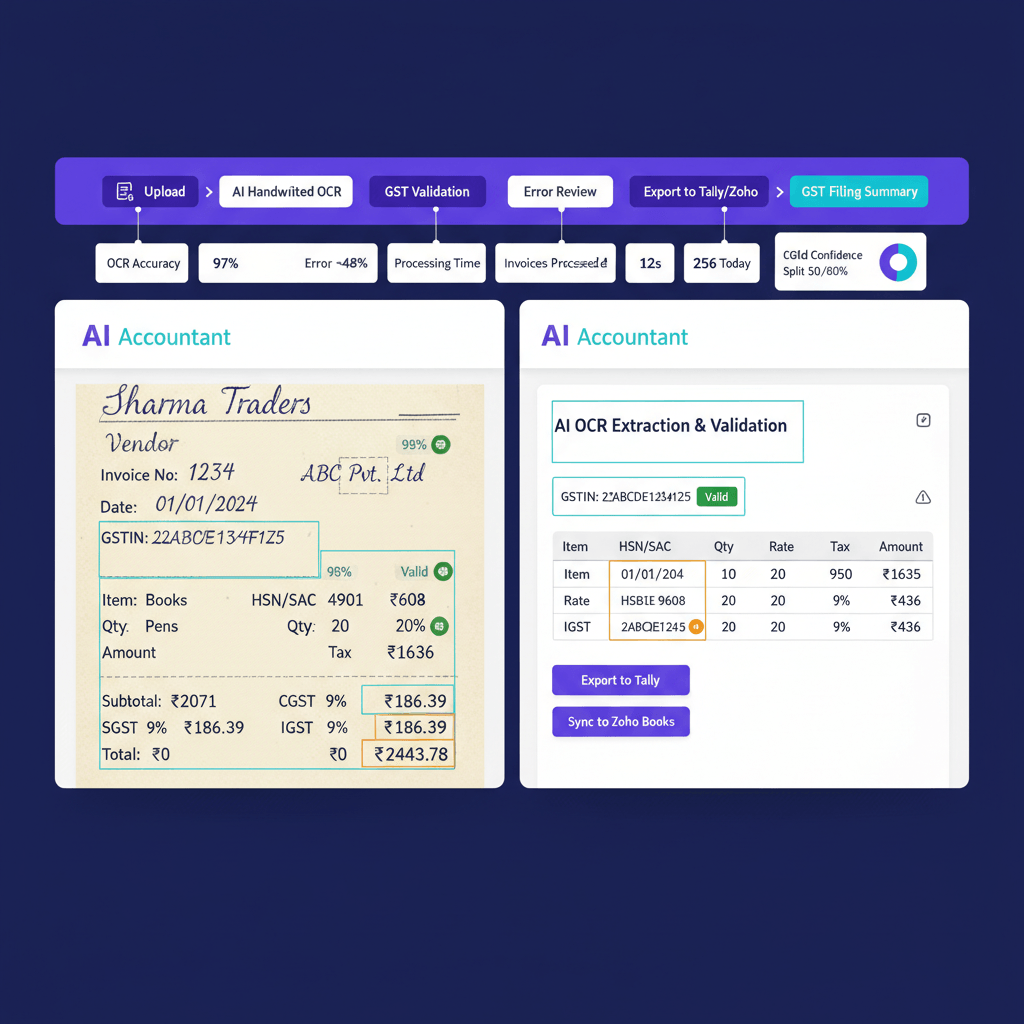
Look for bulk imports from GSTR-2B JSON and Excel, purchase register compatibility, JV and credit note handling, and template validations with row level error reporting. Advanced tools add OCR for PDFs and direct GST portal fetches, which eliminate manual entry.
Matching engine depth
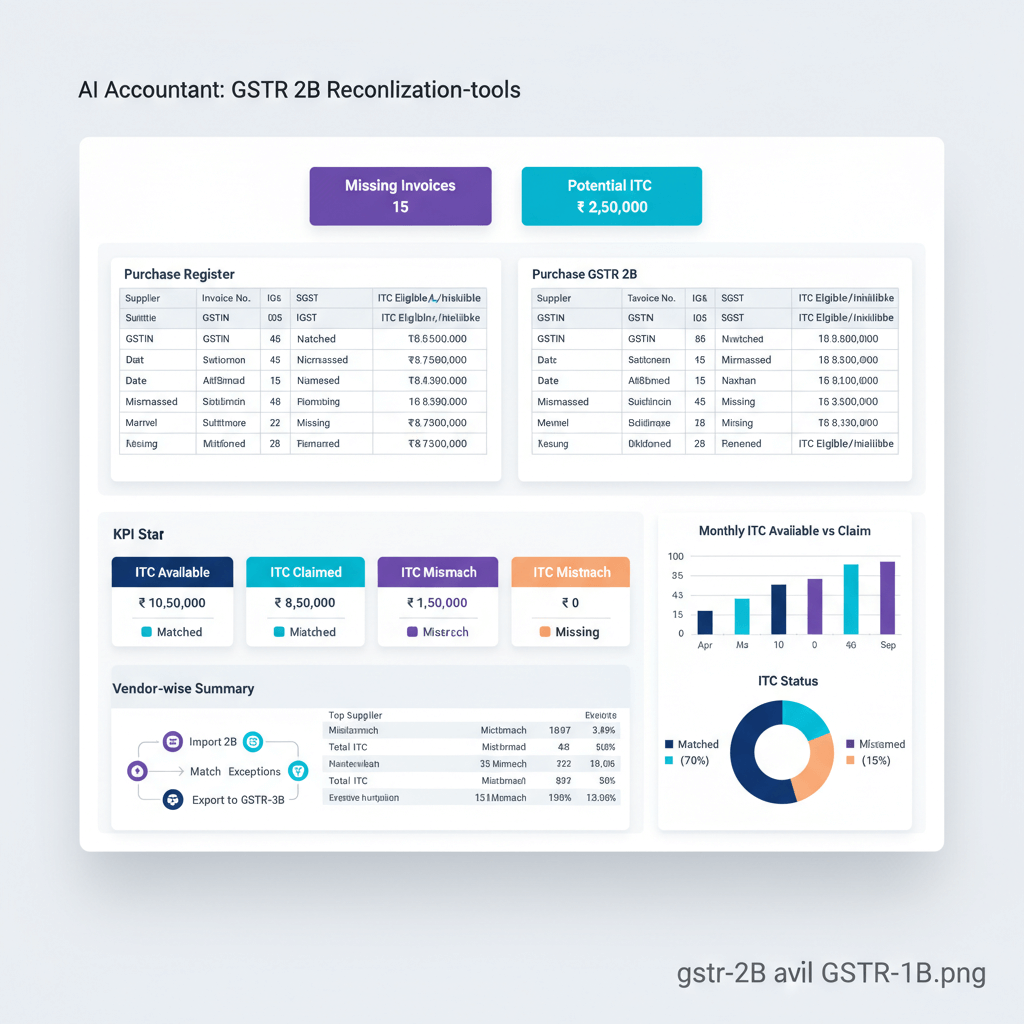
Demand multi key fuzzy logic across GSTIN, invoice number, date, taxable value, and tax amounts. Expect clean status buckets, matched, mismatched, duplicate, not in 2B, not in books, with auto linking for credit notes, debit notes, and RCM.
Exceptions and insights
High quality ITC reconciliation lives on exceptions. Your tool should flag missing invoices in both directions, surface risky suppliers, and handle partial credits, amendments, and rollovers without breaking.
ITC claim optimization
Beyond matching, smart ITC optimization applies Rule 36(4) and Sections 16 and 17(5), recommends deferrals when supplier compliance is uncertain, and provides claim confidence scores with scenario modeling.
Vendor follow up automation
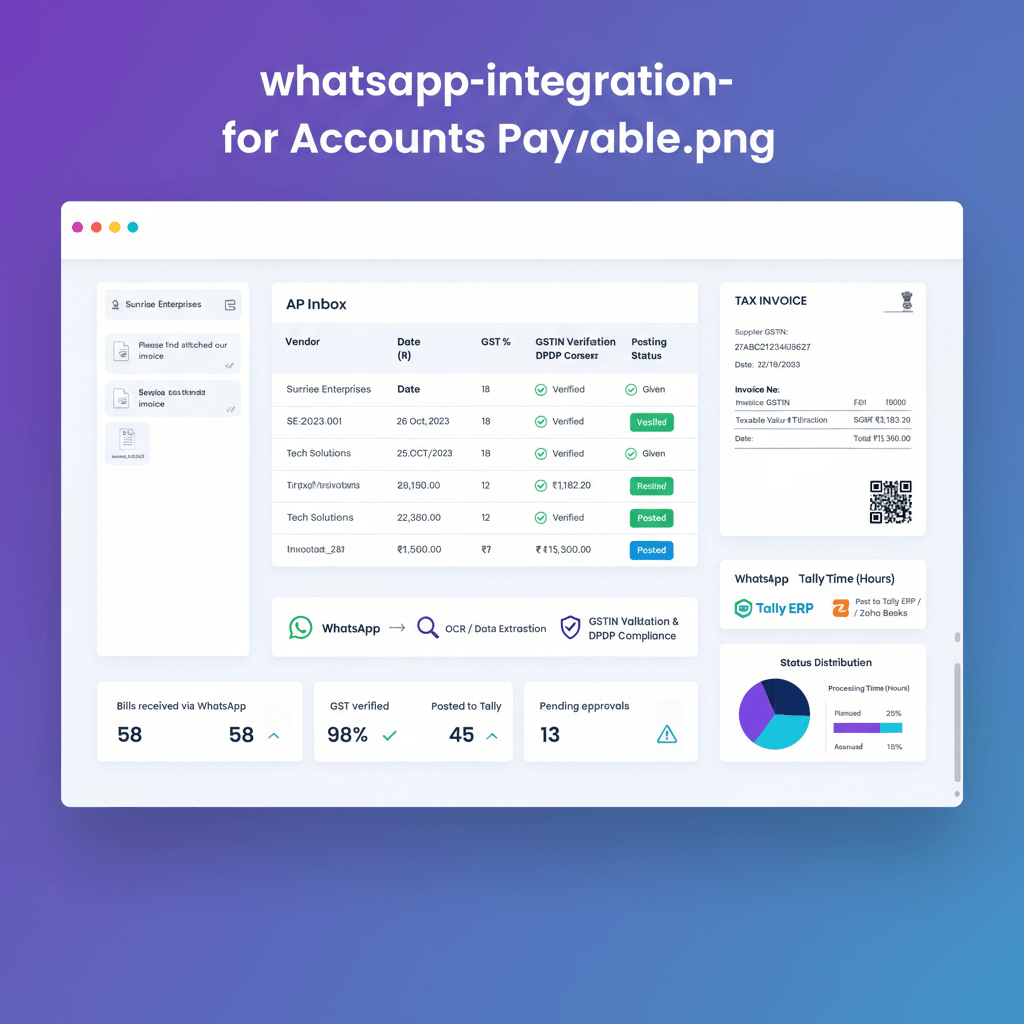
Automated emails and WhatsApp reminders with attachments, schedules, escalations, and full audit logs remove the manual chase, improving vendor response rates and audit readiness.
Review and posting
Maker checker controls, complete audit trails, and direct posting to Zoho Books, Tally, or your ERP ensure governance and eliminate error prone re entry.
Monthly dashboard
Expect an at a glance view of total, eligible, deferred, and at risk ITC, with vendor aging and trends across months and entities.
Scale, reliability, security
Multi organization support, role based access, ISO 27001 and SOC 2 claims, and India data residency are essential for CA firms and SMEs alike.
For further evaluation material, see the detailed overview, this comparison guide, the how to guide, and BUSY’s reconciliation module.
Evaluation criteria and questions to compare vendors
Accuracy assessment
Ask for real match rates on similar volumes, including cross year transactions and rounding mismatches. Validate with customer references.
Speed benchmarks
Time the first pass for one lakh line items, then measure incremental updates. Faster cycles enable more fixes before filing.
Ease of use
Look for intuitive filters, bulk actions, inline edits, and clear error queues. Request hands on demo time, not just a slideshow.
Integration depth
Probe sync frequency, conflict handling, and master data changes mid month. Confirm that integration saves time rather than adding reconciliations of reconciliations.
Governance framework
Validate maker checker, approvals, and exception escalations. Confirm that the audit trail is tamper evident.
Implementation timeline
Get specific timings for data mapping, training, and migration. Shorter setups reduce risk and cost.
Support and SLAs
Insist on India hours response times, phone support for crunch days, and an account manager for larger rollouts.
Pricing models
Clarify per org, per user, and per transaction fees, watch add ons. Budget ranges vary from entry options like Munim to enterprise tools such as ExpressGST smart reconciliation.
Security standards
Seek ISO 27001 and SOC 2 Type II. Ask about encryption at rest and in transit, access controls, and data residency.
Customer references
Talk to users who process volumes like yours, ask what actually improved and what still needs work.
Top GSTR-2B reconciliation tools to consider
- AI Accountant — Comprehensive reconciliation across purchase registers, JVs, and credit notes, predictive fuzzy matching, bulk editing, smart ITC optimization with vendor risk scoring, automated email and WhatsApp follow ups, native Zoho Books and Tally sync, multi org support, ISO 27001 and SOC 2 posture.
- ClearTax GST — Popular enterprise choice with portal integration and robust reports, suitable for larger teams.
- TallyPrime — Solid for existing Tally users, basic reconciliation, may need add ons for complex cases.
- Munim — Budget friendly for straightforward needs, suitable for smaller firms.
- BUSY — Strong GST modules for trading and manufacturing, good accounting depth.
- ExpressGST — Specialized compliance tool with smart reconciliation, see their smart reconciliation notes.
- Zoho GST — Natural fit if you run Zoho Books, may require supplementation for heavy exception management.
Always request demos using your own datasets, not sample files.
Step by step ideal workflow to assess in a demo
Step 1, data import
Import GSTR-2B JSON or Excel, then sync books via API or native connectors. Time the process and note validation quality.
Step 2, auto matching
Run the engine, review fuzzy vendor name cleanup, rounding tolerances, and duplicate detection.
Step 3, exception identification
Validate missing invoices in both directions, assignment, due dates, and risk based prioritization.
Step 4, vendor communication
Trigger email and WhatsApp follow ups, confirm attachments and audit logs, test reminders and escalations.
Step 5, ITC optimization
Review eligible versus deferred ITC, examine reasons and confidence scores, try alternate scenarios.
Step 6, posting to books
Push entries to Zoho Books or Tally, verify mapping, generate working papers for audits.
Step 7, dashboard review
Confirm that totals, trends, and drill downs are sign off ready for your CA or CFO.
For additional walkthroughs, check this GSTR-2B overview and the practical tools guide, and compare takeaways with Munim’s comparison and BUSY’s notes.
ROI model to justify purchase
Time savings calculation
Estimate hours saved across ingestion, matching, vendor follow ups, and postings. Multiply by blended hourly cost for a monthly value.
Cash flow impact
Additional ITC recovery, often five to fifteen percent of monthly ITC, boosts working capital. Earlier claims reduce 18 percent interest leakage.
Compliance benefits
Automated audit trails reduce notices, response hours, and consultant costs, which directly improves ROI.
Total ROI formula
(Hours saved × blended cost) + (additional ITC realized + interest avoided) − tool cost = Net benefit
Many firms see payback within two to three months. For a market perspective, review this 2026 buyers guide to GST ITC reconciliation automation.
How AI Accountant maps to the checklist
AI Accountant unifies purchase registers, JVs, credit and debit notes, and GSTR 2B into one reconciliation workspace, with predictive fuzzy matching on GSTIN, invoice number, name cleanup, and amounts. Exceptions become manageable with bulk edits, automated deferrals on vendor risk, and transparent rationales.
Vendor follow ups use email and WhatsApp with templates, schedules, and escalation, with full chase logs. Direct syncing to Zoho Books and Tally eliminates imports and reduces errors. Dashboards provide immediate visibility on eligible, deferred, and at risk ITC, while multi org controls fit CA firms.
Security posture includes ISO 27001 and SOC 2 Type II. For detailed breakdowns, see the GSTR-2B reconciliation tools overview and the GSTR-2B reconciliation tools guide.
What to request in a pilot or POC
Historical data processing
Run three months of real data, compare match rates and exception categories against your baseline.
ITC validation
Reconcile eligible and deferred ITC, verify risk flags, and confirm that outputs align with your internal compliance policies.
Vendor communication test
Measure response rates and filing updates after automated reminders, compare to manual chasing.
Integration testing
Use sandbox posting to Zoho Books or Tally, confirm mappings, reversals, and report continuity.
Dashboard accuracy
Cross check dashboard metrics with MIS, differences should be explainable and reconcilable.
Risks and mitigation strategies
Data quality issues
Mitigate with template validations, vendor master cleanup, and one parallel cycle post go live.
Change management resistance
Include power users early, provide training, define SOPs with maker checker, and showcase early wins.
Transition timing
Prefer quarter starts, conduct dry runs mid month, keep manual backups for the first automated cycle.
Vendor dependency
Train two administrators, document configurations, and maintain independent data backups.
Implementation best practices
Phase your rollout
Start with one GSTIN, stabilize, then expand, this reduces risk and accelerates adoption.
Document everything
Map processes, note configurations, and keep training guides current for smooth onboarding.
Set clear KPIs
Track match rate, exception clearance time, ITC recovery, vendor response rates, and close cycle time.
Regular reviews
Hold monthly reviews in the first quarter, refine tolerances, mappings, and communication templates.
Continuous training
Update teams as GST rules and product features evolve, use vendor webinars and internal refreshers.
Buying checklist for GST reconciliation software
Core requirements
- Purchase register to GSTR-2B matching
- Missing invoice identification in both directions
- Eligibility tagging and smart ITC optimization
- Automated vendor follow ups with audit trails
- Insightful reconciliation dashboard with trends
Integration needs
- Native Zoho Books or Tally connectors
- Open APIs for custom workflows
- Excel import and export options
- GST portal compatibility or API fetch
Security and compliance
- ISO 27001 and SOC 2 posture
- India data residency
- Role based access with maker checker
- Immutable audit trails
Commercial considerations
- Transparent pricing with no hidden add ons
- Scalability across entities and volume
- India hours support with strong SLAs
- References from similar volumes and sectors
- Free trial or structured POC
For additional comparisons and perspectives, review the in depth overview, this comparison, the evaluation guide, and BUSY’s reconciliation notes.
Making your decision
Document pain points, define must haves, and use a structured framework to evaluate options. The right match depends on volume, team size, and integration landscape. Most importantly, insist on a pilot with your data, that is where strengths and gaps appear.
What gets measured gets managed, set your baseline now and track improvements after automation.
Next steps
Build a shortlist, schedule 30 minute demos with real GSTR-2B and purchase data, and speak with reference customers that mirror your complexity. The right system frees your team for analysis and advisory, recovers legitimate ITC, and strengthens compliance confidence.
If you want a head start, explore this concise GSTR-2B reconciliation overview, then run a fast POC to validate outcomes.
FAQ
How should a CA evaluate fuzzy matching accuracy for GSTR-2B reconciliation, what benchmark is acceptable for audit comfort?
Ask vendors for documented match rates on datasets similar to yours, including typos, rounding, and cross period postings. A strong engine should deliver above 95 percent auto match on clean masters, with transparent buckets for the remainder. During a pilot, measure precision and recall, review false positives and false negatives, and ensure maker checker controls exist for overrides. Tools like AI Accountant provide exception rationales and confidence scores, which help auditors trace decisions quickly.
What is the correct treatment of RCM when it does not appear in 2B but exists in books?
RCM entries usually do not appear as supplier invoices in 2B, you must self account RCM liabilities and claim ITC per eligibility rules. Reconciliation software should tag RCM separately, prevent mistaken duplicate claims, and generate posting entries for liabilities and credits as per your accounting policy. AI Accountant segregates RCM flows and links them to the right ledgers while keeping them out of supplier linked auto matching.
How do I handle supplier timing differences when invoices appear in a later month’s 2B than when booked in the register?
Use a tool that supports month to month rollovers, it should track invoices booked in current month but appearing in a later 2B, and recommend deferral or provisional treatment consistent with Rule 36(4) and your internal policy. AI Accountant flags such items, suggests deferral where risk exists, and auto re evaluates on the next cycle.
What KPIs should a CA firm track post implementation to prove ROI to partners and clients?
Track match rate, exception clearance time, additional ITC realized, vendor response rates, and month end close duration. Also track GST notice frequency and average response hours. AI Accountant’s dashboard surfaces these metrics, which you can export to MIS for client reporting.
How do maker checker controls work in practice for GST reconciliation teams?
Preparers run ingestion and matching, propose resolutions, and draft postings. Checkers review exceptions, approve or return items, and release postings to books. The system must offer granular permissions, approval queues, and immutable audit trails. AI Accountant implements role based access with full change logs, satisfying audit requirements.
What is a realistic month end timeline for one lakh purchase lines across multiple GSTINs?
With well prepared masters and a mature tool, first pass matching can complete in minutes to a couple of hours, with exceptions resolved over one to two days depending on vendor responsiveness. Parallel vendor follow ups and auto deferrals reduce the tail. AI Accountant’s incremental syncs keep the cycle moving without full reruns.
How should credits and debit notes be linked to base invoices during reconciliation, including amendments?
The engine should auto link notes to base invoices using multi key matching on GSTIN, invoice number, date, and amounts, with tolerances for amendments. It must preserve chronology and prevent double counting. AI Accountant auto links and displays lineage, so reviewers can audit the chain quickly.
What is the best practice to post reconciliation adjustments into Tally or Zoho Books without duplicates?
Use native connectors that respect your chart of accounts and vendor masters, post only delta entries, and retain unique external IDs to prevent re posting. Always validate in a sandbox first, then migrate to production. AI Accountant pushes bills and journals with mapping controls and reversal options for corrections.
How can I operationalize vendor chase automation without spamming or missing audit trails?
Adopt templated emails and WhatsApp messages, schedule reminders, escalate to senior contacts, and attach filtered invoice lists. Maintain a unified chase log with timestamps and outcomes. AI Accountant centralizes templates, schedules, and logs, so you standardize tone, reduce noise, and retain evidence for audits.
What security and data residency checks should a CA mandate before onboarding a reconciliation tool?
Insist on ISO 27001 and SOC 2 Type II, encryption at rest and in transit, least privilege access, and India based data residency. Request pen test summaries and incident response playbooks. AI Accountant provides certification evidence and access control documentation for due diligence.
How do I structure a three week pilot to validate both accuracy and ITC outcomes?
Week one, ingest the last three months and establish a baseline, capture match rates and top exception types. Week two, run vendor follow ups and ITC optimization, measure incremental ITC identified and deferrals. Week three, post to a sandbox in Tally or Zoho Books, validate mappings, and reconcile dashboards with MIS. AI Accountant offers POC support to accelerate this timeline.
What is a reasonable match tolerance policy for rounding and minor value variances, and how should it be governed?
Define tolerances by tax head or invoice value bands, document them in SOPs, and enforce via system rules rather than manual overrides. Any exception outside tolerance goes to checker review. AI Accountant allows configurable tolerances with full audit logs of approvals.

Rohan Sinha is a fintech and growth leader building aiaccountant.com, focused on simplifying accounting and compliance for Indian businesses through automation. An IIT BHU alumnus, he brings hands-on experience across 0 to 1 product building, growth, and strategy in B2B SaaS and fintech.