-01%201.svg)
Key takeaways
- Prioritize a reconciliation tool with a fuzzy, rule driven matching engine, it should gracefully handle real world data variations and cross period postings.
- Demand automatic exception bucketing, ITC eligibility classification, and clear workflows for resolution, not just mismatch detection.
- Insist on seamless ingestion from Excel, PDFs, OCR, and APIs, along with bulk edits, validations, and audit trails.
- Ensure deep integration with your accounting or ERP, consistent masters, and automated two way sync to cut manual handoffs.
- Use real time dashboards and exportable reports to monitor ITC, vendor compliance, and exception aging at a glance.
- For multi entity operations, check for strong branch handling, ISD, role based access, and consolidated but compliant reporting.
- Validate vendor maturity, security posture, support quality, and update cadence, not just pricing or feature checklists.
Understanding GSTR-2B reconciliation basics
GSTR-2B is a static monthly statement, generated around the 14th, showing input tax credit available based on supplier filings. Its fixed snapshot brings relief because numbers do not keep changing, and responsibility because you must reconcile with your purchase register before GSTR-3B. Miss an invoice, you lose money, claim incorrectly, you invite notices.
The process demands invoice level matching, identification of missing supplier filings, handling duplicates and amendments, and segregation of eligible versus ineligible credits. Manual work may suffice at 50 invoices, it breaks at 500, and collapses at 5,000. For a practical primer, see this overview of GSTR-2B reconciliation tools.
The mission is simple, match accurately, classify correctly, act quickly.
Essential features every GSTR-2B reconciliation tool must have
Intelligent matching engine with fuzzy logic
Exact matches are not enough because vendors type names differently, invoice numbers may carry spaces or slashes, and rupee rounding varies. You need configurable fuzzy logic across supplier names, GSTIN formats, invoice numbers, and dates, with tolerance rules for amounts. Cross financial year treatments should work without manual tweaks. For context, explore these best practices around GSTR reconciliation engines.
Comprehensive exception identification and handling
Finding mismatches is table stakes, resolving them is the win. The tool should clearly bucket missing supplier uploads, duplicates on either side, GSTIN or name mismatches, cross period postings, and amendment chains that show net ITC impact. Reverse charge and ISD credits need dedicated flows and auto segregation. If you often manage reverse charge, this explainer on reverse charge mechanism accounting in India is useful. Also see practical automation ideas from IRIS GST on simplifying compliance.
ITC eligibility bucketing and classification
Credits must fall into buckets, eligible now, defer, or blocked, aligned with supplier filing status, transaction type, and statutory restrictions. Automated checks for supplier GSTR-1 and GSTR-3B, and section wise blocked credits, are essential. Review this guide to input tax credit reversal automation, and compare market tools in this roundup of reconciliation software. Multi state businesses also need precise place of supply logic for CGST, SGST, and IGST.
Key capabilities for operational efficiency
Bulk processing and data ingestion
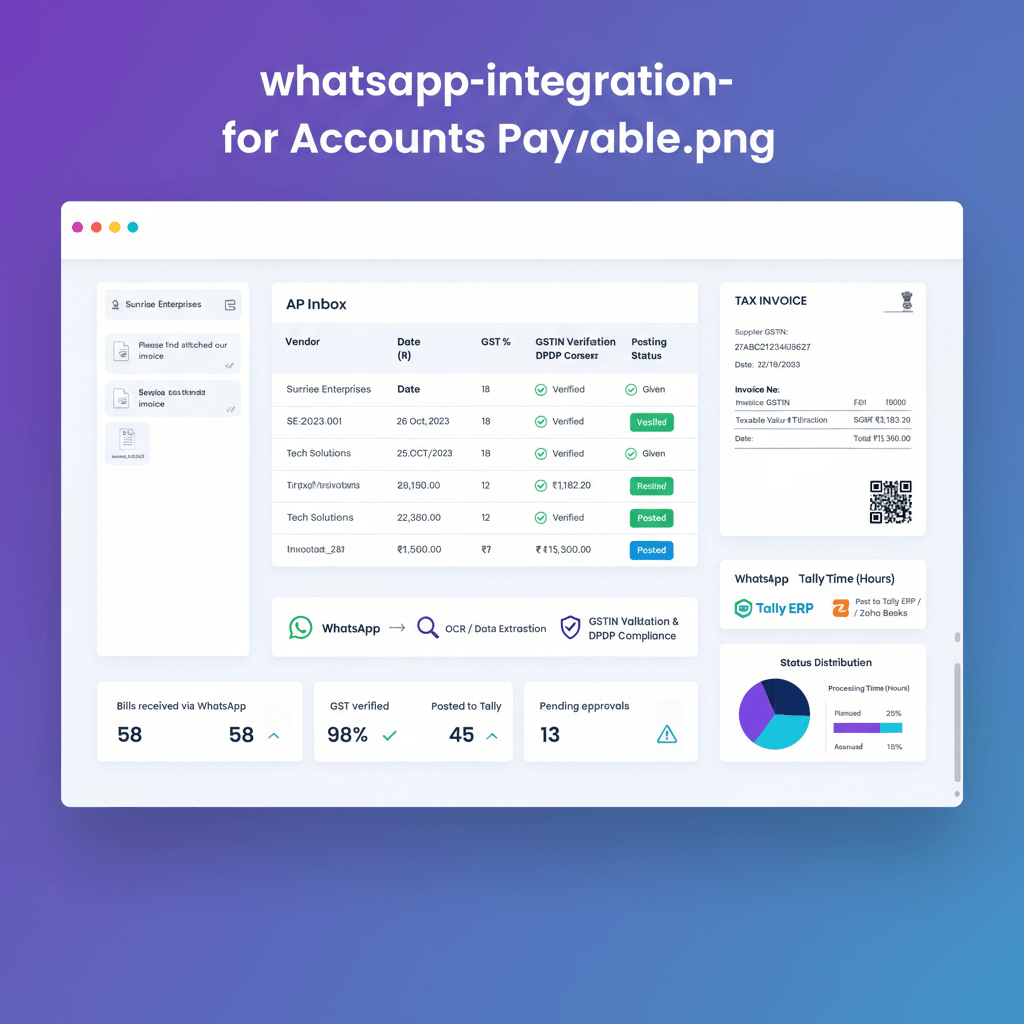
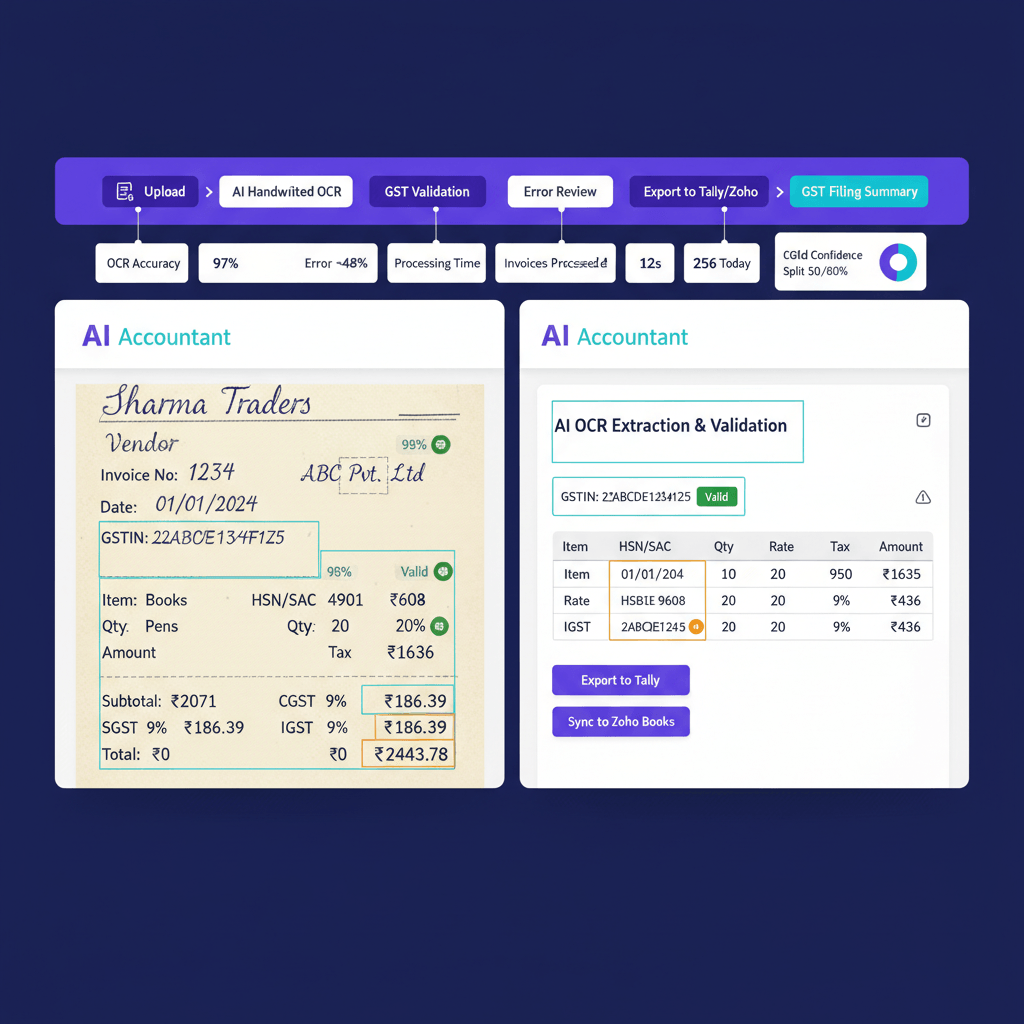
Month end demands speed. Look for multi format ingestion from Excel, PDFs, scanned bills via OCR, and secure API pulls. Row level validations should catch issues early, while bulk edits with filters and audit logs save hours on vendor code or GL updates. The goal, ingest hundreds of invoices in minutes, not hours.
Seamless accounting software integration
The reconciliation layer should live in harmony with Tally, Zoho Books, SAP, or your ERP. Expect automatic sync of masters, clean import of purchases, and posting of reconciliation outcomes back to the books. Consistent vendor codes, invoice series, and GL groups matter. To explore options broadly, review this GST software landscape.
Real time dashboards and reporting
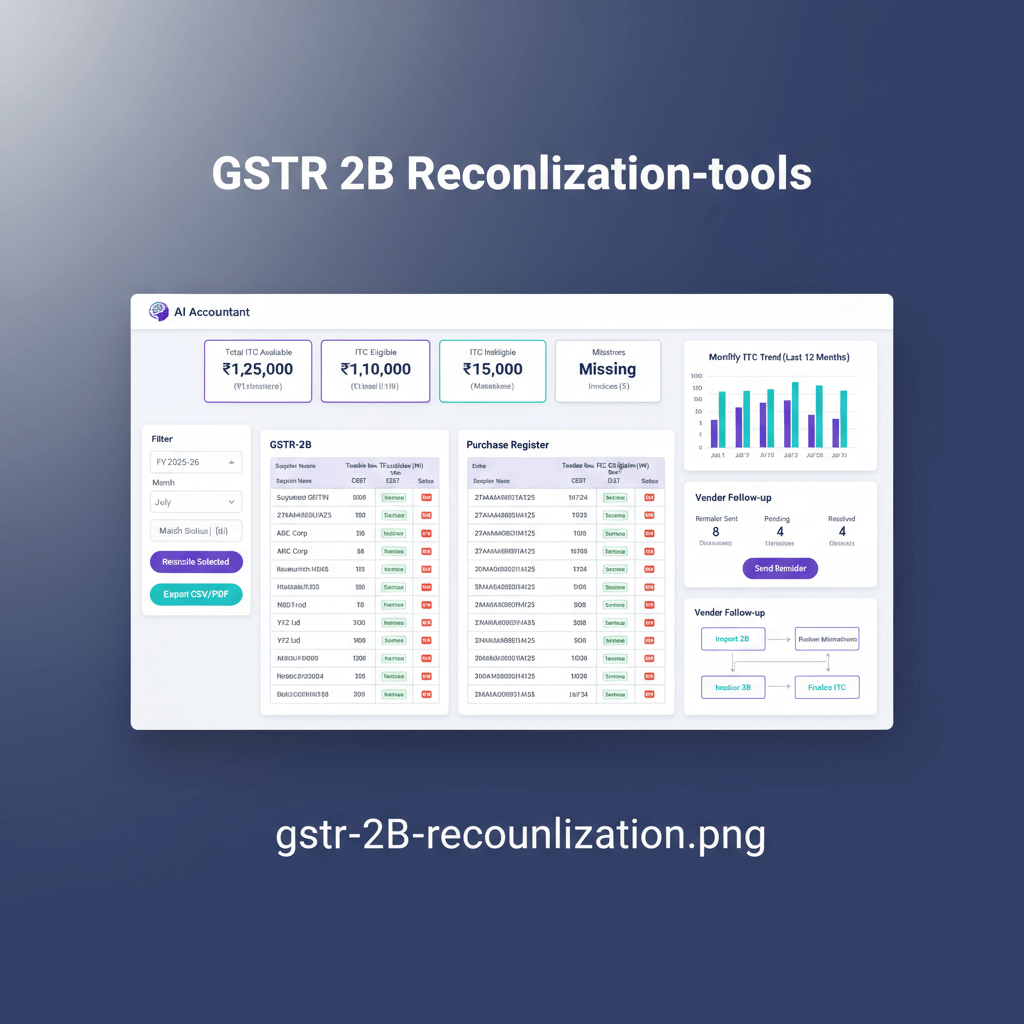
Leadership needs one view, matched percentage, pending exceptions by type, ITC eligible versus claimed, and vendor wise status, with month on month trends. Reports should include invoice level match logs, exception registers, and ITC utilization summaries, all exportable. A quick market scan is available in this guide to GST reconciliation software.
Advanced features that make a difference
Vendor communication automation
Automate the follow up grind. The tool should compile vendor wise discrepancy statements, mail reminders with missing invoice lists, and ideally expose a vendor portal for self service corrections. Vendor scorecards, showing filing timeliness and recurring error patterns, help drive procurement conversations.
Multi entity and branch management
For groups or CA firms, you need multiple GSTINs under one workspace, clean separation of books, and consolidated reporting when allowed. Inter branch transfers, ISD credits, and state wise ITC logic must be native. Role based access and maker checker flows are non negotiable. See considerations summarized in this comparison of reconciliation platforms.
Compliance tracking and audit support
Look beyond reconciliation. Calendars for due dates, alerts for gaps like missing e way bills, and full click through audit trails cut audit stress. Historical snapshots, amendment lineage, and department friendly exports are lifesavers during scrutiny.
Evaluating different tool categories
Cloud based versus on premise solutions
Cloud delivers anywhere access, automatic updates, and lower upfront costs, while on premise offers tighter data control and deeper customizations. Most SMBs and CA firms benefit from cloud for rapid start and frictionless updates. For a broad market view, skim this GST software directory.
Standalone tools versus integrated suites
Standalone tools go deep on reconciliation, while integrated suites bundle returns, e invoicing, and e way bills. If your accounting stack is mature, a focused reconciler is efficient. If you are assembling the stack, an integrated suite can simplify rollout. Tools like AI Accountant focus on automation and reconciliation depth, often outpacing generic suites on matching accuracy and exception workflows.
Industry specific considerations
Manufacturing needs capital goods and BOM linked logic, services focus on place of supply and multi rate handling, trading emphasizes volume and thin margin ITC capture. Choose a vendor with presets and reports aligned to your sector, plus a supplier universe familiar to your industry.
Implementation best practices
Data preparation and cleanup
Standardize vendor masters, validate GSTINs, unify invoice numbering, and purge duplicates before go live. Define naming conventions, import templates, and validation rules, then keep them enforced. For historicals, decide the migration window, validate samples, and run parallel for a month.
Team training and change management
Train power users first, codify SOPs, set escalation paths for exceptions, and schedule early cadence reviews. Communicate benefits clearly, less manual drudgery, faster closings, fewer notices. Celebrate early wins to build momentum.
Continuous optimization
Review matching rules monthly, refresh vendor masters, and refine ITC buckets as scenarios evolve. Track cycle time, exception aging, and ITC recovered as core KPIs. Join user forums, keep documentation current, and ensure the tool tracks regulatory changes promptly.
Top GSTR-2B reconciliation tools to consider
1. AI Accountant
AI Accountant stands out for intelligent automation, large scale fuzzy matching, and multi format ingestion, including PDFs and scanned bills. It integrates neatly with Zoho Books and Tally, auto buckets ITC, and offers real time dashboards. Multi organization support, with learning patterns per org, suits CA firms handling many clients.
2. ClearTax GST
A broad compliance suite with strong reconciliation, customizable tolerances, and enterprise integrations, plus automated vendor communication and robust audit trails.
3. Tally Prime with GST
Practical for Tally first businesses, native matching with GSTR-2B, fewer moving parts, and a familiar interface that cuts training time.
4. Zoho Books GST
Integrated reconciliation within accounting, direct GSTR-2B fetch, exception identification, and ITC tracking for teams already on Zoho.
5. IRIS Sapphire
Specialized GST suite, intelligent matching, deep mismatch analysis, and a vendor portal for supplier side resolution, solid with amendments and credit notes.
6. Masters India
End to end compliance coverage, scalable matching engine, analytics led insights, and flexible authentication for distributed teams.
Making the right choice for your business
Assessing your current pain points
Quantify invoice volumes, reconciliation time, recurring error types, vendor outliers, and team capacity. Balance sophistication with usability, and plan for growth so the tool scales without a future migration.
ROI calculation framework
Model staff time, rework, missed ITC, and penalties, then add softer gains, faster closings, smoother audits, better vendor relations. Compare total cost, subscription, implementation, training, and integrations, and choose a pricing model that fits your volume curve.
Vendor evaluation criteria
Check references in your industry and size band, month end support SLAs, update speed to regulatory changes, and security certifications. Request a demo with your data, let actual users test the UI, and validate export formats for audits.
Future proofing your GST reconciliation process
Staying ahead of regulatory changes
Pick vendors with dedicated monitoring and rapid release cadences. Keep your internal SOPs flexible, and avoid hard coding workflows that may shift with notifications.
Preparing for scale and complexity
Favor automation that improves with data, such as learning based matching. Ensure open APIs for future systems and partner connections, and insist on proven integration track records.
Building internal capabilities
Train teams on GST logic, not just tool clicks. Strengthen data governance and process improvement habits. Create a culture of steady refinement, with reviews and shared learnings.
Conclusion
Selecting a GSTR-2B reconciliation tool should turn a monthly scramble into a predictable, efficient routine. Focus on intelligent matching, clear exception workflows, accurate ITC bucketing, and integrations that remove manual steps. Then, underpin the tool with clean data, trained users, and a cadence of continuous improvement. The payoff arrives as time saved, accuracy gained, stronger ITC recovery, and calmer audits, while finance teams shift from grunt work to analysis and decisions that move the business forward.
FAQ
How should a CA benchmark fuzzy matching tolerance for invoice amounts without risking ITC errors?
Start with a conservative absolute threshold tied to your average invoice size, for example two to five rupees on retail scale, higher for enterprise utilities, then test against prior month data to measure false positives. In tools like AI Accountant, configure dual rules, absolute rupee tolerance plus percentage tolerance, and require second review for exceptions breaching either. Periodically recalibrate using exception analytics so tolerances reflect your current vendor behavior.
What is the best workflow to reconcile GSTR-2B with a client’s purchase register when suppliers file late?
Adopt a two pass workflow. Pass one, finalize ITC for invoices present in GSTR-2B, pass two, park provisional or ineligible buckets for late filers, then auto roll forward to the next cycle. AI Accountant automates roll forwards, tags vendor filing status, and alerts you when a missing invoice appears in a later GSTR-2B, ensuring timely re classification to eligible.
How do I treat amendments and credit notes so that ITC impact is transparent to auditors?
Link amendments to their original invoices and compute net effect at both invoice and supplier levels. The reconciliation tool should maintain lineage, original, amended, reversed, with timestamps and users. AI Accountant generates amendment chains and an audit ready report that shows before and after ITC, which auditors appreciate for clear traceability.
For multi GSTIN clients, how do I prevent cross state ITC misapplication during reconciliation?
Enforce place of supply rules at ingestion, validate GSTIN state codes, and segregate CGST, SGST, and IGST at the document line level. Use branch level books with maker checker approvals for inter branch transactions. AI Accountant enforces state wise credit walls and blocks cross utilization unless supported by rules, reducing mispostings.
What KPIs should a CA track to evidence reconciliation quality to management and auditors?
Track match rate, exception aging by bucket, recurring vendor mismatch ratio, ITC eligible versus claimed gap, amendment turnaround time, and post filing adjustment rate. AI Accountant dashboards present these KPIs with month on month trends, plus vendor scorecards for supplier negotiations.
How can I accelerate month end without sacrificing control in a high volume environment?
Invest in bulk ingestion with validations, predefined exception playbooks, and automated vendor outreach. Segment work by entity and supplier criticality, then parallelize. AI Accountant supports bulk edits with full audit logs and vendor emails with discrepancy attachments, cutting days from the close while preserving traceability.
What is the recommended approach to vendor master cleansing to improve reconciliation accuracy?
Standardize names, validate GSTINs via API, deduplicate by PAN and address, and define naming conventions going forward. Lock critical fields with role based permissions. AI Accountant can auto suggest merges where GSTINs or PANs collide, and it flags irregular naming patterns that often trigger fuzzy mismatches.
How should tolerance and exception rules differ for MSME vendors versus large enterprises?
MSMEs may show more formatting drift and timing delays, so slightly wider fuzzy thresholds and a longer exception aging window can be practical, balanced by tighter communication cadences. Large vendors typically warrant stricter tolerances and SLA based escalations. AI Accountant allows vendor group specific rules, so you can tune precision without one size fits all compromises.
What evidence pack should I maintain for a GST audit focused on ITC claims?
Maintain GSTR-2B snapshots, invoice level match logs, exception registers with resolution notes, amendment chains, ITC bucket summaries, and vendor communication trails. AI Accountant produces an audit binder export, with PDFs and CSVs mapped to department friendly structures, minimizing ad hoc collation during audits.
How do I compare ROI across reconciliation tools with different pricing models, per user versus per document?
Normalize costs to a cost per reconciled document inclusive of implementation, training, and integration, then layer in savings from time reduction, error avoidance, and recovered ITC. Model peaks and troughs since per document pricing may spike seasonally. AI Accountant offers scalable pricing with volume tiers, making cost predictability easier for CA firms with fluctuating loads.
Can an AI driven reconciler reduce dependency on manual vendor follow ups, practically?
Yes, with templated discrepancy notices, auto compiled vendor wise statements, and follow up cadencing by severity and value. AI Accountant automates outreach, tracks responses, and updates exception status when suppliers act, freeing staff to handle complex cases.
What safeguards ensure that automated ITC bucketing does not misclassify blocked credits?
Use rule libraries mapped to statutory sections, maintain a changelog for every rule update, and require dual approval for any override. Schedule periodic sample testing and compare against historical patterns. AI Accountant ships with maintained rule sets, highlights potential misclassifications, and forces reviewer acknowledgements on overrides for robust control.

Rohan Sinha is a fintech and growth leader building aiaccountant.com, focused on simplifying accounting and compliance for Indian businesses through automation. An IIT BHU alumnus, he brings hands-on experience across 0 to 1 product building, growth, and strategy in B2B SaaS and fintech.