-01%201.svg)
Key takeaways
- Multi GST means multiple GSTINs under one PAN, each with its own returns, e invoicing, and place of supply rules, your software must isolate data per GSTIN yet provide group visibility.
- Critical capabilities include multi GSTIN masters, place of supply logic, e invoicing and e way bill integration, inter branch transfers, ITC and 2A and 2B reconciliation, and automated GSTR 1 and GSTR 3B.
- Weak tooling causes mixed ledgers, missed IRNs, broken 2B matches, and denied ITC, which leads to penalties and cash flow issues.
- Evaluate tools with a sandbox, test inter branch, RCM, exports, and reconciliation flows, score functional fit, localization, scalability, integrations, security, usability, and cost.
- AI Accountant, an AI enabled, CA managed virtual accounting service, sets up multi GST, runs monthly compliance, and delivers a live dashboard for per GSTIN filings, ITC, and controls.
Introduction to accounting software for multi GST
If you operate branches in more than one state, you likely hold multiple GST registrations. You need accounting software for multi GST to manage many GSTINs under one company and one PAN, with clean separation of transactions, documents, and returns per registration.
Modern tools let you create per GSTIN invoices, automate GSTR 1 and GSTR 3B, and file state wise returns from one place. They also track ITC, perform 2A and 2B reconciliation, and keep books audit ready. Without this, books get split across files and emails, place of supply goes wrong, ITC gets denied, e invoice and e way bills go out of sync, penalties add up, and cash flow suffers. See examples from TallyPrime, Zoho Books, and ClearTax for reference.
One company, many GSTINs, a single source of truth for finance and tax, that is the goal.
What multi GST means in practice
Multi GST means you hold more than one GSTIN under a single PAN, and each GSTIN maps to a state, a branch, or a business vertical. Each GSTIN files its own GSTR 1, GSTR 3B, and annual GSTR 9 and 9C, and e invoicing and e way bill thresholds apply per GSTIN.
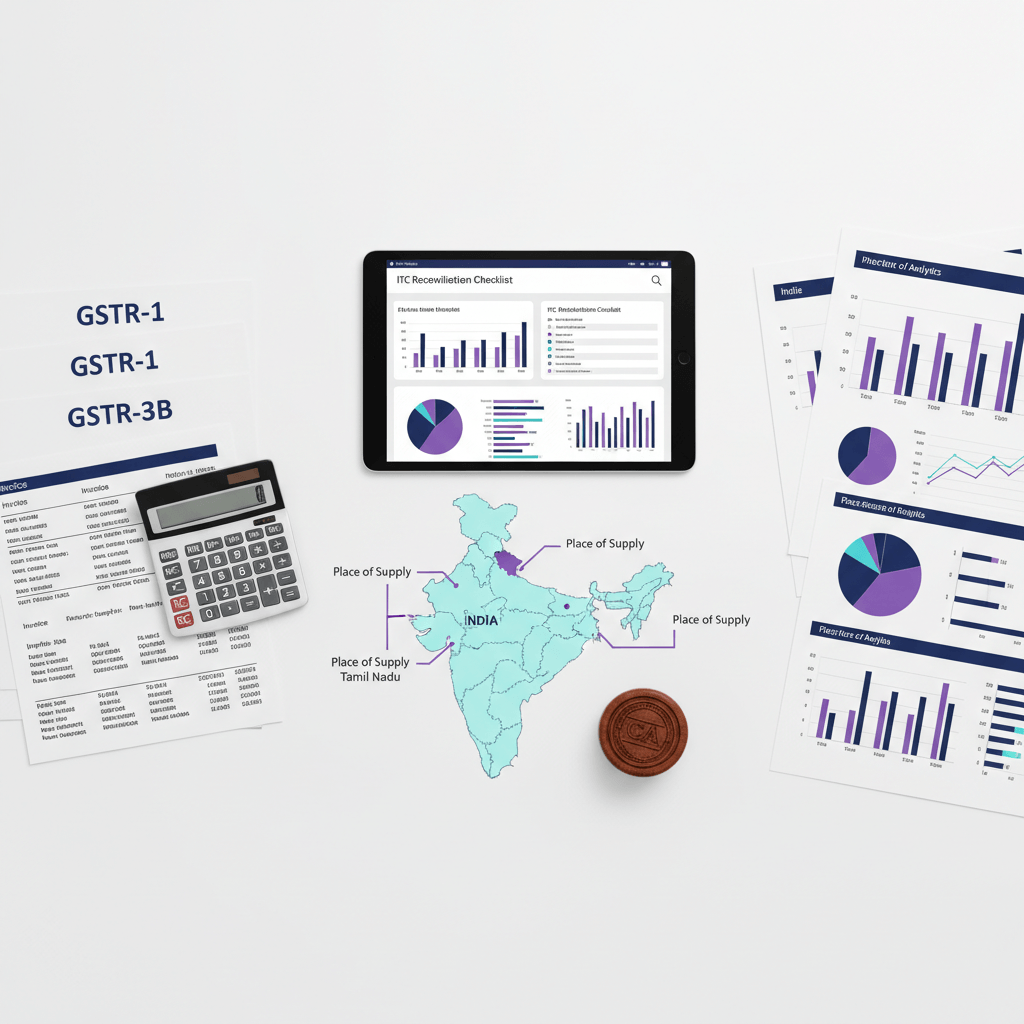
You must classify supplies by place of supply, inter state sales draw IGST, intra state sales draw CGST and SGST. Inter branch transfers and cross charges must be valued and tracked. You also need state wise stock, payables, receivables, and ITC ledgers, with central visibility and per GSTIN controls to avoid errors and mismatches. Helpful primers are available from Ankpal and AI Accountant.
Why generic tools struggle with multi GST
Many small business tools assume a single GSTIN, they do not track per branch stock, AR, and AP, they lack multi series invoicing and per GSTIN returns. They do not automate 2A and 2B reconciliation per GSTIN, teams end up doing manual checks, and e invoice and e way bills are created on portals by hand, which invites mistakes.
Place of supply logic is weak or missing, and inter branch workflows do not exist, so teams hack journal entries just to keep up. Reviews from vendors like Busy and explainers at Mocha Accounting surface these gaps.
Must have features in accounting software for multi GST
Multi GSTIN master
- Maintain a master list of GSTINs under one company, and tag every transaction to a GSTIN, no mixing.
- Create separate invoice series per GSTIN and per branch, enforce number ranges, and prevent cross posting.
- Generate GSTR 1 and GSTR 3B per GSTIN with correct totals and sections.
Place of supply and tax logic
- Auto apply IGST or CGST plus SGST based on state codes, GSTINs, and ship to addresses.
- Maintain HSN and SAC masters with rates, exemptions, and reverse charge flags.
- Support composite, nil rated, and exempt supplies with accurate reporting.
E invoicing and e way bills
- Integrate per GSTIN e invoicing with IRN and QR capture, and store acknowledgements for audit.
- Trigger e way bills from the same flow when rules require it, and link to movement documents.
Inter branch transfers and cross charges
- Move stock between branches via delivery challans or tax invoices.
- Apply correct valuation for cross charges, and show impact in state wise returns.
ITC and reconciliation
- Match purchase registers with 2A and 2B per GSTIN, flag ineligible ITC and 2B cut off issues, and validate supplier GSTINs and HSN data, as outlined by AI Accountant.
Automated returns
- Prepare GSTR 1 with B2B, B2C, CDN, and amendments per GSTIN.
- Prepare GSTR 3B with tax payable, ITC eligible, RCM, and NIL supplies, include maker and checker controls.
TDS and TCS handling
- Compute TDS and TCS where relevant, manage challans and return forms, and keep role based access by branch and GSTIN.
Reporting and consolidation
- State wise profit and loss and balance sheets, plus group consolidation with elimination entries.
- Dashboards with alerts and compliance calendars per GSTIN.
Security and audit
- Audit trails for every change, role based access by location and function, data residency and backups.
These features reduce risk and time, and give a single source of truth. Compare vendor claims from TallyPrime, Zoho Books, and HostBooks to validate coverage.
Advanced features that help multi GST at scale
- Bank and gateway reconciliation per GSTIN, split bank feeds by branch and GSTIN, match payouts and settlements per location.
- Marketplace and POS integrations, pull orders from marketplaces and carts, route invoices to the right state for tax.
- SEZ and exports, handle zero rated supplies with or without LUT, manage refunds with audit ready trails.
- AI anomaly detection, spot rate errors, unusual patterns, and ITC risks, suggest fixes before filing.
- Custom MIS, state wise profitability, cost centers, and contribution margin analysis.
These extras matter for ecommerce, D2C, and high volume businesses, see surveys from ProfitBooks and Commenda.
Implementation blueprint for multi GST setup
- Chart of accounts and dimensions, create a standard chart, add dimensions for branch, GSTIN, and location, post every entry with these tags for clean state wise P and L and balance sheets.
- Master data cleanse, validate all GSTINs, PAN, and state codes, clean customer and vendor masters, set HSN and SAC with correct rates and RCM flags, fix addresses and pin codes.
- Opening balances and carry forwards, load opening AR and AP by GSTIN, carry forward ITC per GSTIN from the last return, tie balances to GSTR 3B and books.
- Configure documents and roles, set invoice series per GSTIN, enable e invoicing for each GSTIN that crosses the threshold, define maker and checker roles by branch.
- Test critical scenarios, run dry runs for inter branch transfers, exports, and RCM freight, validate e invoice, e way bill, and return outputs, fix gaps before go live.
- Monthly governance, use close checklists, reconcile 2B to purchases, reconcile GST ledgers to GSTR 3B, keep a compliance calendar per GSTIN, archive documents centrally.
Tie all of the above to internal controls, then show leaders a simple dashboard for risk and status. For reference, see ClearTax GST setup guides and Mocha Accounting checklists.
Compliance workflows streamlined by accounting software for multi GST
- GSTR 1 and GSTR 3B per GSTIN, auto compile data per state, use maker reviewer approvals, push data to portals, track acknowledgements, lock ledgers on filing.
- 2A and 2B reconciliation, import 2A and 2B, match invoices, identify missing, mismatched, and ineligible items, raise vendor follow ups, post eligible ITC.
- E invoice and e way bill monitoring, track generated IRNs and QR codes, monitor cancellations and amendments, trigger e way bills by rule.
- Annual returns, prepare GSTR 9 and 9C packs, provide ledgers, HSN summaries, and audit trails, export reports for the statutory auditor.
Done right, month end shifts from fire fighting to a predictable flow, as many products highlight in their multi GST guides.
Evaluation checklist for choosing accounting software for multi GST
- Functional fit, multi GSTIN, inter branch transfer, cross charge, e invoicing, automated GSTR 1 and GSTR 3B per GSTIN.
- Localization, latest GST rules, RCM, HSN changes, exemptions, and e invoice schema updates.
- Scalability, hundreds of GSTINs, users, and millions of transactions.
- Integrations, banks, ERPs, ecommerce stores, POS, payment gateways, see integration notes from AI Accountant.
- Security, audit trails, role based access, encryption, data residency.
- Usability, simple dashboards, alerts, onboarding, and training support.
- Cost, license type, per GSTIN fees, implementation effort, and change management.
Score each area with proof during a sandbox trial, and run scripts for your top use cases. Compare options like Zoho Books, Commenda, and ProfitBooks summaries.
Top accounting software for multi GST to consider
- AI Accountant Virtual Accounting https://aiaccountant.com
- TallyPrime https://tallysolutions.com/tally/manage-multi-gstin-in-single-company-with-tallyprime/
- Zoho Books https://www.zoho.com/in/books/gst-accounting-software/
- ClearTax GST https://cleartax.in/gst
- Busy Accounting https://busy.in/
- HostBooks GST https://www.hostbooks.com/in/hb/gst-software/
- ProfitBooks GST features https://profitbooks.net/best-gst-softwares-india/
These are well known in India for GST, e invoice, and returns. AI Accountant adds a CA led layer with a live dashboard for filings, ITC, and documents.
Common mistakes in multi GST and how to avoid them
- Mixing GSTINs in one invoice or ledger, always tag every document to the right GSTIN, use separate series and number ranges.
- Ignoring 2B cut off dates and ineligible ITC, automate 2A and 2B reconciliation, post only eligible ITC per GSTIN, track vendor level issues.
- Missing e invoices due to threshold confusion, enable e invoicing per GSTIN when it crosses the threshold, store IRN and QR proof.
- Wrong cross charge and inter branch treatments, use built in valuation rules, test transfers and cross charges with sample flows.
- Inventory misalignment across branches, use branch wise stock tracking, reconcile goods in transit and delivery challans monthly.
These five issues cause most penalties and notices. Good software and simple SOPs prevent them, as highlighted across ClearTax explainers.
Mini walkthrough examples in accounting software for multi GST
- Maharashtra GSTIN sale to a Karnataka customer, the system reads ship to state, applies IGST, generates e invoice with IRN and QR, posts the sale to the Maharashtra GSTIN, and pushes values to that GSTIN’s GSTR 1 and GSTR 3B only.
- Inter branch stock transfer, Branch A in Gujarat issues a delivery challan to Branch B in Rajasthan, if cross charge is needed, it creates a tax invoice with the right valuation, both GSTINs reflect movement correctly, and returns show correct treatment.
- Reverse charge on freight, accounts records the RCM liability at the right rate, pays via GSTR 3B, and claims ITC once 2B confirms eligibility.
These flows show rules and data working together to keep filings clean. See more vendor examples at Tally and Mocha Accounting.
How AI Accountant Virtual Accounting helps with multi GST
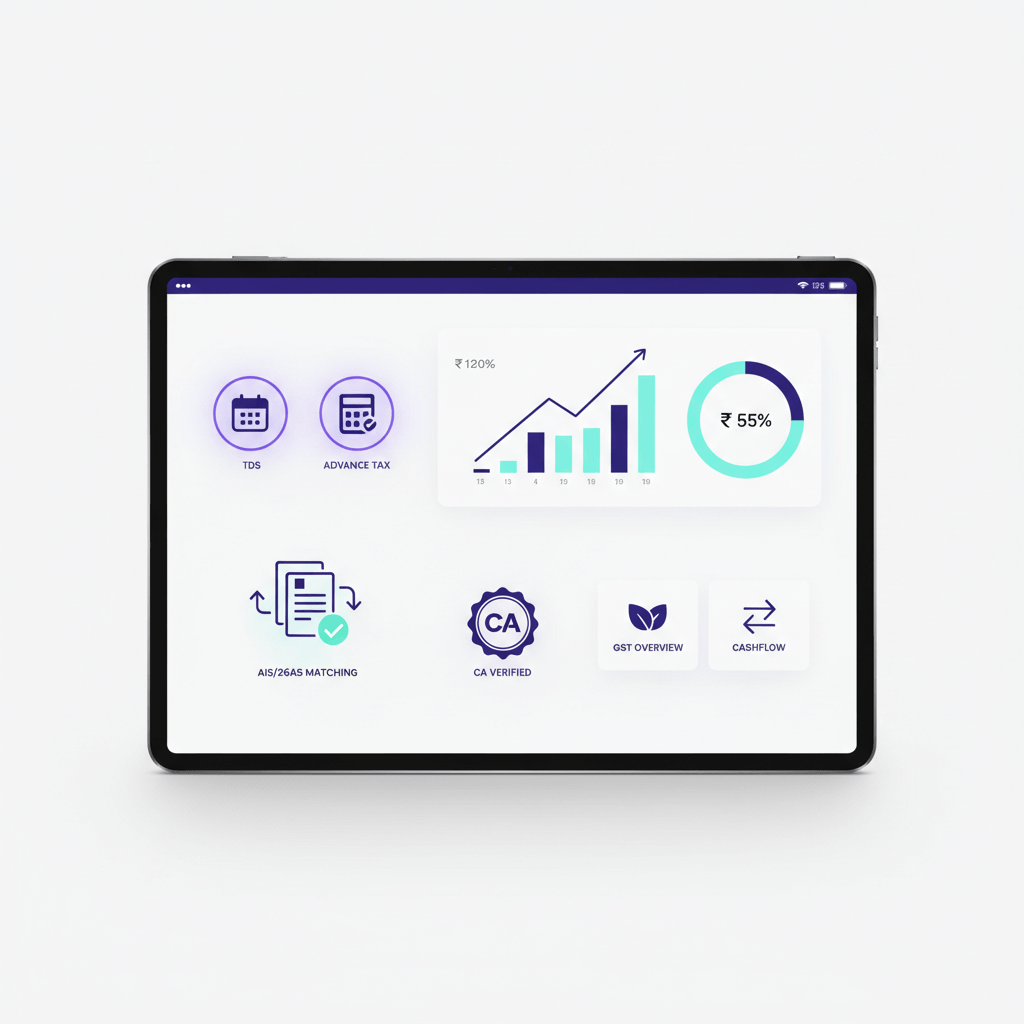
AI Accountant pairs CA led execution with a real time dashboard. Your dedicated CA team does bookkeeping per GSTIN, 2A and 2B reconciliation, and monthly GSTR 1 and GSTR 3B filings. The dashboard shows per GSTIN revenue, ITC, and filing status, plus cash flow, bank reconciliations, and documents, with chat to collaborate in one place.
We set place of supply logic, HSN masters, and e invoice settings, manage inter branch transfers, cross charges, and RCM, and support TDS, TCS, and income tax work that touches GST data. This reduces errors, cuts penalties, and speeds month close, while consolidating state wise books for leaders and investors.
If you prefer software only, we can advise on setup, if you want end to end, the managed service covers it. See references like ClearTax GST for compliance context.
Pricing and operating model guidance for multi GST
Software only can work for one to three GSTINs with lower volumes and simple flows, a small in house team can manage. If you have five or more GSTINs, marketplaces, or inter branch flows, consider a CA led model, ROI often comes from ITC recovery and fewer penalties, many teams see five to ten percent leakage saved once reconciliation is tight.
Typical software fees range from a few thousand to a few tens of thousands per year, managed services add CA oversight and monthly work, often as a fixed retainer per entity. Choose based on complexity, team bandwidth, and audit readiness, if filings lag or notices rise, add expert help.
Proof and trust signals for multi GST outcomes
When teams adopt strong multi GST processes and tools, results follow.
- Filing speed improves, teams move from weeks to a few days for monthly returns.
- ITC match rates rise, clean 2B reconciliation recovers missed credits.
- On time filing rates improve, interest and late fees drop.
Track KPIs monthly, filing cycle time, 2B match rate, on time filings, vendor compliance rate, these metrics show control and reduce risk at scale.
Action plan and next steps for multi GST
- Map your GSTINs, branches, and volumes.
- List your top ten scenarios, exports, RCM, cross charges, credit notes, and SEZ.
- Shortlist two tools and run a sandbox with real data and test scripts.
- Build your chart of accounts and dimensions, branch, GSTIN, and location.
- Clean masters and set HSN and SAC, addresses, and pin codes.
- Set roles and close checklists, maker, checker, and reviewer.
- Go live with a clear month end plan and a compliance calendar per GSTIN.
If you want expert help, AI Accountant can set up the full stack and run compliance as a service. You can also explore our guides for more detail, GST Advisory at AI Accountant, E Invoicing Guide, Reconciliation Best Practices.
Call to action
Book a free demo of AI Accountant Virtual Accounting, see your multi GST dashboard, per GSTIN filings, ITC trends, and documents in one place. We will also send you our multi GST implementation checklist so you can start clean and stay compliant. Visit aiaccountant.com.
FAQ
Do we need separate companies in the ledger for each GSTIN, or can one company handle multi GST with clean reporting
You can maintain one company and tag every entry by GSTIN and branch, the system should then produce per GSTIN returns and state wise financials, along with group consolidation and elimination entries where needed.
How does e invoicing work when multiple GSTINs sit under one PAN and one system
E invoicing is enabled at the GSTIN level, the system sends invoice data to the IRP, fetches IRN and QR, stores acknowledgements, and links them to GSTR 1 for that GSTIN, threshold checks must run per GSTIN to avoid misses.
What specific reports do CAs use to validate GSTR 1 and GSTR 3B on a per GSTIN basis
Key reports include GSTIN wise transaction summaries, 2A and 2B match reports, ITC ledgers, RCM liability and ITC reports, HSN wise summaries, and reconciliation of GST ledgers to GSTR 3B totals.
Can an AI enabled service like AI Accountant run 2A and 2B reconciliation across many GSTINs reliably each month
Yes, AI Accountant automates 2A and 2B import, matches line items per GSTIN, flags ineligible ITC and cut off issues, and routes vendor follow ups, the CA team then reviews exceptions before posting eligible ITC.
How should we design invoice series and document controls across branches to prevent GSTIN mix ups
Define separate series per GSTIN and per branch, lock number ranges, and enforce mandatory GSTIN and place of supply tagging on all sales and purchase documents, implement maker and checker for edits and cancellations.
We have inter branch transfers and cross charges, can we manage this without a heavy ERP
Yes, many accounting tools support delivery challans, tax invoices for cross charge, valuation rules, and correct return treatment, validate with a sandbox that covers stock movements, services cross charge, and GST impact per state.
What are the audit trail expectations for multi GST, especially for annual GSTR 9 and 9C
Maintain immutable audit logs of every change, capture IRN and QR acknowledgements, store e way bills, keep HSN summaries, and retain 2B reconciliations and vendor communications, auditors often request these packs during 9C reviews.
How do we manage RCM on freight and services, and when does ITC become eligible
Post RCM liabilities per GSTIN, pay via GSTR 3B, then claim ITC when the 2B reflects the credit and other eligibility conditions are met, the system should prevent premature claims and track deferred ITC.
What KPIs should a finance head track monthly to prove multi GST control and reduce notices
Monitor filing cycle time per GSTIN, 2B match rate, on time filing rate, vendor compliance rate, RCM reconciliation status, and open exceptions, dashboards in AI Accountant highlight these metrics for leadership.
How do we budget for software versus CA managed services, and when does a virtual model pay back
Software alone may suffice for one to three GSTINs with simple flows, beyond that, a CA managed model reduces leakage, typical payback comes from additional ITC recovery, fewer penalties, and faster close, AI Accountant operates on a fixed retainer per entity.
Can AI Accountant integrate with our existing billing or ERP and still deliver per GSTIN filings
Yes, by connecting bank feeds, billing, and ERP data, AI Accountant maps transactions to GSTINs and branches, runs reconciliations, and files returns per GSTIN, while leaving your operational systems unchanged.
What controls prevent e invoice and e way bill gaps during high volume months like season peaks
Per GSTIN threshold checks, mandatory IRN generation before dispatch, auto triggered e way bills based on rules, exception queues for rejects, and end of day completeness checks keep compliance intact at scale.