-01%201.svg)
Key Takeaways
- Tally ERP 9 Vs Tally Prime is a compliance question, not just a UX one. Tally Prime ships with native e-invoice generation, GSTR-2B import and reconciliation, and the Edit Log edition for MCA's audit trail rule. ERP 9 lacks these features natively. For businesses above ₹5 crore aggregate turnover, e-invoicing is mandatory per CBIC Notification 10/2023-Central Tax. Running ERP 9 means add-ons or manual portal uploads for each invoice, increasing error rates and penalty exposure. For automated 2B matching, consider GSTR-2B import and reconciliation.
- ERP 9's feature freeze creates accumulating risk. ERP 9 does not receive compliance updates for new GST changes like strict GSTR-2B matching or evolving demand provisions. Each budget cycle widens the gap, workarounds multiply, and audit risk grows.
- MCA audit trail enforcement is live. Rule 3(1) requires a non-disableable edit log. Auditors must comment on compliance. Penalties under Section 128(6) can reach ₹5,00,000 on officers in default. Tally Prime’s Edit Log edition addresses this, ERP 9 does not.
- ITC is blocked without a GSTR-2B match. Section 16(2)(aa) caps ITC to invoices in 2B. The earlier 5% provisional ITC is withdrawn. Wrongly availed and utilised ITC attracts 24% interest under Section 50(3). Prime’s 2B reconciliation flags mismatches early.
- Migration is a data conversion, not a reimplementation. Tally Prime reads ERP 9 data and converts it in-place. The main risk is custom TDLs that may need refactoring. Pilot one company before full rollout.
Why Upgrading From ERP 9 Is Now A Compliance Necessity
If your company crossed ₹5 crore turnover and you are still generating e-invoices through a workaround on ERP 9, you are one missed IRN away from a ₹10,000 penalty per invoice under Section 122(1) of the CGST Act. Tally Prime is Tally Solutions’ current flagship, with native e-invoice and e-way bill support, strict GSTR-2B reconciliation, a 64-bit engine, browser-based remote access, and the Edit Log edition mandated under the MCA audit trail rule from 1 April 2023. ERP 9 is on a feature freeze for modern GST and MCA requirements — every month you delay, the compliance gap widens.
Tally ERP 9 Vs Tally Prime: The Difference, Explained
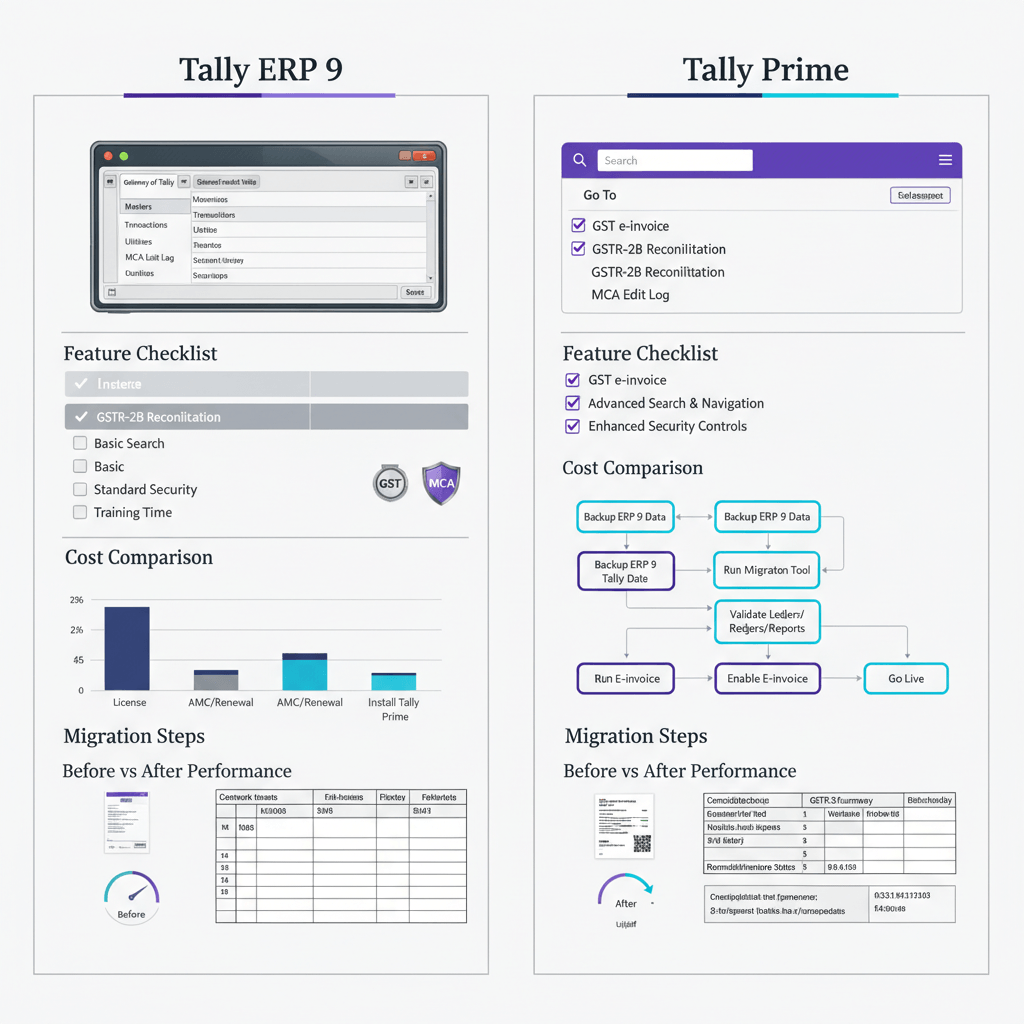
Prime is a generational shift, not a minor version bump. Prime replaces ERP 9’s menu-drill interface with a search-first flow, embeds compliance into core workflows, and runs on a 64-bit engine for stability and scale. The misconception that “ERP 9 still works” misses the point — vouchers post, but compliance workflows fall back to portals and spreadsheets.
| Feature Area | Tally ERP 9 | Tally Prime |
|---|---|---|
| Architecture | 32-bit only | 64-bit native |
| Navigation | Menu tree, shortcut keys | GoTo search bar plus menu tree |
| E-invoice (IRN, QR) | Not native, add-on or portal | Built-in, generate, print, cancel from voucher |
| E-way bill | Limited integration | Native generation and cancellation |
| GSTR-2B reconciliation | Not available | Import 2B, match against purchase register |
| Edit Log (audit trail) | Not available | Edit Log edition, MCA-compliant |
| Remote access | Not available | Browser-based remote access |
| Bank statement import | Manual BRS | CSV or Excel import with auto suggestions |
| OS support | Windows 7 and above, 32-bit | Windows 10 or 11, 64-bit recommended |
| Active feature updates | Discontinued | Ongoing via TSS |
Bottom line: the biggest risk on ERP 9 is not wrong accounting, it is missed or manual compliance — e-invoicing without native controls, GSTR-2B matching in spreadsheets, and no audit trail.
What Changes For Your Month-End Close On Tally Prime
Prime accelerates close by eliminating three manual loops: portal-based e-invoice generation, spreadsheet-driven 2B reconciliation, and offline bank reconciliation.
E-invoice generation without leaving the voucher screen
Above the ₹5 crore threshold, e-invoicing is mandatory. In ERP 9, each invoice requires a portal JSON upload or a third-party connector. In Prime, you generate the IRN and QR code directly from the sales voucher, and cancellations route through the same screen. For 200 invoices a month, this saves 30–60 minutes daily and cuts copy-paste errors.
Bank Reconciliation Statement with statement import
ERP 9’s BRS is a manual tick-and-match exercise. Prime accepts CSV or Excel bank statement imports, suggests ledger mappings, and reconciles against imported entries with clear exceptions. For 500 monthly bank transactions, BRS time drops from a full day to under two hours.
GoTo search replaces menu drilling
Prime’s GoTo bar lets you type “Balance Sheet” or “Sales Register,” avoiding 3–5 menu levels. Across multiple users and reports during close, those seconds add up to hours saved.
Pro tip: Retain ERP 9 shortcuts you love, but adopt Alt+G for GoTo in Prime to speed up navigation.
How Prime Reduces GST Compliance Drag
GSTR-2B reconciliation inside the product
Section 16(2)(aa) caps ITC to invoices that appear in your 2B. Prime imports the GSTR-2B JSON and matches it against your purchase register, surfacing matched, mismatched, missing in 2B, and missing in books. ERP 9 forces a 2–3 day Excel routine for 1,000 invoices per month. If your team spends days matching and posting JVs, AiA reconciles at scale and pushes adjustments into Prime, reducing blocked credits and speeding monthly close.
E-invoice penalty exposure is real
Failure to generate a valid e-invoice invites ₹10,000 per invoice or the tax amount, whichever is higher, under Section 122(1). Prime’s native e-invoice workflow brings risk near zero for standard B2B supplies, with exceptions like SEZ units, insurers, or GTAs still applying.
GSTR-9C self-certification above ₹5 crore
Persons with aggregate turnover above ₹5 crore must file GSTR-9C with GSTR-9 by 31 December following the year. Late fees continue until both are filed, as clarified by CBIC Circular 246/03/2025-GST. Prime’s reconciliation reports feed directly into 9C preparation, avoiding manual extraction that ERP 9 requires.
Migrating From ERP 9 To Tally Prime Without Disrupting Close
Pre-migration checklist
- Back up every company folder. Verify backups open in ERP 9.
- Inventory all TDLs and add-ons. Get Prime-compatible versions.
- Ensure TSS is active. Updates and compliance features depend on it.
- Check hardware. 64-bit Windows 10 or 11 with at least 8 GB RAM is recommended.
- Pick timing. Migrate early in the month, after return filings.
Conversion steps
Install Prime, point to your data path, open the company. Prime detects and converts ERP 9 data, keeping the original folder intact. For sub-1 GB files, this typically completes in under 30 minutes. Verify opening balances, voucher counts, GSTINs, and masters, then compare the trial balance with ERP 9.
Accelerate day one: run AiA alongside Prime to bulk-ingest bills and statements, sync masters, and push clean entries back, so the first month is not blocked by manual data entry.
Rollback plan
The original ERP 9 data folder remains untouched. If needed, reinstall ERP 9 and point to the original folder to roll back. The backup is non-negotiable.
Licensing, TSS, And The Edit Log Edition
Licensing and TSS
Prime follows the same Silver, Gold model as ERP 9. The upgrade is included with an active TSS subscription. Without TSS, you stop receiving statutory updates — meaning e-invoice schema or GSTR export changes can break your compliance cycle.
ERP 9 support reality
No formal end-of-life date exists, but new compliance features ship only for Prime. ERP 9 remains functional for basic bookkeeping, while compliance increasingly shifts to manual or third-party tools.
Edit Log edition
Prime’s Edit Log edition addresses the MCA audit trail mandate. Auditors must report on compliance, with penalties for officers in default under Section 128(6). ERP 9 has no equivalent.
Your Upgrade Decision Framework
Mandatory upgrade triggers
- Turnover above ₹5 crore: e-invoicing is mandatory.
- Statutory audit under the Companies Act: edit log is mandatory.
- Purchase volume above 500 invoices per month: spreadsheet-driven 2B matching is untenable, and wrongly availed ITC attracts 24% interest under Section 50(3).
Recommended sequence
- Audit TDLs and add-ons, secure Prime-ready replacements.
- Back up data, install Prime on one machine, convert a pilot company.
- Run one month in parallel, validate returns, TB, and BRS.
- Roll out to all companies, activate Edit Log where required.
What AiA adds
After Prime, the bottleneck is inputs, not outputs. AiA automates vendor bills via OCR, bank and card statement ingestion, and GSTR-2B reconciliation at scale. Together, Prime and AiA compress close from a week to 2–3 days.
Related Reading
- How AiA automates GSTR-2B reconciliation inside Tally Prime
- Bank statement ingestion and auto-ledger mapping for Tally users
- AP and bills automation for Indian SMBs using Tally Prime
References
- CBIC Circular 246/03/2025-GST — 30 January 2025
- CBIC Circular 238/32/2024-GST — 15 October 2024
- CBIC Rule 80 — CGST Rules
FAQ
What is the difference between Tally Prime Silver and Tally Prime Gold for a small business?
Silver is single-user, one person accesses the data at a time. Gold is multi-user over LAN and supports browser access for remote viewing and voucher entry without a local install. If two or more people need concurrent access, choose Gold. Solo operators who book and report sequentially can use Silver.
Can I generate e-way bills from Tally Prime, or do I still need the NIC portal?
Prime supports e-way bill generation, Part B updates, and cancellations from the voucher itself. The NIC portal remains the backend, but Prime automates the API calls. ERP 9 does not offer this natively, so you would otherwise rely on the portal or add-ons.
What interest applies if I claim ITC not reflected in GSTR-2B?
If ITC is availed and utilised without a 2B match, interest at 24% per annum applies under Section 50(3). If availed but not utilised, reverse the credit promptly. Expect demand proceedings under the applicable section for incorrect claims. Use Prime’s 2B reconciliation and, where scale demands, AiA’s matching engine to prevent these scenarios.
Does the new Section 74A change penalty exposure for FY 2024–25 onwards?
Yes. Section 74A is a unified demand provision effective for FY 2024–25 periods, with a 10% penalty of tax due or ₹10,000 for non-fraud, and 100% for fraud or suppression. Earlier splits between Sections 73 and 74 apply only to prior periods.
Is the GSTR-9 filing exemption for turnover below ₹2 crore permanent?
No. It is notified year by year. For FY 2023–24, the exemption was notified, but there is no guarantee for FY 2024–25. If your turnover hovers near ₹2 crore, maintain reconciliation-ready books and prepare to file if required.
How does GSTR-9C filing interact with GSTR-9 late fees for entities above ₹5 crore?
Late fees accrue until both GSTR-9 and GSTR-9C are filed. Filing GSTR-9 alone does not stop the clock, as clarified by CBIC Circular 246/03/2025-GST. Prime’s reconciliation and audit-ready reports help complete 9C faster.
Does Section 128A help with legacy ITC mismatches from FY 2017–18 to FY 2019–20?
Section 128A waives interest and penalty for Section 73 demands for those years, provided full tax is paid by the notified date, per CBIC Circular 238/32/2024-GST. It does not apply to fraud cases under Section 74.
Can Tally Prime handle RCM invoices for e-invoicing and GST returns?
Yes. Prime supports RCM tagging at voucher level and sets the reverse charge flag in the e-invoice payload as per the schema. For returns, RCM liabilities flow through the tax ledgers appropriately. Validate with a sample RCM purchase and ensure IRN generation reflects RCM correctly.
What if my ERP 9 TDL customisation does not work in Tally Prime?
Some ERP 9 TDLs need refactoring for Prime’s framework. Options include asking your developer to port it, checking if Prime now natively covers the use case, or using marketplace apps. Do not let one TDL block migration — migrate core data, then reintroduce or replace the customisation.
As a CA firm managing dozens of ERP 9 clients, should I migrate all at once?
Migrate in batches. Start with a few simple companies, run one full month on Prime, document issues, then move a larger batch. Standardise a migration checklist, including backups, TDL inventory, TSS validation, and trial balance reconciliation. Consider AiA to centralise 2B matching and bank ingestion across clients for a smoother transition.

Rohan Sinha is a fintech and growth leader building aiaccountant.com, focused on simplifying accounting and compliance for Indian businesses through automation. An IIT BHU alumnus, he brings hands-on experience across 0 to 1 product building, growth, and strategy in B2B SaaS and fintech.