-01%201.svg)
Key takeaways
- Virtual accounting service India gives founders a full finance stack, bookkeeping, compliance, and insights, without hiring full time.
- No more chasing CAs for filings, track cash flow on live dashboards, and close books on time.
- A 10 point checklist, a weighted scoring framework, and founder ready interview questions help you pick a partner confidently.
- Expect predictable pricing, India specific compliance depth, and fast onboarding, or walk away.
- Done right, you save 15 to 20 hours a month, cut penalties, and get clearer decisions from real time MIS.
Why virtual accounting service India matters for founders
Founders need reliability, speed, and clarity, not spreadsheets and surprises. Virtual accounting brings a dedicated CA led team to run your financial backend, it standardizes processes, and surfaces insights that drive better decisions.
The payoff: fewer penalties, cleaner audits, stronger cash flow discipline, and time back for growth.
Think of it as your finance command center, always on, always compliant, and always explaining numbers in plain English.
Understanding Virtual Accounting Service India Basics
Virtual accounting services in India mean remote, CA led management of bookkeeping, GST filings, TDS returns, income tax returns, ROC compliance, payroll including PF and ESI, and MIS reporting. All of this runs on secure cloud, with AI assisted dashboards, so you see cash, receivables, payables, and alerts in real time.
The right provider reduces costly mistakes. Late GSTR 3B attracts penalties, TDS defaults freeze cash, weak AR and AP tracking strains working capital. Virtual accounting builds a process that prevents these issues and gives you 15 to 20 hours back each month.
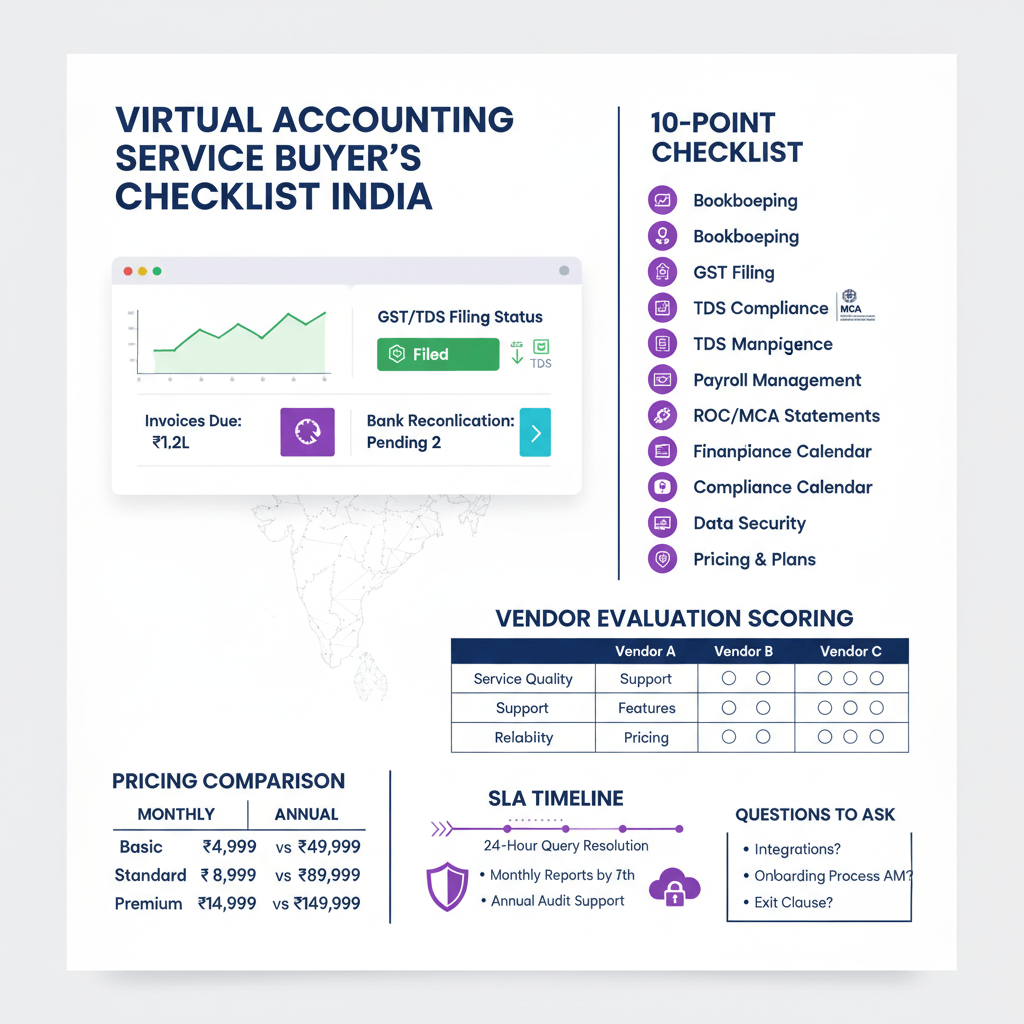
What to Look for in Virtual Accounting India: Your 10 Point Checklist
Compliance depth that matters
Your provider should cover GSTR 1, 3B, 9, 9C, TDS and TCS returns, ITR, ROC filings like MGT 7 and AOC 4, and payroll dues like PF, ESI, and professional tax, including MSME tracking. They must monitor notices proactively and resolve them before they become penalties.
Accuracy plus robust process
Expect monthly closes on a clear calendar, clean bank and UPI reconciliations, and audit ready year end schedules. Ask for a sample reconciliation and a write up on how they treat complex entries, advances, and revenue recognition.
Technology and real time visibility
Insist on dashboards for cash flow, AR and AP ageing, filing alerts, and a secure document vault. Trend insights should arrive automatically, not after manual number crunching.
Speed and clear SLAs
Daily queries answered within hours, filings with buffer timelines, and a named escalation path. Ask how they handle March close, audit season, and system downtime.
Data security standards
Look for encryption, role based access, automated backups, and India data residency. Confirm certifications or documented controls, and ask for a security overview.
Smart integrations
The stack should plug into banks, payment gateways, Tally, Zoho Books, QuickBooks, e invoicing APIs, and ecommerce platforms. More integrations mean less manual work and fewer errors.
Transparent, predictable pricing
Fixed monthly bundles beat hourly billing. Scope should be explicit, filings and routine notices included, and any cleanup or catch up quoted upfront.
Team quality and expertise
Work with dedicated CA pods, not a loose marketplace. Ensure they understand your model, D2C inventory and GST on returns, SaaS revenue and deferrals, services and place of supply rules.
Smooth onboarding and migration
Expect a fast go live, chart of accounts setup, historical cleanup, and prior year catch up without disrupting operations. The best teams start delivering value in 24 to 48 hours.
Responsive support experience
Real time chat or Slack, crisp explanations, and founder centric MIS, P and L clarity, cash flow trends, and variance analysis that you can act on.
How to Evaluate Accounting Service India: Your Scoring Framework
Weighted scoring system
- Compliance coverage, 25 points: Full GST, TDS, ITR, ROC, payroll, run a mock GSTR 3B trial.
- Accuracy, 20 points: Sample bank reconciliation, monthly close timeline, error handling.
- Responsiveness, 15 points: Chat response time, SLAs, escalation clarity during crunch.
- Automation and technology, 15 points: Dashboard depth, proven integrations, zero double entry.
- Reporting quality, 10 points: Custom MIS, metrics by model, CAC and LTV for SaaS, inventory ageing for D2C.
- Onboarding speed, 5 points: Go live in 24 to 48 hours.
- Price predictability, 5 points: All in yearly cost, no hidden add ons.
- Client references, 5 points: Industry specific case studies, not just star ratings.
Tip: Score three providers side by side, then run a one month pilot with the top two to validate assumptions before committing annually.
Founder ready interview questions to vet providers
- If my GSTR 3B data and GSTR 2B do not match, walk me through your reconciliation steps.
- Show me a redacted MIS you delivered last month, highlight three decisions a founder took from it.
- What is your process to catch TDS mismatches before the due date, how do you prevent cash crunch from interest and late fees.
- How do you treat prepaid expenses and revenue deferrals for annual SaaS plans.
- Show a sample AR ageing, what specific actions do you trigger at 30, 60, 90 days.
- What failsafe do you use during March close and audit timelines to guarantee filings do not slip.
- Describe your access controls, backups, and recovery plan in case of account compromise.
- How quickly can you migrate my last twelve months and clean up ledgers, what will you need from me.
- If a GST notice arrives, what steps and timelines do you follow, what is included in my bundle.
- What does success look like in my first 90 days, what metrics will move and by how much.
Red flags and how to mitigate
- Hourly billing with vague scope, ask for bundles that include filings and standard notices.
- No sample MIS, insist on seeing actual reports and a dashboard walkthrough.
- Generic responses to industry specifics, push for examples from your model.
- Slow replies during pilot, test them during month end to see true capacity.
- Manual data entry everywhere, demand integrations and automation proof.
When in doubt, pilot with real data for one month, measure close speed, error rates, and decision clarity, then commit.
Realistic costs and sample bundles
Expect transparent monthly pricing tied to transaction volume and compliance scope. Typical startup ranges cover bookkeeping, GST and TDS filings, payroll, ROC, and MIS. Cleanup and historical catch up are usually one time. Fixed monthly bundles beat hourly billing.
Rule of thumb: If you cannot predict your twelve month accounting spend within a narrow band, the pricing model is not founder friendly.
India specific tips and a simple compliance calendar
- Lock a monthly close date, then slot GST 3B prep, TDS computation, and payroll dues on a repeat calendar.
- Automate invoice capture through e invoicing where applicable, reduce missing purchase credits.
- Use AR ageing to trigger dunning sequences at 30, 45, and 60 days, keep cash predictable.
- Document revenue recognition policies, helpful at audit and due diligence.
- Keep a rolling tax provision so advance taxes do not shock cash in quarter ends.
Great compliance is a habit, not a sprint. Set a cadence once, then let your provider keep the drumbeat.
Implementation plan, your first 90 days
Days 1 to 10
Grant tool access, finalize chart of accounts, connect banks and payment gateways, migrate last three months, and agree on your close calendar.
Days 11 to 30
Run a full close, publish P and L, balance sheet, cash flow, and AR and AP ageing, fix mismatches, log process gaps.
Days 31 to 60
Automate two to three high volume workflows, invoice capture and bank feeds, standardize MIS, and set alert thresholds for variances.
Days 61 to 90
Stabilize, reduce month end to a predictable timeline, lock KPIs, and prepare a quarter end review for founders and investors.
Mini case, what good looks like
A D2C brand with daily COD and prepaid orders struggled with fee reconciliations and GST on returns. In thirty days, virtual accounting mapped payment gateway fees, automated e commerce imports, and set AR and AP alerts. In ninety days, they closed by day five, reduced GST interest to zero, and freed the founder for growth channels.
FAQ
How do I know if my startup is ready for virtual accounting instead of a part time CA
If you are spending more than five hours a week on reconciliations, missing credits, or chasing filings, you are ready. Virtual Accounting by AI Accountant typically replaces ad hoc coordination with a single accountable team, a close calendar, and live dashboards that remove founder firefighting.
What exactly will a virtual accounting team do for me each week
They will post and reconcile transactions, prepare GST 3B working, compute TDS, run payroll, update AR and AP ageing, and publish a short weekly cash brief. With Virtual Accounting by AI Accountant, founders also get filing alerts and a one page Friday summary for quick decisions.
How fast can I migrate without breaking my current books
With clean data access, most startups can go live in 24 to 48 hours. A standard playbook, chart of accounts, bank and gateway connections, and a three month backfill ensures continuity. Virtual Accounting by AI Accountant routinely completes this in under two days for typical stacks.
What tools should my provider integrate with on day one
Bank feeds, payment gateways, Tally or cloud ledgers, e invoicing if applicable, and ecommerce or subscription platforms. The goal is zero double entry. Virtual Accounting by AI Accountant prioritizes bank and gateway reliability first, then adds advanced workflows in weeks two to four.
How do I compare pricing across providers without hidden surprises
Ask for an annual all in quote, including filings, routine notices, and expected cleanup. Model your next twelve months of transactions and see if the price changes. Virtual Accounting by AI Accountant uses fixed bundles with clear limits, so you can predict spend with confidence.
What KPIs will improve in my first quarter after switching
Month end close time, AR ageing at 60 and 90 days, GST interest and late fees, and variance clarity on gross margin and burn. Virtual Accounting by AI Accountant typically reduces close time to under seven days and eliminates routine penalty leakage.
Can a virtual team handle GST notices and audits, or do I still need someone local
Most notices and audits are document and data driven, so a prepared virtual team can handle them end to end. You may need local representation for rare in person visits, which the provider can coordinate. Virtual Accounting by AI Accountant includes standard notice handling in bundles.
We are SaaS, how will revenue recognition and deferred revenue be managed
Set revenue policies for monthly, quarterly, and annual plans, automate deferrals, and tie them to invoicing. Your MIS should show MRR, ARR, churn, and deferred schedules. Virtual Accounting by AI Accountant implements this with clear schedules your auditor can trust.
What happens during March close and statutory audit crunch
Capacity planning, earlier cutoffs, and a frozen change window reduce risk. A great provider shares a dated checklist and daily status. Virtual Accounting by AI Accountant runs audit readiness packs, PBC lists, and a war room calendar so filings land early.
How do I ensure my data is safe with a virtual provider
Demand role based access, encryption, backups, and documented controls. Ask who can access what, from where, and how access is revoked. Virtual Accounting by AI Accountant provides an access matrix and a recovery plan founders can review in onboarding.
Can I still use my existing Tally or do I have to move to a cloud ledger
You can keep Tally if it fits your process, many virtual teams work with it via secure access and backups. If you need multi location access and automation, a cloud ledger may be recommended. Virtual Accounting by AI Accountant supports both models and migrates only when it adds value.
What does a good MIS look like for a seed to Series A startup
A concise pack, P and L with month on month and year to date, balance sheet highlights, cash flow, AR and AP ageing, and three to five operating metrics tied to your model. Virtual Accounting by AI Accountant delivers a founder friendly one pager plus drill downs so you can act fast.

Rohan Sinha is a fintech and growth leader building aiaccountant.com, focused on simplifying accounting and compliance for Indian businesses through automation. An IIT BHU alumnus, he brings hands-on experience across 0 to 1 product building, growth, and strategy in B2B SaaS and fintech.