-01%201.svg)
Key takeaways
- AP automation in India digitizes vendor bills end to end, cutting errors by 80 percent and shrinking month-end close to 3 to 5 days.
- India specific intelligence for GST, TDS, e-invoicing, and native sync with Zoho Books and Tally is essential, not optional.
- Winning teams standardize intake, maintain clean vendor masters, and reconcile GSTR-2B continuously for reliable ITC.
- Modern platforms blend OCR, GSTIN validation, and 3-way matching to eliminate manual entry and duplicate payments.
- A two week pilot, clear KPIs, and risk based approvals speed adoption while keeping controls intact.
What is AP automation in India, in plain English
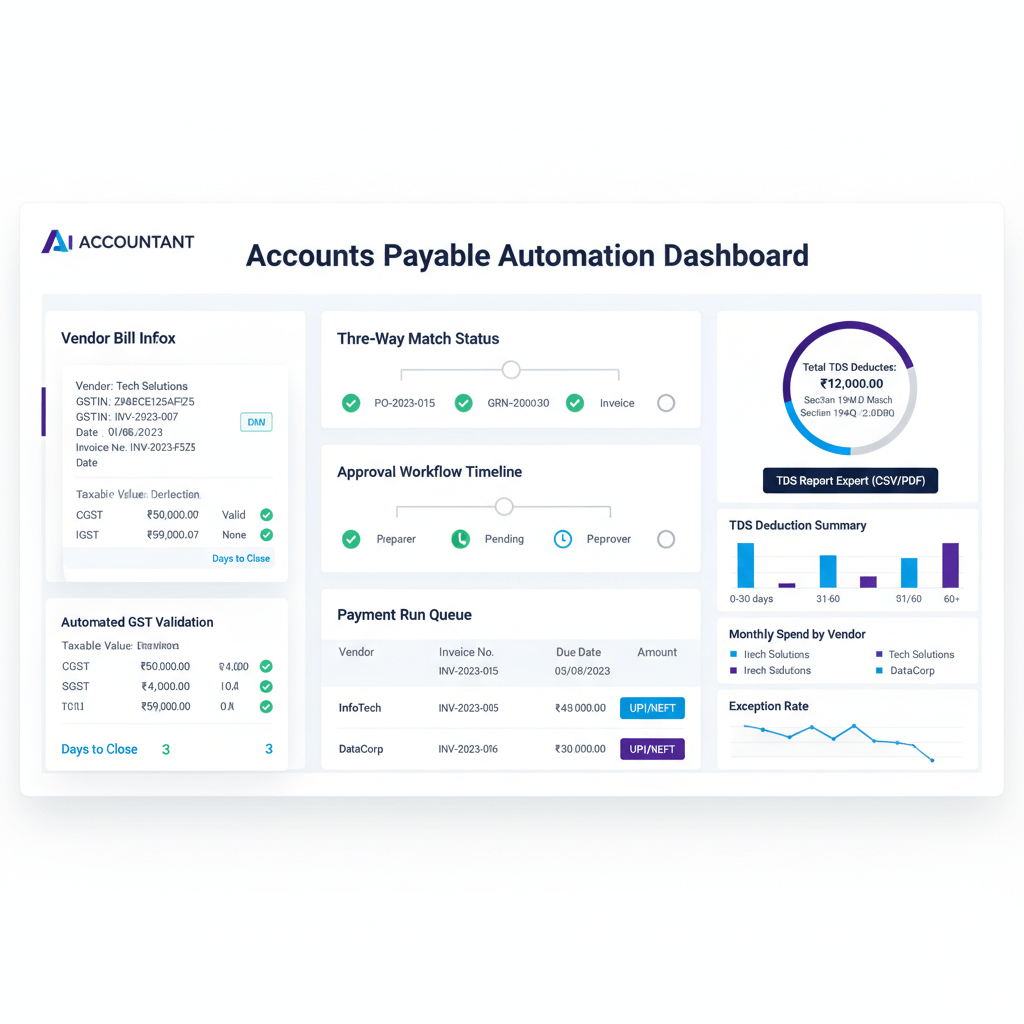
AP automation is software that moves vendor bills from inbox to payment, while handling Indian compliance. It captures invoices, extracts data with OCR, validates GST and TDS, routes approvals, posts to ledgers, and prepares payments, then reconciles books, all in one flow. Humans step in only for exceptions, like nuanced RCM or unusual vendor situations.
Think of it as a dependable teammate that never gets tired, never mistypes a GST rate, and always leaves an audit trail.
For a structured overview tailored to local needs, see this AP automation guide for Indian businesses and this in depth complete AI guide for AP automation in India.
Understanding accounts payable automation meaning
Capture
Bulk ingest emails, PDFs, scanned images, and Excel files into a single queue, no more hunting across threads or drives.
Extract
OCR reads invoice numbers, GSTIN, line items, HSN or SAC, tax breakup, and totals with high accuracy.
Validate
Automated checks confirm vendor details, math accuracy, and GSTIN validation against government databases, duplicates get flagged instantly.
Approve
Configurable matrices route bills by amount, department, or risk level, with reminders and escalations.
Post
Entries sync to Zoho Books or Tally with correct ledgers, GST split, and TDS sections applied.
Pay
Generate UPI or NEFT batches, capture UTRs, and map them back to invoices for clean payment trails.
Reconcile
Automate bank reconciliation, match payments to bills, and track GSTR-2B status on dashboards.
Sector specific nuances are covered in this real estate guide to AP automation in India and this practical accounts payable automation India guide.
Why Indian businesses need AP automation now
GST has made compliance unforgiving, ITC rests on precise GSTR-2B matching, even small mismatches reduce cash you can claim back. E-invoicing, IRN and QR, and RCM rules raise the bar for accuracy. TDS and TCS deductions, for example 194C, 194J, or 194Q, must be calculated correctly and deposited on time. Distributed teams and remote work complicate intake, while Zoho Books and Tally require clean sync to avoid double entry.
- Protect ITC with continuous GSTR-2B reconciliation, not just month end scrambles.
- Automate TDS logic so deposits are timely and error free.
- Maintain a clean vendor master, or mismatches will cascade.
Further reading, AP automation guide for Indian businesses and this AI powered AP automation guide for India.
Breaking down AP workflow stages and automation opportunities
Intake
Centralize emails and uploads into one queue, eliminate forwarding and file hunting.
Extraction
Pull GST breakup and line level HSN or SAC from PDFs and scans, convert to structured data.
Validation
Run GSTIN API checks, vendor name normalization, and duplicate detection by invoice number, date, and amount.
Matching
Adopt 3-way matching where applicable, PO to GRN to invoice for goods, two way matching for services.
Approvals
Risk based routing, small and routine bills auto approve, unusual or high value ones escalate.
Posting
Post to correct ledgers, tax codes, and TDS sections, then sync cleanly to Zoho Books or Tally.
Payments
Batch disbursements and auto capture of UTRs, followed by bank reconciliation.
Reporting
Instant visibility into due and overdue, vendor aging, and cash needs, see also these best practices from accounts payable automation best practices.
Mastering India specific compliance requirements
- GST compliance, auto tag GSTR-2B status, apply ITC rules by invoice type and vendor category, handle RCM correctly.
- TDS or TCS automation, map sections like 194C, 194J, 194Q, and track the 7th of month deposit deadline automatically.
- Vendor master hygiene, verify legal name, state code, GSTIN, PAN, and bank account before first payment.
- E-invoice handling, parse IRN, acknowledgment, and QR, even from JSON files, no manual intervention.
- Audit readiness, complete trails, retention policies, and one click compliance reporting.
Deep dives, accounts payables automation guide for Indian businesses and this India focused AP automation guide.
Measuring real business benefits and outcomes
- Time savings, invoice to post cycle under 3 days, month end close down to 4 days.
- Error reduction, 80 percent fewer mismatches, duplicate payments eliminated, TDS errors near zero.
- Cash visibility, due and overdue views, early payment discounts, and clearer working capital planning.
- Productivity, bills per FTE double, cost per invoice falls from ₹800 to ₹110 to ₹300.
- Compliance confidence, continuous GSTR-2B matching and audit ready trails.
Implementation tips from a step by step AP automation guide and industry specific guidance.
Avoiding common misconceptions and implementation risks
- OCR alone is not the answer, you need validation logic and accounting intelligence for GST and TDS.
- Data cleanup is not optional, messy vendor masters will multiply mismatches after go live.
- Overly rigid approvals slow you down, use risk based routing.
- Change is ongoing, GST rules evolve and vendor details change, schedule periodic reviews.
Pro tip, start simple, then layer sophistication as data quality and trust improve.
More context in this Indian AP automation guide and this field tested playbook.
Your AP automation guide India, a step by step implementation playbook
- Map your current process, trace 20 to 30 invoices end to end, identify delays and rework points.
- Clean your vendor master, standardize names, verify GSTIN and PAN, confirm TDS sections, validate bank details.
- Define approval matrices, keep rules simple and risk oriented.
- Set intake channels, a single vendor bills email, plus Excel standards for bulk uploads.
- Configure tax settings, GST by HSN or SAC, RCM applicability, TDS sections and rates.
- Integrate your ERP, set up Tally integration or Zoho Books sync, test with sample transactions.
- Run a pilot, start with one or two high volume vendors, measure accuracy and cycle time.
- Roll out and train, focus training on exceptions rather than happy path flows.
- Establish reconciliation routines, daily bank recs, weekly GSTR-2B reviews, monthly vendor statements.
- Track and optimize, monitor KPIs weekly, gather feedback monthly, iterate continuously.
For structured checklists, see this implementation guide and these AP best practices.
How to automate vendor bills in India, a practical walkthrough
Ingestion, centralize PDFs, scans, and Excel sheets into a single inbox.
Extraction, OCR pulls line level GST and HSN codes into structured posting data.
Mismatch detection, spot vendor name variations and potential duplicates by invoice number, date, and amount.
Exception handling, route edge cases to humans for review and correction.
Posting, push validated entries to Zoho Books or Tally with tax and TDS intact.
Example, a scanned Excel with many items is ingested, GSTIN mismatch is detected against the master, the item routes for verification, the correct TDS section is applied, then the clean entry posts automatically. For deeper guidance, review this complete AI guide and this concise India guide.
Essential tool capabilities for Indian AP teams
- Data extraction, OCR tuned for Indian formats, tabular GST breakup, regional language support.
- Compliance intelligence, GSTIN validation, HSN or SAC verification, and TDS mapping to sections.
- Integration depth, Zoho Books and Tally connectors, bank reconciliation, and GSTR-2B processing.
- Workflow flexibility, bulk edits, configurable approvals, and clear exception queues.
- Reporting, real time payables dashboards, vendor aging, and cash forecasting.
- Security, encryption, ISO 27001, and SOC 2 Type II.
Top options for India,
- AI Accountant, purpose built for India with deep GST or TDS logic and native Zoho or Tally sync.
- QuickBooks Online, solid basics but limited Indian tax features.
- Zoho Books AP module, native integration yet manual GST reconciliation is often needed.
- Tally Prime, strong compliance, lighter automation.
- SAP Concur, enterprise scale, may be complex for SMEs.
Market overview, top AP automation softwares in India.
Ensuring data quality, controls, and security
- Maker checker, two person verification for high value transactions with full logs.
- Role based access, limit sensitive data visibility by entity or department.
- Audit trail completeness, every edit logged, statutory retention enforced, exports for auditors.
See also, AP automation best practices and this India specific guide.
Change management strategies that work
- Pilot and celebrate, demonstrate early wins like cutting close time by two days.
- Standardize relentlessly, one vendor bills email, one Excel template, fewer variations.
- Train for exceptions, teach edge cases, the system handles the rest.
Helpful resources, complete AI guide and industry examples.
Key performance indicators to track success
- Processing efficiency, invoice to post cycle under 3 days, first pass yield above 80 percent.
- Compliance accuracy, GST or GSTR-2B mismatch under 5 percent, TDS error under 1 percent.
- Payment performance, on time payments at 95 percent, more early payment discounts captured.
- Operational excellence, month end close within 5 days, 50 percent or higher FTE productivity gains.
Benchmark with this step by step guide and these best practices.
Understanding costs and ROI for Indian SMEs and CA firms
Investments, subscriptions at ₹10,000 to ₹50,000 monthly, setup at ₹1 to 2 lakhs, training near ₹50,000.
Savings, cost per invoice falls from about ₹800 to ₹110 to ₹300, fewer penalties, better ITC, more early payment discounts.
ROI example, at 1,000 bills monthly and ₹700 saved per invoice, savings of ₹7 lakhs against ₹50,000 subscription yields near ₹6.5 lakhs net, breakeven in 2 to 3 months.
| Monthly bill volume | Manual processing cost | Automated cost | Monthly savings |
|---|---|---|---|
| 500 bills | ₹4 lakhs | ₹60,000 | ₹3.4 lakhs |
| 1,000 bills | ₹8 lakhs | ₹1.1 lakhs | ₹6.9 lakhs |
| 2,000 bills | ₹16 lakhs | ₹2.4 lakhs | ₹13.6 lakhs |
Deeper context in this complete India AP automation guide.
Real success stories from Indian businesses
CA firm with 20 SME clients, standardized intake and automated GSTR-2B reconciliation, time dropped from 7 days to 2 days per client, Tally sync freed juniors for advisory, client satisfaction rose by 40 percent.
Manufacturing SME in Chennai, from 10 day close to 4 days, complex HSN mapping handled automatically, ITC mismatches nearly vanished, team now focuses on cash optimization.
Where AI Accountant fits in the AP automation landscape
AI Accountant addresses India specific needs, bulk extraction with GST and HSN detection, mismatch checks before posting, seamless Zoho Books and Tally sync, and live GSTR-2B reconciliation. It keeps humans in the loop for RCM and multi rate TDS, while giving CA firms multi entity management to scale without linearly adding headcount.
Your next steps and practical resources
- Two week pilot checklist, map 20 invoices, clean top 50 vendors, set intake, configure basic approvals, measure baseline.
- Templates, vendor master cleanup, approval matrix, and a GSTR-2B reconciliation tracker.
- Start small tomorrow, pick your highest volume vendor, test extraction on the last 10 bills, note exceptions.
- Build momentum, expand to five vendors by week two, include diverse formats, set a go live date.
Helpful reads, industry guide and this concise Indian AP automation playbook.
FAQ
What is the practical difference between AP automation and plain OCR for GST heavy invoices?
OCR reads text, AP automation interprets it. A mature platform applies GST logic, runs GSTIN validation, calculates TDS sections, and posts to ledgers. For example, AI Accountant reads line items, tags HSN or SAC, applies RCM rules where needed, and syncs to Tally without manual edits.
How do I prevent duplicate vendor payments when vendors resend the same bill multiple times?
Use multi key duplicate detection, invoice number, date, amount, and vendor GSTIN together. AI Accountant flags probable dupes during intake, blocks approval, and shows the original bill link so approvers can compare before proceeding.
Can AP automation handle services where GRN does not exist, how does matching work then?
Yes, adopt two way matching, PO to invoice, with tolerances on amount and tax. For goods, use 3-way matching with GRN. AI Accountant lets you configure matching mode per vendor or per item category.
What is the recommended approach to automate TDS under 194C, 194J, and 194Q without misclassification?
Map vendors and expense ledgers to default TDS sections, then allow rule overrides by invoice metadata, for example, nature of work, threshold crossed. The system should compute rate, consider PAN availability, and prepare challan data. AI Accountant’s TDS engine applies these rules and keeps an audit trail of overrides.
How does GSTR-2B reconciliation run inside AP automation, do I still need spreadsheets?
Automated platforms ingest 2B JSON or Excel, match vendor GSTIN, invoice number, date, and taxable value, then tag each bill as eligible, deferred, or mismatch. AI Accountant displays variance by vendor and reason codes, no side spreadsheets required.
What controls ensure maker checker for high value invoices in a multi-entity CA setup?
Define amount thresholds and dual approval for those slabs, restrict posting rights to checkers, and lock edits post approval. AI Accountant enforces two person controls, logs every action, and provides entity wise access segregation for CA firms.
How do we ingest e-invoice JSON, extract IRN and QR, and post to Tally cleanly?
The ingestion layer should accept JSON, parse IRN, acknowledgment number, QR payload, and reconcile with the PDF copy. On posting, retain IRN in a custom reference field. AI Accountant performs this automatically and syncs the references to Tally.
What is a realistic implementation timeline for SMEs, and how should we pilot?
Two weeks for a pilot is typical, week one for setup, vendor master cleanup, and ERP integration, week two for live testing with one or two vendors and KPI tracking. AI Accountant provides a guided pilot playbook so teams see value fast.
How do we maintain vendor master hygiene over time, not only at go live?
Schedule monthly validations against GST and PAN, require bank verification before first payment, and auto lock vendors with repeated mismatches. AI Accountant runs periodic GSTIN validation and flags stale or risky records.
Can small finance teams on Zoho Books or Tally get value without full time admins?
Yes, start with standardized intake, automated extraction, and basic approvals, then add compliance automations gradually. AI Accountant’s defaults for India, GST, TDS, and RCM let lean teams realize gains without heavy admin overhead.
How do I quantify ROI for management approval, what KPIs convince CFOs?
Track baseline cost per invoice, cycle time, mismatch rate, and on time payments. After go live, show cost per invoice reduction, close time improvement, fewer GST or TDS errors, and early payment discounts captured. AI Accountant provides dashboards aligned to these KPIs.
What happens when vendors send mixed formats, PDFs, scans, and Excel, will accuracy suffer?
A robust extractor normalizes all sources and presents a single validation view. Accuracy remains high due to templates, machine learning, and human in the loop for exceptions. AI Accountant supports batch uploads from email, WhatsApp scans, and portal Excel files with consistent results.