-01%201.svg)
Key Takeaways
What CA Services In Noida Actually Cover
A chartered accountant in Noida is not just someone who files your ITR in July and disappears until next year. A practising CA is a member of the Institute of Chartered Accountants of India (ICAI), the only professional in India who can sign statutory audit reports, certify Form 3CD, file Form 3CEB, and represent clients before the Income Tax Assessing Officer.
The scope of what a qualified chartered accountant in Noida covers breaks into at least six core domains:
Many CA firms in Noida also handle FEMA compliance, transfer pricing documentation, internal audit, and cost audit for manufacturing units.
Here is a distinction worth making clearly: a tax consultant in Noida may not hold a CA qualification. They may be a commerce graduate or an ex-accountant handling basic ITR filing and GST returns. A CA can do everything a tax consultant does, but not vice versa. The gap matters the moment you need an audit certificate, a valuation report, or representation before a tax authority.
The Full Compliance Calendar Noida Businesses Cannot Ignore
Compliance has a rhythm. Miss the rhythm and you pay penalties. Here is the full calendar, mapped by tax head.
GST Deadlines
Income Tax Deadlines
For income tax filing in Noida, the deadlines are:
Advance tax instalments apply to anyone with a tax liability exceeding ₹10,000 per year:
TDS Deadlines
ROC Deadlines (Companies)
For LLPs: Form 11 (annual return) by 30 May, Form 8 (statement of account and solvency) by 30 October.
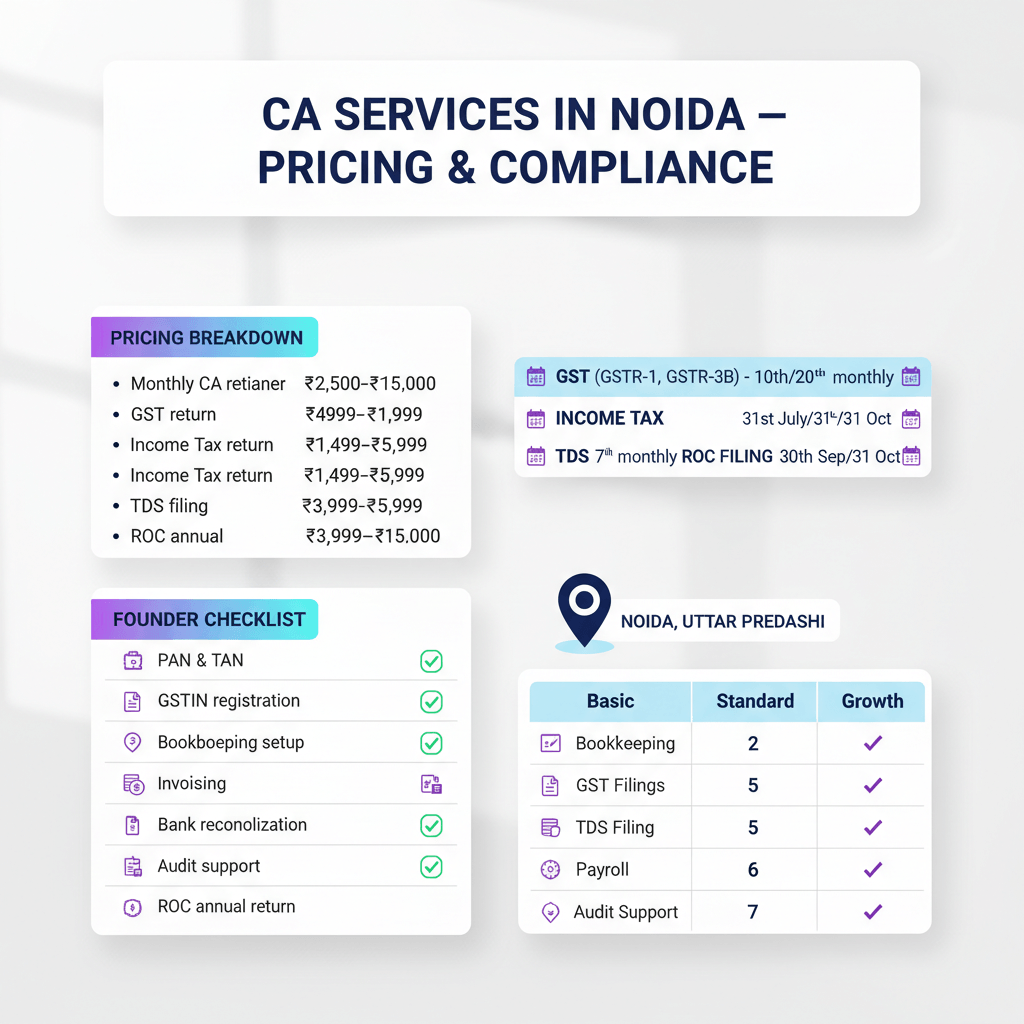
What CA Services Cost In Noida — Realistic Fee Ranges
Fees are not regulated by ICAI, the market sets them. What you pay depends on business type, transaction volume, number of employees, and whether you need standalone filings or a full monthly retainer.
Monthly retainer ranges for Noida businesses:
Per-filing fees (without retainer):
What moves the price up: multiple GST registrations, international transactions, large payroll, more than one business entity, or prior-year backlogs that need cleaning.
Red flag: any CA firm in Noida quoting below ₹1,500 per month for a company with payroll, GST, TDS, and ROC filings. That is not a retainer, that is a deposit for a receipt.
For early-stage startups who need structured bookkeeping plus GST and ITR without the overhead of a full-time CA, tech-enabled providers like Virtual Accounting offer bundled compliance from ₹4,000 per month, useful when transaction volumes are low but the compliance structure needs to be correct from day one.
GST Compliance For Noida Businesses — Registration To Returns
Noida is in Uttar Pradesh, so your GSTIN starts with state code 09. That matters for return categorisation, ITC reconciliation, and determining which due date bucket you fall into under the QRMP scheme, 22nd, not 24th.
Mandatory GST registration triggers:
Even below the threshold, voluntary registration is worth considering if you sell B2B. Your buyers will want to claim Input Tax Credit, and they will prefer a registered supplier.
GST registration process: File Form GST REG-01 with PAN, Aadhaar, address proof for the business premises, bank statement, and a photograph of the authorised signatory. Approval typically comes within 7 working days.
Key returns to know:
E-invoicing is mandatory for businesses with turnover above ₹5 crore. You must generate an IRN from the IRP portal before issuing the invoice to the buyer. Issuing an invoice without an IRN is treated as no invoice for GST purposes.
E-way bill is required for movement of goods worth more than ₹50,000 in value.
One Noida-specific wrinkle: businesses operating from co-working spaces need a No Objection Certificate from the co-working operator to use that address for GST registration. Without it, the application gets rejected.
A qualified tax consultant in Noida or practising CA will flag this before you file, not after.
Income Tax Filing And Audit Requirements For Noida Businesses
ITR form selection — simplified:
Tax audit under Section 44AB becomes mandatory when:
Only a practising CA can conduct a tax audit. The output is Form 3CD, a 41-clause report covering depreciation schedules, related party loans, TDS compliance, and deductions claimed. The audit report must be filed by 30 September, the ITR itself by 31 October.
For companies: Minimum Alternate Tax under Section 115JB applies at 15% of book profit if that exceeds the regular tax liability. From FY 2023-24, the new tax regime is the default for individuals, but companies do not have this choice, they pay 22% under Section 115BAA or 15% under Section 115BAB if they are new manufacturing companies set up after October 2019.
Presumptive taxation advantage for small Noida businesses: if you qualify under Section 44AD, you do not need to maintain detailed books of accounts. That is a significant cost saving on bookkeeping, though you lose the ability to claim actual expenses.
TDS Compliance — What Every Noida Business Owner Must Deduct
Before you deduct a single rupee of TDS, you need a TAN. Apply via Form 49B. Once you have a TAN, here are the key sections your business will encounter:
SectionTransaction TypeRateThreshold192SalarySlab rateFirst taxable rupee194CContractor payments1% (individual) / 2% (others)₹30,000 per transaction or ₹1 lakh aggregate194JProfessional or technical services10% (professional) / 2% (technical)₹30,000194IRent — land, building, furniture10%₹2.4 lakh per year194AInterest (non-bank)10%₹5,000194QPurchase of goods0.1%Purchases above ₹50 lakh per year, buyers with turnover above ₹10 crore
Deposit TDS using challan ITNS 281 via net banking.
Penalty for late TDS return filing: ₹200 per day under Section 234E, capped at the TDS amount itself.
Consequence of not deducting at all: 30% of that expense gets disallowed under Section 40(a)(ia) when computing your taxable income. That is an expensive oversight.
Form 16 must reach employees by 15 June of the following year. Form 16A must be issued within 15 days of the quarterly return due date.
ROC And MCA Compliance For Companies And LLPs In Noida
Companies and LLPs registered in Noida fall under the RoC Delhi jurisdiction.
Annual filings for private limited companies:
Annual filings for LLPs:
Event-based filings (must be filed within 30 days of the triggering event):
Penalty structure: ₹100 per day per form, with no statutory cap for most forms. Let two or three forms run 90 days late and you are looking at ₹27,000 in penalties before your CA has opened the filing portal. Let them run for two consecutive years and the RoC can initiate strike-off proceedings under Section 248 of the Companies Act 2013.
CA Services For Startups In Noida — Incorporation To Fundraising Compliance
Noida and Greater Noida have 500 plus DPIIT-recognised startups. The compliance needs of a Series A startup are fundamentally different from those of a 10-year-old SME.
Incorporation choices:
DPIIT Startup Recognition is worth pursuing early. Apply at startupindia.gov.in. Eligibility: incorporated after 1 April 2016, turnover below ₹100 crore in any prior year, and demonstrably working towards an innovative or scalable business model.
Benefits:
ESOP compliance is a CA job. ESOPs can only be issued by companies, require Board and Shareholder approval under Section 62(1)(b), and need the exercise price set by a registered valuer.
Fundraising compliance has two non-negotiable CA touchpoints:
This is precisely where you need a CA for startups in Noida who has worked on funding rounds. The cap table, the PAS-3, the FC-GPR, the 80-IAC application, these are specialised skills, and choosing the wrong CA at the seed stage creates legal complexity that takes years to untangle.
How To Choose The Right CA Or CA Firm In Noida — Practical Criteria
Start by verifying ICAI membership. Every practising CA has a membership number, every CA firm has a Firm Registration Number.
Five questions to ask before signing an engagement letter:
Red flags that should end the conversation:
Sole practitioner vs. CA firm: a sole practitioner handles basic compliance fine. The moment you need simultaneous attention on a GST notice, a TDS return filing, an ROC deadline, and an ITR revision, you need a firm with at least three practising CAs who can work in parallel.
Online vs. offline delivery model: traditional Noida CA firms cluster around Sector 18 and Sector 62. Tech-enabled CA-as-a-Service platforms deliver the same compliance output remotely. For founders running distributed teams or preferring structured digital workflows, services like Virtual Accounting operate on a monthly subscription model starting at ₹4,000 per month, covering bookkeeping through ROC filings without requiring you to physically drop off bank statements.
Specialisation matters at scale: startups raising capital need a CA with FEMA and valuation experience. Manufacturing units near the NSEZ need one familiar with SEZ regulations and cost audit.
When You Actually Need A CA In Noida — The Business Inflection Points
There is a version of this question that gets asked backwards: “Can I handle this myself?” The more useful question is: “At what point does not having a CA cost more than having one?”
The specific inflection points:
The cost of not having a CA at these points:
Ready to structure your compliance properly? Virtual Accounting by AI Accountant provides a dedicated CA team covering bookkeeping, GST (GSTR-1, 3B, 9), TDS, ITR, payroll, and ROC filings on a monthly subscription starting at ₹4,000 per month. Built for founders who want structured compliance without managing a CA relationship manually. Explore the service here.
FAQ
What Is The Difference Between A CA And A Tax Consultant In Noida?
A CA is a qualified member of ICAI and can sign statutory audit reports, certify Form 3CD, represent clients before the Income Tax Department, and file forms that require a CA signature. A tax consultant may handle ITR and GST filing but cannot legally conduct audits or provide representation in formal proceedings.
How Much Do CA Services In Noida Cost For A Small Startup?
A small startup, LLP or Private Limited with low transaction volume and no employees, typically pays ₹6,000 to ₹15,000 per month on a retainer covering bookkeeping, GST, TDS, and ROC filings. Standalone GST registration costs ₹1,500 to ₹5,000 as a one-time fee. Company incorporation professional fees range from ₹8,000 to ₹20,000 excluding MCA government fees. If you want a bundled, subscription approach, Virtual Accounting by AI Accountant offers early-stage plans around ₹4,000 per month that include core compliance.
Is GST Registration Mandatory For A Service Business In Noida With ₹15 Lakh Annual Revenue?
No. GST registration is not mandatory for a service business below ₹20 lakh turnover in Uttar Pradesh. Voluntary registration can still help with B2B sales since clients can claim ITC.
What Happens If I Miss The GSTR-3B Filing Deadline In Noida?
Late filing attracts interest at 18% per annum on the outstanding tax amount, plus a late fee of ₹50 per day for returns with tax liability, or ₹20 per day for nil returns, until filing and payment are completed.
When Does A Noida Business Need A Tax Audit?
A Section 44AB audit is mandatory when business turnover exceeds ₹1 crore, or ₹10 crore if cash transactions are 5% or less of total receipts and payments. For professionals, the threshold is ₹50 lakh. The audit must be completed and Form 3CD signed by a practising CA by 30 September, with the ITR due by 31 October.
What Are The Specific ROC Compliance Obligations For A Private Limited Company Registered In Noida?
Companies under RoC Delhi must file AOC-4 within 30 days of AGM, MGT-7 or MGT-7A within 60 days of AGM, ADT-1 within 15 days of AGM, and DIR-3 KYC by 30 September each year. Penalties are ₹100 per day per form with no statutory cap.
What Is DPIIT Startup Recognition And Does It Reduce Taxes For Noida Startups?
DPIIT recognition makes startups eligible for a Section 80-IAC tax holiday, a 100% profit deduction for any 3 consecutive years within the first 10 years, and exempts recognised startups from the Section 56(2)(viib) angel tax on share premium. Eligibility requires incorporation after 1 April 2016 and turnover below ₹100 crore in any prior year.
How Does TDS On Contractor Payments Work For A Noida-Based Company?
Under Section 194C, deduct 1% for individual or HUF contractors and 2% for others when a payment exceeds ₹30,000 per transaction or ₹1 lakh in aggregate per year. Deposit by the 7th of the following month and file Form 26Q quarterly by the prescribed due dates.
What Is FC-GPR And When Does A Noida Startup Need To File It?
FC-GPR must be filed on the RBI FIRMS portal within 30 days of receiving foreign investment in an Indian company. A CA certificate is required. Missing the deadline can trigger FEMA penalties up to three times the investment amount.
Can I Use Presumptive Taxation Under Section 44AD As A Small Business Owner In Noida, And What Does It Save Me?
Yes. If turnover is below ₹3 crore and you are not in the excluded categories, you can declare 8% of turnover, or 6% for digital receipts, as income under Section 44AD and file ITR-4. You are not required to maintain detailed books under Section 44AA, which reduces bookkeeping effort and CA fees. Virtual Accounting by AI Accountant can manage simplified books and returns while you operate on presumptive norms.