-01%201.svg)
Key Takeaways
- Tally as a verb, not just a brand. In accounting, to “tally” means to reconcile or match, confirming two independent records agree. In Hindi, the closest equivalents are मिलान करना and हिसाब मिलाना. Tally the software takes its name from this concept.
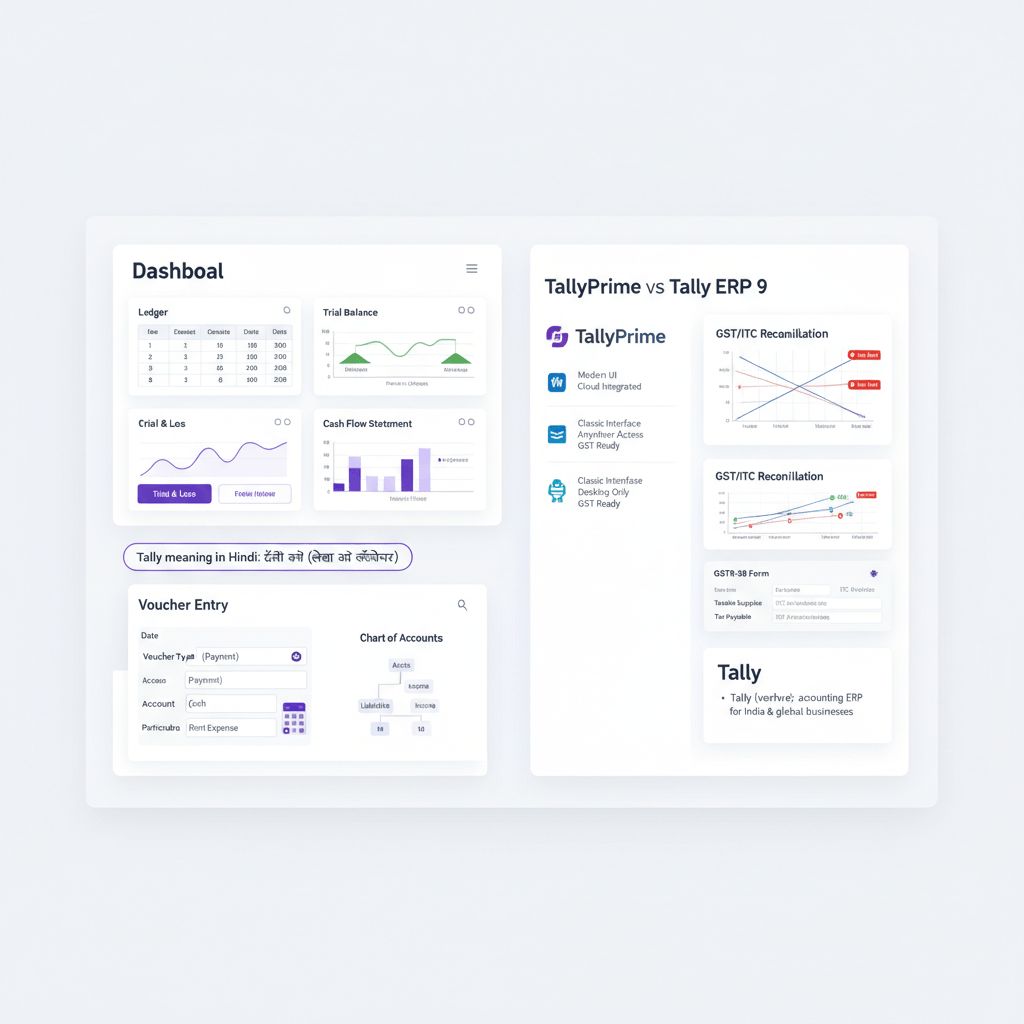
- The most common confusion is software version names. Tally Prime is not a cosmetic rename of Tally ERP 9. It introduces GoTo navigation, redesigned UI, native e-invoicing, and e-way bill workflows. ERP 9 remains functional but no longer receives feature updates.
- GSTR-2B timing creates a monthly ITC risk window. GSTR-2B is generated on the 12th of every succeeding month. ITC availability is tied to GSTR-2B reflection, if your supplier misses the cut-off, your ITC is blocked until they file.
- Wrong ITC attracts interest at 18% per annum. Availing and utilising ITC in contravention of the provisions triggers 18% annual interest, which compounds quickly if mismatches go unresolved.
- Tally handles ledgers, manual entry handles everything else. Tally posts and reports ledgers, but PDF and unstructured Excel bills, exception review, and upstream reconciliation still require manual effort without automation.
Tally meaning in accounting and in computers, the short answer
In Indian finance conversations, “tally” carries two distinct meanings, and context determines which one you need. As a verb, it means to reconcile or match, as a noun, it is the matched count or record. As software, it is a business accounting and compliance platform used by SMBs and CA firms across India.
“Do the ledger balances tally?” is a reconciliation question. “We use Tally” is a software statement. Both can be true in the same sentence.
India’s MSME sector posts millions of vouchers every month, much of it still done manually inside legacy workflows, a reality documented in the Ministry of MSME Annual Report 2022–23. That volume makes disambiguating the word “tally” useful for CFOs, CAs, and controllers training new staff.
What does “tally” mean in accounting and in Hindi?
“Tally” as a verb means to reconcile, confirming that two independent records produce the same number. In accounting, your bank balance tallies when your cash book and the bank statement agree to the last rupee. In Hindi, common equivalents are मिलान करना and हिसाब मिलाना, used daily in finance conversations from month-end reviews to audit queries.
Tally as a noun in accounting
A “tally” is the matched count or record you get after reconciliation. A stock tally is the physical count reconciled against book stock, an AP tally confirms invoices received against invoices posted. The shared root in the Latin talea, a notched counting stick used to record debts, explains the naming logic behind the software.
Tally meaning in Hindi, practical usage
Typical phrases include, “क्या आंकड़े मिल रहे हैं?” or “हिसाब मिलाओ”. Bilingual speech is standard, you will hear, “Tally nahi hua” to mean figures did not reconcile. This mix is common across finance teams in Maharashtra, Gujarat, Delhi, and Tamil Nadu.
Tally meaning in computer contexts
When someone searches for tally meaning in computer, they almost always mean the software product. Tally is a desktop-first business accounting and compliance platform built for Indian statutory requirements, handling GST, TDS, bank reconciliation, and inventory. It is not a general-purpose ERP in the SAP or Oracle sense, it is purpose-built for ledgers and compliance.
What is Tally the software and where does it fit in your finance stack?
Tally is the transaction recording and reporting backbone for most Indian SMBs. It handles masters, voucher posting, compliance preparation, and reporting. The day you standardise voucher discipline and master hygiene, Tally’s ledger engine shines.
What Tally Prime actually does
- Masters: Chart of accounts, ledgers, stock groups, stock items, cost centres, godowns.
- Vouchers: Sales, purchase, receipt, payment, journal, contra.
- Compliance: GST return preparation, e-invoicing with IRN, e-way bill, TDS tracking.
- Reporting: Balance sheet, P&L, trial balance, cash flow, GST returns, all from posted vouchers.
These functions map cleanly to Indian SMB workflows, which is why Tally remains the default ledger system.
Bank reconciliation in Tally Prime
Prime supports Excel and CSV statement import, with auto-matching rules based on amount, date, and transaction type. You configure matching criteria once, then re-use, while exceptions require manual review and posting. The module flags items reflected in the bank against entries in your cash book, and highlights gaps that need attention.
Where the bills bottleneck lives
Prime imports vouchers and masters via XML and Excel, but it does not natively extract data from PDF invoices or unstructured Excel bills. Every PDF bill requires manual field extraction before posting, which is costly at volume. If bills and statements are your bottleneck, automate ingestion upstream. AiA ingests PDFs and Excel invoices, auto-extracts fields, predicts ledger codes, and syncs clean vouchers back to Tally Prime.
Tally Prime vs Tally ERP 9, what changed and why it matters
Tally Prime is a substantive upgrade over ERP 9. It introduces redesigned UI, GoTo navigation, multi-tasking, and integrated compliance workflows.
User interface and navigation
ERP 9 was primarily keyboard-driven with layered menus. Prime adds a top menu, sidebar, and GoTo, a universal search and switch function to jump across vouchers, reports, and masters without backing out. Multi-tasking lets multiple reports or vouchers remain open simultaneously.
E-invoicing, e-way bill, and compliance workflows
Prime builds e-invoicing and e-way bill workflows into the sales voucher process. For businesses above the current threshold, this removes workarounds and reduces compliance risk. The current mandatory IRN threshold is documented in CBIC Notification No. 10/2023 – Central Tax.
Reporting and customisation
Prime improves report filtering, drill-down, export formats, and column configuration. For MIS building, copy-paste friction between Tally and Excel declines meaningfully.
What did not change
Ledger, voucher, and master architecture remain consistent. Historical data migrates from ERP 9 to Prime. Compliance logic for TDS, GST, and inventory valuation carries over. TDL customisations need re-testing.
Where Tally stops, and where you should automate next
Tally Prime is an excellent ledger engine, but it is not an ingestion engine or exception management tool. Three workflows consistently create manual load and financial exposure.
Vendor invoice ingestion
Manual extraction from PDFs adds hours before liabilities hit your books. At 300 invoices per month, teams lose dozens of hours to data entry, which distorts payables ageing and monthly MIS. Keep Tally as your ledger, move ingestion to automation that posts clean vouchers to Tally.
Bank and credit card reconciliation
Auto-matching reduces routine effort, yet exceptions pile up when you have UPI credits, card settlements, and NEFT receipts across multiple accounts. India’s UPI volume crossing 10 billion in a single month is captured in the RBI Digital Payments Scorecard, March 2024, and that scale flows straight into reconciliation queues.
GSTR-2B reconciliation and ITC exposure
GSTR-2B is generated on the 12th of every succeeding month per the GSTN Advisory on GSTR-2B — 29 August 2020. ITC availment is 100% tied to GSTR-2B reflection since CBIC Notification No. 14/2022 – Central Tax. If your supplier has not filed GSTR-1, your ITC will not appear, even with a valid tax invoice. Interest on wrongly availed and utilised ITC is 18% per annum under CGST Act, 2017 — Section 50, with verification procedures described in CBIC Circular No. 183/15/2022-GST. For practical guidance, see does not appear in GSTR-2B and cannot be availed, and consider AiA’s GSTR-2B reconciliation to tag matched, unmatched, and partial matches, propose entries, and sync back to Tally.
How to set up a clean Tally workflow today
A clean Tally workflow is about sequence, accuracy, and cadence. Get data into Tally once, correctly, then reconcile before deadlines.
Step 1, audit and clean your master data
Export ledger masters, sort by name, and merge duplicates. A vendor listed as “XYZ Pvt Ltd”, “XYZ Private Ltd”, and “XYZ Pvt. Ltd.” splits ageing and breaks matching. One afternoon of master hygiene prevents weeks of reconciliation noise.
Step 2, enforce a voucher posting standard
Set a daily cut-off, all invoices received by 5 PM are posted the same day, late postings get a narration note. Never back-date vouchers to “fix” a month, it breaks GST periods and distorts GSTR-1. If you want posting discipline with maker-checker, see voucher posting standard.
Step 3, run bank reconciliation twice a week
Import CSVs on Monday and Thursday, apply auto-matching, and clear exceptions the same day. Keeping the bank current to within 72 hours gives a reliable cash position and avoids month-end pile-ups.
Step 4, run GSTR-2B reconciliation on the 13th
Match your purchase register against GSTR-2B as soon as it publishes. Flag missing ITC, contact suppliers immediately, and adjust claims before interest accrues. If you want it done in one pass, use GSTR-2B reconciliation.
Step 5, identify what to hand to automation
Measure monthly hours for invoice ingestion, bank exceptions, and GSTR-2B matching. If ingestion exceeds 20 hours, or your 2B pass slips past the 20th, hand those to automation. Keep Tally as the ledger, move ingestion and matching upstream, and focus your team on exceptions and supplier follow-up.
Pro tip: Enable duplicate voucher warnings and run a weekly report filtered by supplier and narration to catch repeat entries before they compound.
FAQ
What is the difference between “tally” the verb and Tally the software?
“Tally” the verb means to reconcile or match, confirming two records agree. Tally the software is a business accounting platform built to record transactions, generate reports, and handle Indian compliance workflows. In practice, you might say, “we use Tally to make sure our figures tally.”
What does GSTR-2B mean, and how does it affect my ITC in Tally?
GSTR-2B is a static monthly statement generated on the 12th of every succeeding month, showing ITC available based on suppliers’ GSTR-1 filings, see the GSTN Advisory on GSTR-2B — 29 August 2020. Under the current rules, you can only avail ITC that appears in your GSTR-2B, so any purchase register entry not reflected there cannot be used to reduce GST liability in GSTR-3B. AI Accountant can fetch 2B, match your purchase register, and propose entries back to Tally.
Can I use Tally ERP 9 for e-invoicing, or do I need Tally Prime?
ERP 9 does not have native e-invoicing with IRN integrated into the sales voucher workflow, Prime does. For businesses above the current threshold, relying on ERP 9 workarounds introduces process risk. The threshold is specified in CBIC Notification No. 10/2023 – Central Tax.
What happens if I avail ITC that does not appear in GSTR-2B?
Availing and utilising ITC not reflected in GSTR-2B attracts interest at 18% per annum under CGST Act, 2017 — Section 50. Verification and dispute procedures are outlined in CBIC Circular No. 183/15/2022-GST. Practically, the fastest fix is supplier follow-up, or reversing the ITC claim until it appears in 2B.
How is Tally Prime different from Tally ERP 9 for a finance head?
The operational wins are GoTo navigation for quick switching, native e-invoicing and e-way bill inside the sales voucher flow, and better report filtering and column configuration. The ledger and voucher backbone remains consistent, so data migrates cleanly. If you already run e-invoicing, Prime’s integrated flow typically justifies the upgrade effort.
What is the current e-invoicing turnover threshold?
Aggregate turnover exceeding ₹5 crore in any preceding financial year from 2017–18 onwards, effective 1 August 2023 per CBIC Notification No. 10/2023 – Central Tax. The threshold has been lowered in stages since launch, so monitor future notifications.
My supplier has not filed GSTR-1, my ITC is blocked, what should I do?
Confirm filing status with the supplier, obtain a commitment date, and do not avail the ITC in GSTR-3B until it appears in your GSTR-2B. The 100% match requirement under CBIC Notification No. 14/2022 – Central Tax eliminates provisional claims. If the supply is genuine and tax is paid, you may rely on the verification process in CBIC Circular No. 183/15/2022-GST.
Does Tally Prime work for businesses with multiple locations or godowns?
Yes, Prime supports multi-location inventory via godowns, you track stock items per location and move items with inter-godown vouchers. For multiple GSTINs across states, maintain separate company books under one installation, then consolidate via manual merges or a third-party multi-org reporting layer. AI Accountant can centralise ingestion and reconciliation, while leaving posting and statutory reporting in Tally.

Rohan Sinha is a fintech and growth leader building aiaccountant.com, focused on simplifying accounting and compliance for Indian businesses through automation. An IIT BHU alumnus, he brings hands-on experience across 0 to 1 product building, growth, and strategy in B2B SaaS and fintech.