-01%201.svg)
Key takeaways
- Three way matching compares Purchase Order, Goods Receipt Note or Service Entry Sheet, and supplier invoice to prevent overpayment, duplicate bills, and GST errors.
- In India, correct GSTIN, HSN or SAC, place of supply, and e-invoice IRN details are crucial for accurate matching and ITC claims.
- Use 2-way matching for services, 3-way for goods and inventory, and 4-way when quality inspection is mandatory.
- Well defined tolerances for quantity, price, and tax, plus exception workflows, drive first pass match rates above 90 percent.
- Strong controls around vendor masters, duplicate detection, and maker checker approvals safeguard cash and audit readiness.
- Automation with OCR, intelligent PO or GRN linking, and ERP sync eases GSTR-2B reconciliation and speeds month end close.
- Tools like AI Accountant can auto extract invoices, validate GSTIN, link to POs or GRNs, and sync with Tally or Zoho for clean postings.
What is 3-Way Match vs 2-Way vs 4-Way
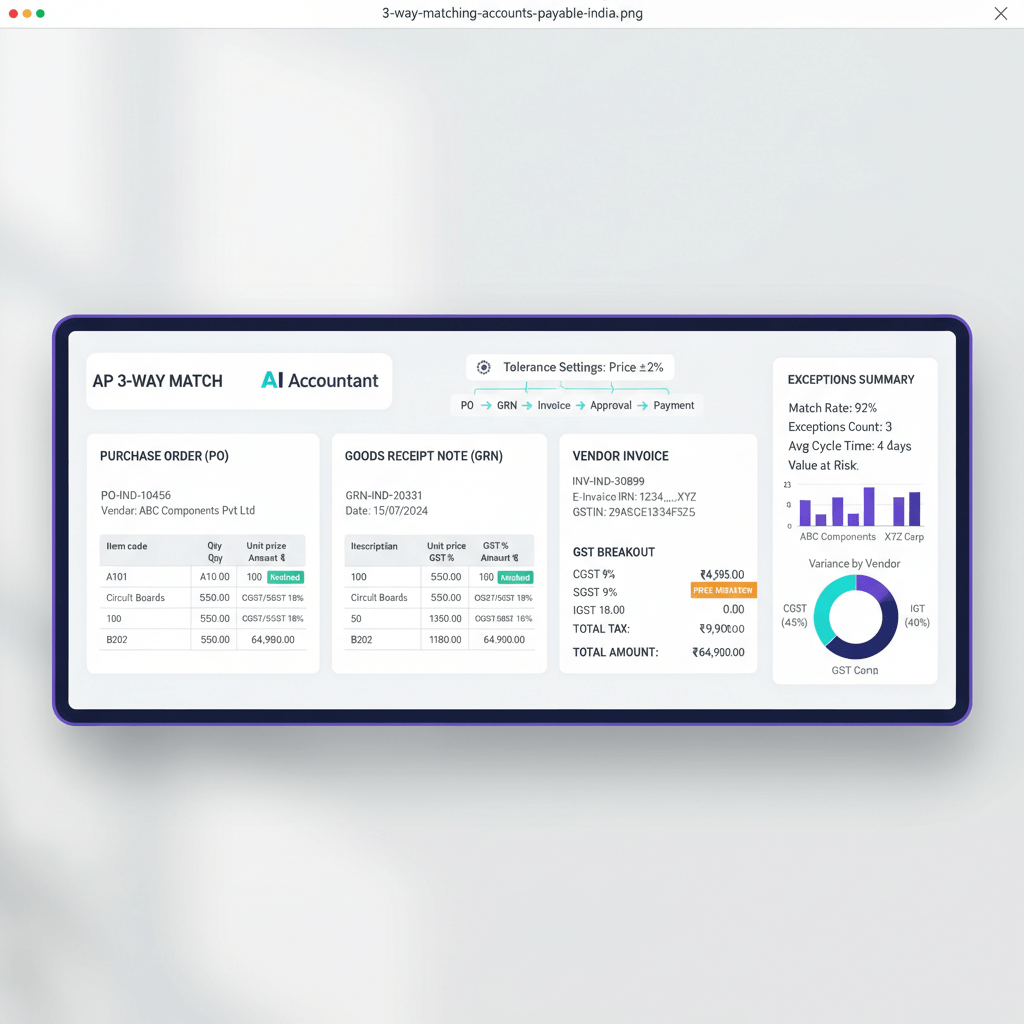
Three way match AP India compares three documents, your PO, your GRN or SES, and the supplier invoice. When they agree within defined tolerances, the invoice is approved. If not, it moves to an exception queue for investigation.
Think of it like ordering biryani online, your app order is the PO, the delivered food is the GRN, and the restaurant bill is the invoice, you would cross check all three before paying.
2-way matching compares PO and invoice, fit for services and recurring spend where there is no physical receipt document.
3-way matching adds proof of receipt, essential for goods, inventory, partial shipments, and higher risk categories.
4-way matching includes inspection or quality acceptance, used in pharma, regulated manufacturing, and any context where quality certification precedes payment.
Most Indian SMBs blend methods, 2-way for services and utilities, 3-way for goods and inventory, with 4-way for regulated or critical items.
India-Specific Components and Compliance Touchpoints
Purchase Order, PO
Your PO now anchors GST discipline. Capture legal vendor name as per GSTIN, the 15 digit GSTIN, PAN, and registered address. Add HSN or SAC, unit of measure, base price, CGST or SGST or IGST, delivery terms, and validity. Define tolerances upfront, for example 5 percent on quantity, 2 percent on price. Flag TDS or TCS, freight, and insurance as separate lines to simplify later matching.
Goods Receipt Note, GRN
Distinguish gate entry, GRN after physical verification, and quality acceptance. Record partial receipts, excess, or short supplies immediately. Reverse or return for damages, and link returns to the original GRN. Capture e way bill number and vehicle details for traceability. For services, use a Service Entry Sheet, SES, as delivery confirmation.
Supplier Invoice
For eligible vendors, e invoicing with IRN and QR is mandatory, the invoice should carry the IRN. Manage credit or debit notes that adjust the base invoice. Identify ITC eligibility during capture, especially blocked credits and RCM. Watch MSMED Act timelines for MSME registered vendors to avoid interest.
Accurate matching supports GSTR-2B reconciliation, clean matching prevents ITC reversals and notices.
PO Invoice GRN Matching India
Raise a PO with clear tolerances. On receipt, create GRN or SES. On invoice arrival, run the match across quantity, price, taxes, and terms. If within tolerance, approve for posting, if not, route to exceptions.
Simplified flow: PO created → Goods arrive at gate → GRN after verification → Invoice received → Automated match with tolerances → Match success, approve for payment → Match failure, exception queue → Investigation and resolution → Final ledger posting with GST or TDS.
Matching Logic and Tolerances to Configure
- Quantity variance, often 5 to 10 percent, with stricter limits for precision items, apply per line and on total PO value.
- Price variance, separate base price from freight or insurance, example 2 percent on base, looser for freight based on weight or distance.
- Tax variance, GST rates must match exactly, allow small rounding differences in amounts.
- Multi currency, lock an exchange rate source such as RBI reference rate or bank rate, be consistent.
- Services, use 2-way matching with SES, for non PO invoices like rent or utilities, use vendor caps and approval workflows.
- High risk buys, new vendors, imports, or high value inventory, enforce exact matching and zero tolerance.
Common Exceptions and How to Resolve
- Partial deliveries and staggered invoices, link multiple GRNs and invoices to a single PO, track cumulative quantities against the PO.
- Substituted SKUs or UOM conversions, document conversion factors, get approval, then proceed.
- Price changes post PO, require credit or debit notes, do not accept silent price changes on invoices.
- Shortage or damage, reverse GRN for affected quantities, align ITC accordingly, obtain vendor credit notes.
- Advances or prepayments, use GRNI account for timing differences, net off during final settlement.
- RCM services, vendor invoice will not carry GST, self account for GST separately in postings.
- Inter branch transfers, use stock transfer documentation, not PO GRN matching.
Controls, Audit Readiness, and Metrics
Enforce maker checker, segregate duties so PO raisers do not approve invoices. Control vendor master edits, especially bank updates, with multi level verification and callback. Use duplicate detection across vendor, invoice number, date, and amount.
Auditors expect a full trail, PO, GRN or SES, invoice, approvals, and match results available in one place.
Track these KPIs:
- First pass match rate, aim above 90 percent
- Exception rate and aging
- AP cycle time from invoice receipt to payment
- DPO trend
- ITC variance versus GSTR-2B
- Spend under PO control
If first pass match rate falls below 70 percent, investigate tolerances, master data quality, and purchasing discipline.
Implementing 3-Way Matching in Common India Stacks
Tally Prime or ERP
Enable Purchase Orders, use Receipt Notes as GRN, and Purchase vouchers for invoices. Link via references, set tolerances in configuration, and park timing differences in the GRNI ledger. Capture HSN or SAC, GST rates, place of supply, and enable TDS or TCS automation per vendor and transaction type.
Zoho Books and Inventory
Create POs in Zoho, record Item Receipts in Zoho Inventory as GRN, then create Bills. Auto matching works when links are in place, with approval workflows for variances and separate mapping for landed costs. For services without Inventory, run 2-way matching and attach SES. For basic setups, maintain GRNI manually with frequent reviews.
Where Automation Fits and What Good Looks Like
Manual matching drains hours and risks errors. An automated three way match AP India workflow uses OCR for invoice capture, validates GSTIN against vendor masters, auto links to open POs or GRNs, and routes exceptions with audit trails, then posts clean entries to Tally or Zoho.
Automation advantages:
- OCR driven capture, zero manual keying of vendor, amount, or line data
- Master mismatches flagged early, GSTIN, HSN or SAC, place of supply
- Smart PO or GRN suggestions by vendor, amount, and date patterns
- Bulk exception handling with reason codes and approvals
- ERP sync for postings, avoiding double entry
- Dashboards for payables aging, GSTR-2B status, and cash projections
Tools to consider for PO matching accounts payable:
- AI Accountant, auto extracts and validates invoices, detects GSTIN mismatches, links intelligently, syncs with Zoho or Tally, and provides payables dashboards with GST tracking
- QuickBooks, offers basic PO to invoice matching with approvals
- Xero, supports PO creation and invoice matching
- FreshBooks, simple 2-way matching for service businesses
- SAP Ariba, enterprise procurement with advanced 3-way controls
- Oracle NetSuite, end to end P2P with configurable rules
The target is above 90 percent first pass matching, letting teams focus on exceptions that need judgment.
Practical Tools and Templates
- 3-way match policy template, tolerances by category, approval matrices by variance, escalation paths, and documentation standards.
- GRN checklist, verify vendor GSTIN, capture e way bill, SKU wise quantity and condition, storage location, and QC sampling details.
- Exception reason codes, PRICE_VAR, QTY_SHORT, DAMAGED, SUB_ITEM, standardize analysis and remediation.
- Vendor onboarding checklist, GSTIN portal verification, bank verification letter, MSME certificate, signed agreement with payment terms, tax residency for international vendors.
Moving Forward with Confidence
Implementing strong 3-way matching accounts payable India controls brings cleaner GST filings, fewer overpayments, and faster closes. Start by defining rules and tolerances, document them, train teams, then layer automation for scale. The leap from spreadsheets to automated workflows pays off in weeks, not months.
Whether you are an AP manager, a CA serving multiple clients, or a founder seeking cash clarity, mastering PO, Invoice, and GRN controls will anchor a resilient payables function.
FAQ
Is three way matching compulsory for Indian entities, or only a best practice?
It is not legally compulsory, yet auditors expect it for goods and inventory. It materially improves GST compliance and control. For services, 2-way matching with SES or completion proof is sufficient, many CA firms standardize this across clients.
How should a CA configure tolerances for a manufacturing client versus a services client?
For manufacturing, set quantity variance at 5 to 10 percent by item category, price variance near 2 percent on base price, and zero tolerance on GST rates. For services, use 2-way matching with SES and monetary thresholds for approvals, for example auto approve below ₹10,000 variance with maker checker.
What is the correct approach when the invoice carries GST but the GRN shows short receipt?
Post GRN for actual receipt, request a credit note for the short quantity, and reduce ITC accordingly. Do not claim ITC on quantities not received. Tools like AI Accountant can flag this as PRICE_VAR or QTY_SHORT for workflow resolution.
How do I handle RCM services during matching and GST posting?
Match PO to invoice on base value, vendor invoice will not show GST. Self account RCM as tax on the recipient, book ITC as eligible subject to rules, and ensure your matching workflow permits tax without vendor charge. AI Accountant can template these journal entries for consistency.
Can a CA automate 3-way matching without replacing Tally or Zoho Books?
Yes, use an overlay automation tool. It reads invoices via OCR, matches against POs and GRNs, and pushes matched entries back to Tally or Zoho. AI Accountant is a common choice because it syncs vendor masters, validates GSTIN, and posts to the right ledgers.
What controls reduce duplicate invoice payments across multiple branches?
Implement duplicate detection on vendor, invoice number, date, and amount across the group, centralize vendor masters, and lock invoice series for GST vendors. An AI layer can also catch near duplicates, for example spacing or OCR variations in invoice numbers.
How do MSMED Act timelines impact the approval queue in a 3-way process?
For MSME vendors, missed timelines trigger interest. Prioritize MSME dated invoices in the exception queue, ensure SES or GRN is confirmed quickly, and route approvals with due date visibility. AI Accountant can flag MSME status and due date risk on dashboards.
What documentation should I keep to satisfy statutory and tax audits?
Maintain PO, GRN or SES, supplier invoice with IRN if applicable, e way bill reference, approvals, and exception logs with reason codes. Auditors often sample start to finish, so keep links intact and retrievable within a few clicks.
How do I treat freight and insurance in matching, especially when billed separately?
Split landed cost components from base price, allow a wider tolerance for freight due to weight or route variations, and map to separate ledgers. If billed via debit note, link it to the original PO and GRN for a complete audit trail.
When should a CA advise clients to use 4-way matching instead of 3-way?
Adopt 4-way where quality is critical, pharma ingredients, safety components, or regulated devices. Require inspection acceptance before invoice approval, with zero tolerance on quality parameters.
How can AI Accountant help with GSTR-2B reconciliation tied to 3-way matching?
AI Accountant validates GSTIN, HSN or SAC, and place of supply during capture, ensures receipt proof aligns with ITC claims, and maps vendor reported invoices to your books. The tool highlights mismatches early, reducing reversals and notices.
What first pass match rate should I target for a mature AP process, and how do I get there?
Target above 90 percent. Clean vendor masters, clear tolerances, strong PO discipline, robust GRN or SES capture, and automated matching with exception reason codes are the key steps. Regularly review exception aging to sustain performance.