-01%201.svg)
Key Takeaways
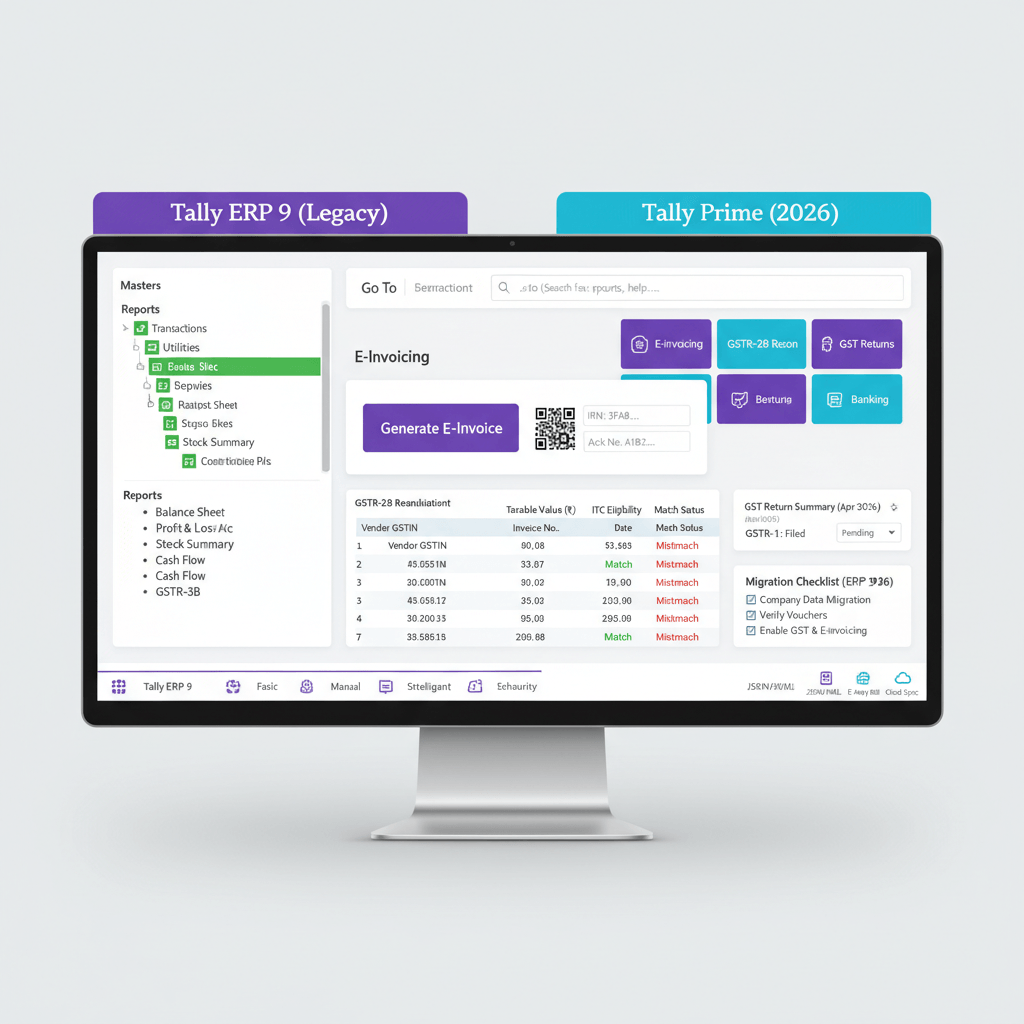
- Tally Prime is the actively developed successor to Tally ERP 9, with a redesigned interface, native e-invoicing and e-way bill integration, better GST reconciliation views, and granular user roles.
- ERP 9 lacks native IRP connectivity for e-invoices, which forces manual workflows and monthly reconciliations that increase compliance risk.
- Businesses above ₹5 crore turnover must generate e-invoices, making Prime the practical choice for compliance and operational efficiency.
- Prime accelerates navigation with the "Go To" command bar, improves multi-company switching, and strengthens auditability.
- Prime does not eliminate manual choke points like vendor PDF entry, bank statement ledger mapping, or auto-posting of 2B reconciliation adjustments without an automation layer.
Tally vs Tally Prime: The Difference, Explained
Tally Prime replaces Tally ERP 9 as the active product line, with substantive changes to navigation, compliance integration, and user management, not just a visual update.
| Feature | Tally ERP 9 | Tally Prime |
|---|---|---|
| Interface model | Menu-driven, multi-screen | "Go To" universal command bar |
| E-invoicing (IRP/IRN) | Not native, requires add-on | Native integration from Prime 2.0 |
| E-way bill generation | Partial/add-on | Native, inline with invoice |
| GSTR-1 filing | Supported | Supported with enhanced error flags |
| GSTR-2A/2B view | Limited reconciliation | Dedicated reconciliation report |
| User role management | Basic password control | Granular role-based access |
| Remote access | Tally.NET (limited) | Improved Tally.NET with web capabilities |
| Multi-company navigation | Separate sessions | Single session switching |
| Data migration from ERP 9 | N/A | Direct, same data format |
| Active development | Discontinued updates | Current, actively updated |
The most important operational rule: if your turnover is above ₹5 crore, you need e-invoicing. ERP 9 cannot do it natively.
If your invoices are generated in ERP 9, but IRNs are generated outside Tally, you inherit a permanent reconciliation task every month.
What Actually Changes In Your Month-End Close With Tally Prime?
The difference between Tally and Tally Prime in daily finance ops shows up in three concrete places: how fast your team finds reports, whether e-invoicing happens inside or outside your books, and how cleanly GST return data flows.
Navigation And Report Speed
ERP 9’s menu structure meant multiple keystrokes to reach any report. Tally Prime’s "Go To" bar lets a team member type a ledger name, voucher type, or report name and arrive in one step. For a finance team pulling the same 10 reports every month-end, this adds up. Multi-company teams benefit further, Prime lets you switch companies within a single session instead of opening separate instances.
E-Invoicing And E-Way Bill, Inside Your Books
From Tally Prime 2.0 onwards, IRN generation happens at the point of invoice creation. The IRP response (IRN, QR code, acknowledgement number) writes back to the voucher. Your invoice register and your e-invoice register stay in sync by default. In ERP 9, this required an external tool, a manual upload step, and a separate reconciliation.
E-way bill generation works the same way, triggered from the sales or delivery voucher, with transporter details captured inline. For businesses dispatching 50–200 shipments a month, removing the external portal step is a meaningful time save.
GST Return Preparation And 2A/2B Reconciliation
Tally Prime provides a dedicated GSTR-2A/2B reconciliation report. You can import your 2B JSON from the GST portal and match it against your purchase register within Prime. Mismatched invoices are flagged by supplier and invoice number. This is more structured than ERP 9’s basic 2A import, though it still requires manual intervention to resolve mismatches and post adjustments.
If vendor bill entry and 2B reconciliation at volume are your choke points, automation on top of Prime is where the time savings appear.
Should You Switch From Tally ERP 9 To Tally Prime In 2026?
The operational case for switching is now driven primarily by e-invoicing compliance and GSTR-2B discipline, not preference.
The E-Invoicing Threshold Has Reached Most SMBs
Businesses with aggregate turnover exceeding ₹5 crore in any financial year from 2017–18 must generate e-invoices for B2B, export, and SEZ supplies. Below ₹5 crore, e-invoicing is not yet mandatory, but that threshold has been lowered multiple times. Planning your stack around the current floor is risky.
Above ₹5 crore, e-invoicing is non-negotiable. ERP 9 cannot generate IRNs natively, which means every invoice travels through a workaround.
GSTR-2B Is Now The ITC Standard
Under Rule 36(4) of the CGST Rules, ITC availment is capped at what appears in GSTR-2B. If a supplier files GSTR-1 late, their invoices do not appear in your 2B for that month. You either defer the ITC or risk 18% per annum interest under Section 50 of the CGST Act if you claim it early.
Decision Criteria: Tally And Tally Prime Difference In Context
| Your Situation | Action |
|---|---|
| Turnover above ₹5 crore | Move to Prime, e-invoicing is non-negotiable |
| Turnover below ₹5 crore, stable | Prime still recommended, threshold may fall |
| Multi-user, role-based access needed | Prime, ERP 9 access controls are insufficient |
| Running audit trail requirements | Prime, better voucher-level logging |
| Single user, very low volume | ERP 9 functional, but no compliance updates |
| New implementation in 2026 | Prime, no reason to start on a legacy product |
Where Manual Work Still Burns Hours After Moving To Tally Prime
Moving to Prime is the right base decision. But it does not close the three largest manual choke points in a mid-size finance team’s month. Understanding the tally prime vs tally gap means understanding what Prime solves and what it does not.
Vendor Bill Entry From PDFs And Scans
Tally Prime does not auto-ingest vendor invoices. Every PDF or paper bill that arrives gets keyed in manually, vendor name, GSTIN, invoice number, date, line items, GST amounts. For a business processing 300–500 vendor bills a month, this is a material time cost and a source of field-level errors.
Industry estimates put per-invoice manual processing at 3–8 minutes. At 400 invoices a month, that is 20–50 hours before reconciliation begins.
Bank Statement Structuring And Ledger Mapping
Prime supports bank statement import in structured templates, but many Indian bank PDFs and proprietary Excel exports require pre-processing. Then each line needs a ledger code. Without AI-based prediction, your team assigns the ledger for every transaction.
AI-predicted ledger mapping based on your Tally chart of accounts and history posts confirmed transactions to Prime, so your team reviews exceptions, not every line.
GSTR-2B Reconciliation And Adjustment JVs
Prime’s 2B reconciliation tool shows mismatches. It does not auto-tag resolution types or auto-post adjustment journal vouchers. For 100+ vendor accounts with monthly purchase volumes, this can run to a full day’s work each month. Unresolved mismatches compound and create blocked ITC, which has a direct cash flow cost.
What To Expect On Cost, Rollout, And Training When Moving To Prime
Licensing And Cost Structure
Tally Prime is sold under annual subscription or perpetual licences. Silver is single-user, Gold is multi-user at one location. Remote access runs via Tally.NET. Pricing is adjusted periodically, confirm current rates with an authorised partner. Renewal/TSS covers compliance updates and is required for e-invoicing and GST features. Operating without active TSS effectively disables compliance updates.
Migration Steps And Timeline
| Step | Action | Typical Time |
|---|---|---|
| 1 | Install Tally Prime alongside ERP 9 | 30 minutes |
| 2 | Point Prime at existing ERP 9 data folder | 15 minutes |
| 3 | Verify data load, ledger balances, voucher count | 2–4 hours |
| 4 | Configure e-invoicing credentials | 1–2 hours |
| 5 | Set up user roles and access controls | 1–2 hours |
| 6 | Run parallel for one transaction cycle (optional) | 3–5 days |
| 7 | Go live on Prime, archive ERP 9 | Day 7–10 |
Training And Change Management
The main adjustment for ERP 9 users is unlearning menu-path habits and adopting "Go To". Most teams reach comfortable speed within 5–7 working days. Budget one day for admin/configuration, one day for walkthrough, and one week of parallel use if desired.
What Stack Works By Business Size: Tally Prime Alone Or With Automation?
The tally vs tally prime comparison settles quickly. The more useful question for a ₹1–₹100 crore business is what to run on top of Prime, based on document volumes and month-end pressure points.
By Turnover Band And Document Volume
| Turnover | Monthly Invoices | Monthly Bank Lines | Recommended Stack |
|---|---|---|---|
| ₹1–₹5 crore | 50–150 | 100–300 | Tally Prime Silver, manual workflows |
| ₹5–₹20 crore | 150–400 | 300–700 | Tally Prime Gold, AP automation |
| ₹20–₹50 crore | 400–900 | 700–1,500 | Prime, AP, bank ingestion, 2B recon |
| ₹50–₹100 crore | 900–2,000+ | 1,500–3,000+ | Prime with full automation stack |
Next Steps By Situation
- Still on ERP 9, turnover above ₹5 crore: Migrate to Prime this quarter.
- Still on ERP 9, turnover below ₹5 crore: Plan for Prime within the financial year.
- Already on Prime, close takes more than 5 days: Identify whether AP entry or 2B reconciliation is the bottleneck.
- Already on Prime, bank posting is the problem: Use AI-led bank ingestion and ledger mapping for a single-system fix.
- Multi-entity or multi-branch on Prime: Consider consolidation and cross-entity 2B views via automation.
Related Reading
- Ultimate Guide to Tally Prime Automation & Smart Extensions
- PDF to Tally Vendor Bill Automation — Complete Workflow Guide
- Tally Integration with AP Automation — Complete Setup Guide
References
- CBIC Circular No. 246/03/2025-GST
- CBIC Circular No. 238/32/2024-GST
- Income Tax Act — Penalties and Prosecutions
Frequently Asked Questions
What is the main difference between Tally and Tally Prime for GST filing?
Tally Prime includes a dedicated GSTR-2A/2B reconciliation report, native e-invoice generation with IRP connectivity, and structured GSTR-1 preparation with error flags. ERP 9 supported GST returns but lacked native IRP integration and the structured 2B reconciliation view, which increases manual work and risk.
Can I run Tally ERP 9 and Tally Prime in parallel during migration?
Yes. Install Prime alongside ERP 9 and point both to the same data folder. Since both use the same data format, you can validate Prime’s reports against ERP 9 for 1–2 weeks before fully switching.
Do I need to re-enter or convert historical data to move into Tally Prime?
No. Prime reads the same data format as ERP 9. Your ledgers, vouchers, and masters open directly in Prime. The practical work is configuration, e-invoicing credentials, roles, and TSS activation.
What happens if I generate IRNs outside Tally but book invoices in ERP 9?
You maintain two registers, the IRP acknowledgement register and your Tally voucher register, and must reconcile them monthly before GSTR-1. This creates recurring effort, and discrepancies can lead to filing errors. Prime removes this by storing IRN data in the voucher itself.
If a supplier has not filed GSTR-1, can I claim ITC for that month?
Under Rule 36(4) of the CGST Rules, ITC is limited to what appears in GSTR-2B. If an invoice is missing from 2B, you cannot claim it in that period. Claiming it early risks interest at 18% per annum under Section 50 of the CGST Act from the date of incorrect availment.
How long does GSTR-2B reconciliation take if done manually each month?
For 200–400 purchase invoices across 80–150 vendors, manual 2B reconciliation can take 6–12 hours monthly, including downloading JSON, running the Prime report, resolving mismatches, and posting JVs. Late-filing suppliers extend this timeline.
Does Tally Prime automatically import bank statements and predict ledgers?
Prime imports statements that match its template. Most Indian bank PDFs or proprietary Excel formats need pre-processing. Ledger prediction is not native. Many finance teams add an automation layer to ingest native bank formats and apply AI-based ledger mapping before posting to Prime.
Is there an announced end-of-support for Tally ERP 9?
No specific date has been announced, but new capabilities ship only on Prime. ERP 9 is effectively feature-frozen, which means any new compliance requirement will require a workaround outside the product.
What is the penalty for not issuing e-invoices when mandated?
Under Section 122 of the CGST Act, the penalty is ₹10,000 per instance or the tax evaded, whichever is higher. Practically, buyers may also reject such invoices for ITC, creating commercial disputes alongside compliance exposure.
Is Tally Prime sufficient for a ₹10 crore business, or do I need extra tools?
Prime Gold is sufficient for core accounting, GST returns, and e-invoicing. The usual gaps are AP data capture from PDFs, bank ingestion, and 2B mismatch resolution. Many businesses at this scale add an automation layer to reduce close time and error rates, for example, using an AI Accountant workflow to extract vendor bills, auto-map bank lines, and prepare adjustment JVs for review.

Rohan Sinha is a fintech and growth leader building aiaccountant.com, focused on simplifying accounting and compliance for Indian businesses through automation. An IIT BHU alumnus, he brings hands-on experience across 0 to 1 product building, growth, and strategy in B2B SaaS and fintech.