-01%201.svg)
Key takeaways
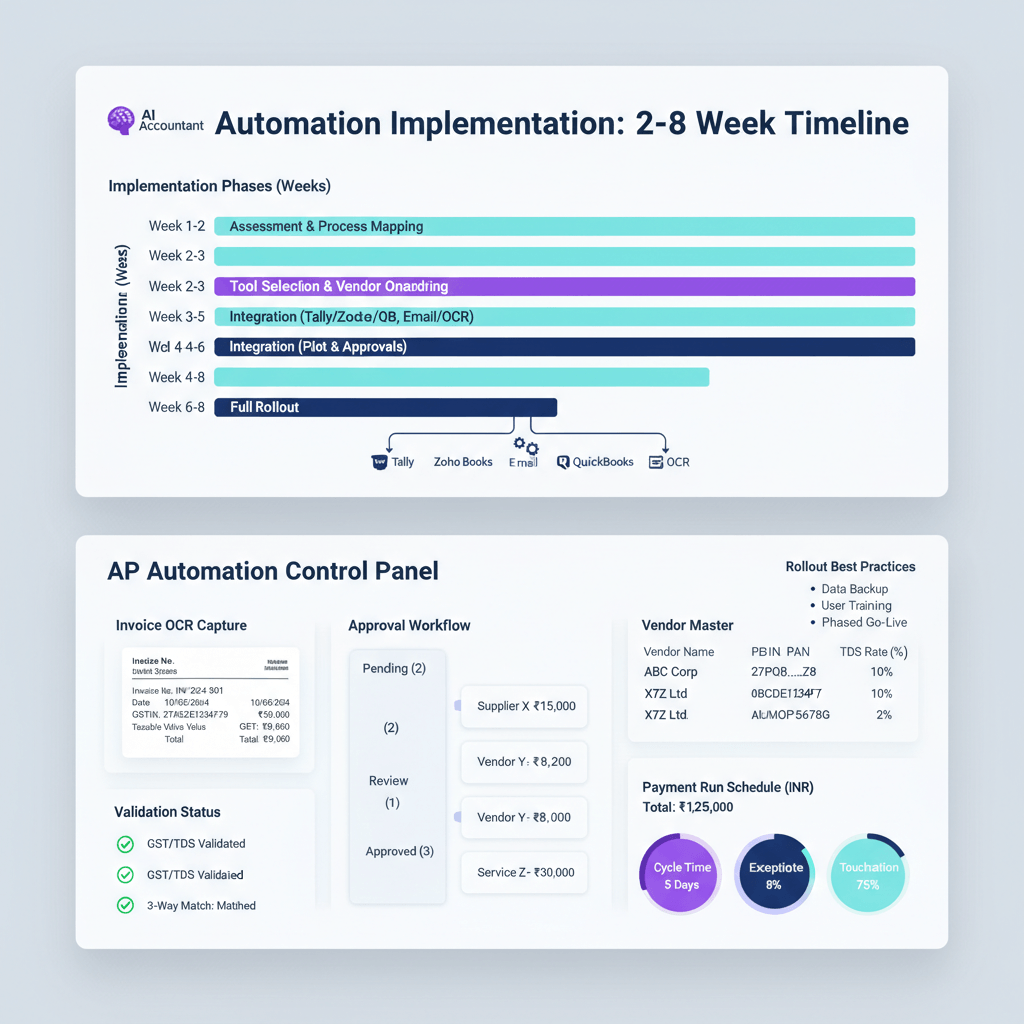
- Most Indian SMEs can implement core AP automation in 2 to 4 weeks, comprehensive setups including bank reconciliation and GST workflows complete in 4 to 6 weeks, complex multi unit setups need 6 to 8 weeks.
- Set success targets early, aim for 60 to 80 percent touchless posting, 30 to 50 percent faster month end, and over 95 percent GSTR 2B match rates.
- Prioritize India specific features, GST and TDS automation, native Tally and Zoho Books integration, multi level approvals, bank statement mapping, and vendor hygiene controls.
- Start with a narrow pilot, keep approval rules simple, and scale in waves, this accelerates learning and reduces change resistance.
- For CA firms, build a center of excellence and reusable templates, roll out in waves of 5 to 10 clients to standardize and scale efficiently.
- Track ROI with touchless rate, close time, exception rates, and cost per invoice, most teams see 70 to 80 percent cost reduction within one quarter.
How long does AP automation implementation really take in India
The implementation timeline depends on complexity, data quality, and team readiness. A single entity SME on Tally or Zoho Books usually completes core features in 2 to 4 weeks, adding bank statement mapping and GST reconciliation extends the plan to 4 to 6 weeks. Multi unit SMEs typically need 6 to 8 weeks due to inter unit transactions, consolidated reporting, and advanced approvals. CA firms piloting with 1 to 2 clients need 2 to 3 weeks, then 4 to 12 weeks to scale across 10 to 50 clients using a wave approach.
What drives the variance, mainly vendor master hygiene, chart of accounts clarity, approval complexity, and GST configuration needs. Clean vendor masters and thoughtful ledger mapping can reduce timelines by about a third. For deeper planning guidance, see how to implement AP software, accounts payable automation India guide, and AP automation guide for Indian businesses.
What good AP automation looks like in India
Set outcomes before features. Strong implementations deliver 60 to 80 percent touchless vendor bill posting, reduce month end from 10 to 15 days to 3 to 5 days, and keep vendor master errors under 1 percent. GSTR 2B match rates should exceed 95 percent, with dashboards offering real time cash position, payables aging, and category spend.
These are realistic, repeatable results when India specific workflows, GST and TDS logic, and native integrations are configured correctly.
For benchmarks and blueprints, review accounts payable automation India guide, AP automation in India, a complete AI guide, and AP automation guide for Indian businesses.
Selecting the right AP tool setup India
Your platform must handle Indian compliance, GST splits for CGST, SGST, IGST, TDS sections like 194C and 194J, HSN and SAC mapping, and MSME compliance alerts, while integrating natively with Tally and Zoho Books.
Essential AP automation tools for Indian businesses
- AI Accountant, built for Indian accounting with native Tally and Zoho Books integration, GST reconciliation, and multi org support for CA firms, with ISO 27001 and SOC 2 compliance.
- QuickBooks, popular and capable for basics, limited for complex Indian tax scenarios.
- Xero, good usability for basic AP, limited India localization.
- Zoho Books, India native with built in GST features.
- TallyPrime, robust accounting and GST, limited automation without add ons.
- FreshBooks, simple, but lacks advanced Indian tax logic.
Integration capabilities matter most, native Tally and Zoho sync guide shortens setup time by weeks, pulling masters and posting bills without manual intervention. Your tool should support PDFs, scans, Excel and CSV bulk uploads, auto GSTIN validation, bank statement ingestion with auto matching, AI driven ledger predictions and splits, and multi level approval routing. For broader comparisons, see best AP automation software in India, plus accounts payable automation India guide, how to implement AP software, and AP automation guide for Indian businesses.
Step by step implementation process
Phase 0, readiness and scope definition, days 1 to 3
Define baseline metrics, touchless rate, cycle time, cost per invoice, and error rates. Decide scope, start with bill capture, approvals, and posting before adding payments. Select a pilot entity with clean data and motivated users, limit vendor scope to 20 to 30 for test runs. Set tangible targets, for example 50 percent touchless in two weeks, and assemble a lean decision making team. For structure, reference how to implement AP software and AP automation implementation.
Tip, clarity and momentum beat exhaustive planning in week one.
Phase 1, data and systems audit, days 4 to 7
Export and cleanse vendor master data management, remove duplicates, fix GSTINs, and standardize addresses. Validate chart of accounts and tax ledgers, map approval rules, and assess unpaid bill backlogs. Test API connectivity with Tally or Zoho Books. Use these checklists alongside how to implement AP software and AP automation guide for Indian businesses.
Phase 2, AP tool setup India configuration, days 8 to 14
Connect your digital invoice processing platform, start read only, then enable posting. Sync masters, configure GST, TDS, HSN and SAC mappings, and reverse charge rules. Build simple amount based approvals, set up email ingestion and bulk upload templates, define vendor mismatch and new vendor workflows, configure bank narrative rules for NEFT, RTGS, IMPS, and finalize posting preferences and numbering. Test each element with sample data. Useful references, accounts payable automation India guide, AP automation guide for Indian businesses, and how to implement AP software.
Phase 3, migration and pilot testing, days 15 to 21
Load one to two months of history, ingest bank statements, and run end to end UAT, bills, credit or debit notes, advances, and approvals. Validate extraction on varied formats, test GST splits for intra and inter state, ensure reverse charge logic, verify posting outcomes in Tally or Zoho, and train core users with your real examples. Capture custom field needs and refine. See how to implement AP software and accounts payable automation India guide for UAT patterns.
Phase 4, go live and stabilization, days 22 to 28
Go live with new bills first, keep dual processing for high risk vendors for a week, monitor exceptions daily, and iterate extraction rules and approval thresholds. Keep brief daily stand ups and maintain a stabilization scorecard tracking volume, exception rate, and cycle time. References, how to implement AP software and AP automation guide for Indian businesses.
Celebrate early wins, visible progress sustains momentum and adoption.
Phase 5, scale and optimize, week 5 onwards
Extend to more entities with templates, add three way matching, automated GST reconciliation, a vendor portal, and integrate payments, including TDS certificates. Build management dashboards and formalize SOPs, then review monthly to push automation rate higher. See AP automation guide for Indian businesses and accounts payable automation India guide.
AP automation rollout CA firm strategies
Building your center of excellence
Create a centralized team with reusable templates, approval matrices, and tax settings, so most client setups are configure, not build. Maintain a knowledge base and troubleshoot playbooks.
Client segmentation strategy
Segment by complexity, simple clients without POs, standard with POs and multi level approvals, complex with multiple GSTINs and inter unit transactions. Start with simple clients to standardize, then progress to complex implementations as your team matures.
Wave based implementation
Roll out in waves of 5 to 10 clients, mix complexity to balance workload, run wave kickoff sessions for shared learning, and maintain a common cadence across the cohort.
Standardized assets and tools
- Excel import templates aligned to common bill structures.
- Vendor onboarding packs, GSTIN verification, master templates, and payment term agreements.
- Workflow presets for utilities, rent, and standard purchases, plus exception SOPs.
Change management approach
Batch training across clients, provide video how tos, and vendor communication templates. Offer weekly office hours for live support. For deeper tactics, see accounts payable automation India guide and AP automation implementation.
Measuring success and ROI
Key performance metrics
Track touchless rate as your north star, expect 60 to 65 percent in quarter one and 75 to 80 percent by month six. Monitor month end close time, vendor master GSTIN match rate, per invoice processing cost, and exception drivers by vendor and category.
Financial impact calculation
At 1,000 invoices monthly, automation typically saves 120 to 150 staff hours, enables early payment discounts, reduces disputes and penalties, and improves cash planning with real time visibility.
Compliance benefits
GST filings become straightforward with clean purchase registers mapped to GSTR 2B, audits are faster, and TDS thresholds and certificates are handled systematically. Explore calculators and methods in accounts payable automation India guide, AP automation in India, a complete AI guide, AP automation guide for Indian businesses, and best AP automation software in India.
Common implementation pitfalls and solutions
Data quality issues
Duplicate vendors, missing GSTINs, and inconsistent names derail matching and compliance. Run a cleanup sprint before go live, validate with GSTIN tools, merge duplicates, and establish governance for ongoing master data hygiene.
Over complex initial configurations
Excessive approval rules and edge case handling slow delivery and confuse users. Start simple with amount based approvals, then gradually add complexity after stabilization. Eighty percent automation delivers outsized value, perfection can wait.
Poor OCR results
Scans and handwritten bills reduce extraction accuracy. Offer multiple capture options, encourage native PDF emails from vendors, give Excel templates to smaller vendors, and reserve manual entry for rare cases. Keep training the engine with your formats.
Integration failures
Posting may fail due to wrong field mappings, tax ledger mismatches, or missing cost centers. Test thoroughly with samples and keep rules simple at first, then extend once posting is bulletproof.
Inadequate bank reconciliation
Skipping bank feeds kills downstream visibility. Set up early, even read only, configure narration patterns for NEFT, RTGS, and IMPS, and iterate matching rules steadily. Learn more in AP automation guide for Indian businesses, how to implement AP software, and accounts payable automation India guide.
Real world implementation examples
SME manufacturing company
A manufacturer with 3,000 monthly bills on Tally, 250 vendors, and three level approvals faced 15 day closes and GST mismatches. Week one, data cleanup and setup, week two, pilot with 30 vendors, week three, ramp to all vendors, week four, 65 percent touchless. After one quarter, month end at 5 days, 85 percent fewer GSTIN mismatches, and a 40 percent productivity gain.
CA firm managing 25 clients
A mid sized CA firm piloted with two clients in two weeks, then rolled out in waves of five through eight weeks, using templates and shared training. Exception rates fell 40 percent, month end shortened by 3 to 5 days across clients, and capacity rose by 30 percent without adding headcount. Many such rollouts have used accounts payable automation India guide patterns with AI Accountant capabilities.
Implementation checklists
Pre implementation readiness checklist
- [ ] KPIs defined with baselines documented
- [ ] Scope finalized and approved
- [ ] Budget allocated
- [ ] Project team and roles assigned
- [ ] Executive sponsor engaged
- [ ] Current process documentation completed
- [ ] Vendor masters exported and reviewed
- [ ] Chart of accounts and tax ledgers validated
- [ ] Integration credentials confirmed
- [ ] Historical samples collected for testing
- [ ] Change management plan drafted
- [ ] Success criteria agreed with stakeholders
Configuration checklist
- [ ] Tally or Zoho Books connection tested
- [ ] Vendor masters synced and validated
- [ ] Ledgers and cost centers mapped
- [ ] GST settings configured
- [ ] TDS sections and rates defined
- [ ] HSN or SAC mappings verified
- [ ] Approval workflows tested
- [ ] Email routing and bulk upload set up
- [ ] Vendor mismatch rules defined
- [ ] Bank narrative mappings created
- [ ] Posting preferences aligned
- [ ] User roles and permissions set
- [ ] Exception procedures documented
Testing checklist
- [ ] Extraction tested across formats
- [ ] Critical field accuracy verified
- [ ] GST calculations validated
- [ ] All approval paths confirmed
- [ ] Notifications working
- [ ] Posting verified in accounting system
- [ ] Document numbering intact
- [ ] Bank matching tested
- [ ] Exception workflows triggered
- [ ] User acceptance sign off obtained
- [ ] Performance benchmarks met
- [ ] Training materials updated
Go live readiness review
- [ ] Configurations frozen and documented
- [ ] User training completed
- [ ] Vendor communications sent
- [ ] Fallback procedures defined
- [ ] Support and escalation mapped
- [ ] Monitoring dashboards configured
- [ ] Daily reviews scheduled for week one
- [ ] Success metrics tracking started
- [ ] Phase two enhancements logged
CA firm wave planning checklist
- [ ] Client segmentation by complexity
- [ ] Wave schedule and assignments
- [ ] Resource allocation confirmed
- [ ] Standard templates prepared
- [ ] Kickoff materials ready
- [ ] Training schedule shared
- [ ] Office hours publicized
- [ ] Progress dashboard created
- [ ] Lessons learned cadence set
- [ ] Next wave planning in motion
Anchors for deeper dives, how to implement AP software and accounts payable automation India guide.
FAQ
How long does AP automation implementation take for a single entity SME on Tally or Zoho Books
Expect 2 to 4 weeks for bill capture, approvals, and posting, and 4 to 6 weeks if you add bank statement mapping and GST reconciliation. Clean vendor masters and simple approvals shorten the calendar. Guides like how to implement AP software provide planning templates, and tools such as AI Accountant accelerate setup with native integrations.
What is a realistic touchless processing target in quarter one
Aim for 60 to 65 percent touchless posting in the first quarter, moving to 75 to 80 percent by month six with continuous tuning. This assumes disciplined data hygiene, clear approval design, and a platform like AI Accountant that learns from corrections.
How should a CA firm plan a pilot and scale to 25 plus clients
Run a two to three week pilot with two clients, finalize templates, then roll out in waves of five to ten clients every one to two weeks. Maintain a center of excellence that owns standards and training. Many firms use the accounts payable automation India guide patterns with AI Accountant for multi client operations.
Which integrations are must have for Indian AP automation
Native Tally and Zoho Books, automated GSTIN validation and reconciliation, and bank statement ingestion with narration pattern matching are critical. Confirm bi directional master sync and posting, and test with sample transactions before go live.
How do we handle poor scan quality and handwritten bills without derailing automation
Offer multiple intake paths, prefer native PDF via email, provide Excel templates to smaller vendors, and route low volume complex cases to manual entry. Train extraction with your vendor formats, and continuously review exceptions. Tools like AI Accountant improve with feedback and allow structured uploads.
What KPIs should finance track weekly during stabilization
Touchless rate, average cycle time from receipt to posting, exception rate by reason code, GSTIN match rate, and reconciliation match percentage. Share a daily or weekly scorecard to drive rapid iteration and accountability.
How can we quantify ROI within one quarter
Baseline staff hours per invoice, error corrections, late fees, and early payment discounts. After three months, most teams see 30 to 50 percent faster close, 60 to 65 percent touchless, and 70 to 80 percent lower processing cost. Use an ROI calculation approach that includes GST reconciliation and audit readiness savings.
What GST and TDS settings are commonly misconfigured
Incorrect CGST or SGST or IGST splits on interstate transactions, missing reverse charge flags, wrong HSN or SAC mapping, and misapplied TDS sections like 194C or 194J. Validate with sample invoices across common scenarios and lock a reviewed configuration before go live. Platforms such as AI Accountant provide prebuilt India specific tax logic.
Should we automate payments in phase one or wait
Focus phase one on clean capture, approvals, and posting. Add payments after stabilization to avoid compounding variables. When ready, link approved bills to payment runs and automate payment advice and TDS certificates with an AP tool that supports Indian banking formats.
What is the best way to manage vendor master hygiene continuously
Centralize vendor onboarding, mandate GSTIN validation, standardize naming, and schedule quarterly reviews. Automate checks that flag new vendors without GSTINs or mismatches with GSTR 2B. Systems like AI Accountant include automated validations and exception workflows.
How do we approach change management for non finance approvers
Keep approval rules simple, give quick video walkthroughs, and send concise email nudges with links to approve. Track delays and refine thresholds or escalations. In early weeks, daily check ins help remove friction quickly.
What are common pitfalls when integrating with Tally or Zoho Books
Mismatched ledger or tax codes, missing cost centers, and duplicate vendors. Test with a controlled data set, verify posted entries, and confirm numbering sequences. Start with minimal mapping logic and expand after proof. Using a tool with native connectors, for example AI Accountant, reduces mapping risk.
How can we speed up bank reconciliation during implementation
Enable bank feeds early, standardize statement formats, and write narration rules for NEFT, RTGS, IMPS patterns. Begin with read only ingestion, then enable auto matching once confidence grows. Review unmatched items daily during the first week.
Moving forward with your AP automation journey
This AP automation implementation guide India lays out a practical path from pilot to scale. Start small, pick a clean entity or motivated client, and focus on bill capture, approvals, and posting. Aim for 60 to 80 percent automation quickly, keep the team empowered, and measure progress weekly. Data quality first, complexity later is the mindset that wins.
Choose a platform built for India, with robust GST and TDS logic, and native Tally or Zoho Books integration. Leverage resources like accounts payable automation India guide and consider tools such as AI Accountant to accelerate outcomes. The Indian accounting landscape rewards speed and compliance, and a focused 2 to 8 week effort now pays back for years through faster processing, stronger controls, and better cash management.