-01%201.svg)
Key takeaways
- Clean vendor master data reduces duplicate payments, GST credit rejections, and audit exceptions, delivering faster close and stronger compliance.
- Set practical standards for legal names, GSTIN, PAN, TAN, bank details, and TDS categories, then enforce them at creation and during change control.
- Deduplicate methodically using fuzzy matching, appoint a single master record, maintain audit trails, and deactivate, not delete, old entries.
- Automate validation and matching with modern tools like AI Accountant, while keeping humans in the loop for approvals.
- Leverage Zoho Books and Tally configuration to bake data quality into daily workflows, from imports to vendor portals and audit logs.
- Sustain quality with SOPs, training, and monthly KPI reviews that track completeness, accuracy, and business impact.
- Start with your top vendors by volume, clean in manageable batches, then scale with templates, APIs, and scheduled checks.
Understanding Vendor Master Data in Indian Context
Vendor master data is your single source of truth for supplier identity, tax, and payment information. In India, this record spans legal names, GSTINs across states, PAN and TAN, bank accounts with IFSC, payment terms, and vendor categorization for TDS. Each field carries operational and compliance weight, which is why precision matters.
The consequences of messy data are real. Duplicate ledgers route money to outdated bank accounts, GST reconciliation stalls when GSTINs do not match GSTR filings, TDS is misapplied when categories are wrong, and audits surface inconsistencies that should have been prevented upstream.
The bottom line: if you cannot trust the vendor master, every downstream AP process slows, and risk rises.
“Bad vendor data looks like a minor nuisance, yet it multiplies exceptions, burns month end hours, and erodes GST credit claims.”
Why Vendor Deduplication Matters for Indian AP Teams
Multiple entries for the same supplier, for example ABC Enterprises, ABC Enterprises Pvt Ltd, A.B.C. Enterprises, ABC Ent, fragment spend, raise the odds of duplicate payments, and make GST reconciliation labor intensive. Research often places duplicates between 10 and 30 percent in typical systems, which is a direct cost on working capital and finance time.
In India, compliance stakes are higher. Slight GSTIN or name mismatches can block input tax credit, incorrect TDS categories attract penalties, and split vendor records obscure total exposure during vendor risk reviews. Consolidation into a single master record restores visibility and control.
Building Your Vendor Data Cleanup Checklist
Set the gold standard first, then clean to that standard, and finally enforce it prospectively.
Naming and identity standards
- Use the legal name exactly as per GST registration, allow standard abbreviations like Pvt Ltd only when documented.
- Keep capitalization consistent, store alternate short names in a secondary field if your system supports it.
- Map multi state GSTINs to one commercial relationship, while retaining state specific tax details.
Regulatory and bank validations
Make GSTIN validation non negotiable. Verify the 15 digit format, confirm legal name on the GST portal, and cross check that the PAN embedded in the GSTIN matches the vendor’s PAN. Validate bank accounts and IFSC through penny drop where feasible, maintain approvals for any bank change, and retain change logs for audit.
Vendor classification and risk
Define categories for TDS, industry, and risk so reporting and controls are consistent. Align to Finance and Procurement policy, and document decision rules. Use explicit risk categories to drive payment terms and review cadence.
Documentation and transparency
- Publish example vendor records with correct field formats.
- Provide a pre go live validation checklist for every new vendor.
- Maintain an exception register with owners and closure dates.
Step by Step Vendor Deduplication Strategies
Identify duplicates with structured passes
- Exact GSTIN matches across different names.
- Near name matches using fuzzy logic, for example Infosys Limited versus Infosys Ltd.
- Shared bank accounts or IFSC plus last four digits of account repeated across vendors.
- Same address, phone, or email across multiple entries.
Select the master record
Pick the entry with complete KYC, the most recent transaction history, and correct GST and TDS details. Mark others inactive, not deleted, to preserve traceability and to avoid orphaned transactions.
Execute the merge safely
- Export transaction history for all candidate records.
- Repoint open POs and unpaid bills to the master vendor.
- Consolidate balances, verify aging, and rerun sample payment runs.
- Document who merged what, when, and why, then deactivate duplicates.
Work in batches, for example 50 to 100 vendors, start with the highest impact by volume, validate with test payments, then proceed.
“Deactivation beats deletion, since it preserves auditability and prevents broken links in historical ledgers.”
Implementing Vendor Management with Modern Tools
Automation reduces manual checks, enforces standards, and flags anomalies, while your team retains final approval.
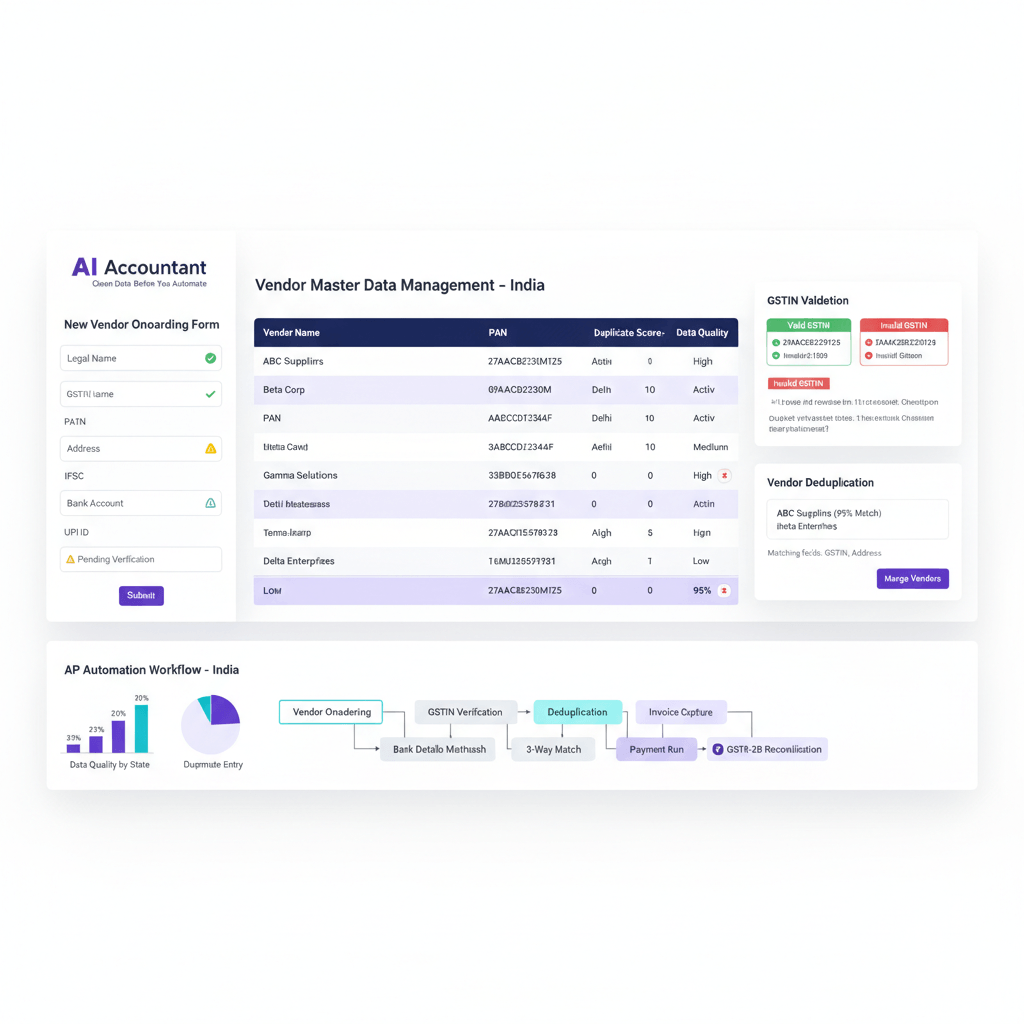
- AI Accountant detects mismatches at bill capture, validates GSTIN and legal names in real time, suggests corrections, and syncs with Zoho Books and Tally. It learns from your decisions to improve matching over time.
- QuickBooks Online supports duplicate detection and controlled merges that preserve transaction history.
- Zoho Books offers a vendor portal, reminders, and customizable fields tailored to Indian compliance.
- Xero streamlines supplier capture and coding so records stay consistent.
- FreshBooks combines vendor profiles with expense and payment scheduling.
Prioritize automated validations against government data, fuzzy duplicate detection, bulk updates, deep integrations, and immutable audit trails.
Optimizing for Zoho Books Integration
Design the data model
- Create custom fields for GSTIN, TDS category, alternate contact, and internal approval state.
- Standardize dropdown lists for categories to avoid free text drift.
Import, clean, and control changes
- Use Zoho import templates, cleanse in Excel, test small batches, then scale.
- Enable the vendor portal so suppliers update addresses and bank details, with approval workflows before changes go live.
Automate for quality at source
- Set rules to flag vendors without GSTIN, or with no activity for 12 months for review.
- Trigger alerts when bank details change, and route for dual approval.
- Connect procurement or ERP systems via API and use webhooks to validate on create.
Configuring Tally for Vendor Data Quality
Structure ledgers for clarity
- Treat vendors as Sundry Creditors with subgroups, for example raw materials, services, statutory.
- Use the ledger name for the legal name, keep short codes in the alias field.
Get GST and tax right
- Enable GST on all applicable vendor ledgers, set registration type, and default HSN or SAC where relevant.
- Ensure PAN links correctly to vendor records that drive TDS.
Import and audit with care
- Prepare Tally XML imports with mandatory fields, back up the company file, and test in a dummy company first.
- Enable audit features to track ledger edits, and review the daybook for unauthorized creations.
Creating Vendor Master Data SOPs
SOPs make quality repeatable. Document the lifecycle end to end, then train, audit, and refine.
- Onboarding workflow, requestor to approver, with mandatory KYC, and timelines.
- Pre activation checklist, legal name against GST, GSTIN format and portal validation, PAN confirmation, bank verification.
- Periodic reviews, monthly checks for new entries, quarterly duplicate scans, annual cleanup of inactive vendors.
- Exception handling for vendors without GSTIN, non residents, government departments, and individuals.
Use a clear, accessible guide. Your vendor onboarding SOP should include templates for bank change notifications, duplicate vendor deactivation, and missing information requests.
Monitoring Vendor Data Quality Metrics
Completeness
- % vendors with validated GSTIN, full addresses, verified bank details, correct TDS category, target 95 percent or higher.
Accuracy
- GSTIN validation failure rate, PAN versus GSTIN mismatches, bank verification success, duplicate count per month.
Business impact
- Payment errors from bad vendor data, hours spent on month end fixes, GST credit rejections, audit findings with rupee impact.
Process efficiency
- Average time from request to activation, % created via standard workflow, auto validation rate versus manual intervention.
Automate weekly reports, visualize red flags, and assign owners. When metrics slip, locate root causes, update SOPs, and retrain.
Future Proofing Your Vendor Management
AI and integrations are reshaping vendor management. Machine learning classifies vendors and detects duplicates, natural language processing extracts data from invoices, RPA closes routine updates, and deeper government APIs will harden real time validations for GSTIN, PAN, and TAN.
Prepare by choosing systems with open APIs, maintaining portable, clean data, and documenting business rules outside of any one tool. Coordinate across Procurement, Finance, Compliance, and Risk so vendor data becomes a shared, strategic asset.
Conclusion
Clean vendor master data is the bedrock of efficient, compliant AP. Each validated GSTIN, each merged duplicate, and each enforced SOP shortens month end, protects cash, and sharpens reporting. Start with your top vendors, clean in batches, use automation like AI Accountant for validation and matching, and keep score with clear KPIs. Improvement compounds, and the payoff arrives every close when vendor issues no longer choke the process.
FAQ
How do I design a vendor master structure that handles multi state GSTINs without fragmenting spend?
Create one commercial vendor record per legal entity, attach state level GSTINs as child entries or fields, and drive reporting at the parent vendor while maintaining state specific tax data for compliance. Tools like AI Accountant can map invoices to the correct GSTIN while preserving a unified spend view.
What is the fastest way to validate GSTIN, PAN, and legal name at scale during vendor onboarding?
Adopt a pre activation checklist that calls the GST portal for GSTIN and legal name, parse PAN from the GSTIN and cross check the vendor’s PAN, then block activation until all checks pass. AI Accountant automates this triage inside bill capture or onboarding forms, sending only exceptions to approvers.
How can I safely merge duplicate vendors in Zoho Books without breaking historical transactions?
Export all transactions for the candidate vendors, pick the most complete record as master, repoint open POs and unpaid bills, perform a controlled merge or map entries via import, then deactivate the duplicates. Run a test payment and vendor aging report to confirm integrity before proceeding to the next batch.
What deduplication rules work best for Indian vendor names that vary widely?
Combine deterministic keys, GSTIN, PAN, bank account, with fuzzy name matching on normalized names that strip punctuation and common suffixes, for example Pvt Ltd, Limited. Weight GSTIN and bank matches higher than names. AI Accountant uses such weighted models to surface high confidence duplicate candidates first.
How do I manage vendors without GST registration, for example small service providers, without creating audit risk?
Define a specific category for unregistered vendors, capture reason and supporting documents, enforce TDS settings per Income Tax rules, and require annual reconfirmation. Flag these vendors for secondary approval before first payment, and document the exception in your SOP register.
How should I verify bank accounts to prevent payment returns or fraud during changes?
Use penny drop or bank account verification APIs, require maker checker approval for bank edits, and lock payments for 24 hours after a change unless CFO approved. AI Accountant can trigger verification workflows automatically when a new bank account is detected on a bill or vendor profile.
Which KPIs should a CA track monthly to prove vendor data quality is improving?
Track % vendors with validated GSTIN, bank verification pass rate, PAN versus GSTIN mismatches, duplicate count closed, payment errors due to master data, and hours saved in month end reconciliation. Convert exceptions to rupee impact to highlight value delivered.
Can I automate vendor onboarding across Procurement and Finance while keeping strong controls?
Yes, implement a guided form with mandatory KYC, real time GSTIN and PAN checks, bank verification, and risk scoring. Route for approvals based on category and exposure, then auto create the vendor on approval. AI Accountant provides these validations and integrates with Zoho Books and Tally.
What is the recommended review cadence for keeping the vendor master clean over time?
Monthly review for new vendors and bank changes, quarterly dedup scans and dormant vendor cleanups, annual re KYC for critical suppliers, and ad hoc reviews triggered by exceptions, for example GSTIN validation failures. Automate dashboards and assign clear metric owners.
How do I prepare data for a Tally import when running a large scale cleanup?
Normalize names to the legal format, ensure GST enabled flags and registration types are correct, validate GSTIN and PAN beforehand, and populate alias with short codes. Build Tally XML with mandatory fields, back up the company, and test imports in a sandbox before posting to production.
What controls prevent duplicate vendors from reappearing after a cleanup?
Block creation unless a pre check passes GSTIN, PAN, and bank uniqueness tests, enforce standardized picklists, and require approvals for any new vendor in a category that already exists. Use AI Accountant’s real time duplicate alerts at invoice capture to catch strays early.
How can we quantify the ROI of vendor master cleanup to justify tooling and effort?
Measure recovered duplicate payments, reduced GST credit rejections, fewer audit findings, hours saved in reconciliation, and faster time to close. Attribute savings to before and after baselines, then project annualized impact. Case studies with AI Accountant often show rapid payback through reduced exceptions and cycle time.