-01%201.svg)
Key takeaways
- AP automation ROI compares measurable savings from time, errors, and discounts against the total investment, showing whether automation pays off quickly.
- Use the core formula, ROI = (Total Savings - Total Investment) / Total Investment × 100, then unpack each input with your real costs and volumes.
- Indian specifics matter, GST compliance, ITC eligibility, and GSTR reconciliation add compliance value that boosts ROI.
- Expect 70 to 80 percent time reduction per invoice, error rates near 0.5 percent, and a big jump in early payment discount capture.
- Most Indian SMEs see a payback period within 6 to 12 months, with scalability benefits as invoice volumes rise.
- Integrations with Tally and Zoho, plus automated GSTIN validation and GSTR-2B matching, are critical to realize the full return.
- Use the free ROI calculator workflow to model savings, validate a pilot, then scale across entities and high volume vendors.
- Avoid pitfalls like ignoring compliance penalties, underestimating training time, or overpromising timelines.
Understanding AP Automation ROI Basics
What is AP Automation ROI?
AP automation ROI measures the financial benefit you get from automating accounts payable compared to what you invest. In practice, it weighs how much money and time you save against software, implementation, and training costs.
ROI = (Total Savings - Total Investment) / Total Investment × 100
Savings typically include labor reduction, fewer errors and rework, higher early payment discount capture, and avoided late fees. Investments include subscriptions, setup, integrations, and upskilling your finance team.
Why ROI Calculation Matters for Indian Businesses
Indian AP teams manage GST intricacies, multi rate tax, ITC eligibility, and monthly GSTR filings, so mistakes are costly. A clear ROI model helps you quantify impact, for example, saving 20 lakhs annually on a 5 lakh investment, which makes the case compelling for stakeholders.
Key Metrics and Components for ROI Calculation
Cost Savings from AP Automation
Labor cost reduction: If a manual process takes 30 minutes per invoice at ₹500 per hour, that is ₹250 per invoice. Automation can cut this to 5 minutes, saving about ₹208 per invoice.
Error reduction savings: Manual error rates of 3 to 4 percent often drop to below 0.5 percent with automation, which reduces duplicate payments, wrong amounts, and costly corrections.
Early payment discount capture: Many vendors offer 2 to 3 percent for prompt payments. Automation surfaces and schedules these opportunities, improving capture rates. Learn more about early payment discounts.
Investment Costs to Consider
Software subscription fees: ₹10,000 to ₹50,000 monthly, based on volume and features.
Implementation and setup: Typically 2 to 4 weeks, with a sensible budget of ₹1 to 3 lakhs for integrations and migration.
Training and change management: 20 to 40 hours spread across your team, including approvers.
Ongoing maintenance: Consider annual uplifts, additional modules, and support.
Step-by-Step ROI Calculation Process
Gathering Current AP Process Data
Invoice volume and frequency: Track monthly totals and spikes, many Indian businesses see 60 percent of invoices arrive in the last week.
Processing time per invoice: Measure receipt to payment, including approvals, GST verification, and posting.
Current error rates: Quantify duplicate payments, incorrect GST treatment, and missed discounts, plus vendor queries resolved monthly.
Staff costs: Use fully loaded costs, salary, benefits, overhead, and peak period overtime.
Estimating Automation Benefits
Time savings: Commonly 70 to 80 percent faster, for example, 30 minutes becomes 6 to 9 minutes.
Accuracy improvements: Error rates move from 3 to 4 percent to below 0.5 percent, which reduces rework and disputes.
Discount capture rate: Often jumps to 80 to 90 percent versus 20 to 30 percent manually.
Scalability: Volumes can double without doubling headcount.
Calculating Payback Period
Payback Period = Initial Investment / Monthly Savings
Example, a ₹5 lakh upfront investment with ₹1 lakh monthly savings yields a 5 month payback. Most Indian teams land between 6 to 12 months, depending on volume, manual cost base, and features deployed.
Indian Market Specific Considerations
GST Compliance and ITC Benefits
Automated GSTIN verification: Instant checks reduce rejected ITC and vendor master errors.
Seamless GSTR reconciliation: Match purchase data with GSTR-2B automatically, resolve mismatches before filing.
ITC optimization: Track eligible credits accurately, claim what is due, maintain compliance.
Audit trail maintenance: A complete chain of custody per invoice simplifies audits.
Integration with Indian Accounting Software
Tally integration benefits: Eliminate manual voucher entry, push bills with correct GST treatment directly to ledgers.
Zoho Books compatibility: Automate bill creation, vendor mapping, and payment tracking across entities.
Multi entity management: Manage multiple GSTINs and inter company flows with consistent controls.
Vendor Payment Methods in India
NEFT and RTGS automation: Generate bulk bank files, save hours, reduce errors.
UPI integration: Track and reconcile small vendor payments cleanly.
Cheque management: For cheque heavy vendors, keep visibility on issuance and clearing.
Real-World ROI Examples
Small Business Case Study, 50 to 200 invoices per month
Context: A Bangalore trading firm processes 150 invoices monthly.
Before automation: Two AP staff, 30 minutes per invoice, 3 percent error rate causing ₹50,000 monthly corrections, 20 percent discount capture.
After automation: Same staff handle 300 invoices, 8 minutes per invoice, 0.5 percent error rate, 85 percent discount capture.
ROI snapshot: Monthly savings ₹45,000 labor + ₹40,000 errors + ₹25,000 discounts = ₹110,000. Investment ₹25,000 software + ₹8,000 amortized setup. Net benefit ₹77,000, annual ROI 279 percent.
Result: Faster closes, fewer disputes, stronger vendor goodwill.
Medium Business Case Study, 500 to 1,000 invoices per month
Context: A Mumbai manufacturer processes 750 invoices monthly.
Current state: Five person AP team costing ₹2.5 lakhs monthly, 40 percent time on data entry, periodic overtime, GST rec takes 3 days.
Post automation: Same team handles 1,500 invoices, no overtime, GST rec in 3 hours, more time for vendor and cash flow strategy.
Financial impact: Labor ₹1 lakh, overtime ₹30,000, error reduction ₹75,000, discounts ₹60,000 monthly. Annual savings ₹31.8 lakhs, investment ₹8 lakhs, ROI 297 percent.
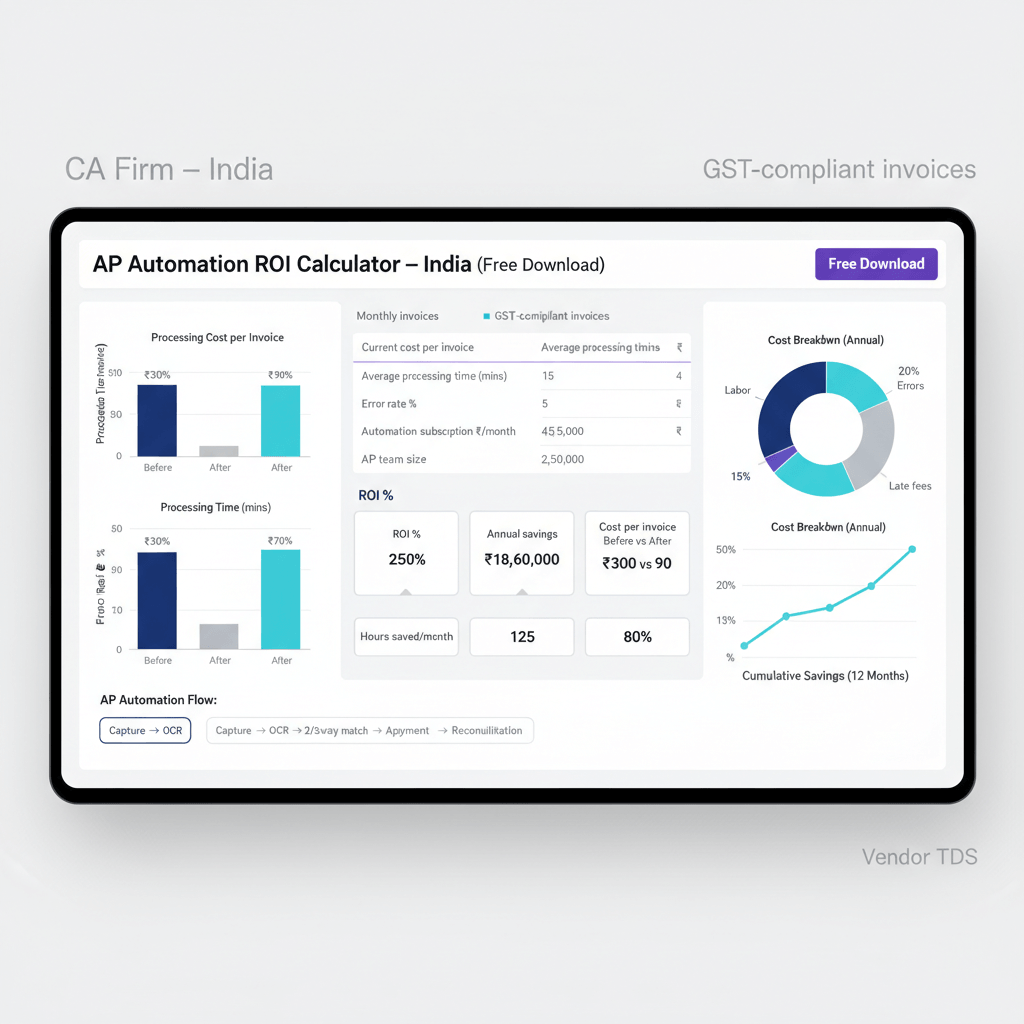
Free ROI Calculator Template
How to Use the Calculator
Step 1, input current metrics: Volume, processing time, team size, hourly cost, correction time.
Step 2, define error costs: Duplicate payments, incorrect amounts, missed discounts, dispute handling time.
Step 3, set automation targets: Use 70 percent time reduction, 80 percent error reduction, and 3x discount capture as starting points.
Step 4, enter investment costs: Subscription, implementation, training, integrations.
Step 5, review results: Monthly savings, payback period, three year ROI.
Key Input Variables Explained
Invoice volume: Include utilities, rent, PO based and service invoices, plus credit and debit notes.
Processing time: Receipt to posting, include approval and clarifications.
Labor costs: Salary, benefits, space, and equipment, add about 30 percent to base salary for accuracy.
Error rates: Track six months of duplicates, GL miscodes, GST mistakes, and missed TDS deductions.
Interpreting Your Results
Positive ROI within 12 months: Strong justification to proceed, most common with 100 plus monthly invoices.
Payback over 18 months: Consider a phased rollout or target the highest value workflows first.
Low projected savings: You may already be efficient, focus automation on compliance heavy or error prone areas.
High labor savings mix: Plan role evolution to analytics and cash optimization rather than reductions.
Best Practices for Maximizing ROI
Choosing the Right AP Automation Tools
Essential options for Indian businesses:
- AI Accountant, purpose built for India with GST reconciliation, Tally and Zoho integrations, and multi entity support, from bill capture to payment posting with minimal manual work.
- QuickBooks Online, solid basics and reporting, GST workflows may need customization.
- Zoho Books, Indian native GST, ideal for smaller teams.
- SAP Concur, enterprise grade breadth at a higher price point.
- Xero, modern automation capabilities, less optimized for Indian compliance.
Evaluation criteria:
- GSTIN validation and GSTR matching
- Direct integration with your accounting system
- Bulk processing capacity for month end spikes
- Vendor portal for self service submissions
- Mobile approvals for faster cycle times
Implementation Strategy for Maximum Returns
Phase 1, high volume vendors, weeks 1 to 2: Quick wins and confidence building.
Phase 2, complex workflows, weeks 3 to 4: Multi level approvals, special terms, TDS handling.
Phase 3, exception handling, weeks 5 to 6: Advance payments, partial deliveries, service invoices.
Phase 4, full integration, weeks 7 to 8: Accounting sync and dashboards, train all stakeholders.
Continuous Improvement and Optimization
Monthly reviews: Compare actuals to plan, tune rules.
Vendor onboarding: Educate on digital submissions, share templates.
Process refinement: Convert recurring exceptions into new automation rules.
Team development: Shift AP focus to cash management, vendor strategy, and working capital.
Common ROI Calculation Mistakes to Avoid
Overlooking Hidden Costs
Opportunity costs: Reinvest freed finance time into analytics and treasury.
Compliance penalties: Account for avoided late filings and ITC reversals.
Vendor relationship costs: On time, accurate payments improve terms and pricing.
System maintenance: Budget for updates and incremental training.
Underestimating Soft Benefits
Employee satisfaction: Less repetitive work reduces attrition, replacing experienced AP talent is expensive.
Improved decision making: Real time dashboards sharpen cash positioning and spend control.
Scalability value: Grow volumes without linear headcount increases.
Audit readiness: Complete trails cut audit cycle time and cost.
Unrealistic Timeline Expectations
Implementation period: Plan 6 to 8 weeks for setup, integrations, and training.
Learning curve: Allow 2 to 3 months for the team to fully adapt.
Process stabilization: Expect 3 to 6 months for tuning and steady state.
Full benefit realization: Maximum ROI typically appears after 12 months.
Conclusion and Next Steps
Making the Business Case
Use your numbers to present savings, payback, and long term value. Emphasize role evolution, not reduction, and highlight risk mitigation through stronger compliance and fraud controls. Faster cycles and better vendor relationships create a competitive edge.
Taking Action on Your ROI Analysis
If the ROI is strong, shortlist vendors, run demos against your pain points, and start a pilot. If marginal, phase the rollout and attack high value areas first. If negative, standardize processes and revisit as volumes grow.
AP automation transforms finance from data entry to strategic value, delivering measurable returns while improving team experience and compliance confidence. Start with the calculator mindset, then execute a focused pilot that proves value fast.
FAQ
How do I compute AP automation ROI for a GST registered SME using Tally?
List your monthly invoices, average handling minutes, and fully loaded hourly cost, then quantify current error costs and missed discounts. Model time cut by 70 to 80 percent, error rate near 0.5 percent, and improved discount capture, subtract the subscription and implementation spend. Many Tally users adopting AI Accountant see payback within 6 to 10 months.
What inputs should a CA collect before advising clients on AP automation ROI?
Gather invoice volume by month, processing minutes per invoice, current approval delays, duplicate or incorrect payment counts, discount opportunities offered versus captured, overtime costs, and GST reconciliation effort. With these, you can create a baseline and an automated future state model, for example with AI Accountant benchmarks.
How do I treat implementation fees in ROI and payback calculations?
Include one time setup, integrations, and training as the initial investment. For payback, divide that upfront amount by your net monthly savings. For multi year ROI, amortize the setup over 12 to 36 months to reflect useful life.
What is a reasonable invoice processing cost per invoice benchmark in India?
Manual costs often range from ₹150 to ₹300 per invoice depending on complexity and salaries. With automation, many firms land between ₹30 and ₹80 per invoice, especially when using tools like AI Accountant that embed GST validations.
How should I value error reduction and duplicate payment avoidance?
Use the last six months of corrections, vendor disputes, and recovered duplicates to find an average monthly cost. Apply projected error rate reduction, for example from 3 percent to 0.5 percent, to estimate monthly savings. Include both direct cash and staff time saved.
How do early payment discounts affect ROI for Indian vendors?
If suppliers offer 2 to 3 percent for early payment, increasing capture from 20 percent to 85 percent materially lifts savings. Automation schedules approvals and payments to land within discount windows. AI Accountant frequently lifts capture rates above 80 percent in India focused workflows.
How do I factor GST compliance benefits, like ITC accuracy, into ROI?
Quantify avoided ITC reversals, interest, and penalties, plus time saved in GSTR-2B reconciliation. Assign a monthly rupee value to past issues, then project reductions with automated GSTIN checks and reconciliation. This compliance value is a real, often overlooked ROI driver.
What payback period should I target before recommending a rollout to management?
For most Indian SMEs, a 6 to 12 month payback is a practical target. If your model shows more than 18 months, try phasing by high volume vendors or exceptions first to accelerate returns, then scale post pilot.
How do I account for multi entity or multi GSTIN complexity in ROI?
Model separate volumes, approval paths, and bank workflows per entity, then sum the savings. Choose software that supports multi entity rules and consolidated dashboards. AI Accountant handles multi entity GST and inter company flows with shared controls, which helps maintain ROI at scale.
What is the best way to validate my ROI assumptions before a full deployment?
Run a 4 to 8 week pilot with your top vendors by volume, measure baseline versus automated cycle time, error rates, and discount capture, and verify accounting sync accuracy in Tally or Zoho. Use pilot data to refine your ROI model and investment case.
How should a CA communicate soft benefits like audit readiness in an ROI memo?
Translate soft gains into time and fee reductions, for example, fewer audit sampling hours, faster evidence retrieval, and lower advisory time on reconciliations. Note that AI Accountant maintains end to end audit trails, which compresses audit cycles and can reduce external fees.
Can AP automation reduce working capital needs and how do I show that in ROI?
Yes, shorter cycles, higher discount capture, and better payment scheduling improve cash predictability. Illustrate by modeling a 3 to 5 day reduction in average AP cycle, the value of discounts earned, and reduced emergency funding or overdraft usage.
What KPIs should I track post go live to ensure ROI is realized?
Track cost per invoice, cycle time receipt to posting, error rate, discount capture rate, touchless rate, exception rate, and GST mismatch resolution time. Review monthly, and tune rules and vendor onboarding to keep KPIs trending in the right direction.