-01%201.svg)
Key Takeaways
- Online accounting services deliver bookkeeping, GST filings, TDS compliance, ITR, payroll, and ROC returns remotely via cloud tools and a dedicated CA team, no office visit required
- Cost for Indian small businesses typically ranges from ₹3,000 to ₹15,000 per month, depending on transaction volume and compliance scope
- India's GST framework alone generates 5 or more compliance events every month, GSTR-1, GSTR-3B, GSTR-2B reconciliation, e-invoicing, and ITC matching, making remote, tech-enabled delivery the practical default for most SMEs
- TDS must be deposited by the 7th of every following month (except March TDS, which is due by 30 April); quarterly returns are due 31 July, 31 October, 31 January, and 31 May
- Tally Prime, QuickBooks, and Busy are among the most widely used accounting platforms for Indian SMEs; platforms with direct GSTN integration automate return preparation and eliminate manual data entry errors
- A legitimate online accounting provider must have a qualified CA (ICAI member) overseeing statutory filings, not just bookkeepers running spreadsheets
- Key evaluation criteria: CA oversight, data encryption, written SLA on turnaround time, and a transparent scope document with no hidden per-event add-ons
- A Pvt Ltd company with GST registration, five employees, and normal vendor payments has roughly 20 to 25 compliance touchpoints per year before counting notices, amendments, or audits
Introduction
Online accounting services are the delivery of bookkeeping, tax compliance, payroll, and financial reporting by a remote CA-led team using cloud software, with no physical office visit required on either side.
For Indian founders and business operators, the problem they solve is specific: running a company in India means managing monthly GST filings, TDS deposits, advance tax instalments, annual ITR, ROC filings, and payroll statutory contributions. Every one of these has a due date. Every due date has a penalty attached. Managing all of it with an in-house accountant costs ₹25,000 to ₹60,000 per month in salary alone in a metro city, before PF, ESI, software licences, and training.
Online accounting services give you CA-level oversight at a fraction of that cost. A Bengaluru SaaS founder who registered a Pvt Ltd company last year, a Mumbai D2C brand crossing ₹1 crore in turnover, a Delhi consulting firm with five employees and a growing vendor list, these are the businesses that benefit most.
This guide covers everything: what the service actually includes, what it costs, how the process works, which software runs underneath it, and how to choose a provider who will not leave you exposed to a GST notice you knew nothing about.
What Online Accounting Services Actually Are
Online accounting services are not a different type of accounting. The work is identical to what a local CA firm does. What changes is how it is delivered, remotely, via cloud platforms, shared document portals, and video or chat communication, rather than in a physical office.
It is worth distinguishing this from three things readers frequently confuse it with.
An in-house accountant is a salaried employee, on-site, typically costing ₹25,000 to ₹60,000 per month in a metro city. You get one person's skill set. If your TDS computation is wrong, there is no second set of eyes catching it before the return is filed.
A local CA firm operates from a physical office. The relationship is often reactive, you call when something breaks, they respond when they have capacity. Technology use is variable. Availability during filing season is not guaranteed.
DIY accounting software used alone, without a CA team behind it, is infrastructure, not a service. The software captures transactions, but it does not file returns proactively, does not flag a GSTR-2B mismatch before a Section 61 scrutiny notice arrives, and does not advise you when your turnover crosses the tax audit threshold.
Online accounting services are the combination of all three layers: cloud software for data capture, a qualified CA for statutory oversight, and proactive compliance management so nothing falls through.
The terms virtual accounting services and remote accounting services mean exactly the same thing. The terminology varies by provider, the delivery model is identical.
In India, this model has grown sharply since 2020. The GSTN now processes over 1.3 crore returns per month. That compliance load made remote, tech-enabled delivery not just convenient but necessary for most SMEs who cannot staff a full finance function in-house.
One statutory note that matters for evaluating any provider: the Chartered Accountant credential in India is governed by the Institute of Chartered Accountants of India (ICAI), established under the Chartered Accountants Act, 1949. Any service that signs tax audit reports, appears before the Income Tax Department, or certifies financial statements must have a CA on record, not just a bookkeeper with accounting software access.
What Is Included In Online Accounting Services
Bookkeeping And Financial Reporting
Monthly bank reconciliation, accounts payable and receivable tracking, P&L statement, balance sheet, and cash flow statement. For companies, financial statements must be prepared under Schedule III of the Companies Act 2013, online providers handle that formatting as part of the standard deliverable.
GST Compliance
- GSTR-1 (outward supply details): Due 11th of the following month for taxpayers with turnover above ₹5 crore; due 13th of the month after the quarter for QRMP scheme filers (turnover up to ₹5 crore)
- GSTR-3B (monthly summary): Due 20th of the following month for large taxpayers; 22nd or 24th for small taxpayers depending on state category
- GSTR-9 (annual return): Due 31 December following the financial year
- GSTR-2B reconciliation: Auto-populated by GSTN by the 14th of each month; mismatches must be resolved before ITC claims are made, unresolved mismatches attract scrutiny under Section 61 of the CGST Act
GST registration thresholds for reference: ₹40 lakh aggregate turnover (goods), ₹20 lakh (services), ₹10 lakh for special category states.
TDS Compliance
- TDS deposit: 7th of the following month for all months; March TDS deposited by 30 April
- Quarterly returns: Form 24Q (salaries), 26Q (non-salary payments to residents), 27Q (payments to non-residents), 27EQ (TCS)
- Q1 (April to June): due 31 July
- Q2 (July to September): due 31 October
- Q3 (October to December): due 31 January
- Q4 (January to March): due 31 May
- TDS certificates: Form 16 (salary TDS, due 15 June), Form 16A (non-salary TDS, due 15 days after the return due date)
- Late filing penalty under Section 234E: ₹200 per day per day of delay, capped at the TDS amount
Income Tax And ITR
- ITR due 31 July for non-audit cases; 31 October for companies and audit cases; 30 November for transfer pricing cases
- Advance tax: Four instalments, 15 June (15%), 15 September (45%), 15 December (75%), 15 March (100%)
- Penalty for non-filing under Section 234F: ₹5,000; reduced to ₹1,000 if total income does not exceed ₹5 lakh
ROC And Company Compliance
- AOC-4 (financial statements): Due 30 days from AGM date
- MGT-7 or MGT-7A (annual return, MGT-7A for small companies): Due 60 days from AGM date
- AGM must be held within six months of the financial year end, by 30 September for FY April to March companies
- Late filing penalty: ₹100 per day per form under the Companies Act 2013, with no upper cap specified, this compounds quickly if ignored
Payroll And Labour Compliance
- PF: 12% employee contribution plus 12% employer contribution; deposit by 15th of the following month
- ESI: Applicable for employees earning up to ₹21,000 per month; 0.75% employee contribution plus 3.25% employer contribution; deposit by 15th of the following month
- Professional Tax: State-specific (Maharashtra levies up to ₹200 per month per employee)
How Much Do Online Accounting Services Cost In India
Pricing is structured around three variables: transaction volume per month, compliance scope, and entity type.
| Business Profile | Monthly Transactions | Typical Scope | Indicative Cost Per Month |
|---|---|---|---|
| Freelancer or solo proprietor | Under 50 | Bookkeeping + GST | ₹2,500 to ₹5,000 |
| Startup or small Pvt Ltd | 50 to 200 | Bookkeeping + GST + TDS + payroll | ₹5,000 to ₹12,000 |
| Growing SME | 200 to 500 | Full compliance + MIS reporting | ₹12,000 to ₹25,000 |
| Mid-size company | 500 and above | Full compliance + audit support + MIS | ₹25,000 to ₹60,000 |
Compare that to the in-house alternative. A junior accountant in Delhi or Mumbai earns ₹25,000 to ₹35,000 per month in salary alone. Add PF, ESI, office space, software licences, and training, and the real cost clears ₹40,000 to ₹50,000 per month, for a single person with a limited skill set and no CA oversight.
What drives the cost up: multiple GSTIN registrations, TDS across many vendor categories, international transactions requiring Form 15CA and 15CB, high transaction counts, and multiple bank accounts.
What to watch for in quotes: many providers advertise a base price that excludes GST registration amendments, notice responses, ITR filing, and ROC filings. Ask upfront: “Is ITR filing included? Are ROC filings included? What happens if I receive a GST notice, is that billed separately?” Get the answers in writing.
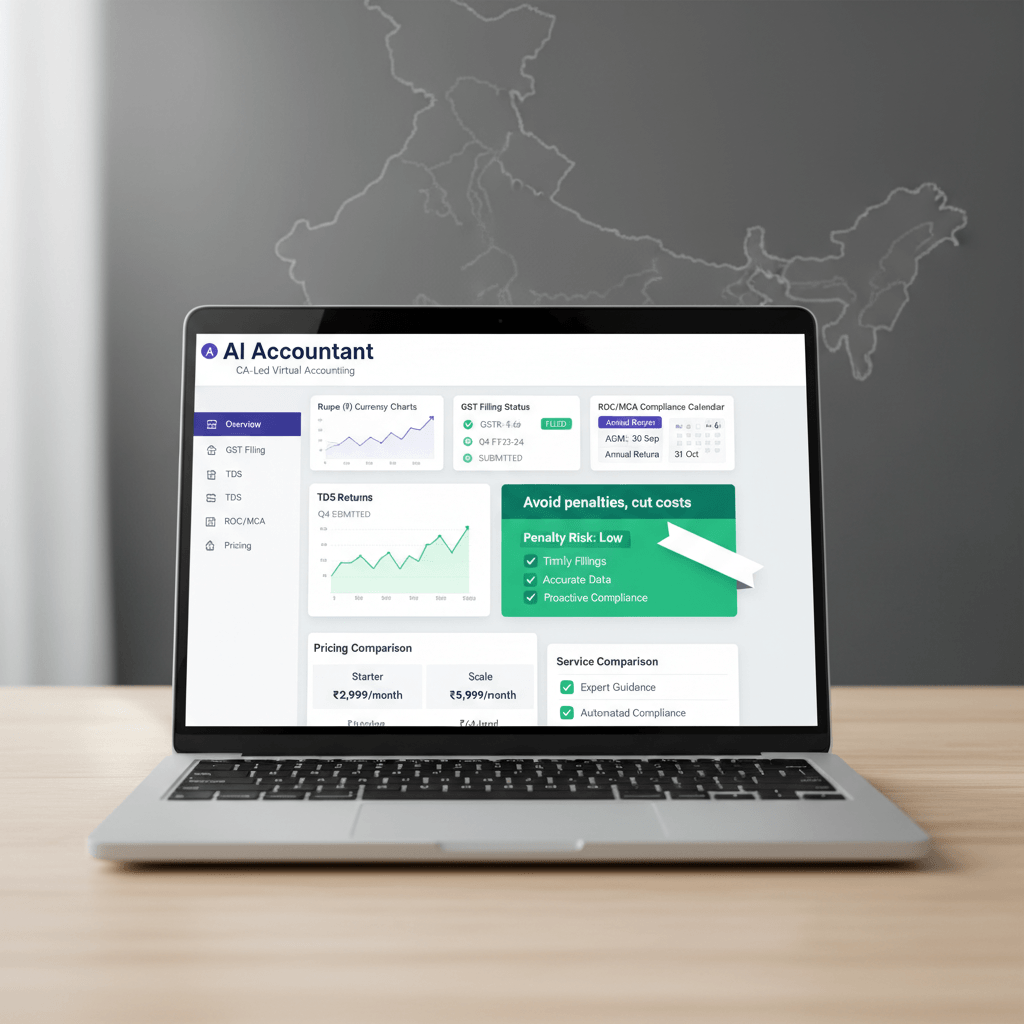
For context, Virtual Accounting by AI Accountant starts at ₹4,000 per month for up to 200 transactions, with the next tier at ₹6,000 per month above that, covering bookkeeping, GST, TDS, payroll, and ROC compliance under a dedicated CA team.
The question to ask any provider: “Is notice handling included, and do I have independent access to my accounting data if I decide to switch?”
How The Process Works: From Onboarding To Monthly Delivery
What You Provide At Onboarding
- PAN card, GST registration certificate, Certificate of Incorporation, MOA and AOA (for companies)
- Bank statements for the last three to twelve months depending on engagement scope
- Prior years' ITR and financial statements
- Existing accounting data (Tally data file or Excel records)
- Vendor and customer master list for TDS applicability mapping
How Documents Move Each Month
Most providers accept documents via email, Google Drive, Dropbox, or a dedicated client portal. WhatsApp is common in practice but not recommended for sensitive financial data, ask your provider explicitly which mechanism they use and whether it is encrypted.
The Monthly Operating Rhythm
- You share bank statements, sales invoices, and expense receipts by a cut-off date, typically the 3rd to 5th of the month
- The accounting team reconciles, categorises, and books entries
- GSTR-2B auto-populates by the 14th; the team reconciles it against your purchase register
- GSTR-1 is filed by the 11th; GSTR-3B is filed by the 20th
- TDS is computed, the challan (ITNS 281) is generated, and deposit is confirmed by the 7th
- MIS reports, P&L, cash flow summary, are delivered, typically by the 15th to 20th of the month
Portal Access And Credentials
You should always own your GST portal login, Income Tax portal login, and MCA21 login. The provider operates via authorised signatory or sub-user access, never hand over your primary login credentials to any third party. If a provider asks for your primary login, that is a red flag.
Communication standards worth confirming before you sign: dedicated CA contact versus a ticket system, SLA on query response time, 48 hours is a reasonable standard, same-day for urgent GST or TDS matters, and quarterly review calls for financial context.
The Compliance Calendar Online Accounting Services Manage For You
This is the section that explains why so many founders outsource: the deadlines are relentless, the penalties are automatic, and missing one creates a cascade.
Monthly Deadlines
| Date | Obligation |
|---|---|
| 7th | TDS deposit for previous month |
| 11th | GSTR-1 (monthly filers, turnover above ₹5 crore) |
| 15th | PF deposit, ESI deposit; advance tax, in designated months |
| 20th / 22nd / 24th | GSTR-3B (based on taxpayer category and state) |
Quarterly Deadlines
- TDS returns (24Q, 26Q, 27Q, 27EQ): 31 July, 31 October, 31 January, 31 May
- GSTR-1 for QRMP scheme: 13th of the month after each quarter end
- Advance tax instalments: 15 June, 15 September, 15 December, 15 March
Annual Deadlines
- 31 July: ITR for non-audit individuals and businesses
- 31 October: ITR for companies and audit cases
- 31 December: GSTR-9 annual return
- 30 September: AGM for FY April to March companies
- 30 days post-AGM: AOC-4 financial statements filed with ROC
- 60 days post-AGM: MGT-7 annual return filed with ROC
Penalty Summary
| Obligation | Penalty |
|---|---|
| GST late filing | ₹50 per day (₹25 CGST + ₹25 SGST); ₹20 per day for nil returns |
| TDS late deposit | Interest at 1.5% per month under Section 201(1A) |
| TDS late filing | ₹200 per day under Section 234E |
| ITR late filing | ₹5,000 under Section 234F (₹1,000 if income does not exceed ₹5 lakh) |
| ROC late filing | ₹100 per day per form; no cap, compounds significantly |
A Pvt Ltd company with one GST registration, five employees, and routine vendor payments has roughly 20 to 25 compliance touchpoints per year before counting notices, amendments, or audit queries. That number scales fast with business complexity.
Cloud Accounting Software Used In Online Accounting Services
Cloud accounting services run on a technology layer underneath the CA team. Understanding what software your provider uses matters for one reason: if you leave, you need your own books in a format you can access independently.
Tally Prime is the market leader in India, used by approximately two million businesses. It supports GST returns, TDS, and payroll. It is desktop-based by architecture, but TallyPrime 4.0 and above offers remote access via Tally on Cloud hosting. Perpetual single-user licence is approximately ₹22,500. Preferred by larger SMEs and CA firms managing multiple clients.
QuickBooks is used by some providers for MIS and reporting layers. India-specific compliance features are less deep compared to Tally, but the reporting interface is clean and accessible to non-accountants.
Busy Accounting is strong in manufacturing and trading sectors, handles multi-location inventory plus GST well, and is popular in Tier 2 and Tier 3 cities.
On e-invoicing: the IRN mandate under the GSTN is now applicable to all B2B invoices for businesses with aggregate turnover above ₹5 crore. Any platform or provider handling your invoicing must be e-invoicing compliant if you are above this threshold.
Modern online platforms also automate direct GSTN submission and provide real-time deadline alerts, which significantly reduces the risk of late filing.
The question you must ask any provider: “Do I have independent access to the software my books are kept in?” If the answer is no, data portability becomes a problem the day you decide to switch.
Who Benefits Most From Online Accounting Services
Startups And Early-Stage Companies
A Pvt Ltd registration triggers immediate ROC, GST, and TDS obligations, even if the company has zero revenue. Hiring a full-time CA or senior accountant at this stage is a cost most early-stage companies cannot justify. Online accounting for small business is the dominant use case here, and the cost-to-coverage ratio is clearest at this stage.
Solopreneurs And Proprietors
Once turnover crosses ₹20 lakh, services, or ₹40 lakh, goods, GST registration becomes mandatory. ITR is mandatory once gross receipts exceed the basic exemption limit. Managing these obligations while running the business solo is the problem online services were built to solve.
SMEs Scaling From ₹1 Crore To ₹25 Crore
This is when compliance complexity multiplies fast. TDS applicability expands across more vendor categories. Tax audit becomes mandatory once turnover crosses ₹1 crore for businesses or ₹50 lakh for professionals under Section 44AB, revised to ₹3 crore if cash receipts are below 5% of total receipts. Multi-state GST registrations become common. A part-time bookkeeper is no longer adequate, full CA oversight is needed but a full-time finance hire is still difficult to justify.
Bootstrapped Founders
No budget for a ₹50,000 per month finance hire. Online CA services provide the same statutory oversight at a fraction of the cost, with the flexibility to scale the scope as the business grows.
Companies With Distributed Or Remote Operations
No single city office to anchor a local CA relationship. Remote delivery is structurally the right model, and remote accounting services India-based providers are equipped for exactly this: NRI-founded businesses, Indian subsidiaries of foreign companies, and Indian arms of global businesses that need India-specific compliance expertise without a physical presence.
Who it is NOT ideal for: listed companies, businesses with complex daily physical inventory requiring on-site supervision, or entities processing above 500 transactions per day who need a full in-house finance function.
How To Choose An Online Accounting Services Provider In India
Non-Negotiable: CA Oversight
Only a Chartered Accountant, ICAI member, can sign tax audit reports, Form 3CD, statutory audit reports, and appear before the Income Tax Department as an authorised representative under Section 288 of the Income Tax Act.
Ask directly: “Is a qualified CA responsible for my filings, or does a bookkeeper handle the work and a CA signs off without reviewing it?” These are different things.
Verify ICAI membership at icai.org, the public member search is free and takes thirty seconds.
Data Security
- Is your data stored on Indian servers or abroad? This matters for RBI-regulated entities.
- Is data encrypted in transit and at rest? Look for TLS or SSL encryption and reputable cloud infrastructure.
- Is access controlled by individual logins, or do multiple staff share one credential?
- The Digital Personal Data Protection Act, 2023 applies to accounting data containing employee PII. Your provider is a data fiduciary with obligations under Indian law.
Modern platforms maintain tamper-proof audit trails that log all transactions user-wise with accurate date and time stamps, which supports both internal governance and regulatory audits.
SLA Clarity
Get these in writing before you sign:
- Monthly MIS delivery date, should be a specific date, not “within the month”
- Query response time, 48 hours standard; same-day for urgent matters
- Notice handling: GST notices, income tax scrutiny notices under Section 143(2), and demand orders, is this included or billed separately?
Red Flags
- No named CA on the engagement
- Quoted price excludes ITR, ROC filings, or notice responses
- No written scope of work document
- Cannot share a sample MIS report before you sign
Green Flags
- Proactive compliance calendar shared at onboarding, with WhatsApp and email deadline reminders
- Uses software you can access independently
- Explicit scope document listing inclusions and exclusions
- References from businesses at a comparable stage and entity type
Risks And Limitations Of Online Accounting Services
Quality Risk
India has a large market of “accountants” who are not CAs. There is no statutory oversight of their work, no professional liability, and no recourse through a professional body. Bookkeeping can legally be done by non-CAs. Signing tax audit reports, statutory audit reports, and Form 15CB cannot. Before you engage any provider, confirm: who is the CA on record, and what is their ICAI membership number?
Communication Lag Risk
The async nature of remote delivery means a document you forget to share by the 5th of the month can cascade into a missed GSTR-1 deadline by the 11th. The operational rhythm only works if both sides respect the agreed cut-off dates. This is a shared responsibility, not just the provider's.
Scope Exclusion Disputes
Many providers quote low for a “basic” scope and charge per-event for GST registration amendments, MSME registration, FEMA compliance for foreign transactions, transfer pricing reports, or Section 12A and 80G filings for NGOs. Before you sign, get a written list of what is explicitly excluded, not just what is included.
Software Lock-In
If the provider owns the Tally or accounting software subscription and you exit the engagement, data export can become contentious. Your books belong to you. Clarify before signing that you can export your full accounting data in a machine-readable format, CSV, Excel, or the native software format, at any time and on exit.
Regulatory Liability
Outsourcing accounting does not transfer legal liability. A GST demand raised on incorrect HSN code classification falls on your company, not on the CA, unless negligence is provable in a professional capacity. Understanding this is critical when hiring any online accountant India-based or otherwise. You remain the responsible taxpayer. The provider is your agent and advisor.
If something goes wrong with a GST filing, the appeal path is: GST Officer → Adjudicating Authority → Appellate Authority → GST Appellate Tribunal, GSTAT, → High Court. For income tax disputes: Commissioner of Income Tax, Appeals, → ITAT → High Court. A good online accounting provider guides you through notice responses and is available through this process, confirm whether notice handling is in scope before you sign.
Ready to move from managing compliance manually to having a CA team handle it end to end? Virtual Accounting by AI Accountant covers bookkeeping, GST, TDS, ITR, payroll, and ROC compliance from ₹4,000 per month, with a dedicated CA team and a real-time dashboard. Explore the service here.
FAQ
What Is The Difference Between Online Accounting Services And Hiring A Local CA?
A local CA operates from a physical office and typically manages compliance reactively. Online accounting services deliver the same CA-level oversight remotely using cloud platforms, with a structured monthly rhythm, proactive compliance tracking, and clearer SLAs, usually at a lower total cost than maintaining an in-house or ad hoc arrangement.
Can An Online Accounting Provider File My GST Returns On My Behalf?
Yes. The provider operates via sub-user or authorised signatory access on the GST portal while you retain your primary login credentials. They can prepare and file GSTR-1, GSTR-3B, and GSTR-9, and perform GSTR-2B reconciliation to protect your ITC.
Is My Financial Data Safe With An Online Accounting Provider?
It depends on the provider’s controls. Ask if data is encrypted in transit and at rest, where it is hosted, how access is managed, and whether audit trails are maintained. Under the DPDP Act, 2023, providers handling employee or customer PII must meet legal obligations, so insist on written confirmation of their controls and backup policy.
What Happens If I Receive A GST Or Income Tax Notice?
First, do not ignore it. Share the notice, draft a response with supporting schedules, and file within the stipulated time. Many providers bill notice handling separately, so confirm scope upfront. If you prefer an end-to-end managed approach, Virtual Accounting by AI Accountant offers structured notice support, including reconciliation, draft replies, and representation guidance when applicable.
Do I Need To Switch Accounting Software To Use Online Accounting Services?
Not necessarily. Competent providers work with Tally, QuickBooks, or Busy based on your needs. What matters most is data portability and your independent access, ensure your contract explicitly states that you can export a complete data set, including ledgers, vouchers, and masters, at any time.
How Long Does Onboarding Take?
Two to four weeks is typical. You provide registration documents, prior ITR and financials, bank statements, existing books, and master lists. Parallel filing can begin within the first month if documentation is complete and portal access is granted promptly.
What Credentials Should The CA Overseeing My Account Hold?
An active ICAI membership is essential. Only a CA can sign tax audit reports, statutory audit reports, and appear as an authorised representative under Section 288. Ask for the ICAI membership number and verify it via the public search on icai.org.
What Is The Minimum Business Size For Online Accounting Services To Make Sense?
Even sole proprietors benefit once GST registration or TDS obligations start. The cost of a single missed deadline, late fee, or interest charge can exceed a month of service fees, so the ROI often appears at very small scale, and grows with complexity.
Are ROC Filings (AOC-4 And MGT-7) Included In Standard Online Accounting Packages?
It varies. Some bundle ROC filings, others list them separately. Since late fees are ₹100 per day per form with no cap, confirm in writing whether drafting, e-filing, and follow-ups are included, and who signs as the professional certifier.
Can Online Accounting Services Handle Payroll For A Growing Team?
Yes. A complete scope covers monthly payroll processing, TDS on salaries under Form 24Q, PF and ESI computation and deposits by the 15th, and state-specific Professional Tax. For a turnkey approach that integrates payroll with GST and TDS compliance, Virtual Accounting by AI Accountant provides unified processing and statutory filings under CA oversight.