-01%201.svg)
Key Takeaways
- QuickBooks India was permanently discontinued on 31 January 2023, the global version does not support Indian GST, e-invoicing, or GSTR-2B workflows.
- For Indian SMBs, TallyPrime remains the practical, compliant system of record for GST, e-invoicing, e-way bills, and MCA audit trail.
- ITC errors discovered late, because of weak 2B reconciliation, attract 18% per annum interest and potential penalties, creating real cash-flow risk.
- Migrating off Tally mid-year breaks the MCA-mandated edit log continuity, creating audit exposure without compliance upside.
- Stay on Tally for statutory compliance, automate inputs like AP bills, bank postings, and GSTR-2B reconciliation to remove manual work.
QuickBooks vs Tally: The Short Answer
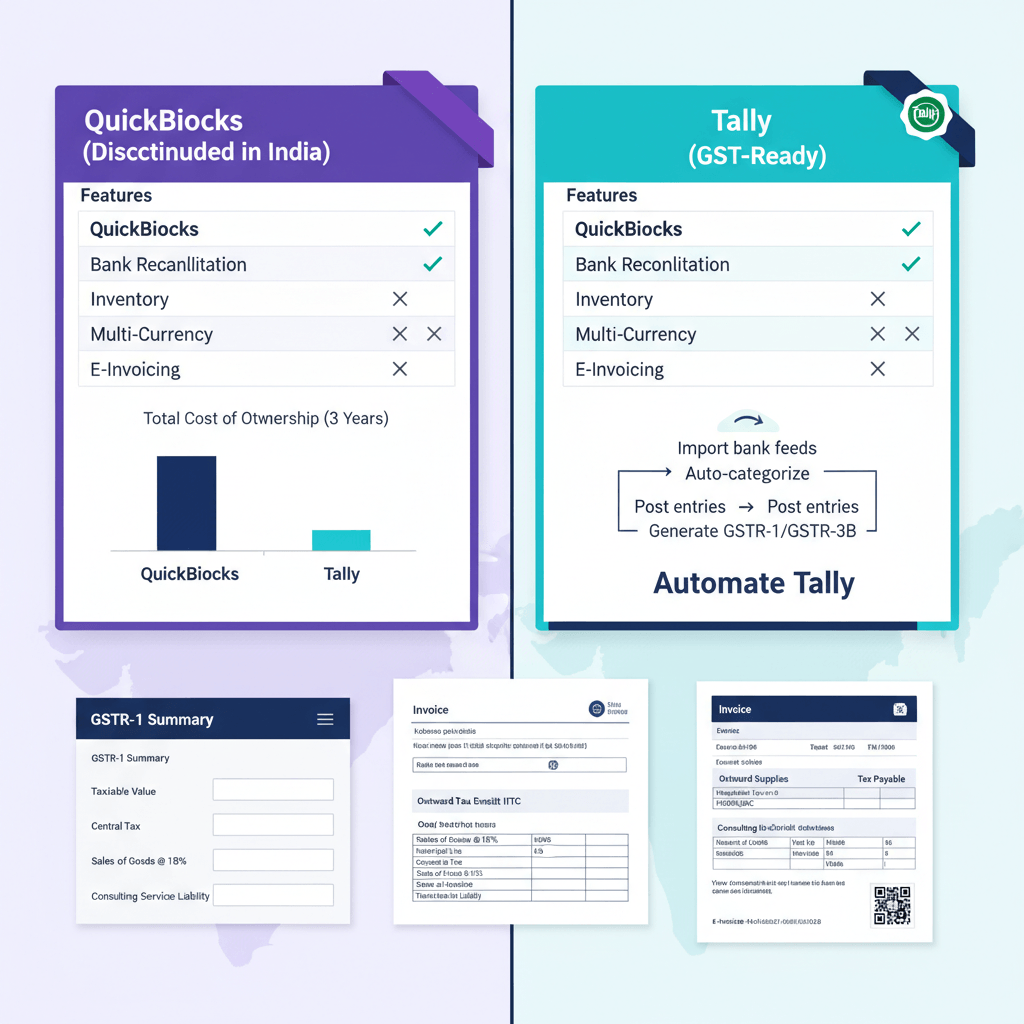
For Indian SMBs, TallyPrime is the only viable choice between these two for GST-compliant books. QuickBooks is not available in India and does not support Indian GST natively in its global version. The real question is not which software to pick, it is how to remove the manual grind from your existing Tally workflows.
| Criterion | TallyPrime | QuickBooks Online (Global) |
|---|---|---|
| Available in India | Yes | No, discontinued 31 Jan 2023 |
| Native GST, HSN, SAC | Yes | No |
| GSTR-1 and GSTR-3B | Yes, native | No |
| GSTR-2B reconciliation | Yes | No |
| E-invoicing, IRN | Yes | No |
| E-way bill | Yes | No |
| MCA audit trail compliance | Yes | Not applicable |
| Bank statement import | CSV, Excel, MT940 | No coverage for Indian banks |
| Pricing, multi-user | One-time licence, low TSS renewal | High monthly subscription, no India GST |
| India support ecosystem | Large partner network | None |
The most common mistake is treating QuickBooks’ global cloud interface as an advantage. A sleek interface means little if the tax engine behind it does not recognise Indian GST.
QuickBooks vs Tally: Which Fits Indian SMB Finance Today?
QuickBooks India is gone, not just deprecated
New subscriptions for QuickBooks India ended on 1 July 2022, and all existing accounts were closed on 31 January 2023. The global product does not include Indian GST rates, HSN or SAC codes, GSTR-1 or 3B reporting, GSTR-2B reconciliation, e-invoicing, or IRN generation. This is a product architecture limitation, not a configuration gap, and no workaround restores India GST compliance in the global product.
Tally’s India-specific readiness
TallyPrime generates GSTR-1 and GSTR-3B directly from transactions, reconciles GSTR-2A and GSTR-2B against your purchase register, generates e-invoices and IRNs through IRP connectivity, and manages e-way bills in the same interface. Bank statements import from CSV, Excel, and MT940, then reconcile quickly. These are native capabilities.
MCA audit trail is a compliance non-negotiable
The Companies (Accounts) Amendment Rules, 2021, require an edit log that records every change, and this audit trail cannot be disabled. TallyPrime meets this requirement, helping preserve audit evidence across the financial year.
Compliance lens: If your accounting system cannot reconcile to GSTR-2B and cannot log every edit, you are not just slower, you are exposed. Interest at 18% per annum, plus penalties, compounds quickly when ITC mistakes sit undetected.
Feature-by-Feature: The Differences That Matter for GST Books and Close
E-invoicing: Tally is production-ready, QuickBooks has no India mode
| Threshold | Effective Date | CBIC Notification |
|---|---|---|
| ₹500 crore | 1 October 2020 | No. 61/2020 – Central Tax |
| ₹100 crore | 1 January 2021 | No. 88/2020 – Central Tax |
| ₹50 crore | 1 April 2021 | No. 05/2021 – Central Tax |
| ₹20 crore | 1 April 2022 | No. 01/2022 – Central Tax |
| ₹10 crore | 1 October 2022 | No. 17/2022 – Central Tax |
| ₹5 crore | 1 August 2023 | No. 10/2023 – Central Tax |
If your aggregate turnover is ₹5 crore or more, you must generate IRNs when you raise invoices. TallyPrime handles this natively via IRP integration. QuickBooks has no India e-invoicing capability.
GSTR-2B reconciliation and ITC: where gaps cost real money
Section 16(2)(aa) of the CGST Act, 2017, links ITC eligibility to whether your supplier’s invoice appears in your GSTR-2B. If the software cannot reconcile your purchase register against 2B, mismatches surface late and you carry interest at 18% per annum until reversal. TallyPrime provides native reconciliation, and you can further accelerate with GSTR-2B reconciliation tools that post reversal entries back into Tally with correct ledgers.
For upstream automation, streamline AP and banking inputs without changing systems. Use AP and bills processing for extraction, matching, and posting, and automate statement ingestion with bank and credit card bookkeeping automation. You retain the Tally audit trail, you lose the keystrokes.
Inventory, banking, and audit trail
- TallyPrime supports multi-location inventory, batches, reorder levels, and BOM for manufacturing.
- Bank reconciliation via CSV, Excel, and MT940 import, with auto-matching and exceptions.
- QuickBooks global lacks India bank feeds and is not tuned to Indian manufacturing complexity.
Total Cost and Migration Risk: Licences, Training, Downtime, and Audit History
Direct cost: Tally vs QuickBooks for a 10-user team over 24 months
TallyPrime Gold is a one-time licence with modest annual renewal, delivering native GST, e-invoicing, and 2B reconciliation. QuickBooks Online Advanced charges high monthly subscription fees in USD while lacking India GST. The difference over two years is structural, not marginal.
Migration risk: what breaks in transit
Moving off Tally mid-year creates a break in your MCA-mandated edit log. Your auditor must stitch evidence from two systems for one financial year, which is avoidable risk. Data remapping errors during migration can distort GST returns, then trigger interest and penalties.
Best practice: If you must migrate, do it at the financial year start, complete ledger mapping, validate opening balances, and reconcile the first GST period end-to-end before go-live.
What QuickBooks gave departing Indian customers
Exports were provided in CSV, Excel, and PDF. TallyPrime can import masters and transactions from Excel or XML, so a one-time move from QuickBooks to Tally is feasible. The reverse move gains nothing for Indian compliance, and loses core GST functionality.
Where Tally Feels Slow, and How to Fix It Without Switching
Before and after: AP and bills
Before: Manual keying of vendor, invoice number, taxable amounts, GST split, and TDS codes increases error risk, which then distorts returns.
After: Ingest bills via vendor bill automation, extract fields, detect vendor master mismatches, and post directly to Tally. Your team reviews exceptions, not every line.
Before and after: bank and card postings
Before: Hundreds of monthly transactions keyed voucher by voucher, recon drifts to quarter-end.
After: Use bookkeeping automation to ingest statements, predict ledgers from history, approve in bulk, and sync to Tally. Bank recon closes in hours.
Before and after: GSTR-2B vs purchase register
Before: Manual Excel matching of JSON or Excel 2B files to Tally exports, reversals get delayed, interest accrues.
After: Automated 2B reconciliation tags matches and mismatches, proposes JVs and credit or debit notes, and posts back to Tally. ITC reversals happen in the same month.
Before and after: MIS and month-end close
Before: Exports and stitching in Excel delay management visibility by weeks.
After: With inputs automated, Tally books stay current, so MIS lands days after close, not weeks.
Decide in 5 Minutes: Stay on Tally and Automate, or Move to QuickBooks?
The decision checklist
| Condition | Stay on Tally + Automate | Consider another platform |
|---|---|---|
| India GST compliance required | Yes | — |
| E-invoicing threshold met | Yes | — |
| GSTR-2B reconciliation needed | Yes | — |
| MCA audit trail required | Yes | — |
| Multi-entity India operations | Yes | — |
| No Indian GST for a foreign subsidiary | — | Evaluate global platforms for that entity |
| Team already Tally-trained | Yes | — |
| Manual AP and bank entry is the pain | Automate on Tally | — |
| 2B reconciliation is slow | Automate on Tally | — |
| Want QuickBooks for Indian GST | — | Not viable, no India product |
Two worked examples
Example 1, stay on Tally and automate: A Pune manufacturer, ₹18 crore turnover, 150 purchase invoices and 300 bank transactions per month. Pain: bill entry and 2B reconciliation consume a week. Fix: automate AP, statements, and 2B matching. Result: same-day bill posting, 2B closes in under a day, no migration, no retraining, no audit trail gap.
Example 2, when to add a global platform: A new foreign subsidiary with no Indian GST needs multi-currency and global payroll integrations. Run a global platform there, keep the India entity on Tally. Parallel systems by geography preserve compliance and fit.
The rule
There is no RBI, MCA, or CBIC mandate to leave a current TallyPrime installation. It is updated for GST amendments, e-invoicing thresholds, and MCA audit trail requirements. Leave only for a genuine, proven operational need that Tally cannot satisfy, not for perceived modernity.
References
- CBIC Notification No. 10/2023 – Central Tax — E-invoicing threshold reduction to ₹5 crore, effective 1 August 2023
- India Code – CGST Act, 2017, Section 16(2)(aa) — ITC eligibility linked to GSTR-2B
- India Code – CGST Act, 2017, Section 50(1) — 18% interest on wrongful ITC availment
- India Code – CGST Act, 2017, Sections 73 and 74 — Penalties for incorrect ITC claims
- MCA Companies (Accounts) Amendment Rules, 2021 — Audit trail, edit log requirement
- CBIC Circular No. 238/32/2024-GST — Clarification on ITC eligibility and GSTR-2B linkage
Related Reading
- Alternative To Tally: Keep It, Fix It, Or Replace It
- 2A vs 2B GST: Which One Controls Your ITC Each Month
- PDF to Tally Vendor Bill Automation — Complete Workflow Guide
Frequently Asked Questions
Is QuickBooks available in India in 2025?
No. Intuit discontinued QuickBooks in India, closed all accounts on 31 January 2023, and the global product does not support Indian GST, HSN or SAC, GSTR-1 or 3B filing, GSTR-2B reconciliation, e-invoicing, or IRN generation. Using the global product for GST books would force you to manage statutory tax outside the software.
What is the most material difference between QuickBooks and Tally for Indian GST?
TallyPrime is built for Indian GST, it handles GSTR-1 and 3B, e-invoicing and IRNs, e-way bills, and GSTR-2B reconciliation natively. QuickBooks India has been discontinued, and the global product lacks these India-specific workflows, so it cannot be your compliant system of record.
How does Section 16(2)(aa) affect my ITC process and software choice?
Section 16(2)(aa) ties ITC eligibility to invoices appearing in your GSTR-2B. If your software cannot automatically reconcile your purchase register to 2B, mismatches will be caught late, and you will incur interest at 18% per annum under Section 50(1) until reversal. Choose software and automation that make 2B reconciliation continuous and auditable.
Can I automate GSTR-2B reconciliation and bill posting without leaving Tally?
Yes. Keep Tally as the ledger of record, then add automation on top. For example, use GSTR-2B reconciliation automation for matching and posting ITC reversals, and AP automation to ingest and post supplier bills. This keeps the Tally audit trail intact while eliminating manual steps.
What happens to my audit trail if I migrate off Tally mid-year?
The Companies (Accounts) Amendment Rules, 2021, require a non-disableable edit log. A mid-year migration creates two systems for one year, which complicates evidence and risks an audit qualification. If migration is unavoidable, schedule for year start, complete full ledger mapping, verify opening balances, and reconcile the first GST period end-to-end before cutover.
Does TallyPrime Silver include GST, e-invoicing, and 2B reconciliation?
Yes. Silver is single-user but feature-complete for GST, including GSTR-1 and 3B, 2B reconciliation, e-invoicing via IRP, and e-way bills. Gold adds concurrent access for teams, not GST features.
How should an India-first SMB think about QuickBooks for multi-entity operations?
Keep Indian entities on Tally for GST, e-invoicing, and MCA audit trail. If you have a foreign subsidiary with no Indian GST, consider a global platform there. Run systems in parallel by geography, not a one-size-fits-all switch that harms India compliance.
What are the penalties for missing e-invoices when mandated?
Invoices are invalid under GST if e-invoicing is mandatory and not done, the buyer cannot claim ITC, and the supplier faces penalties under Section 122 of the CGST Act of ₹10,000 per invoice or the tax amount, whichever is higher. Threshold is currently ₹5 crore aggregate turnover from 1 August 2023, per CBIC Notification No. 10/2023 – Central Tax.
Can QuickBooks global be configured to handle India GST with add-ons?
No. The global product lacks the native tax structures, return formats, and e-invoicing rails for India. Piecemeal add-ons still leave you outside core statutory workflows, which increases risk and manual work. For India GST, TallyPrime remains the compliant path.
What is a practical way to cut Tally data-entry time by half this quarter?
Automate the three highest-volume inputs: bills, statements, and 2B matching. Use bill automation to extract and post AP, statement automation for bank and card postings with AI-ledger predictions, and 2B reconciliation to close ITC exceptions in the same month. This preserves Tally as your system of record while removing the manual grind.

Rohan Sinha is a fintech and growth leader building aiaccountant.com, focused on simplifying accounting and compliance for Indian businesses through automation. An IIT BHU alumnus, he brings hands-on experience across 0 to 1 product building, growth, and strategy in B2B SaaS and fintech.