-01%201.svg)
Key Takeaways
- Tally Prime and Zoho Books both cover Indian GST end to end, the choice is about workflow architecture, not compliance coverage.
- Switching platforms does not fix ITC leakage, only a disciplined, early GSTR-2B reconciliation and vendor follow-ups do.
- E-invoices without IRN above the ₹5 crore threshold are invalid tax invoices, penalties apply per instance alongside buyer ITC risk.
- The 180-day ITC reversal rule creates cash flow exposure, neither platform automates this by default, your AP ageing must.
- Total cost of ownership includes users, infrastructure, audit trail compliance, and CA access patterns, not just license fees.
Tally vs Zoho Books: The short answer
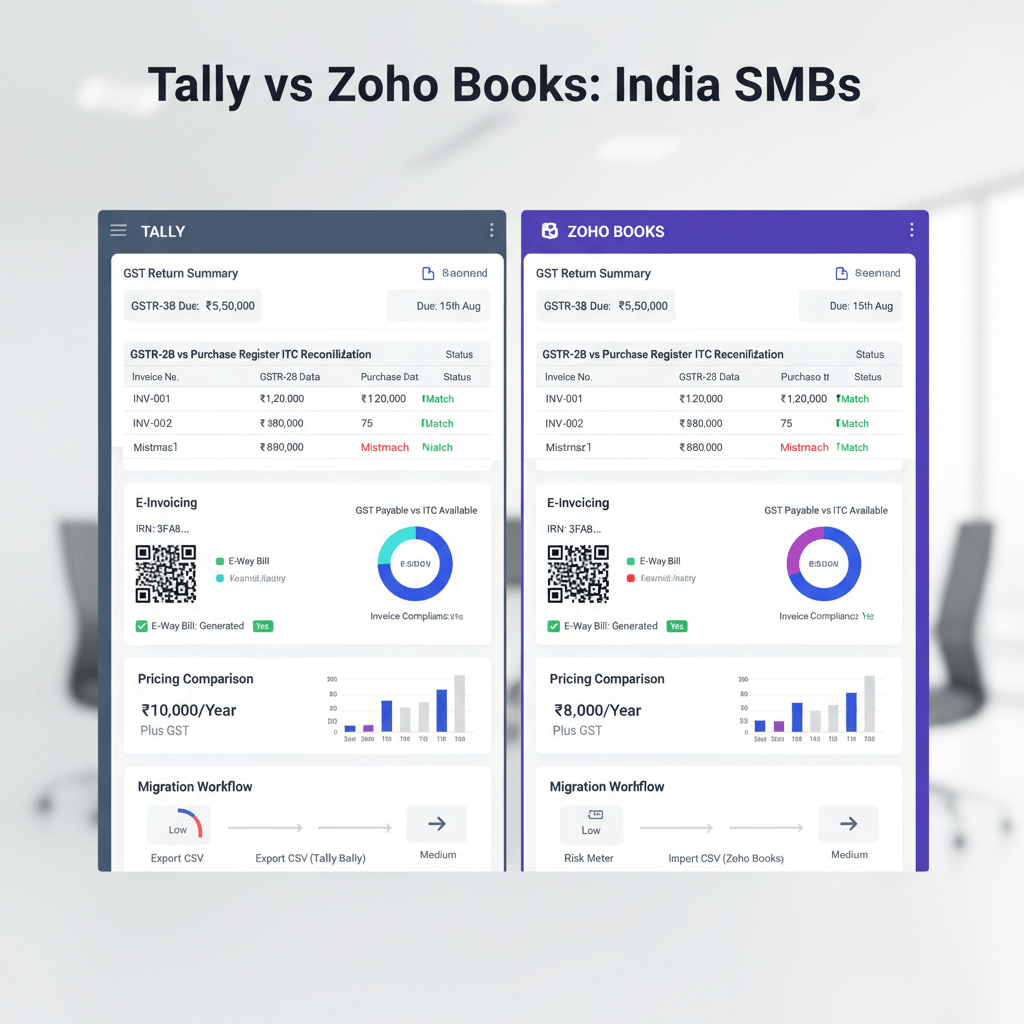
Tally vs Zoho Books is a workflow decision, not a features decision. Both platforms handle IRP-integrated e-invoicing, e-way bills, GSTR-1 and 3B, and GSTR-2B reconciliation. The real question is where your bottleneck lives, and how much migration risk you can absorb right now.
For context, see the Zoho vs Tally comparison for Indian SMBs.
- Deployment: Tally is desktop-first with full offline continuity, Zoho is cloud-first with browser and mobile access.
- Compliance: Both support e-invoicing, e-way bills, and GST returns; Tally exports JSON for portal upload, Zoho supports direct filing as well.
- Reconciliation: Tally matches after a manual 2B JSON download, Zoho reconciles within the platform against live data.
- AP and banking: Tally needs add-ons or imports for automation, Zoho offers bank feeds and AP workflows natively.
- Access: Tally needs TSS remote access or VPN for CAs, Zoho offers simple browser logins.
- Cost: Tally’s Gold license allows unlimited LAN users with an annual TSS, Zoho charges per plan and per additional user.
Rule of thumb: Evaluate where you lose time and control, not the length of the features list. Features look similar, workflows do not.
Which stack fits a ₹1–100 crore finance team today?
If you already run Tally Prime, the default answer is to stay and automate the gaps. Only switch to Zoho Books if you truly need a cloud-first, browser-native workflow and can absorb the migration cost without risking filings and customer ITC.
What Tally Prime already covers on GST
Tally Prime handles IRP e-invoice generation with QR code printing and cancellation, e-way bills including bulk generation, and GSTR-1, 3B, 4, and 9 in JSON for portal upload. GSTR-2A and 2B reconciliation is built in, driven by portal JSON downloads that you match against your purchase register.
The gap is not compliance, it is automation and timing — how much runs automatically and early versus manually and late.
What Zoho Books adds on the same checklist
Zoho Books offers the same GST surface, with reconciliation inside the platform and direct bank feeds that reduce daily data entry. If your bottleneck is AP entry and bank statement coding, Zoho’s native workflows help. If your Tally processes are already disciplined, the productivity delta is smaller.
The real risk of switching
Migration requires master exports, opening balances, transaction imports, and live validation. In a four to eight week window, any mapping error — GSTINs, HSNs, ledger groups — can cause IRN failures and GSTR-1 mismatches that disrupt your buyers’ ITC. That is why many sub-₹100 crore teams fix workflow gaps on Tally rather than rip and replace.
If you want Zoho-like automation without replacing Tally, AP processing and bank ingestion can sit on top of your Tally stack. For example, AP processing and purchase-to-2B reconciliation can be layered to keep books clean while the team continues in Tally Prime. You can also work with AI Accountant (AiA) to sync masters, process bills, ingest statements, and push ledger-coded entries back into Tally.
Cost and control: licenses, users, infra, and CA access
License and subscription math
Tally Prime offers a single-user perpetual license with an annual TSS for updates and connected features, and a multi-user Gold option where users on the LAN are effectively unlimited, with one TSS. Zoho Books is subscription-only, with per-plan user caps and per-seat add-ons. A three-year TCO comparison often narrows or flips once you factor users and growth.
Infrastructure and backup
Tally runs locally and needs server upkeep, backups, and recovery discipline. Zoho is cloud-hosted, removing infrastructure overhead but adding dependence on service availability and connectivity.
MCA audit trail mandate
Under the amended Companies, Accounts Rules effective 1 April 2022, the audit trail, or edit log, must be enabled for companies throughout the year. Both platforms support audit trails. Retrieval is typically faster on a cloud stack, whereas locally managed Tally requires in-house evidence during audit.
CA access
Tally requires TSS remote access, shared network, or VPN. Zoho allows simple browser access with role-based users. If your CA reviews monthly for GST, access friction translates into time and fees, which is part of TCO.
GST operations reality: e-invoicing, 2B matching, RCM, and vendor compliance
E-invoicing threshold and penalties
As of 1 August 2023, e-invoicing applies to aggregate turnover above ₹5 crore. See CBIC. Invoices issued without a valid IRN in that bracket are not valid tax invoices under Rule 48(5). Penalties under Section 122 apply per instance, and buyers cannot claim ITC on those invoices. The platform can generate IRNs, but your dispatch process must ensure IRN before goods move.
GSTR-2B is the only ITC basis that counts
Section 16(2)(aa) ties ITC to what appears in GSTR-2B. The provisional ITC path under Rule 36(4) has been removed, see CBIC. GSTR-2B freezes on the 14th, giving you a six-day window to reconcile before the 20th. Late supplier GSTR-1 pushes ITC to next month, and non-filers block it indefinitely.
Tally’s 2B match works after a portal JSON download. At 200 plus monthly purchase invoices, manual tagging consumes a half day. AiA’s GSTR-2B reconciliation tags every line and generates the adjusting entries, then pushes corrections back into Tally. Your team retains control without re-inventing the workflow.
RCM entries your AP process must catch
Reverse Charge applies on notified services, including GTA, advocates, and security agencies. See CBIC. Neither platform auto-detects RCM unless vendor masters and ledgers are configured correctly. A GTA freight bill coded to a regular purchase ledger means missed self-assessment and interest exposure.
Control that matters: correct vendor master flags, RCM ledgers, and a monthly review of RCM liability versus 3B payment.
Day-0 reality: migration, masters, bank feeds, and offline continuity
The migration checklist
Export and validate masters and balances, configure GST in the target, import transactions if needed, and run a parallel month. A practical starting point is this Tally to Zoho migration checklist. Cutting the parallel run short is what causes IRN failures and buyer ITC pain.
Bank feed coverage and reconciliation
Zoho supports feeds for major Indian banks, falling back to CSV where needed. Tally relies on CSV imports and manual matching. In both stacks, your team downloads statements. Zoho’s auto-categorisation reduces ledger coding time for recurring expenses, which is material if bank reconciliation is your bottleneck.
2B timing and your reconciliation window
2B is static from the 14th, so start reconciliation on the 14th, not the 18th. Whether you run Tally or Zoho, the delta is how fast you match, tag, and follow up with non-filers before the 20th.
Offline continuity
Tally operates fully offline, a daily advantage where power or connectivity is unreliable. Zoho requires internet. If your team books high-volume transactions during off-hours, continuity is not optional.
The decision framework: when to stay on Tally versus when Zoho wins
Stay on Tally Prime, and automate, if you:
- Have a trained team and stable ledger structure, with tested IRN and return routines.
- Need offline continuity or run multiple entities where per-user cloud costs scale poorly.
- Can fix AP entry, bank coding, and 2B matching with automation instead of migration.
- Cannot accept filing or IRN failure risk in the next two quarters.
Move to Zoho Books if you:
- Are setting up a new entity with no Tally history to migrate.
- Operate fully remote and desktop workflows create collaboration friction.
- Lack IT support and want zero infrastructure overhead.
- Require browser-based CA access and faster audit trail retrieval.
Worked examples
Scenario A, ₹10 crore distributor, 180 purchase invoices per month: Above the e-invoice threshold, their pain is a two-day 2B match that runs too close to 3B. The right move is a reconciliation layer on Tally, not migration.
Scenario B, ₹2 crore SaaS, 3-person remote team: Low volume, predictable transactions, and below the e-invoice threshold. Zoho Books Standard provides GST invoicing and CA access with no infra burden. No migration risk, clean win.
For visibility gaps on Tally, add reporting rather than changing cores. A layer that syncs books and builds MIS reporting provides real-time cash and ITC views without altering your accounting engine.
Frequently Asked Questions
What is the difference between Tally Prime and Zoho Books for GST e-invoicing?
Both integrate with the IRP to generate IRNs and QR codes, the practical difference is trigger and workflow. In Tally, the user initiates IRN generation from the voucher, in Zoho, IRN is part of invoice creation with direct submission. For entities above ₹5 crore, both satisfy the mandate. Your main control is ensuring IRN is generated before dispatch.
Can I run Tally and Zoho Books simultaneously during migration, and for how long?
Yes, and you should. Run a full parallel cycle covering invoice entry through GSTR-1 on the 11th and 3B on the 20th. Four to six weeks of parallel running exposes master errors before they affect buyer ITC. Cutting this short shifts the cost to post-go-live corrections and relationship damage.
If I switch software mid-year, what happens to my ITC position in assessment?
ITC eligibility depends on GSTR-2B and Section 16, not the software. The risk is migration errors that create GSTR-1 mismatches, which then block your buyers’ ITC. During assessment, officers reconcile invoices to GSTR-1, so maintain complete records in both systems through the transition and ensure 2B-based claims match your books.
How should I operationalise the 180-day ITC reversal rule in my AP process?
Set up an AP ageing report that flags invoices at 150 days outstanding, review weekly, and either pay or plan the reversal in the next 3B. Under Rule 37 read with Section 16(2)(d), reverse ITC in the month after expiry and add interest from the date the ITC was availed. Re-avail when paid. Build this control regardless of platform.
Can I process expenses in Zoho Books but file GSTR-3B from Tally without issues?
It is possible but risky as a steady state. Ensure the 3B ITC claim ties to 2B, and that the purchase register is reconciled in one system of record. Running two books doubles reconciliation and raises the chance of over or under-claim. Treat it as a short migration bridge, not your operating model.
What is the late fee if I miss the GSTR-1 deadline, and why does it matter for my buyers?
Late fee is ₹50 per day with caps, lower for nil returns. More importantly, late GSTR-1 delays your invoices in your buyers’ 2B, which blocks their ITC until you file. That is a commercial risk beyond the statutory fee and will surface in vendor scorecards.
Does Zoho Books’ free plan support GST e-invoicing for sub-₹5 crore turnover?
The free plan targets turnover up to ₹50 lakh and covers core GST invoicing. E-invoicing is not mandated below ₹5 crore, so the free plan aligns with the compliance requirement at that scale. If and when you cross ₹5 crore in any prior year, move to a plan that supports IRP integration before the next financial year starts.
How do Tally and Zoho handle RCM on GTA freight in practice?
In both platforms, mark the vendor as RCM and apply the notified rate, then self-invoice and pay under 3B. See CBIC for the GTA notification. The systems will not auto-detect RCM from description text, so master configurations and AP training decide accuracy.
What is the penalty if a business above ₹5 crore continues issuing invoices without IRN?
Invoices without IRN are invalid under Rule 48(5). Penalties under Section 122 apply per invoice, and your buyers cannot claim ITC. See the CBIC, CGST Act. Beyond the penalty, commercial fallout with customers is often the larger cost.
How do I decide between Tally with automation and Zoho Books while scaling from ₹10 crore to ₹50 crore?
If you are adding volume and complexity quickly, migration adds execution risk when your control environment is already stretched. Default to Tally plus automation for AP, bank, and 2B until a natural break point like a new financial year. If cloud-first is a strategic requirement, plan Q4 migration and run parallel through Q1.

Rohan Sinha is a fintech and growth leader building aiaccountant.com, focused on simplifying accounting and compliance for Indian businesses through automation. An IIT BHU alumnus, he brings hands-on experience across 0 to 1 product building, growth, and strategy in B2B SaaS and fintech.