-01%201.svg)
Key takeaways
- GSTR-2B is your static anchor for accurate, audit-ready ITC, effective tools finish reconciliation in hours, not days.
- Modern platforms auto-match purchase registers with GSTN data, tag exceptions clearly, and push clean entries back to Zoho Books or Tally.
- Automated vendor nudges, escalation matrices, and SLA tracking convert follow-ups from chaos to a predictable cadence.
- Smart ITC logic becomes your safety net, with blocked credits, the 180-day payment rule, and auto-reclaim flows handled in the background.
- Leadership needs a single dashboard for ITC, mismatch aging, and vendor risk, updated in near real time for filing readiness.
- Choose tools that scale to lakhs of invoices monthly, support multi-GSTIN portfolios, and come with ISO 27001, SOC-2 assurances.
- With the right software, most teams recover additional ITC, reduce manual hours by more than half, and cut month-end stress significantly.
Why GSTR-2B reconciliation matters now
Every month, finance teams juggle thousands of invoices, vendor dependencies, and filing deadlines. If you are still merging Excel sheets and sending ad-hoc reminders, you are not alone. Yet there is a better way. GSTR-2B provides a static, department-ready reference for ITC, so your books can be both accurate and efficient, month after month.
When reconciliation is done right, your status board is green by T+3, exceptions are triaged, and leadership has a crisp picture of ITC and cash impact. For a primer, see this practical GSTR-2B reconciliation tools overview.
What “good” looks like: clear invoice statuses, automated exception handling, built-in vendor nudges, and dashboards that leadership actually understands.
Must-Have Capabilities to Evaluate in GSTR 2B Reconciliation Tools
Match Purchase Register
The foundation is rock-solid matching. Expect bulk imports via Excel, CSV, or GSTN JSON, with pre-validations for GSTIN formats, dates, and tax splits. Matching should be deterministic where possible, and forgiving where reality demands it.
- Match keys, GSTIN plus invoice number or date plus taxable and IGST or CGST or SGST values.
- Handle real-world complexity, tolerances for rounding, fuzzy logic for OCR errors, amendment mapping, credit and debit note linkage, and RCM segregation via RCM segregation.
- Support IGST on imports with Bill of Entry references, duplicate detection, and confidence scoring for triage.
For an end to end view, refer to this concise GSTR-2B reconciliation tools overview and the ICAI perspective on AI for GST use cases in this ICAI use case note.
Identify Missing Invoices
ITC leakage often hides in invoices present in books but missing in 2B. Your tool should go beyond a basic flag.
- Vendor-wise drill-downs that spotlight repeat offenders and timing patterns.
- Cross-period checks that detect filing period roll-forward or cut-off differences.
- Root-cause tagging, late filing, non-filing, invoice number variance, or value mismatch, with playbooks for targeted follow-ups.
See examples in this GSTR-2B reconciliation tools overview.
ITC Claim Optimisation
Maximize legitimate ITC, stay compliant, and keep an audit trail.
- Auto-tag eligible versus ineligible, Section 17(5) blocks, place of supply checks, capital goods, non-business expenses.
- Deferred credits with auto-reclaim against Section 16 timelines, and RCM segregation that never mixes flows.
- Strict monitoring of the 180-day payment rule with reversal and re-credit automation.
Deep-dive guidance is covered in this GSTR-2B automation explainer.
Vendor Follow Up Automation
Replace manual chasing with systematic, data-backed communication.
- One-click email or WhatsApp nudges, templated with invoice-level mismatch details.
- Escalation chains for persistent gaps, acknowledgements, and SLA tracking.
- Compliance scorecards that drive proactive vendor management.
See how modern tools structure this in the same automation explainer.
Monthly Dashboard
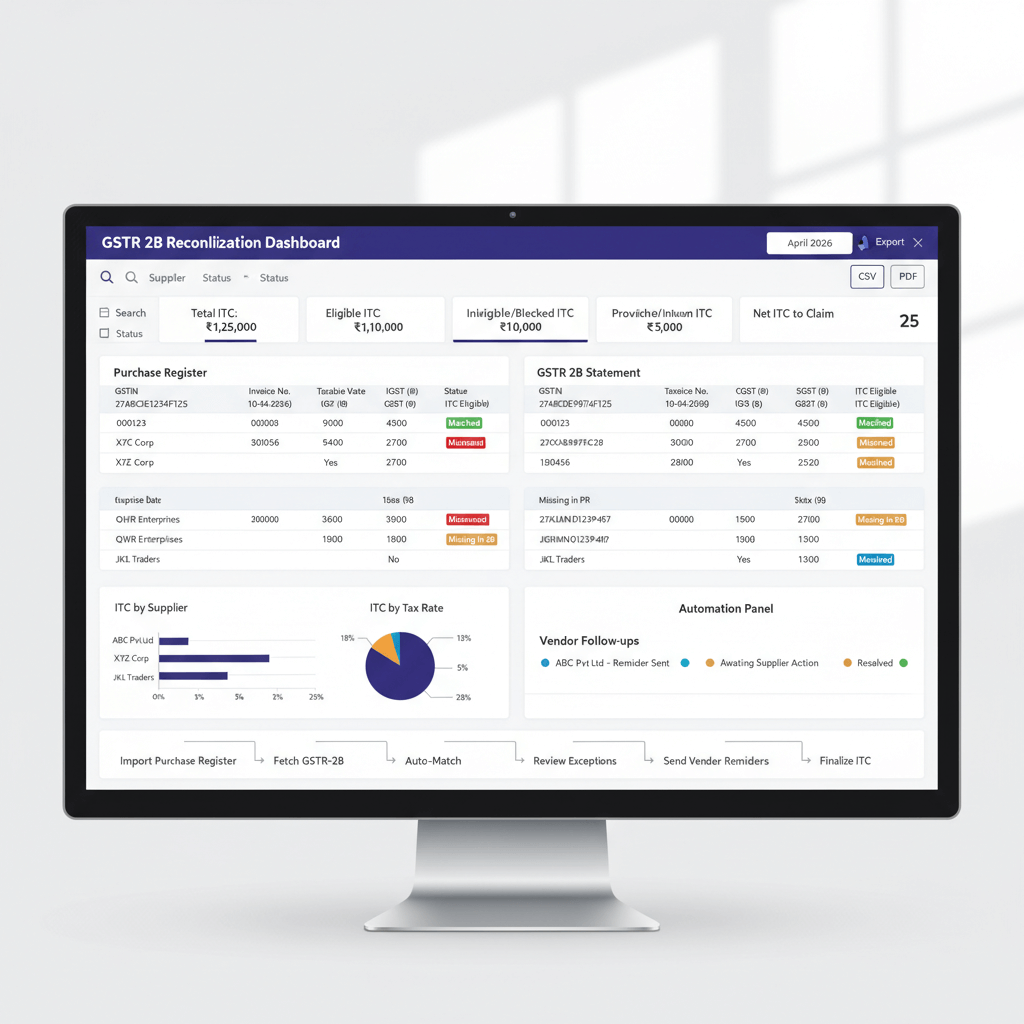
A good dashboard tells a story at a glance. ITC in 2B, booked, eligible, and claimed, with aging on deferred and reversals, and unresolved mismatches.
- Vendor-wise compliance trends and vendor risk tiers.
- Expected cash impact that connects compliance to treasury conversations.
- Auto-refresh as reconciliation progresses, no manual status checks.
Examples are showcased in this GSTR-2B reconciliation tools overview.
Integrations and Data Flow
Avoid silos. Bi-directional sync with your core accounting system is crucial. Tools should pull masters and push clean bills, adjustments, and reversals back to your books without CSV hops. Multi-org or multi-GSTIN support and role-based access keep governance intact. For implementation patterns, review this implementation guide.
Scale, Security, Support
Enterprise standards matter, even for small teams.
- High-volume performance for lakhs of invoices, peak-time stability.
- ISO 27001 and SOC-2 certifications, and India data residency options.
- SLA-backed support, structured onboarding, and ongoing training.
Checklist pointers appear in this buyer’s overview.
Deep-Dive Workflows
Match Purchase Register Workflow
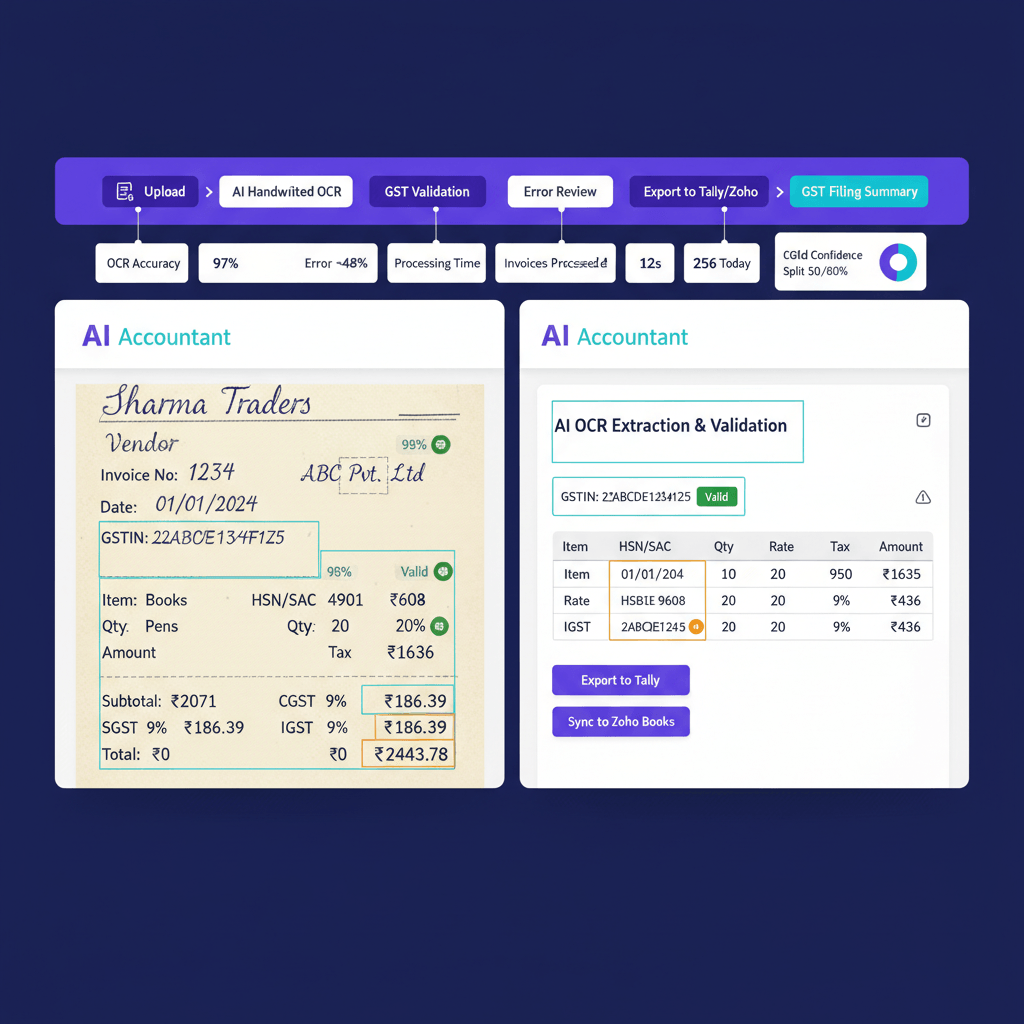
Upload your purchase register or GSTR-2B JSON, let smart mapping align columns, and let pre-validations catch GSTIN format or date errors. The engine blends deterministic rules with fuzzy logic, aligning invoice numbers, dates, GSTINs, tax breakups, and place of supply. Amendments and rounding tolerances are first-class, RCM stays segregated, reversals link to the right base invoices. Bulk filters, inline edits, and learning from corrections accelerate closure. Reference patterns in this GSTR-2B reconciliation tools overview and this ICAI use case.
Identify Missing Invoices Workflow
Cross-period checks catch timing differences. Auto-tagging prioritizes risk, block ITC where the same vendors repeatedly miss 2B, and generate vendor-wise packs with specific gaps, due dates, and contact details. The automation explainer shows this end to end.
ITC Claim Optimisation Workflow
Configurable rules auto-classify eligibility, compute deferrals, track the 180-day payment rule, and manage reclaims when conditions are met. Imports via Bill of Entry, ISD credits, and credit notes receive correct treatment, while monthly summaries show new eligibility, deferrals, and permanent blocks.
Vendor Follow Up Automation Workflow
Establish a cadence, T plus 3 gentle reminders, T plus 7 escalations, and pre GSTR-1 cut-off alerts. Templates personalize at scale, each vendor sees only their issues, and response tracking builds an audit trail. See examples in this automation explainer.
Monthly Dashboard Walkthrough
From day one post 2B release, visualize matched, in books not in 2B, and 2B not in books. Track week by week closure, vendor escalations, and cash impact. Drill into material items, export packs for management, and keep everyone aligned. Useful references live in this overview and this ICAI note.
Implementation and Change Management
Connect your accounting system, let the tool sync masters, and import historical purchase registers and GSTR-2B JSONs for baselining. Run a first reconciliation alongside your current method, resolve configuration gaps, and lock SOPs for month-end. Define roles, approvals, and exception playbooks. Build trust with quick wins, time saved metrics, and transparent accuracy comparisons. A step by step path is outlined in this implementation guide.
ROI and Business Case
Most teams save 60 to 80 percent of manual effort, and recover 1 to 2 percent additional ITC through tighter controls. A business with 1,500 invoices monthly often shifts from two FTEs to one on reconciliation alone.
- Quick calculator, monthly invoices multiplied by 0.01 to 0.02 gives annual ITC recovery, add 20 to 30 hours per FTE at ₹500 per hour for labor savings, payback is usually under one quarter.
Illustrative proof points appear in this automation explainer.
How to Choose the Right GSTR 2B Reconciliation Software
- AI Accountant, advanced GSTR-2B reconciliation with status tagging, high fidelity purchase register matching, missing invoice packs, ITC deferrals and auto-reclaim, vendor follow-up automation, deep dashboards, and native sync with Zoho Books and Tally. Processes at scale, ISO 27001 and SOC-2 Type II.
- ClearTax, robust matching and mismatch identification, good for volume, limited deep integrations.
- TallyPrime, basic built-ins for those standardized on Tally, instant start, fewer advanced controls.
- Zoho GST, well integrated for the Zoho stack, handles standard cases well.
- TaxPro GST, wide compliance suite, strong analytics for CA firms, deeper learning curve.
- OctaGST, analytics forward with vendor scorecards and integrations, quick to deploy.
- Busy, configurable tolerances and ERP flavor, scalable with some customization for complex cases.
See market context in this GSTR-2B reconciliation tools overview and this detailed guide.
Comparison Framework for Shortlisting GSTR 2B Reconciliation Tools
- Score 1 to 5 across matching accuracy, exception tagging, ITC automation, vendor follow-ups, dashboards, integrations, scale, security, and support.
- Must-haves, full reconciliation, bi-directional sync, multi-GSTIN support, and audit logs.
- Red flags, CSV hopping, missing audit trails, fragile performance, or weak access control.
- Context fit, high-volume enterprises need throughput, groups need consolidation, CA firms need client and team administration.
Use this as a checklist alongside the buyer’s overview.
Common Pitfalls and How to Avoid Them
- Confusing GSTR-2A with 2B, 2A is dynamic, 2B is static, see this primer on the difference between GSTR-2A and 2B.
- Ignoring amendments and credit note linkages, causes chronic breaks later.
- Missing the 180-day payment rule, reverse and reclaim on time to avoid cash surprises.
- Loose tolerances lead to over-claims, over-caution leaves ITC on the table, document policies and automate them.
- Weak vendor follow-ups and no monthly dashboard keep problems recurring, fix both.
Additional examples are covered in this implementation guide.
FAQ
How frequently should a CA firm run GSTR-2B reconciliation for clients to minimize ITC risk?
Run a full reconciliation immediately after each month’s 2B release, add a mid-cycle high value vendor sweep, and conduct a quarterly deep-dive for structural issues. Tools like AI Accountant can automate all three layers and surface vendor risk early.
What is the best approach to handle prior-period ITC when the supplier filed GSTR-1 late and the invoice appears in a later 2B?
Use multi-period reconciliation with cross-year matching and deferral tagging. Defer the ITC in the original period, then auto-reclaim when the invoice lands in a subsequent 2B. AI Accountant supports deferred status with audit logs for each reclaim.
How should we configure matching tolerances to avoid both over-claiming and under-claiming ITC?
Adopt tiered tolerances, strict for invoice number and GSTIN, controlled rupee or percentage tolerance for tax amounts to absorb rounding, and explicit exception queues for material variances. Calibrate with a two-cycle pilot, then lock policies in the tool.
What controls are needed for the 180-day supplier payment condition to prevent surprise reversals?
Automate the 180-day payment rule tracker, flag invoices nearing deadline, reverse ITC on day 181 if unpaid, and auto-reclaim post payment. Ensure the register sync captures payment application dates precisely.
How do we treat imports, ISD credits, and RCM in reconciliation without polluting the main ITC pool?
Create distinct flows, Bill of Entry mapping for import IGST, ISD allocation registers for service credits, and segregated RCM buckets with tax liability, payment, and reclaim steps. Documentation and status tagging keep audits smooth.
What is a practical vendor follow-up cadence that actually moves compliance metrics?
Follow T plus 3 for gentle nudges, T plus 7 for escalation, and pre GSTR-1 cut-off alerts with invoice-level details. Track opens, deliveries, and vendor acknowledgements. AI Accountant provides templated packs and escalation matrices.
How can a CA firm manage multi-GSTIN clients without data silos and version confusion?
Use a tool with multi-entity and multi-GSTIN workspaces, role-based access, and bi-directional sync to the underlying ERPs. A centralized dashboard provides consolidated ITC and vendor health across entities while keeping client data segmented.
What security posture is minimum acceptable when client GST data sits in the cloud?
Ask for ISO 27001 and SOC-2 evidence, India data residency options, encryption at rest and in transit, granular access controls, and immutable audit logs. SLA-backed support and incident response are non negotiable for regulated finance data.
How fast can we go live if we have historical mismatches and pending deferrals to load?
Baseline in days by syncing masters and importing historical purchase registers and GSTR-2B JSONs. A typical full rollout with history and SOPs is two to four weeks, with rule tuning in the next two to three months. Many teams parallel run for one close cycle to build confidence.
What is the ROI benchmark for GSTR-2B automation in CA-led portfolios and in-house finance teams?
Expect 60 to 80 percent effort reduction and 1 to 2 percent incremental ITC recovery, plus reduced interest and penalties from greater accuracy. Use a simple calculator, invoices per month multiplied by 0.01 to 0.02 for ITC recovery, add saved hours valued at your internal rate.
Which reconciliation reports are audit favorites, and how do we structure them?
Auditors prefer period-wise ITC movement, matched versus mismatched breakdowns, deferred and reclaimed logs with timestamps, and vendor-wise compliance history. Exportable packs with invoice trails ensure quick closures. AI Accountant can generate audit-ready bundles in minutes.
Is there a reference checklist we can use to validate our monthly reconciliation close?
Yes, align to a standard R2R reconciliation checklist, import completeness, exception queue cleared, deferrals tagged, 180-day reversals processed, vendor escalations actioned, and dashboard sign-off captured. For a general orientation on reconciliation concepts, see this overview of GSTR reconciliation and this GSTR-2B reconciliation tools overview.
Next Steps
You now have a complete framework to evaluate GSTR 2B reconciliation tools. Document your pain points, quantify hours spent and leakage from mismatches, and build a data-backed business case.
Download a buyer’s checklist, compare options using the criteria above, and focus on capabilities that fit your context. Book a 30 minute walkthrough of AI Accountant to see automated matching, vendor follow-ups, and ITC optimization on your own data. The best time to automate was yesterday, the second best time is now.
Further reading, a compact GSTR-2B reconciliation tools overview and a step by step implementation guide.

Rohan Sinha is a fintech and growth leader building aiaccountant.com, focused on simplifying accounting and compliance for Indian businesses through automation. An IIT BHU alumnus, he brings hands-on experience across 0 to 1 product building, growth, and strategy in B2B SaaS and fintech.