-01%201.svg)
Key takeaways
- Manual GSTR-2B reconciliation drains time, increases errors, and blocks ITC, modern tools fix this with automation, analytics, and vendor workflows.
- Monthly reconciliation is mandatory to claim accurate ITC, avoid reversals, and stay audit ready, especially after recent compliance enforcement.
- Non negotiable capabilities include robust data ingestion, an intelligent matching engine, variance analytics, and automated vendor communication.
- Deep integrations with Zoho Books and Tally, combined with audit trails and access controls, ensure governance, scalability, and trust.
- Dedicated GSTR-2B tools outperform spreadsheets and basic ERP modules, delivering faster closures, higher ITC realization, and clearer cash flow visibility.
- Most teams recover software costs within one or two quarters through time saved, error reduction, and improved working capital.
- AI Accountant provides end to end reconciliation, ITC optimization, and vendor automation for SMEs and CA firms, with proven scale and secure infrastructure.
Understanding GSTR-2B Reconciliation Fundamentals
What is GSTR-2B and Why Monthly Reconciliation Matters
GSTR-2B is a monthly statement from the GST portal that lists Input Tax Credit available based on your suppliers’ filings. Think of it as your official receipt register from the network of vendors. To claim credits correctly, you must reconcile the statement with your purchase register every month, then book only eligible credits. When you delay or miss reconciliation, you risk reversals, interest, and penalties, which is why timely, accurate processes and tools matter for accurate ITC.
Your purchase register is your internal ledger of supplier invoices. If invoices exist in your books but do not show in 2B, you face blocked credits until the supplier files correctly. Understanding eligible, ineligible, and deferred ITC is foundational, and correctly classifying Reverse Charge Mechanism (RCM) transactions is equally critical.
Common pitfalls include duplicate invoices, unprocessed amendments, mismatched credit or debit notes, and GSTIN or vendor name mismatches that prevent clean matching. Industry guides underline the shift from manual effort to automation, for example, GSTR-2B auto-reconciliation, manual vs automated GSTR-2B reconciliation, and specialized GSTR-2B reconciliation solutions.
Missed credits today become tomorrow’s cash crunch. Automation closes that gap by turning raw data into reliable, review ready ITC.
Core Features Every GSTR-2B Tool Must Have
Data Ingestion and Import Capabilities
Look for flexible ingestion, JSON and Excel for 2B data, direct API fetch for automatic refresh, and multi period support to clear backlogs. For purchase registers, expect CSV and Excel support with validations, ERP friendly exports, and multi organization management for CA firms. Leading tools handle messy vendor files gracefully, they validate GSTINs, normalize formats, and flag obvious errors before processing. See examples in GSTR-2B reconciliation product pages, auto-reconciliation explainers, and manual vs automated benchmarks.
Intelligent Matching Engine Requirements
The engine should blend exact matching on GSTIN, invoice number, date, and value with configurable fuzzy logic for real life variations. It must respect Place of Supply rules, process amendments, pair credit or debit notes accurately, identify RCM items, and auto detect duplicates. Clear, auditable statuses are essential, matched, probable, mismatched, and books only for vendor follow up. Coverage comparisons in specialized reconciliation suites, automation primers, and broader GST reconciliation software guides can help you benchmark engines.
Variance Analytics and Reporting
Analytics should transform mismatches into decisions, supplier gap analysis, defaulter watchlists, and trends over time. Drill down filters, audit exports, and presentation ready summaries help both operators and management. Predictive signals, like ITC forecasts and unusual variance alerts, turn reconciliation into a forward looking process. Explore perspectives in product pages and comparative write ups.
Advanced Automation Features
ITC Optimization and Rule Engine
Rule based classification should auto mark eligible, ineligible, and deferred ITC, with cash flow impact views that quantify working capital locked due to vendor delays. Robust audit trails and maker checker approvals preserve compliance. For context, see auto-reconciliation case notes and enterprise GST reconciliation capabilities.
Automated Vendor Communication
Automate outreach with templated emails, escalation cadences, and response tracking. Add WhatsApp Business and SMS for urgency, and give vendors a portal view when possible. This is a major time saver noted across manual vs automated GSTR-2B reconciliation comparisons.
Executive Dashboards and Visualization
Leaders need instant visibility, ITC available versus claimed versus deferred, reconciliation progress, and cash impact. Vendor scorecards drive accountability. Heat maps and trend charts help teams spot patterns quickly, with exports for board packs. See examples discussed in solution overviews and analytics explainers.
Workflow and User Experience Considerations
Bulk Operations and Queue Management
High volume teams need bulk edits, prioritized queues, inline corrections, keyboard shortcuts, and saved views. Collaborative assignments, notes, and real time status tracking prevent bottlenecks. For workflow depth, review operations centric product pages.
Integration Capabilities
ERP and Accounting Software Sync
Two way sync with Zoho Books and Tally is essential, master data, vouchers, and reconciled statuses should flow without manual uploads. Complexities like multi company structures, branch mapping, and inter company transactions must be handled cleanly. Learn more from integration checklists and GST reconciliation software roundups.
Audit Trail and Compliance Exports
Every user action, system decision, and data change should be timestamped with before and after views. Export reconciliation certificates, variance reports, and filing summaries on demand. Long term retention and searchable archives protect institutional memory.
Security and Governance Features
Access Control and Data Protection
Role based permissions, maker checker flows, and encryption in transit and at rest are table stakes. Independent certifications like ISO 27001 and SOC 2 Type II signal maturity. At scale, systems must remain performant during month end peaks, a trait often emphasized in automation guides.
Comparing Solution Approaches
Spreadsheets vs ERP Native vs Dedicated Tools
Spreadsheets are fragile, no audit trail, error prone formulas, and broken version control. ERP native modules provide basic reconciliation, yet often lack deep matching logic, vendor automation, and rich analytics. Dedicated tools deliver specialized matching, dashboards, vendor workflows, and compliance features, which is why many analysts highlight the move to automated reconciliation, broader GST ITC reconciliation automation software guides, and focused GSTR-2B reconciliation and auto-reconciliation resources.
Top GSTR-2B Reconciliation Tools for 2026
Leading Solutions in the Market
1. AI Accountant
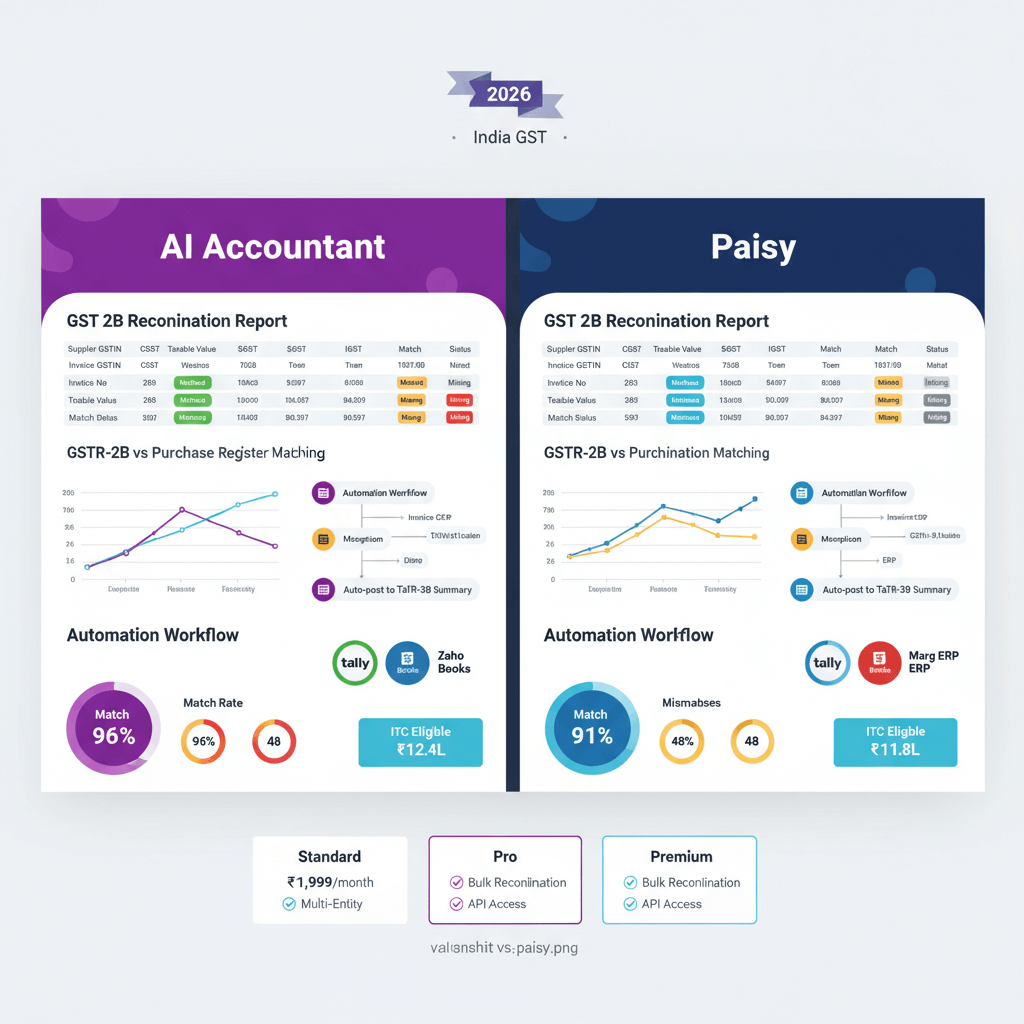
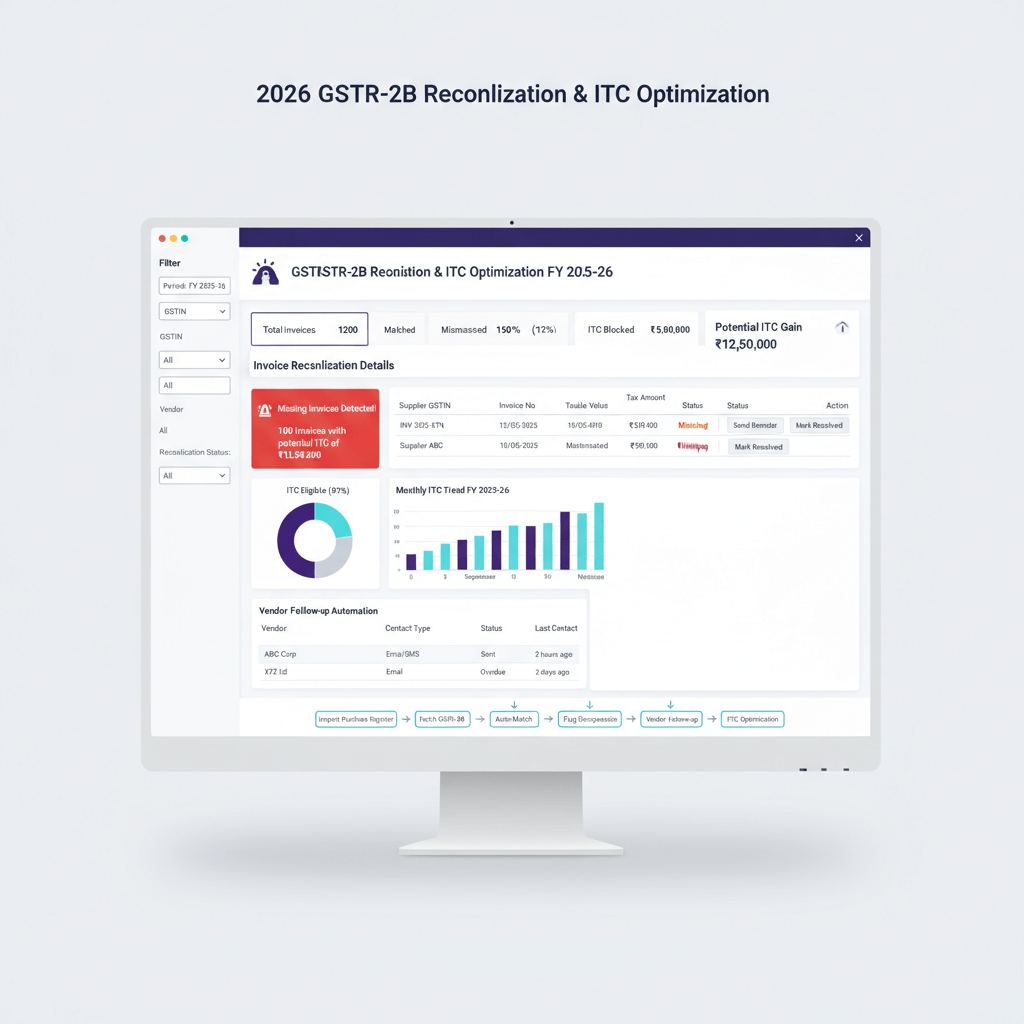
AI Accountant offers end to end GSTR-2B reconciliation with deep Zoho Books and Tally integration. Automated ingestion, a fuzzy matching engine, missing invoice detection with vendor follow ups, ITC optimization, and executive dashboards make it a strong choice for SMEs and CA firms.
2. Octa GST
Focused GST compliance with solid reconciliation, drill down analytics, vendor scorecards, and volume friendly performance.
3. RealBooks
Automation heavy reconciliation that shortens month end cycles and strengthens audit readiness.
4. Vyapar TaxOne
SME friendly interface and pricing, vendor communication templates, and GST workflow coverage.
5. MySA
Cloud reconciliation with real time processing, broad integrations, and detailed variance reporting.
6. Ginesys
Enterprise grade capabilities, multi location and complex scenarios, plus advanced ITC rules.
How AI Accountant Stands Out
AI Accountant treats reconciliation as a complete workflow. It ingests 2B and purchase data, applies smart matching with clear statuses, triggers vendor follow ups automatically, and classifies ITC with rule based precision. Cash flow dashboards quantify impact instantly. The Zoho Books and Tally connectors enable two way sync, so reconciled outcomes flow back to your ledgers without manual uploads.
For CA firms, true multi client management, tenant level learning, and consolidated reporting unlock scale. Security is enterprise grade with encryption and independent certifications. In short, you get speed, accuracy, governance, and visibility in one system.
Implementation Best Practices
Data Preparation Checklist
Verify GSTIN formats, standardize invoice numbers and dates, resolve opening differences, and decide historical coverage. Clear old mismatches before migration. See setup tips in implementation primers.
Matching Configuration Setup
Set tolerances for amount and dates, define vendor name matching rules, configure amendment logic, duplicate detection, and RCM classification. Test thoroughly on historical months and document decisions. Product pages like GSTR-2B reconciliation show common patterns.
ITC Policy Definition
Codify eligibility by expense category, define deferred conditions, and list ineligible items per law. Establish overrides with thresholds, and lock periods after finalization. Enterprise examples appear in GST reconciliation resources.
Vendor Communication Setup
Prepare templates for mismatches, escalations, and resolutions. Use email for detail, WhatsApp for urgency, and calls for high value issues. Track response rates by supplier and publish scorecards. See practices in automation guides.
Dashboard Customization
Design executive, operator, and audit views. Emphasize ITC at risk, vendor compliance, and reconciliation progress. Enable self service drill downs. Examples are outlined in solution showcases.
Integration Steps
Map fields, test syncs, and define error handling. For Zoho Books, validate API scopes and voucher mapping. For Tally, configure ODBC, exports, and voucher creation. Assign ownership for ongoing monitoring and escalation. Reference notes from GST reconciliation software discussions.
Measuring Success and ROI
Key Performance Metrics
Track time per reconciliation, month end closure duration, mismatch resolution rate, prevented ITC leakage, and cash flow uplift from faster ITC realization. Vendor filing improvements and fewer disputes show relationship gains. Benchmarks appear in auto-reconciliation case notes and automation comparisons.
Calculating Return on Investment
Sum labor hour reductions, penalty avoidance, and interest savings from earlier ITC. Add indirect benefits like audit readiness and better vendor behavior. Most teams see payback within three to six months, with high volume operations and CA firms realizing faster returns. See ROI considerations.
India Specific Considerations
Common Reconciliation Challenges
Variable invoice formats, rounding differences, interstate PoS issues, SEZ supplies, advances, and cross period notes complicate matching. Sophisticated fuzzy logic helps normalize vendor name variants, clean GSTIN patterns, and tolerate sensible rounding thresholds. Broader guides such as automation primers and GST reconciliation software summaries capture these nuances.
Real World Success Story
CA Firm Transformation Case Study
A mid sized CA firm serving 30 SMEs spent weeks on manual matching, with high ITC deferrals and unhappy clients. After adopting a dedicated tool, 95 percent of invoices matched automatically, only 5 percent needed review. Automated vendor follow ups accelerated filings, dashboards improved client confidence, and the team shifted from grunt work to advisory. The tool paid for itself within two months through time savings alone, while opening capacity to onboard more clients.
Taking the Next Steps
Your Action Plan
Start with an evaluation worksheet, list pain points, volumes, and integration needs. Shortlist vendors, schedule demos, and observe the matching engine, vendor workflows, and dashboards on your data. Run a pilot for one month, validate results, and measure time saved. For a focused experience, book a walkthrough of AI Accountant to see fuzzy matching, automated vendor communication, and ITC optimization tuned to your policies. For broader market context, review GST ITC reconciliation automation software guides along with solution showcases and automation comparisons.
Conclusion
GSTR-2B reconciliation can become a strategic advantage when powered by automation. Accurate ITC, stronger cash flow, reliable vendor accountability, and audit ready records lift operational confidence. Whether you are a CA firm orchestrating many clients or an SME finance team seeking speed and certainty, the winning play is clear, adopt a dedicated reconciliation tool and let your team focus on analysis, not manual matching.
FAQ
How should a CA structure monthly GSTR-2B reconciliation so that ledgers in Tally remain untouched until final approval?
Adopt a staging workflow. Ingest 2B and purchase registers into a reconciliation tool like AI Accountant, perform matching and variance analysis, apply maker checker approvals, then post only approved adjustments back to Tally via two way sync. This preserves ledger integrity and creates an auditable trail.
What variance tolerance is reasonable for invoice value and date without risking audit exposure?
Most firms set a small amount tolerance, for example one to two percent or a fixed cap, and a date window of three to seven days for period end spillovers. Configure these as soft matches requiring review. AI Accountant allows granular tolerances by vendor or document type, which you can justify in your SOP and audit notes.
How do I handle backdated supplier credit notes that hit a later 2B but relate to an older purchase period?
Use amendment aware matching. Link the credit note to the original invoice in the tool, document the period impact, and apply the adjustment in the current return with a clear audit explanation. AI Accountant’s amendment logic keeps both periods reconciled and exports a variance note for your working papers.
What is the best way to reconcile RCM entries between 2B and books when supplier filings are inconsistent?
RCM does not appear in 2B like normal ITC. Classify RCM transactions in your books, verify tax liability discharge and self ITC claim eligibility, and ensure documentation. AI Accountant tags RCM lines during ingestion, keeps them out of supplier follow ups, and reports RCM utilization separately for compliance.
Can clients claim ITC when the supplier has filed GSTR-1 but payment of tax is uncertain?
Law requires supplier tax payment for final ITC eligibility. As a control, monitor supplier compliance through defaulter analytics and vendor scorecards. AI Accountant’s vendor communication and compliance scoring help you prioritize high risk vendors and defer ITC where prudent until confirmations or patterns indicate reliability.
For multi GSTIN, multi branch organizations, how do I prevent cross posting during reconciliation?
Enforce branch and Place of Supply mappings at ingestion. Ensure vendor GSTIN to branch rules are locked, and segregate reconciliation queues by registration. AI Accountant supports branch wise views, role based access, and location mapping so teams cannot post outside their assigned GSTIN.
What documentation should I keep for auditors to prove my ITC optimization rules are compliant?
Maintain an ITC policy document, screenshots of system rule configurations, maker checker approvals for overrides, reconciliation certificates, and variance reports. AI Accountant exports rule logs with before and after states, plus rationale notes, which auditors value.
How do I automate supplier follow ups without damaging relationships?
Use polite, structured templates that specify exact invoices, taxes, and due dates, set gentle escalation cadences, and provide a simple reply path. AI Accountant personalizes emails, adds WhatsApp nudges for urgency, tracks open and response rates, and produces monthly scorecards for vendor review meetings.
What KPIs should a CA firm present to clients to prove reconciliation ROI?
Time to close month end, percent auto matched, ITC realized versus deferred, vendor filing improvement, and penalty avoidance. AI Accountant’s dashboards quantify these, and scheduled PDF reports help you present outcomes during review calls.
How should we migrate historical months without overwhelming the team?
Adopt a wave plan. Reconcile the latest month first for immediate ITC impact, then backfill the previous two or three months where material. Use bulk queues and overnight batch processing. AI Accountant supports multi period ingestion, saved filters, and batch actions to accelerate catch up.
Is it better to centralize reconciliation at HO or distribute to branches for large enterprises?
Hybrid models work best. Centralize policy, rules, and final approvals, distribute first pass matching and vendor communication to branches with clear SLAs. AI Accountant enables role based access, branch views, and consolidated oversight so HO retains control while branches act quickly.
How do I evidence cash flow improvement from faster ITC realization to the CFO?
Track average days from invoice date to ITC claim, compute working capital unlocked, and estimate interest savings. AI Accountant’s cash flow widgets display realized versus deferred ITC, trend the improvement, and export a board ready summary for finance leadership.

Rohan Sinha is a fintech and growth leader building aiaccountant.com, focused on simplifying accounting and compliance for Indian businesses through automation. An IIT BHU alumnus, he brings hands-on experience across 0 to 1 product building, growth, and strategy in B2B SaaS and fintech.