-01%201.svg)
Key takeaways
- Handwritten invoice OCR for India blends ICR and document AI to read messy kirana, transport, and job work bills, delivering 93% to 99% field accuracy with GST validations.
- Indian realities matter, mixed Hindi English, mobile photos, stamps, glare, and WhatsApp compression demand preprocessing, layout detection, and domain aware checks.
- Hybrid workflows, AI plus human in the loop, consistently beat 95% on critical fields, while routing medium confidence items for quick review.
- Clean extraction accelerates GSTR 2B reconciliation, boosts match rates, and reduces audit queries through checksum, tax math, and duplicate detection.
- Direct mapping to Tally and Zoho, including multi rate GST and cost centers, enables posting ready vouchers without manual typing.
- A disciplined pilot, golden datasets, confidence thresholds, and master data hygiene unlock real ROI, faster month end close, and fewer errors.
Why handwritten invoice OCR matters in India
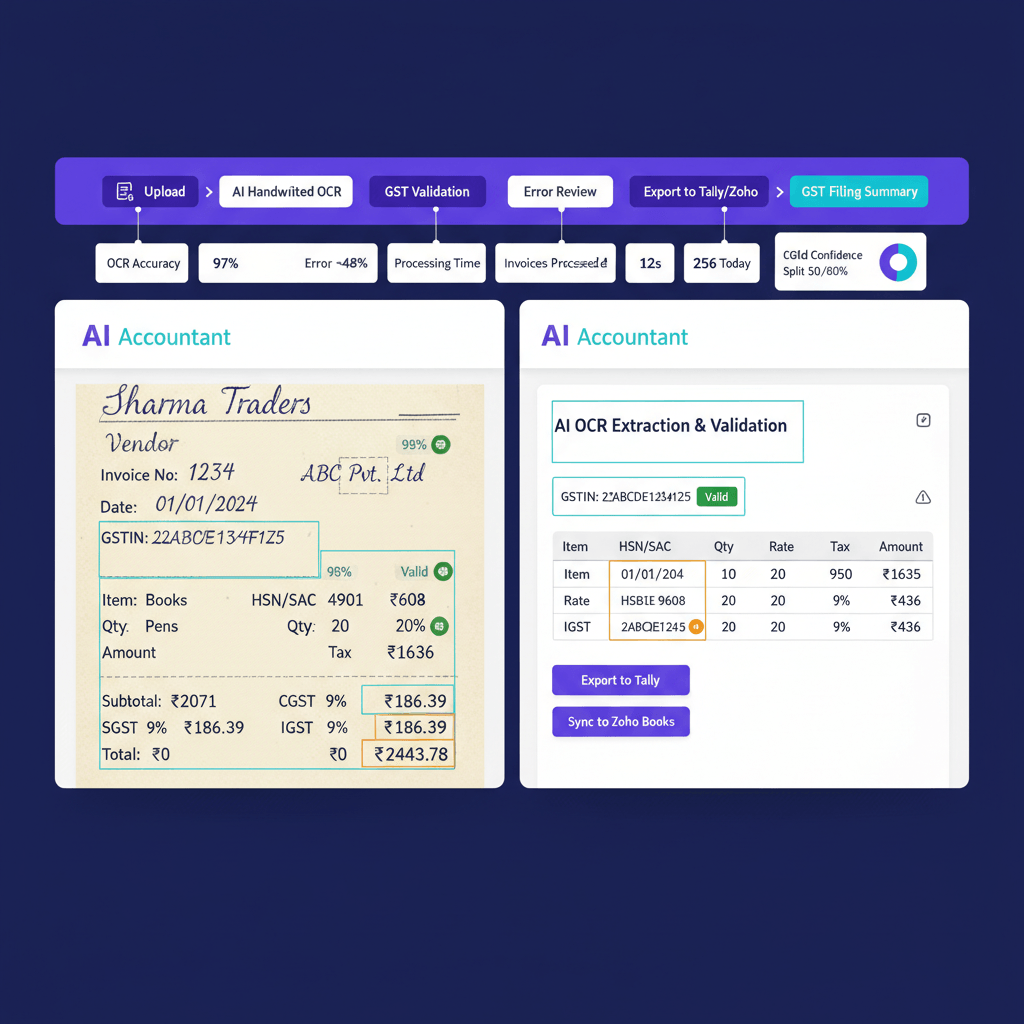
Handwritten invoices from kirana stores, transport PODs, job work slips, and small vendors dominate SME books. They slow month end data entry, complicate GST reconciliation, and delay Tally or Zoho posting. With handwritten invoice OCR India, AI extracts supplier names, GSTINs, invoice numbers and dates, taxable values, GST splits, line items, and totals that are fit for compliance and audits.
Bottom line: Accuracy, validation, and workflow design, not just OCR engines, determine whether GST filing runs smoothly or creates last minute chaos.
What is Handwritten Invoice OCR for India?
It goes beyond basic OCR. Intelligent Character Recognition and document AI learn India specific traits, mixed language text, stamps, signatures, smudges, crumpled edges, and low light mobile captures. Modern systems understand context, they validate totals against line items, run GSTIN checksum, and reconcile tax math, turning a shaky 60% into a reliable 95% or higher.
Further reading, OCR accuracy problems in invoices, PDFs, and scanned documents, how we built a 99% accurate invoice processing system using OCR and LLMs, AI based invoice data extraction, customer stories on AI invoice processing with OCR and SLM.
Challenges unique to India you must solve
Skewed angles, dim lighting, glare, shadows, compression artifacts, and fax noise corrupt characters, O becomes 0, I becomes 1, decimals vanish, 118.00 becomes 11800. Vendor names vary, Krishna Traders appears as K. Traders or Krishna, and inconsistent formats blur lines between credit notes, delivery challans, and tax invoices. Stamps overlap values, coffee stains hide items, and staple holes pierce numbers.
- Diversity of handwriting: Cursive versus print, ambiguous 4s and 7s, and regional numeral styles.
- Format inconsistency: Rounding differences, partial tax mentions, or totals written over stamps.
- Photo quality: WhatsApp compressed images and low resolution scans.
- Impact: GSTR 2B matching fails when invoice number, date, or tax components are off by even a character.
Deeper analysis, OCR accuracy problems in invoices, PDFs, and scanned documents, invoice automation accuracy reality check, AI based invoice data extraction, AI invoice processing with OCR and SLM.
Accuracy and evaluation framework
Measure per field first, then per document. GSTIN, invoice number, and total amount often reach 93% to 99%, line items with quantity, rate, and amount land around 85% to 95% for complete rows. A document is fully accurate only when every extracted field is correct, so overall document accuracy might sit at 60% to 70% even when key fields are excellent.
Confidence thresholds and human in the loop
Above 90%, auto approve or auto post, 70% to 90%, quick review, below 70%, route to detailed review. Build a golden dataset of 500 to 1000 handwritten bills, annotate ground truth, track monthly drift, and refine models and rules.
ROI is not a percentage on a dashboard, it is fewer errors, faster close, and better compliance.
Helpful frameworks, how we built a 99% accurate invoice processing system using OCR and LLMs, AI based invoice data extraction, AI invoice processing with OCR and SLM.
Approaches to AI read handwritten invoice
Template based OCR and RPA break on unstructured handwriting. Deep learning approaches excel where templates fail, vision transformers capture spatial context, CTC models decode cursive, and table detectors isolate line items.
Preprocessing and post processing
De skew, denoise, and binarize to boost clarity, detect layout to segment headers, footers, and tables. Apply GSTIN checksum validation, master data matching, and GST math checks so CGST plus SGST equals total GST. Domain aware AI knows Disc means discount, 9% implies 9% plus 9% for 18% total, and it recognizes common Indian vendor patterns.
Benchmarks and pitfalls, OCR accuracy problems in invoices, PDFs, and scanned documents, how we built a 99% accurate invoice processing system using OCR and LLMs, AI based invoice data extraction, AI invoice processing with OCR and SLM.
End to end handwritten bill processing India
Start with omnichannel ingestion, WhatsApp forwards, emails, scans, and PDFs. Extract with confidence scores, enrich with GSTIN lookups, historical patterns, and master data, then create clean bills mapped to chart of accounts, inventory masters, and tax ledgers. Payment linking handles multi invoice, split, and advance scenarios.
Reconciliation ready by design
With normalized fields and audit links back to images, GSTR 2B matching becomes a review task rather than a hunt. Exceptions, poor photos, odd formats, and multi page documents route to tailored handling queues.
Process insights, invoice automation accuracy reality check, AI based invoice data extraction, how we built a 99% accurate invoice processing system using OCR and LLMs.
Handwritten voucher Tally India
Map extracted data to purchase vouchers, items to inventory or expense ledgers via HSN and description, GST components to Input CGST, Input SGST, or Input IGST, and cost centers to departments or projects. Respect Tally rounding, post small differences to Round Off, and detect credit notes even when mislabeled. Multi rate invoices split correctly across 5%, 12%, and 18% lines, and every extracted field maintains an audit trail to its source image.
Direct push to Tally happens after validation, with bulk creation through APIs or import formats, retries on missing masters, and automatic re sync once fixed.
Background reading, AI based invoice data extraction.
Zoho Books workflow parity
Sync vendors and tax masters, map GST correctly including reverse charge and composition dealers, and align approvals with Zoho’s native flows. Batch similar transactions, perform bulk edits, and maintain parity with Tally style workflows while leveraging cloud speed.
Learn more, AI based invoice data extraction.
GST reconciliation impact
Clean extraction fixes decimal and digit errors at source, validates GST math, and blocks duplicates. Status tagging marks matches, and buckets mismatches by date, amount, or missing in 2B, so resolution is fast and auditable. Firms report match rate jumps from mid sixties to above ninety, along with a steep drop in audit queries.
Evidence and methods, OCR accuracy problems in invoices, PDFs, and scanned documents, AI based invoice data extraction.
How AI Accountant solves this
AI Accountant ingests handwritten PDFs and scans at scale, learns vendor patterns, and sustains 95% or higher field accuracy. HITL queues speed exception handling, Excel imports offer a fallback for the worst handwriting, and transaction prediction suggests likely ledgers and vendors using your own accounting context. Master data sync with Tally and Zoho keeps everything consistent, while the reconciliation module tracks 2B versus purchase register end to end. Dashboards surface accuracy, pending bills, and cash flow impacts, and enterprise security, ISO 27001 and SOC 2, protects financial data.
Mini case examples: a CA firm processing fifteen thousand handwritten invoices monthly cut data entry time by over seventy percent and lifted 2B match rates from sixty to eighty five. A logistics SME dealing with handwritten PODs reduced Tally posting errors by eighty percent, taking voucher creation from five minutes to under one minute.
Related reads, how we built a 99% accurate invoice processing system using OCR and LLMs, AI based invoice data extraction.
Implementation guide
Pilot phase setup
Run a two to three week pilot with 500 to 2000 real handwritten samples, covering vendors, formats, and quality levels. Define success metrics, field accuracy, auto post rate, time saved, and 2B match improvement. Set realistic targets, improve iteratively, and expand scope as confidence grows.
Data preparation and change management
Adopt scanning rules, 300 DPI, readable to a human, PDF or high quality images. Clean vendor masters, especially GSTINs. Train reviewers, write playbooks, and reassure teams that automation removes drudgery, it does not remove judgment. Start with simpler invoices, then add messy cases.
Implementation notes, invoice automation accuracy reality check, how we built a 99% accurate invoice processing system using OCR and LLMs.
Tool selection checklist
| Criterion | Key checks |
|---|---|
| Accuracy | Demand proof of 95% or higher on handwritten samples, test Hindi English mix, verify HITL with confidence thresholds, and always trial on your own invoices. |
| Validations | Confirm GSTIN verification and checksum, GST math checks, vendor master matching, and duplicate detection. |
| Integrations | Check direct Tally and Zoho sync, error handling and retries, bulk posting, and full audit trails. |
| Scale and security | Evaluate bulk throughput, audit completeness, ISO 27001 or SOC 2 compliance, and transparent pricing. |
Options to consider:
- AI Accountant, purpose built for Indian businesses, deep Tally and Zoho integration, handwritten support with 95% plus accuracy, complete GST reconciliation workflow.
- QuickBooks, solid for structured documents, limited on complex handwritten Indian bills.
- Xero, strong accounting features with basic OCR, struggles on Indian GST specifics and handwriting.
- FreshBooks, simple OCR, not a fit for multi rate GST and messy handwriting.
- Wave Accounting, minimal OCR, not suitable for handwritten invoice processing.
Comparative insights, how we built a 99% accurate invoice processing system using OCR and LLMs, AI based invoice data extraction, AI invoice processing with OCR and SLM.
Practical tips and pitfalls
Scanning best practices
Keep pages flat, ensure even lighting, avoid glare, and use mobile scanning apps that fix perspective and boost contrast. Preprocess before upload to lift accuracy materially.
Master data hygiene
Maintain accurate GSTINs and standardized vendor names. Consistency improves matching and reduces reconciliation noise.
Confidence thresholds
Tune auto approval by risk, always review high value bills, and define separate queues for invoices, challans, and PODs.
Common pitfalls
Do not chase full automation on day one, do not skip a pilot, do not ignore reviewer feedback, and do not operate without backups during month end.
Deeper dives, OCR accuracy problems in invoices, PDFs, and scanned documents, how we built a 99% accurate invoice processing system using OCR and LLMs, invoice automation accuracy reality check, AI based invoice data extraction.
Moving forward with confidence
Handwritten invoice OCR for India is now practical. With AI, OCR, and human review, you get reliable extraction, faster close, and stronger compliance. Choose a domain aware tool, run a focused pilot, measure field accuracy and cycle time, then scale. The destination is not fewer people, it is fewer keystrokes and more insight.
FAQ
Can AI read handwritten invoices reliably enough for GST filing and audits?
Yes. With domain trained models, checksum and tax validations, and a human in the loop, field accuracy between 93% and 99% is routine. See AI based invoice data extraction and how we built a 99% accurate invoice processing system using OCR and LLMs for practical setups used by CAs.
What accuracy benchmarks should a CA expect on Indian handwritten bills?
Expect 93% to 99% on critical fields, GSTIN, invoice number, totals, and 85% to 95% on complete line items. Overall document level perfection is lower, since one wrong field marks the document as incorrect. AI Accountant typically routes medium confidence cases for two click correction to achieve near perfect books.
How do I validate GSTINs and tax math automatically in my workflow?
Use checksum logic for GSTIN, verify PAN and state code, and ensure CGST plus SGST equals total GST or IGST when interstate. Tools like AI Accountant apply these rules by default and flag mismatches before posting. Reference, GSTIN validation in AP workflow.
Will mobile phone photos and WhatsApp images work for OCR in a CA office?
They will, provided you correct skew, reduce noise, and enhance contrast. Preprocessing is critical. Apps that fix perspective and remove background noise materially improve outcomes. Hybrid review in AI Accountant catches the few remaining low confidence fields.
How does handwritten voucher creation in Tally happen without manual typing?
Extraction maps items to ledgers, tax to input GST accounts, and cost centers to projects, then posts via API or import. With Tally integration, AI Accountant bulk creates vouchers, retries failures after master creation, and maintains an image linked audit trail.
What changes should a CA implement before a pilot to avoid false failures?
Clean vendor masters, especially GSTINs, define scanning rules at 300 DPI or clear mobile scans, and select 500 to 2000 real world samples. Track field accuracy, auto post rate, and 2B match lift. Calibrate confidence thresholds to your risk appetite.
How does this improve GSTR 2B reconciliation for multi state clients?
Normalized invoice numbers, dates, and amounts reduce mismatches, GST math checks catch split errors, and duplicate detection prevents re entries. Status tagging speeds review by grouping differences by date, amount, or missing in 2B. AI Accountant dashboards give firms client wise reconciliation progress in real time.
What is the recommended human in the loop model for busy month ends?
Use three queues, auto approve above 90% confidence except high value bills, quick verify 70% to 90% with hotkeys, deep review below 70% or for unusual formats. This model keeps throughput high while protecting against risk.
Can AI handle mixed Hindi English descriptions and regional numeral styles?
Yes, with multilingual recognition and Indian numeral training, plus context checks on quantity, rate, and amount. Domain models learn recurring vendor patterns over time, so performance improves with usage.
What are the biggest pitfalls CAs report when rolling out handwritten OCR?
Skipping the pilot, underestimating master data issues, setting confidence thresholds too aggressively, and lacking a fallback for month end. AI Accountant mitigates this with guided pilots, master sync, conservative defaults, and Excel import as a safety valve.
How does AI Accountant compare to generic OCR tools for handwritten Indian bills?
Generic OCR reads characters, AI Accountant reads invoices, with GSTIN checksum, vendor fuzzy match, multi rate GST handling, duplicate detection, and direct posting to Tally or Zoho. Case studies show 70% plus cycle time reduction and significant 2B match rate lift. See AI invoice processing with OCR and SLM for examples.
What audit trail features should I demand as a practicing CA?
Every extracted field must trace back to the source image, reviewer changes must be logged with user and timestamp, and posted voucher references must be retained. AI Accountant provides end to end traceability suitable for peer review and statutory audits.