-01%201.svg)
Key takeaways
- AI invoice data extraction in India improves field level accuracy beyond 95 percent, reduces cycle time from minutes to seconds, and cuts error rates below one percent.
- OCR is fine for clean, repetitive templates, while AI handles messy layouts, multilingual text, complex line items, and India specific GST validations, the best results come from a hybrid approach.
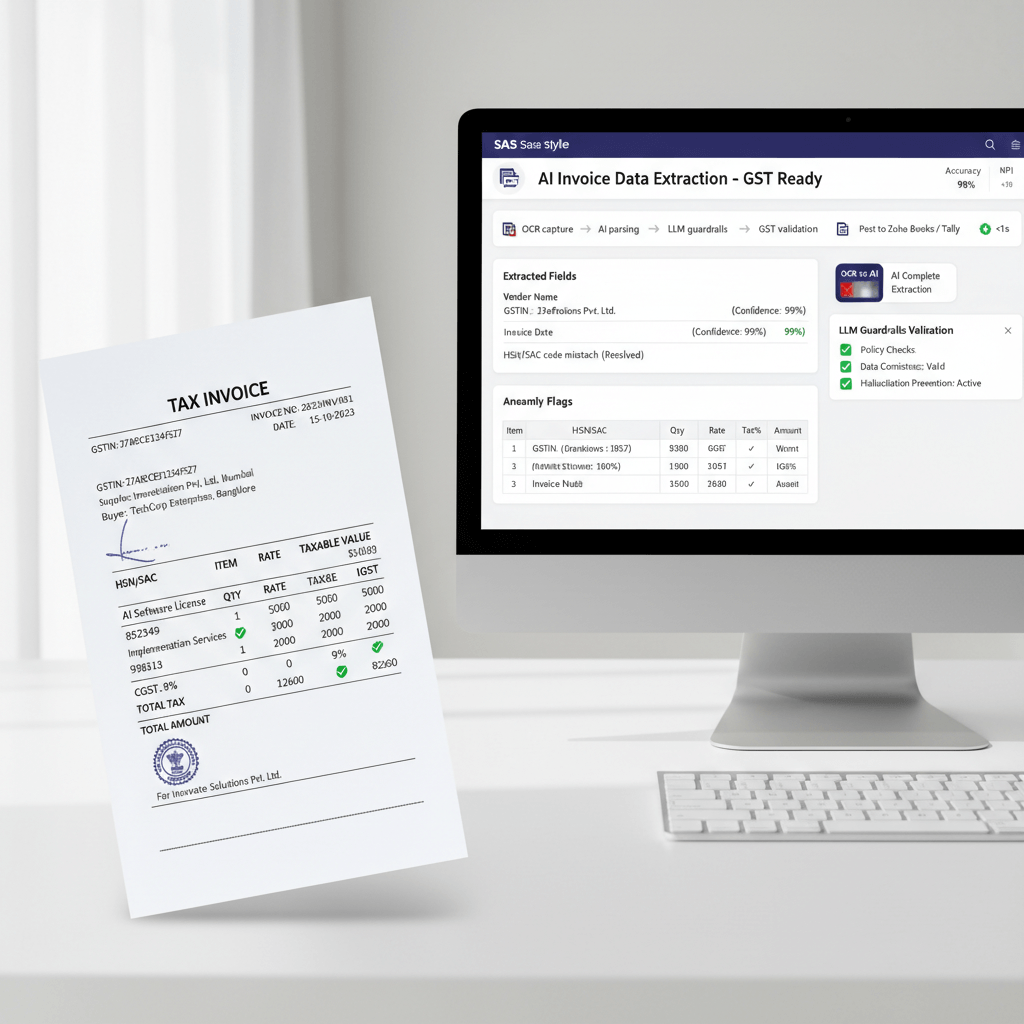
- Intelligent invoice capture is more than extraction, it validates GSTIN, HSN or SAC, tax math, and IRN or QR, then posts cleanly into Zoho Books or Tally with audit trails.
- LLMs add power for template free parsing and multilingual cases, however, guardrails like JSON schemas, checksum validations, and confidence thresholds are essential.
- Operational excellence requires confidence scoring, maker checker, human in the loop queues, and continuous learning tailored to your vendor base.
- Security and compliance matter, seek ISO 27001, SOC 2, encryption at rest and in transit, access controls, and India data residency options.
- Integration with master data, purchase order matching, GRN checks, and GSTR 2B reconciliation unlocks full downstream value.
- Evaluate vendors on India specific field coverage, accuracy benchmarks, throughput, exception handling, and case studies that match your volume and complexity.
Why AI invoice data extraction India is different
Indian invoices demand far more than header text. You must capture invoice number, date, vendor legal name, vendor GSTIN, place of supply, and IRN or QR where applicable. Line items require HSN or SAC, quantities, UOM, discounts, and mixed tax rates. Taxes involve CGST, SGST, IGST, and reverse charge flags, often with rounding at header or line level. Add e way bill references, TDS or TCS mentions, export or SEZ specifics, and you have a uniquely Indian challenge.
Invoices arrive as PDFs, scans, images, Excel files, JSON from e invoicing portals, and even WhatsApp photos. Templates vary by vendor and change over time. Low resolution scans, stamps, or handwritten notes are common. This is exactly where AI outperforms simple OCR.
AI vs OCR invoice processing India
OCR, the basic text extractor
Traditional OCR pulls text reliably from clean, standard formats. Once you add vendor template variability, low resolution images, Hindi mixed with English, and handwritten stamps, plain OCR begins to miss fields, confuse columns, and drop line items. For header only extraction at scale on very consistent invoices, OCR can still be enough.
AI powered extraction, the smart alternative
AI understands context, not just text. It recognizes different invoice layouts, validates fields automatically, and assigns confidence scores. It decodes long tail vendor variability, extracts multi page tables, and handles bilingual labels. Most importantly, it performs line level extraction accurately and flags exceptions for review.
Quick mental model
Small, clean, repetitive invoices, OCR is fine for headers. Varied vendor formats and line items, AI wins. Noisy scans and layout shifts, AI maintains structure and meaning better than OCR alone.
The hybrid approach
The best teams blend OCR, machine learning, and human review. Set clear goals, field level accuracy above 95 percent, India specific coverage for 27 plus fields, throughput for peak periods, and maintainability as vendors change. Use confidence thresholds to auto approve high quality extractions and route low confidence cases to reviewers.
Pro tip, Standardize on a single accuracy definition, field level accuracy over document level accuracy, and measure line item recall, not just precision.
Intelligent invoice capture India, beyond basic extraction
Intelligent invoice capture starts with automated ingestion, email parsing and forwarding, bulk uploads, watched folders, and APIs. It deduplicates files and classifies documents as invoices, credit notes, debit notes, or receipts so the right workflow kicks in automatically.
Extraction plus validation
Real intelligence shows up in checks and balances. Systems validate GSTIN structure and checksums, see GSTIN validation in AP workflow. They confirm HSN or SAC structure, verify tax rates, and reconcile state codes with place of supply. Fuzzy vendor matching links to masters, and suggested ledgers accelerate coding.
Line item intelligence
Complex line items need careful handling. Units of measurement must map to item masters. Header level and line level discounts must apply accurately. Mixed tax rates across items require precise allocation. Multi page tables must preserve row integrity.
Exception management
Low confidence results trigger human in the loop review. Maker checker workflows ensure four eyes control. Every change is captured in an audit trail, so you can trace who did what, and when.
Clean posting to accounting systems
Extraction is only valuable when it posts cleanly. Whether you are pushing to Zoho Books or following this Tally integration AP automation guide, ensure vendor and item mapping, attachment links, and tax application are correct.
India specific requirements checklist
- GST fields, GSTIN, legal name, place of supply, CGST or SGST or IGST split, reverse charge flags, composition scheme notes.
- E invoicing compliance, IRN, acknowledgment number and date, and QR validation, see the e invoice IRN and QR integration guide.
- HSN or SAC capture with rate verification, including mixed rates across line items.
- Document variety, B2B, B2C, export, SEZ, advance, proforma, tax invoices, and linked credit or debit notes.
- Payment narrations, UPI IDs, UTR numbers, and cheque details found within descriptions.
- Format challenges, bilingual invoices, low resolution scans, handwritten stamps or notes.
- Mathematical precision, header and line rounding, tolerances, and discrepancy thresholds.
LLM invoice extraction India, opportunities and safeguards
Understanding the risks
LLMs shine with template free parsing and multilingual labels, yet they can hallucinate fields and struggle with numeric accuracy. They also cost more to run and may add latency for large documents.
Building guardrails
Use structured JSON schemas, validate amounts with tax math, run GSTIN checksums, and cross verify IRN or QR. Apply confidence thresholds and route anything ambiguous to reviewers. Keep fallback paths to traditional ML or OCR when LLM confidence drops.
Practical applications
LLMs are ideal for new vendor formats, messy or rotated scans, and multilingual invoices. Treat them as part of an ensemble, not a solo act, so finance teams get reliability with flexibility.
Accuracy, controls, and operations
Measure what matters, field level accuracy above 95 percent, line item recall, false positive rates for reviewer load, exception rates, and time from receipt to posting. These metrics predict real business impact.
Control mechanisms
- Confidence scoring to prioritize reviews.
- Auto approval thresholds for high confidence extractions.
- Human in the loop queues for exceptions.
- Maker checker for critical or high value invoices.
Continuous learning
Great systems adapt to your vendors, items, and ledgers. They learn from accepted corrections, record every edit in audit logs, and keep version history so you can roll back when needed.
Outcome, fewer exceptions over time, faster approvals, and cleaner books.
Integration and downstream posting
Extraction is the start, not the finish. Sync vendor masters, item catalogs, tax codes, and cost centers. Post bills with attachments for audit readiness. Resolve vendor name or GSTIN mismatches gracefully. Match purchase orders and GRNs for three way control. Connect bank reconciliation and map payments to invoices. Feed GSTR 2B data to reconcile tax credits quickly.
Security, compliance, and data residency
Financial data demands strong controls, ISO 27001 and SOC 2, encryption at rest and in transit, role based access, and PII protections. Many Indian organizations also require India data residency and clear retention or deletion policies. Confirm audit trail completeness and exportability for statutory requests.
ROI and business case
Most teams see processing time drop from minutes to seconds, month end closing shorten from days to hours, and error rates fall below one percent. GST compliance improves through systematic validations. CA firms scale across multiple client organizations with shared workflows and multi org management.
Commercials vary, per document, per line item, or subscription. Model the mix by vendor, month end spikes, and growth trajectory, then pick the plan that fits your volume pattern.
Vendor evaluation checklist
- Core technology, real AI or only OCR, depth of GST coverage, line level handling quality.
- Accuracy benchmarks, GST specific fields, line item recall, throughput for bulk uploads, email parsing, and APIs.
- Operations, exception handling, maker checker, and integrations with Zoho Books or Tally.
- Compliance and infrastructure, security certifications, data residency, pricing scalability, and Indian case studies.
Recommended invoice processing tools
- AI Accountant, purpose built for Indian businesses, bulk ingestion from email and Excel, automatic vendor detection, comprehensive GST validations, direct Zoho Books and Tally posting, GSTR 2B reconciliation, and multi org support for CA firms, trusted by hundreds of customers and CA firms, processing at scale with ISO 27001 and SOC 2.
- QuickBooks, strong integrations and basic OCR, Indian GST needs often require customization.
- Xero, cloud native with invoice scanning, suitable for basic extraction, limited Indian tax finesse.
- FreshBooks, easy to use with mobile capture, best for simpler invoices.
- Zoho Invoice, native Indian GST support, extraction depth is basic compared to specialized AI tools.
- SAP Concur, enterprise grade breadth for complex organizations, strong controls and workflow depth.
How to run a pilot that proves value
Pick 200 to 500 invoices that reflect reality, messy scans, bilingual labels, long tail vendors, and multi page line items. Measure baseline effort and errors, then compare field level accuracy, exception rate, reviewer minutes per invoice, and time to post. Include a small maker checker sample to validate controls. Aim to demonstrate faster processing, fewer errors, and reliable postings, not just pretty demos.
Further reading and references
- Invoice OCR India guide
- Smartest invoice data capture
- Role of AI in invoice processing and accounts payable automation
- Invoices India ML package
- Extract invoices in seconds
- AI invoice data extraction guide
- Machine learning invoice data guide
- ArXiv preprint on invoice data extraction
FAQ
Is OCR alone sufficient for GST heavy Indian invoices or should I prefer AI based extraction
OCR is adequate for clean, repetitive templates where you only need headers, however, Indian invoices include GSTIN, HSN or SAC, CGST or SGST or IGST, RCM flags, IRN or QR, and multi page line items, which is where AI, or a hybrid of OCR plus AI, delivers materially higher accuracy and lower exception rates.
How can an LLM be safely used for invoice extraction without hallucinations in amounts
Constrain outputs to a strict JSON schema, validate all numeric fields using tax math and rounding rules, verify GSTIN through checksum, cross check IRN or QR, and set confidence thresholds that trigger human review. Tools like AI Accountant use ensemble methods and fallback paths when confidence dips.
What field level accuracy should a CA firm demand for Indian invoices in production
Target at least 95 percent field level accuracy overall, with high recall on line items, and sub one percent error on GSTIN, taxes, and totals. Monitor exception rates and reviewer minutes per invoice, then tighten auto approval thresholds as the system learns.
Can AI handle bilingual invoices, for example English plus Hindi, and handwritten stamps
Yes, modern AI plus ICR models handle bilingual labels and noisy stamps better than OCR alone. Expect robust layout understanding, improved table extraction, and context aware field mapping, especially in ensemble systems like AI Accountant.
How do systems validate GSTIN, IRN, and tax splits automatically
They run GSTIN checksum and format checks, compute expected CGST or SGST or IGST from base values, verify rounding rules, and cross reference IRN or QR for e invoiced documents. Discrepancies are flagged with variance highlights for reviewer action.
What is the best way to pilot AP automation for a multi client CA practice
Run a four week pilot across three to five client organizations with varied volumes. Include long tail vendors, exports, SEZ, and credit notes. Measure baseline effort, then track field accuracy, exception rate, review time, and time to post. AI Accountant supports multi org setups that make such pilots straightforward.
How should invoices flow into Zoho Books or Tally after extraction to avoid rework
Sync vendor and item masters first, enforce ledger and tax mapping rules, and post bills with attachments and references intact. For Tally, follow a proven connector or the Tally integration AP automation guide, and for Zoho Books, use APIs that preserve document links and auditability.
What control mechanisms satisfy maker checker and audit trail requirements
Use confidence scoring to route exceptions, maker checker approval for critical invoices, immutable audit logs for every field change, and version history for rollback. AI Accountant provides queue based reviews with clear user actions and timestamps.
How do I reconcile three way matching, PO to GRN to invoice, in an automated flow
Ingest PO and GRN data alongside the invoice, align vendor, item, quantity, and rate, then apply tolerances and flag mismatches. Approved exceptions move forward, while rejections go back to procurement or the vendor for correction.
What data residency and compliance checks should I insist on for Indian finance data
Confirm ISO 27001 and SOC 2 certifications, encryption in transit and at rest, role based access, detailed logging, and India data residency if your policy requires it. Clarify retention windows and export options for statutory audits.
How do I quantify ROI for AP automation across SMEs and CA managed clients
Model cost per invoice, reviewer minutes saved, exception reduction, faster month end close, and compliance risk reduction. Most teams see minutes drop to seconds, exceptions fall, and error rates below one percent, which compounds across multiple clients when CA firms standardize on a tool like AI Accountant.
When does a pure OCR pipeline make sense despite AI options
Use OCR for very high volume, uniform templates with header only needs and strong supplier standardization. The moment vendor variability or line item complexity enters, AI or a hybrid will outperform on accuracy and total cost.
What documents beyond invoices should the capture pipeline handle for smooth AP
Include credit notes, debit notes, receipts, delivery challans, POs, GRNs, and payment advices. A unified pipeline reduces context switching, simplifies reconciliation, and strengthens audit readiness.
How do I ensure LLM costs and latency stay under control in production
Apply routing logic, send simple, clean cases to traditional models, reserve LLMs for messy or ambiguous documents, cache vendor specific prompts, and batch process where possible. Monitor cost per document and latency SLAs continuously.