-01%201.svg)
Key takeaways
- The best GSTR 2B reconciliation tools replace manual Excel matching with layered fuzzy logic, raising automated match rates above 95% and cutting reconciliation cycle time from days to under four hours.
- Two way missing invoice detection with ageing buckets and vendor drill downs helps CA firms and SME teams recover 1 to 2% of eligible ITC that typically slips through manual processes.
- Automated vendor follow up with templates, SLAs, and escalation rules lifts response rates from around 30% to 70%, turning ad hoc chasing into a measurable compliance workflow.
- ITC claim optimisation engines auto tag eligibility, track the 180 day payment rule, and align with GSTR 3B totals, preventing costly under claims or over claims at filing time.
- A structured seven day pilot on a single GSTIN validates matching accuracy, workflow fit, and integration reliability before full rollout, making adoption low risk.
- Platforms like AI Accountant's GST reconciliation module automate the entire cycle from portal fetch to cleaned data push back, so finance teams focus on judgment calls instead of data wrangling.
ITC Reconciliation Tools and GSTR 2B Matching: What's New in 2026
Until mid 2025, many CA firms still relied on semi manual workflows, downloading GSTR 2B data from the GST portal and matching it against purchase registers in spreadsheets. From late 2025 onward, GSTN began enforcing stricter auto population of ITC in GSTR 3B directly from GSTR 2B, leaving almost no room for provisional claims. The practical effect: if your purchase data does not match 2B line by line, the excess credit is blocked at filing itself.
The operational shift is significant. Finance teams now need to reconcile weekly, not monthly, because mismatches caught on the 11th (when 2B is generated) leave barely a week to chase vendors before the GSTR 3B deadline. Cross period amendments that were once quietly adjusted now require explicit tracking to avoid double counting or missed reversals. CBIC circulars through 2025 reinforced that GSTR 2B is the single source of truth for ITC eligibility, making reconciliation accuracy a compliance prerequisite rather than an efficiency preference.
This hits mid sized CA firms managing 15 to 50 client GSTINs the hardest. Each GSTIN needs its own tolerance configuration, vendor master cleanup, and deferral policy. Firms on Tally without automated connectors face the steepest climb because CSV based shuttling introduces lag and errors at every step.
The cost of inaction is tangible: interest at 18% on excess ITC claimed, potential penalties under Section 74 for wrong claims, and blocked filings when GSTR 3B auto populated figures do not reconcile. For firms processing ₹1 crore or more in monthly purchases, even a 1% mismatch translates to ₹1,800 in monthly interest liability alone.
What to do now:
- Shift to weekly mini reconciliations instead of a single month end run.
- Audit your vendor masters for GSTIN accuracy and naming consistency before the next filing cycle.
- Test your current tool's cross period amendment handling against at least two months of live data.
AI Accountant's vendor bill matching engine now handles this weekly cadence natively, auto fetching 2B data and flagging exceptions the day the statement is generated.
Opening: Month End Pain Points and Why Tools Matter Now
It is the 8th of the month. You are juggling thousands of rows in Excel. A mismatch appears, and the scramble begins. Was it a typo, a late filing, or a carry forward from last month? Hours go by with little clarity.
Manual reconciliation invites errors, slows vendor follow ups, and leaves ITC on the table. In today's static GSTR 2B environment, provisional credit is curtailed. The 2B statement sets your ceiling. If an invoice is not present, you cannot claim it.
Modern GSTR 2B reconciliation tools resolve this. They auto fetch GSTR 2B from the portal, ingest purchase registers, journal vouchers, credit and debit notes. Then they categorize every transaction as matched, mismatched, missing, ineligible, or deferred, complete with audit trails, notes, and exports.
Think of a digital team member that never tires, never miscalculates, and processes thousands of invoices in minutes, not days.
Must Have Capabilities in GSTR 2B Reconciliation Tools
Match Purchase Register with AI Tools for GST Reconciliation
The core feature, matching, depends on layered logic, not just duplicate removal. Strong engines compare GSTIN, invoice number, date, taxable value, and tax breakups. They then apply fuzzy rules for variations, with tolerance for rounding differences.
They also resolve amendments (B2BA), credit and debit notes, RCM, imports with IGST, ISD credits, and composition suppliers. Cross period reconciliation is essential when invoices shift between filing months.
Example: your vendor labels an invoice as INV-2024-001 in books but files it as INV2024001 on the portal. Fuzzy matching spots it instantly, preventing a false mismatch that would otherwise block your ITC.
Pattern recognition improves with every cycle. The more vendor specific variations the engine processes, the higher the auto match rate climbs. Firms that configure tolerance settings carefully during setup often see match rates above 95% within the first two months.
Identify Missing Invoices with a 2B Reconciliation Tool
Two way detection is non negotiable. Find invoices in books but not in GSTR 2B, and invoices in GSTR 2B but not in books.
Useful views include ageing buckets (0 to 30, 31 to 60, 61 to 90 days), supplier drill downs, high value risk flags, and exportable lists for vendor outreach. Quick filters and side by side views accelerate resolution significantly.
Without systematic missing invoice detection, eligible ITC simply evaporates. A vendor who consistently files late may cost you lakhs over a financial year if not flagged early. Ageing views surface these patterns and help prioritize which vendors to chase first.
ITC Claim Optimisation
Maximising ITC means claiming the right amount at the right time while staying compliant. Engines should auto tag eligibility, identify blocked credits under Section 17(5) of the CGST Act, track the 180 day payment rule, and validate RCM and place of supply.
Deferral management with reasons and audit trails helps you park ITC and bring it back later. Alignment with GSTR 3B totals prevents under claims or over claims. Support for partial ITC plus apportionment handles complex scenarios common in manufacturing and services.
Real win: a manufacturer discovered consistent under claiming on capital goods. The eligibility engine caught the pattern, unlocking substantial legitimate ITC that had been missed for three consecutive quarters.
Vendor Follow Up Automation
Automated outreach replaces ad hoc chasing with templates, SLAs, and escalation rules. Multi channel reminders with invoice level detail (email plus WhatsApp) lift response rates. Compliance scorecards make discussions data driven rather than subjective.
Case studies show vendor response rates jumping from roughly 30% with manual follow up to 70% with structured automation. The key is specificity: each reminder includes invoice numbers, dates, taxable values, and a clear ask.
Sample reminder: Hi ABC Traders, we found a mismatch on Invoice 1234 dated 15 Oct 2024, taxable value ₹50,000, missing in our GSTR 2B. Please file or amend. Reply with action taken.
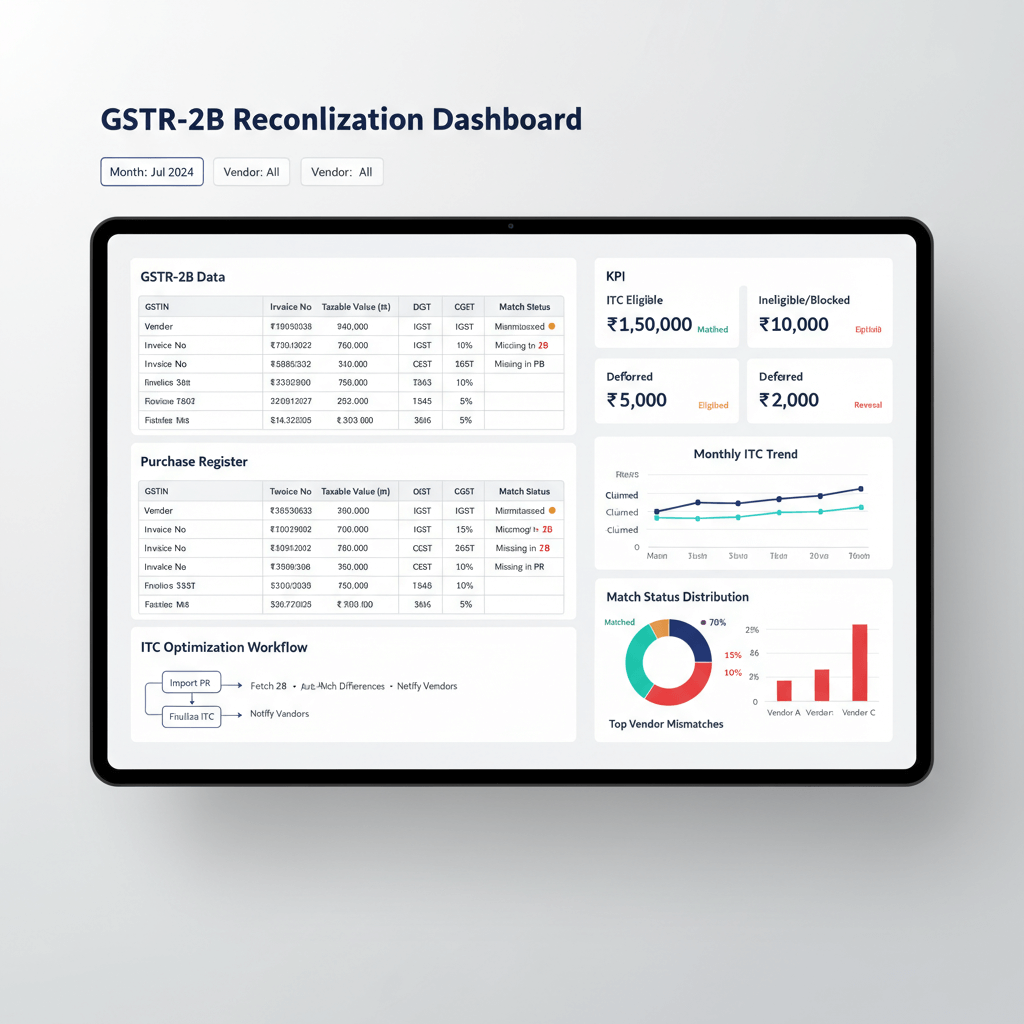
Monthly Dashboard for GSTR 2B and Purchase Data Reconciliation
Leaders need instant visibility: eligible versus claimed ITC, deferred amounts and ageing, top non compliant vendors, and month over month trends.
For CA firms, multi organisation views and drill downs by GSTIN are essential. PDF and Excel exports support client review meetings. Daily monitoring of dashboards catches issues early, avoiding the month end panic that erodes team productivity and client confidence.
Evaluation Checklist for CA Firms and SME Teams
Assess tools against your environment with a simple scorecard. Insist on proof during demos, and avoid compromises on integration and security. The ICAI has increasingly emphasized technology adoption in practice management, making tool evaluation a professional responsibility.
| Criteria | Must Haves | Examples from Tools |
|---|---|---|
| Data Ingestion | PDF, Excel, CSV, scans, portal auto fetch, scale to 100,000 lines | AI Accountant enables GSTN auto fetch with scheduled pulls |
| Matching Engine | Configurable tolerance, fuzzy rules, cross month logic, fast processing | AI Accountant applies fuzzy logic with vendor specific pattern learning |
| Workflow Depth | Approvals, notes, bulk operations, complete audit trail | AI Accountant provides exception workflows with role based approvals |
| Integrations | Native Tally sync, push back clean data, APIs | AI Accountant offers native Tally integration with bi directional sync |
| Security | ISO 27001, SOC 2 Type II, encryption, India data residency | AI Accountant is ISO 27001 and SOC 2 Type II certified |
| Multi Org | Role based access, per GSTIN config, consolidated reporting | AI Accountant is designed for CA firms with 450+ customers |
| Reporting | Real time dashboards, vendor scorecards, flexible exports | AI Accountant provides unified views across GSTINs |
| Support and Pricing | Onboarding assistance, SLAs, per GSTIN tiers, free trials | Varies by vendor, always test with a pilot |
Top GSTR 2B Reconciliation Tools for Different Needs
- AI Accountant, automation focused with native Tally integration, multi org management for CA firms, ISO 27001 and SOC 2 Type II certified, 300M+ transactions processed across 450+ customers.
- TaxBuddy, early mismatch detection, secure portal pulls, AI driven insights for individual practitioners and small firms.
- Octa GST, visual side by side views, strong vendor compliance analytics, good for teams that prefer graphical interfaces.
- BUSY Accounting, configurable tolerance settings, straightforward for firms already on the BUSY platform.
- TallyPrime (built in reconciliation), seamless for Tally users handling basic matching, limited advanced automation and vendor follow up features.
How AI Accountant Fits Without Heavy Pitch
The platform streamlines end to end reconciliation. It ingests purchase registers, journals, and credit or debit notes alongside GSTR 2B, then applies pattern recognition to resolve duplicates and cross period matches.
Vendor management is automated with templates, SLAs, and escalation. Dashboards show live ITC positions, deferrals, and supplier compliance across all client GSTINs.
CA firms benefit from multi organisation architecture and role based access, plus native Tally sync for reliable push back of cleaned data. Security is backed by ISO 27001 and SOC 2 Type II certifications with India data residency.
7 Day Pilot Plan
Day 1: Setup and Data Import
Connect Tally, import two months of purchase data, and pull GSTR 2B from the portal. Validate completeness by checking total invoice counts and values against your books.
Day 2: Configure Matching Rules
Set tolerance thresholds (start with ₹1 to ₹2 absolute and 0.1% on larger invoices). Map fields and run the first pass to match purchase register entries. Gauge baseline match rates.
Day 3: Exception Management
Clean duplicates and tag deferrals with reasons. Identify missing invoices by value and ageing. Prioritize high value items for immediate action.
Day 4: Vendor Communication
Launch automated reminders with escalations. Track responses and reopen unresolved items. Test both email and WhatsApp channels to see which gets faster replies.
Day 5: ITC Validation
Align outcomes with GSTR 3B totals. Validate ITC claim optimisation recommendations. Check for blocked credits, RCM entries, and the 180 day payment rule.
Day 6: Data Sync
Push reconciled data back to your books. Compile audit trails and exception exports. Verify that synced data appears correctly in Tally ledger entries.
Day 7: Analysis and Decision
Review the monthly dashboard. Quantify time saved, document pain points solved, and set KPIs for rollout. A mid sized CA firm managing 25 client GSTINs reported reducing reconciliation time from 30 hours to 5 hours monthly after completing this pilot.
ROI Model and KPIs
Time savings: 1,000 invoices that take 8 to 10 hours manually can be processed in minutes. At 5,000 invoices a month, firms often save 40 plus hours, worth ₹80,000 monthly at ₹2,000 per hour.
Error reduction: manual efforts show 2 to 3 percent error rates. Automation typically reduces this under 0.1 percent, as documented across multiple industry analyses.
ITC recovery: missing 1 to 2 percent of eligible ITC is common. On ₹1 crore of monthly purchases with 18 percent GST, recovering 1 percent yields ₹18,000 in additional credit. Over a financial year, that compounds to over ₹2 lakhs for a single GSTIN.
Case study benchmark: a mid sized CA firm with 25 client GSTINs documented these results after implementation:
- Reconciliation time dropped from 30 hours to 5 hours monthly
- Vendor response rates rose from 30% to 70%
- ITC recovery improved from 92% to 98%
- Annual benefits totalled approximately ₹37 lakhs (combining time savings and additional ITC)
KPIs to track:
- Match rate percentage: aim for 95 percent plus automated matches
- Missing invoice value: reduce month over month
- Eligible versus claimed variance: keep under 0.5 percent
- Duplicate detection rate: a sign of improving data quality
- Vendor compliance score: target steady improvement
- Reconciliation cycle time: finish monthly close under four hours
Common Pitfalls and Fixes
Amendment and credit note misalignment: link amended documents to originals via cross period logic. Keep a clear amendment register. Without this, double counting or missed reversals become inevitable during quarterly reviews.
GSTIN errors and composition dealers: use fuzzy matching on vendor names alongside GSTIN. Flag composition dealers separately, as their transactions are ineligible for ITC under GST composition scheme rules.
Round off differences: configure tolerance, often ₹1 to ₹2, and standardise rounding rules across your team. Document the policy in your audit playbook.
RCM and import complications: ensure built in RCM categorisation. Separate IGST on imports (tracked via Bill of Entry references) from regular domestic purchases.
ISD credits: maintain distinct ISD reconciliation and categorisation. Mixing ISD with regular vendor invoices creates noise that slows down the entire matching process.
Over reliance on provisional ITC: treat GSTR 2B as the single source of truth. Any credit not reflected in 2B is at risk of reversal with 18% interest.
Best practices:
- Clean vendor masters monthly. Most mismatches start with poor masters (wrong GSTINs, inconsistent naming, inactive registrations).
- Run weekly mini reconciliations. Smaller batches mean faster fixes and fewer surprises at month end.
- Document deferral policies. Consistent reasons and timelines matter for audit defence.
- Standardise vendor messages. Clarity and specificity improve response rates dramatically.
- Monitor dashboards daily. Early alerts avoid month end panic.
- Train teams on exceptions. Tools automate routine work. Judgment handles the rest.
Moving Forward with Confidence
Shifting from spreadsheets to automated GSTR 2B reconciliation tools transforms GST compliance from firefighting to a predictable process.
Higher match rates reduce filing day surprises. Cleaner books improve audit confidence. Safer claims lift cash flow. With time savings alone, the platform pays for itself. Add ITC recovery and error reduction for compelling ROI.
The numbers speak clearly: firms that adopt structured ITC reconciliation tools report 95%+ match rates, 70% vendor response rates, and reconciliation cycles under five hours. The gap between manual processes and automated workflows widens every quarter as GST compliance requirements tighten.
Start with a structured evaluation and a one week pilot, then scale across GSTINs.
FAQ
How do GSTR 2B reconciliation tools match purchase register entries with fuzzy rules and tolerance?
They layer exact matching on GSTIN, invoice number, date, and tax amounts first, then apply fuzzy logic for common variations like INV 001 versus INV001 or extra characters. Tolerance controls handle rounding differences, typically ₹1 to ₹2 on small invoices or 0.1% on larger ones. The engines learn vendor specific patterns over time, so match accuracy improves with each reconciliation cycle.
What is the best method to identify missing invoices across months without losing ITC?
Use two way detection: items in your books but not in GSTR 2B, and items in GSTR 2B but not in your books. Ageing buckets (0 to 30, 31 to 60, 61 to 90 days) help prioritise follow ups by urgency. Supplier drill downs reveal habitual late filers, and exportable lists provide both vendor outreach material and audit evidence.
How should a CA structure an ITC claim optimisation workflow end to end?
Start with automated eligibility tagging for blocked credits, place of supply, and RCM, then track the 180 day payment rule for reversals and reclaims. Add deferral management with documented reasons and audit trails. Align final figures with GSTR 3B totals before filing to prevent under or over claims. This structured approach typically improves ITC recovery from around 92% to 98% (2026 update).
What KPIs should a CA firm present to clients to prove impact of automation?
Report automated match rate (target 95%+), missing invoice value trend, eligible versus claimed ITC variance (keep under 0.5%), and reconciliation cycle time (target under four hours). Adding recovered ITC from past periods highlights direct cash impact. Vendor compliance scores round out the picture by showing supply chain health improvements.
How can I run a low risk pilot before full rollout across GSTINs?
Follow a seven day plan: connect one GSTIN, import two months of data, run baseline matching, clean exceptions, automate vendor reminders, align with GSTR 3B, push data back, then review dashboard metrics. This validates accuracy and workflow fit quickly without disrupting ongoing operations for other clients.
What are the best AI tools for GST reconciliation in 2026?
The leading AI tools for GST reconciliation in 2026 combine fuzzy matching, pattern learning, and automated vendor follow up in a single platform. Key capabilities to evaluate include GSTN auto fetch, configurable tolerance, cross period amendment handling, and native Tally integration. Firms should prioritize tools with ISO 27001 and SOC 2 Type II certifications and test with a structured pilot before committing (2026 update).
How do I quantify ROI for management approval on GST reconciliation software?
Combine three metrics: time saved (40+ hours monthly at ₹2,000 per hour equals ₹80,000), error cost avoided (reducing error rates from 2 to 3% down to under 0.1%), and ITC recovered (1% recovery on ₹1 crore monthly purchases yields ₹18,000 per month). Track results on the dashboard for three months to validate assumptions against actual performance before scaling.

Rohan Sinha is a fintech and growth leader building aiaccountant.com, focused on simplifying accounting and compliance for Indian businesses through automation. An IIT BHU alumnus, he brings hands-on experience across 0 to 1 product building, growth, and strategy in B2B SaaS and fintech.