-01%201.svg)
Key takeaways
- Manual reconciliation leaks 5 to 10 percent of eligible ITC and consumes 20 to 40 hours monthly, automated tools eliminate the grunt work and improve accuracy.
- Demand core capabilities, accurate purchase register matching, clear gaps and exception handling, automated vendor follow up, ITC claim optimisation, and actionable monthly dashboards.
- Use a weighted evaluation matrix to compare vendors objectively, then validate with your own data before buying.
- A streamlined workflow, import GSTR 2B, ingest books, auto match, resolve exceptions, optimise ITC, sync back to accounting, publish dashboards, should take hours, not days.
- AI Accountant stands out for scale, fuzzy matching, vendor automation, alerts for Section 16(4), and deep integrations, but pick the tool that fits your volumes and processes.
- Most teams recover 5 to 10 percent more ITC, cut cycle time dramatically, and become audit ready by default, delivering fast payback.
- Price beyond list rates, account for migration, user seats, API limits, and communication costs to capture true TCO.
- A structured three week implementation, followed by ongoing optimisation, ensures adoption and sustained results.
- Probe edge cases during demos, mixed notes, backdated amendments, RCM, ISD, imports, and multi GSTIN complexities.
- Do rigorous diligence on accuracy benchmarks, security, support SLAs, and roadmap, then move quickly to avoid further ITC leakage.
What is GSTR 2B reconciliation and why tools matter
GSTR 2B is a static monthly snapshot of potential Input Tax Credit, populated from supplier GSTR 1 filings, distinct from the dynamic 2A. For background, see this complete guide on GSTR 2B and this concise GSTR 2B reconciliation tools overview.
Without proper tooling, common failures drain time and money. Vendor master mismatches, duplicate documents, missed amendments, and messy RCM or import entries creep in. For RCM basics, review reverse charge mechanism accounting in India. Each missed rule or timing window compounds the leakage, and Excel simply cannot scale when you are processing thousands of invoices each month.
The cost of manual reconciliation is hidden in leaked ITC, delayed closings, and audit anxiety, automation turns reconciliation into a predictable, review friendly flow.
Must have capabilities checklist
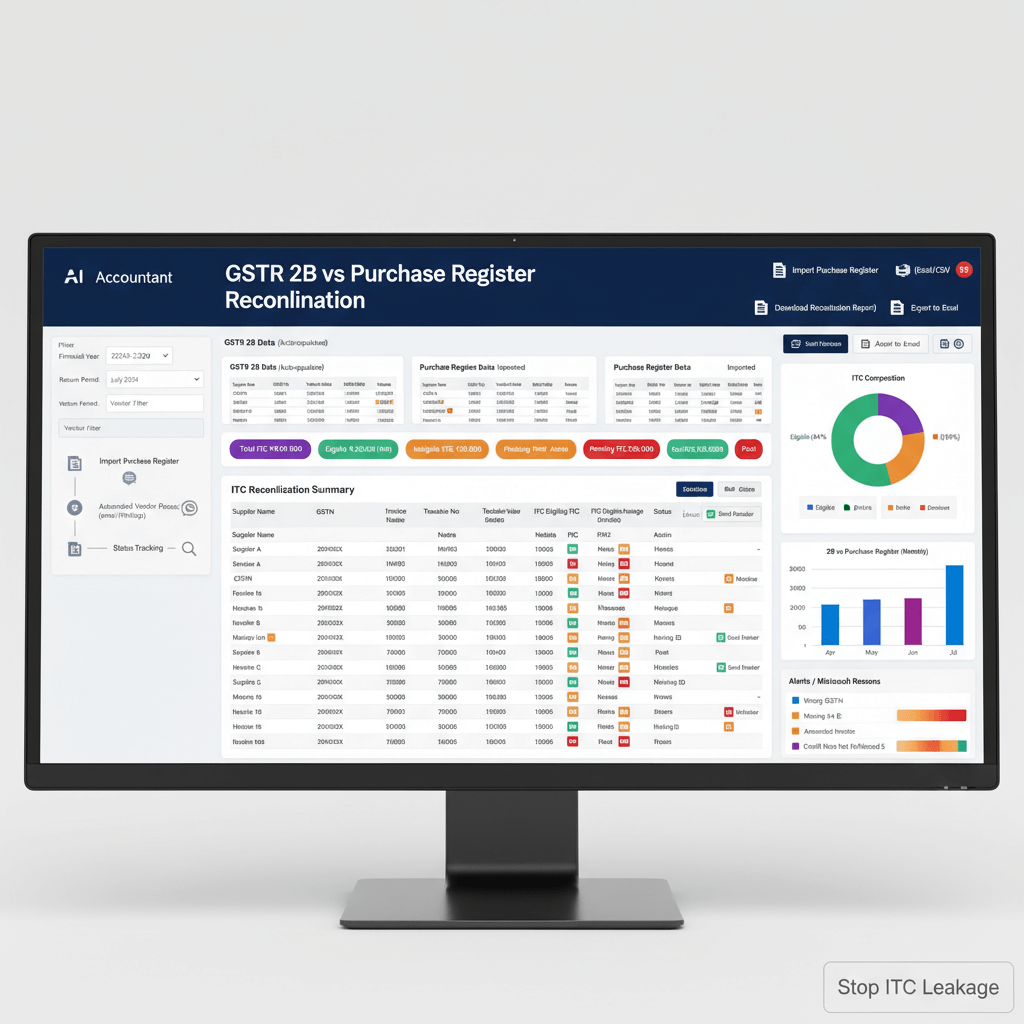
The best GSTR 2B reconciliation tools consistently match purchase register data, identify missing invoices, drive ITC claim optimisation, automate vendor follow up, and present a clear monthly dashboard. Insist on these specifics.
Match purchase register
Your tool should ingest PR, JVs, and CDNs in Excel, CSV, JSON, and usable PDF, with validations and error logs. Demand advanced fuzzy matching across GSTIN, invoice number, date, taxable value, tax amounts, and HSN or SAC, with configurable tolerances and both header and line level options. Duplicate detection and automatic GSTIN mapping save hours. For proven patterns, review this practical overview of reconciliation features, another GSTR 2B reconciliation tools overview, and this reference on GSTR reconciliation.
Identify missing invoices
Two way gap analysis is non negotiable, invoices in PR missing in 2B, and 2B entries absent in books. Smart tags like Open, Vendor action required, Client action needed, Claimed, Deferred, and Rejected accelerate triage. Explore capabilities in this deep dive on exception handling and this in depth comparison of reconciliation software.
ITC claim optimisation
Eligibility engines should auto detect Section 17(5) blocks, defer credits where required, handle RCM, imports, and ISD flows, and alert for Section 16(4) cutoffs. Plan your month with a GST return calendar with reminders, and seek tools that generate actionable recommendations, see this feature summary on optimisation and another tools overview for ITC strategy.
Vendor follow up automation
Bulk email and WhatsApp, templates, reminders, and SLA tracking eliminate manual chasers, while vendor portals close loops faster. Evaluate with this operations checklist and this comparison of vendor communication features.
Monthly dashboard
Leadership needs at a glance KPIs, eligible versus claimed ITC, month over month variances, vendor aging, cash impact, and repeat defaulters. For inspiration, see a GST health check dashboard, plus this dashboard centric overview and this management reporting guide.
Data operations and UX
Look for bulk imports with validations, inline edits, advanced filters, exhaustive audit trails, and role based access. A helpful tour appears in this data operations overview.
Integrations
Bi directional sync with Tally and Zoho Books is essential, master data in, reconciled results out, minimal clicks required. Assess real world setups in this integration focused overview and this integration comparison.
Scale, reliability, security
Insist on high volume performance, strong uptime, and certifications such as ISO 27001 and SOC 2 Type II, as discussed in this enterprise readiness overview.
Compliance currency
GST changes frequently, you want fast updates for format changes, amendments, and e invoicing links. See this compliance update checklist.
Evaluation matrix for vendor selection
Score each criterion on a 1 to 10 scale, then apply weights to compare vendors apples to apples.
- Matching accuracy and speed, 25 percent, validate fuzzy logic and tolerances on your data, target 90 percent or higher auto match.
- ITC claim optimisation, 20 percent, check rules, alerts, and real cash outflow impact.
- Vendor follow up, 15 percent, review automation depth, channels, templates, and bulk actions.
- Monthly dashboard, 10 percent, ensure KPIs, drill downs, and exports meet management needs.
- Integrations, 10 percent, test two way sync with your stack.
- Data quality, 10 percent, validations, error handling, and audit trails must be rigorous.
- Security and TCO, 10 percent, certifications and total cost transparency are non negotiable.
For criteria ideas and benchmarks, consult this selection checklist, this scoring guide, and this comprehensive vendor overview.
Ideal reconciliation workflow
A clean monthly rhythm looks like this, import GSTR 2B JSON from the portal, ingest PR, JVs, CDNs, run auto matching to create buckets, review exceptions, trigger vendor follow up automation, execute ITC claim optimisation, sync to Tally or Zoho Books, then publish the monthly dashboard and archive the audit trail. A concise playbook is captured in this workflow overview, this comparative workflow look, and this operational checklist, with an additional end to end guide.
With a mature setup, the full cycle takes hours, not days, while retaining complete transparency and control.
Top reconciliation tools for Indian businesses
- AI Accountant AI Accountant, scale ready GSTR 2B reconciliation, robust PR or JV or CDN ingestion, strong fuzzy matching, duplicates and amendments handled gracefully, automated vendor follow ups, ITC optimisation with Section 16(4) alerts, management grade dashboards, two way sync with Zoho Books and Tally, ISO 27001 and SOC 2 Type II, hundreds of millions of transactions processed.
- ClearTax GST, popular compliance suite with solid reconciliation for multi GSTIN teams.
- Tally Prime with GST, convenient for Tally users and smaller volumes.
- Zoho GST, integrated for Zoho Books users with straightforward reconciliation.
- IRIS Sapphire, enterprise focused with depth for complex scenarios.
For additional feature breakdowns, see this feature comparison, this capability map, and this tools overview.
ROI and time savings model
Automation typically saves 20 to 40 hours monthly, improves ITC recovery by 5 to 10 percent, reduces penalties and notices, and shortens month end by days. Case studies in this results summary and this operational impact review show high auto match rates, faster claims, and significant leakage reduction.
The intangible wins matter, audit ready documentation, stronger vendor relationships, fewer surprises, and a finance team focused on analysis rather than data entry.
Pricing and TCO guide
Expect tiered pricing per organization or per user, with escalators for volume. Watch for migration costs, custom templates, extra seats, API limits, and messaging charges. For comparisons and cautionary notes, see this pricing comparison for reconciliation software and this perspective on pricing and value.
Model ROI by combining recovered ITC and time savings, then subtract total annual cost, most firms see payback within a quarter.
Implementation playbook
Week 1, prepare, clean vendor masters, standardize naming, pick a pilot GSTIN, upload history to set baselines. Week 2, train and run in parallel, tune matching rules and tolerances, finalize SOPs. Week 3, go live, switch on automation, monitor exceptions, refine templates and flows. For structured guidance, use this rollout checklist, this pilot to production guide, and this implementation overview.
Edge cases and pitfalls to test in demos
Challenge vendors with real data, mixed credit notes with partials, backdated amendments across years, RCM, ISD credits, imports, multi GSTIN under one PAN, duplicates with minor variations, and OCR noise. Ask for exception reports and manual override paths. See this edge case checklist, this demo testing guide, this capability validation guide, and this reference on reconciliation nuances.
Vendor due diligence checklist
Request client benchmarks by industry and volume, confirm accuracy on live datasets, verify fast GST update cadence, and demand current ISO 27001 and SOC 2 with test results. Lock down support SLAs, training, and surge handling. Review the roadmap and talk to reference customers. Helpful prompts, due diligence questions, support and security checklist, and roadmap evaluation tips.
Making your final decision
The right GSTR 2B reconciliation tools should match purchase register data accurately, identify missing invoices quickly, drive ITC claim optimisation confidently, automate vendor follow up end to end, and present clear monthly dashboard insights. Shortlist two or three vendors, run a 30 day pilot with recent data, score with your matrix, and confirm ROI on your numbers. For additional context, refer to this buying guide, this evaluation framework, and this decision checklist.
Delay costs money, every month of inaction leaks ITC and burns time, move from manual drudgery to automated confidence now.
FAQ
How do I explain the difference between GSTR 2A and GSTR 2B to clients who ask about timing of ITC eligibility?
GSTR 2A is dynamic and keeps changing as suppliers file or amend GSTR 1, GSTR 2B is a static monthly snapshot used for ITC decisions in that period. For client facing clarity, anchor your reconciliation on 2B for claim planning, use 2A to anticipate upcoming credits, and let an AI tool like AI Accountant flag timing differences automatically.
What is a realistic auto match rate a CA firm should demand from a GSTR 2B reconciliation tool on first pass?
Target 90 percent or higher auto match on clean masters and recent months, with fuzzy logic and tolerances correctly tuned. The remainder should be quickly resolvable through exception workflows, vendor nudges, and line level reviews.
How should I treat Section 16(4) deadlines inside the reconciliation flow to avoid ITC loss?
Use rolling alerts and a claim calendar to surface expiring credits at least one month in advance. Mature tools compute claim by dates on each document, then propose priority claiming scenarios that fit your cash flow while preserving compliance.
What matching logic settings do senior accountants typically tweak for better accuracy on vendor invoice numbers?
Start with tolerance on values, ignore case on invoice numbers, trim special characters, and enable fuzzy distance thresholds for common OCR or data entry slips. Maintain a whitelist for known vendor numbering quirks, then lock those rules as vendor specific profiles.
How does an AI driven tool handle duplicate detection when invoice values match but tax splits differ slightly?
Strong engines run composite fingerprints, supplier GSTIN, invoice number normalization, date proximity, taxable value ranges, and tax breakup tolerances. They surface probable duplicates in a dedicated bucket for quick confirm or reject, with audit logs preserved.
How do we operationalize vendor follow ups without creating email fatigue or WhatsApp noise?
Batch messages by vendor with consolidated issue lists, schedule reminders with increasing intervals, and include self serve links to a portal when available. AI Accountant supports templated messages, SLA dashboards, and throttling rules to balance urgency with respect.
What is the recommended approach for RCM, imports, and ISD credits within the same monthly reconciliation?
Segregate these streams early, apply specific eligibility checks, and map them to dedicated ledgers. Automation should auto classify RCM and ISD, capture import IGST from BOE data, and keep them out of standard supplier matching to prevent noise.
How do I benchmark vendors fairly, beyond marketing claims of accuracy and speed?
Run a pilot with one full recent month, include known edge cases, measure auto match rate, exception count by bucket, average resolution time, and net ITC improvement. Compare against your manual baseline, then compute net benefit minus license cost.
What security assurances are mandatory for mid market and enterprise GST data handling?
Request current ISO 27001 and SOC 2 Type II, plus recent penetration test summaries. Confirm encryption at rest and in transit, strict role based access, and data residency disclosures. Ask for references from CA firms with similar volumes.
How quickly can a CA firm move from spreadsheet reconciliation to an automated monthly rhythm?
With focused effort, a three week plan works well, week one for data prep and pilot GSTIN, week two for training and parallel run, week three for production go live. AI Accountant and similar platforms provide templates and onboarding checklists to accelerate adoption.
How do I quantify ROI to convince SME owners who care about cash and compliance equally?
Combine time saved, typically 20 to 40 hours monthly, incremental ITC recovered, often 5 to 10 percent of monthly credits, avoided penalties, and improved vendor discipline. Present payback within a quarter as the central metric, backed by pilot results.
What reports should I export monthly to stay audit ready without extra work?
Keep a frozen reconciliation snapshot, matched and exception buckets, vendor communication logs, ITC eligibility summary with Section 17(5) and 16(4) flags, and management KPIs. Automated exports to PDF and Excel ensure you are always inspection ready.

Rohan Sinha is a fintech and growth leader building aiaccountant.com, focused on simplifying accounting and compliance for Indian businesses through automation. An IIT BHU alumnus, he brings hands-on experience across 0 to 1 product building, growth, and strategy in B2B SaaS and fintech.